
The mechanical rule that settles half the cases
Kudasai is what remains of kudasaru, the honorific verb for a superior giving something down to you. It attaches in two ways. After a noun and the particle o it means please give me that thing: mizu o kudasai. After a verb in te-form it means please do that action: matte kudasai, mite kudasai, kaite kudasai. Nothing else attaches to it, so a bare dictionary form or a masu stem in front of kudasai is always wrong.
Onegaishimasu is the polite form of onegai suru, to make a request or wish. It follows a noun directly, usually with o and often with de when you are specifying a choice, and it can stand entirely alone as a whole sentence. What it cannot do is follow a te-form, because it is not a verb ending; it is a separate request verb of its own. Matte onegaishimasu does not exist.
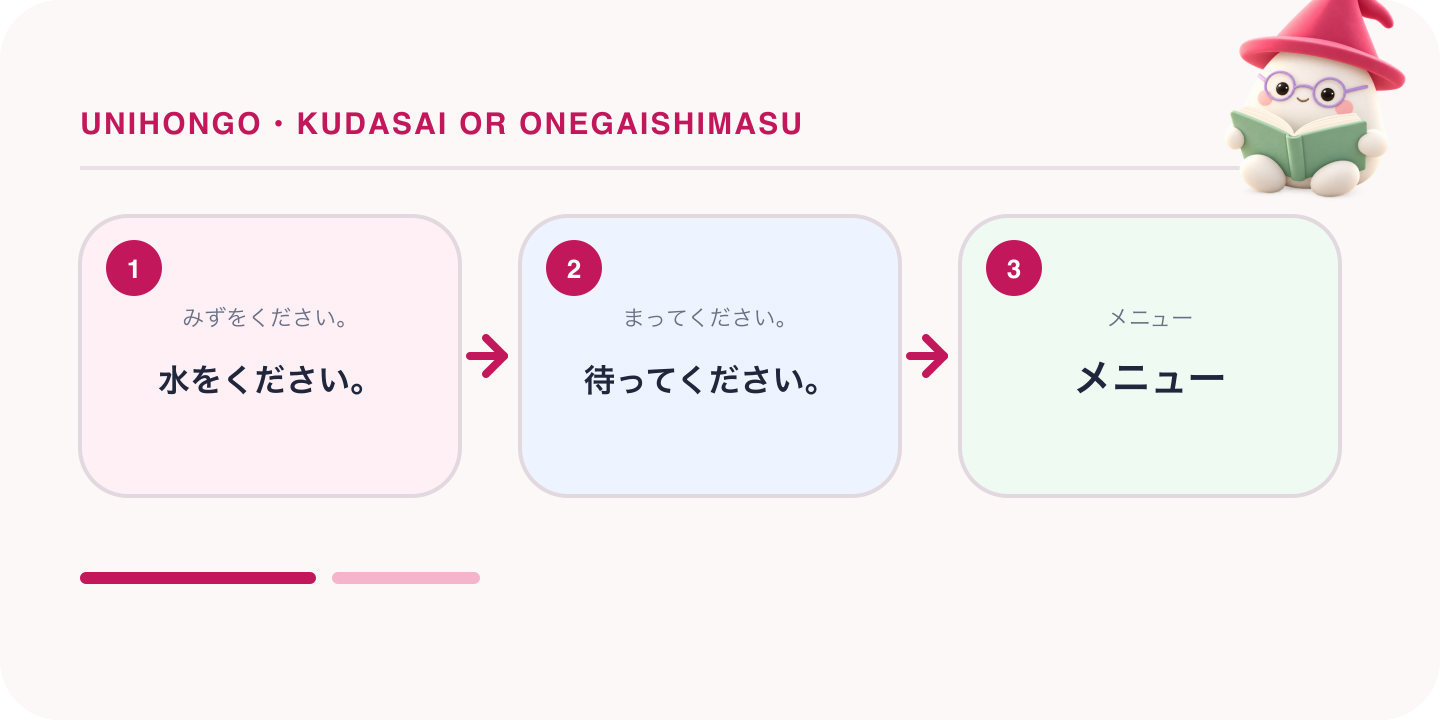
| Pattern | Attaches to | Example | Meaning |
|---|---|---|---|
| Noun + を + ください | A noun you want handed over | 水をください。 | Please give me water |
| て-form + ください | An action you want done | 待ってください。 | Please wait |
| ない-form + でください | An action you want stopped | 入らないでください。 | Please do not enter |
| お + stem + ください | A polite instruction to a customer | 少々お待ちください。 | Please wait a moment |
| Noun + を + お願いします | A thing or service requested | お会計をお願いします。 | The bill, please |
| Noun + で + お願いします | A choice you are specifying | カードでお願いします。 | By card, please |
| お願いします alone | Anything already on the table | はい、お願いします。 | Yes, please do |
| て-form + お願いします | Nothing, this is ungrammatical | Not used | Use ていただけますか instead |
The feeling difference behind the rule
Grammar tells you what is possible; register tells you what is natural. Kudasai points at the action and asks for it plainly, which makes it excellent for transactions and instructions where clarity is the whole point. Nobody is offended when you say kore o kudasai at a counter, because handing you the item is the shop's job and no favour is involved.
Onegaishimasu points at the outcome and asks the listener to take care of it. Because it invokes a favour rather than an instruction, it sounds less like you are directing the other person, which is why it wins whenever the person is doing something for you out of goodwill. Say kopī o onegaishimasu to a colleague and you have asked; say kopī o shite kudasai and you have instructed, which is fine from a manager and slightly stiff from a peer.
| Japanese | Romaji | Meaning |
|---|---|---|
| メニューをください。 | Menyū o kudasai. | The menu, please. (plain request) |
| メニューをお願いします。 | Menyū o onegaishimasu. | May I have the menu. (softer) |
| コピーをしてください。 | Kopī o shite kudasai. | Please make a copy. (instruction) |
| コピーをお願いします。 | Kopī o onegaishimasu. | Could you handle the copying. (favour) |
| 確認してください。 | Kakunin shite kudasai. | Please check it. |
| 確認をお願いします。 | Kakunin o onegaishimasu. | I would be grateful if you would check it. |
| 名前を書いてください。 | Namae o kaite kudasai. | Please write your name. (staff to you) |
| ご記入をお願いします。 | Gokinyū o onegaishimasu. | Please fill this in. (staff to you, softer) |
Which one each situation prefers
| Situation | Natural choice | Line to say |
|---|---|---|
| Ordering at a cafe counter | Either, onegaishimasu sounds smoother | ホットコーヒーをお願いします。 |
| Pointing at an item in a shop | Kudasai | これをください。 |
| Asking for a bag or a receipt | Kudasai | 袋をください。 |
| Asking for the bill | Onegaishimasu | お会計をお願いします。 |
| Telling a taxi driver where to go | Onegaishimasu | 東京駅までお願いします。 |
| Specifying size, temperature or payment | De plus onegaishimasu | 大盛りでお願いします。 |
| Asking someone to wait | Te-form plus kudasai | ちょっと待ってください。 |
| Asking someone to repeat | Either | もう一度お願いします。 |
| Asking a colleague for a favour | Onegaishimasu or itadakemasen ka | この件、お願いできますか。 |
| Handing over a completed form | Onegaishimasu | こちら、お願いします。 |
| Checking in at a hotel | Onegaishimasu | チェックインをお願いします。 |
| Closing a phone call | Yoroshiku onegaishimasu | では、よろしくお願いします。 |
Read down the middle column and a pattern appears. Objects that simply need handing over take kudasai; services, procedures and favours take onegaishimasu. Actions you want performed take a te-form, which forces kudasai unless you climb the politeness ladder in the next section.
In a shop, a cafe and a taxi
Counter Japanese is where both words appear most often, and staff will answer either one without blinking. The useful skill is hearing the reply, because kashikomarimashita and shōchi itashimashita both mean your request has been accepted, and a follow-up question usually arrives immediately afterwards. Keep your order short, then add the specification with de.
| Japanese | Romaji | Meaning |
|---|---|---|
| これをください。 | Kore o kudasai. | I will take this one. |
| ホットコーヒーを一つお願いします。 | Hotto kōhī o hitotsu onegaishimasu. | One hot coffee, please. |
| Mサイズでお願いします。 | Emu saizu de onegaishimasu. | Medium, please. |
| 温かいのをお願いします。 | Atatakai no o onegaishimasu. | The warm one, please. |
| カードでお願いします。 | Kādo de onegaishimasu. | By card, please. |
| 袋をください。 | Fukuro o kudasai. | Could I have a bag. |
| レシートをください。 | Reshīto o kudasai. | Could I have the receipt. |
| かしこまりました。 | Kashikomarimashita. | Certainly. (staff) |
| お会計をお願いします。 | Okaikei o onegaishimasu. | The bill, please. |
| 東京駅までお願いします。 | Tōkyō-eki made onegaishimasu. | To Tokyo Station, please. (taxi) |
| ここで止めてください。 | Koko de tomete kudasai. | Please stop here. (taxi) |
At a counter with staff and forms
Reception desks run on a small script, and both request words appear on both sides of it. You hand over documents with onegaishimasu, staff instruct you with te-form plus kudasai or with the honorific o plus stem plus kudasai, and you accept an offer with a bare onegaishimasu. Learning the staff lines is as valuable as learning your own, because they arrive fast and in fixed order.
| Japanese | Romaji | Meaning |
|---|---|---|
| チェックインをお願いします。 | Chekkuin o onegaishimasu. | I would like to check in. |
| 予約の確認をお願いします。 | Yoyaku no kakunin o onegaishimasu. | Could you check my booking. |
| こちら、お願いします。 | Kochira, onegaishimasu. | Here you are. (handing a form over) |
| パスポートをお願いします。 | Pasupōto o onegaishimasu. | Your passport, please. (staff) |
| こちらにご記入ください。 | Kochira ni gokinyū kudasai. | Please fill this in here. (staff) |
| 少々お待ちください。 | Shōshō omachi kudasai. | Please wait a moment. (staff) |
| ご確認ください。 | Gokakunin kudasai. | Please check it. (staff) |
| 袋にお入れしましょうか。 | Fukuro ni oire shimashō ka. | Shall I put it in a bag? (staff) |
| はい、お願いします。 | Hai, onegaishimasu. | Yes, please do. |
| いいえ、大丈夫です。 | Iie, daijōbu desu. | No, I am fine. |
The bare onegaishimasu in the second-to-last line is worth memorising on its own. Whenever staff offer to do something for you, hai onegaishimasu accepts it completely and correctly without your needing to name the action again.
Climbing the ladder upward
When the favour is larger, or the person is senior to you, both request words start to feel too flat. The standard move is to turn the request into a question about the listener's ability, using the humble receiving verb itadaku. Te-form plus itadakemasen ka is the polite workhorse: it literally asks whether you might receive the action, which is about as indirect as spoken Japanese gets in everyday use.
Onegaishimasu has its own upgrade. Onegai itashimasu uses the humble form of suru and belongs in business speech, on the phone and in email; onegai mōshiagemasu is more formal again and mostly written. None of these change the meaning of the request. They change how much distance you are showing, so match them to the relationship rather than sprinkling them everywhere.
| Japanese | Romaji | Meaning |
|---|---|---|
| 手伝ってください。 | Tetsudatte kudasai. | Please help me. (direct) |
| 手伝っていただけますか。 | Tetsudatte itadakemasu ka. | Could you help me? (polite) |
| 手伝っていただけませんか。 | Tetsudatte itadakemasen ka. | Would you be able to help me? (more polite) |
| ご協力をお願いいたします。 | Gokyōryoku o onegai itashimasu. | We ask for your cooperation. (formal) |
| 確認していただけると助かります。 | Kakunin shite itadakeru to tasukarimasu. | It would help me if you could check. |
| 明日までにお願いできますでしょうか。 | Ashita made ni onegai dekimasu deshō ka. | Might I ask for it by tomorrow? |
| 引き続きよろしくお願いいたします。 | Hikitsuzuki yoroshiku onegai itashimasu. | Thank you for your continued help. (business) |
Sliding the ladder downward
Among friends and family the request words shrink. A bare te-form with a rising or falling tone is the ordinary casual request, so matte replaces matte kudasai and mite replaces mite kudasai. Adding yo or a softening ending keeps it friendly rather than curt. Onegai without the masu ending does the same job for noun requests.
Chōdai is the casual counterpart of kudasai, used after a noun with o or after a te-form. It sounds familiar and a little coaxing, is common from parents to children and among close friends, and is more often heard from women and older speakers than in neutral office speech. Recognise it easily, and use it only where you already use plain forms comfortably.
| Japanese | Romaji | Meaning |
|---|---|---|
| ちょっと待って。 | Chotto matte. | Hang on a second. (casual) |
| これ、見て。 | Kore, mite. | Look at this. (casual) |
| 塩、お願い。 | Shio, onegai. | Pass the salt. (casual) |
| それ、ちょうだい。 | Sore, chōdai. | Give me that one. (casual) |
| ちょっと待ってちょうだい。 | Chotto matte chōdai. | Wait a moment, would you. (casual, coaxing) |
| お願い、聞いて。 | Onegai, kiite. | Please, just listen. (casual) |
Casual requests carry their politeness in the voice rather than in the words, so a flat matte can sound sharp even between friends. Keep the pitch light and add a short ne or a name, and the same two syllables become friendly.
The uses of onegaishimasu that are not requests
A large share of the onegaishimasu you hear asks for nothing at all. Yoroshiku onegaishimasu is a social bracket: it marks the start of a relationship, the handing over of a task, the end of a message, and the close of a phone call. The nearest English feelings are I look forward to working with you, thanks in advance, and I leave it with you, but no single translation fits every slot, which is why it is better learned as a move than as a phrase.
It also appears in gentle instructions. Announcements use it to ask a whole room for cooperation, and a receptionist may use it where English would use a sign. When you hear it at the end of someone's turn, the safe reply is kochira koso yoroshiku onegaishimasu if you are meeting, or hai, wakarimashita if you have just been handed a job.
| Japanese | Romaji | Meaning |
|---|---|---|
| よろしくお願いします。 | Yoroshiku onegaishimasu. | I look forward to it. / Thanks in advance. |
| こちらこそ、よろしくお願いします。 | Kochira koso, yoroshiku onegaishimasu. | Likewise, thank you. (reply at an introduction) |
| 今後ともよろしくお願いします。 | Kongo tomo yoroshiku onegaishimasu. | I hope we can continue working together. |
| では、よろしくお願いします。失礼します。 | Dewa, yoroshiku onegaishimasu. Shitsurei shimasu. | Right, I will leave it with you. Goodbye. (ending a call) |
| この件、よろしくお願いします。 | Kono ken, yoroshiku onegaishimasu. | I am leaving this matter with you. |
| ご協力よろしくお願いします。 | Gokyōryoku yoroshiku onegaishimasu. | Your cooperation is appreciated. (announcement) |
| お願いがあるんですが。 | Onegai ga aru n desu ga. | There is something I wanted to ask you. |
The mistakes learners make most
- Attaching onegaishimasu to a te-form: matte onegaishimasu is not Japanese, so use matte kudasai or matte itadakemasu ka.
- Dropping the o after the noun. Mizu kudasai is understandable but clipped; mizu o kudasai or omizu o onegaishimasu is the full form.
- Using kudasai for every request to a superior, which makes a string of instructions out of what should be favours.
- Forgetting that o plus stem plus kudasai is what staff say to you, not what you say to staff: omachi kudasai from a customer sounds odd.
- Reading yoroshiku onegaishimasu as please, and then answering it as though a request had been made.
- Adding kudasai to a noun without o and a verb, as in kōhī kudasai onegaishimasu, which doubles the request word.
A drill you can run in five minutes
- List five objects near you and ask for each with noun plus o plus kudasai, out loud, at speaking speed.
- Turn the same five into services and ask for them with onegaishimasu: kakunin, henshin, yoyaku, setsumei, annai.
- Take three actions and say each three ways: te kudasai, te itadakemasu ka, and the casual bare te-form.
- Practise the counter script end to end, from your order to hai onegaishimasu when the staff offer a bag.
- Close by saying yoroshiku onegaishimasu in its four moments: meeting someone, handing over a task, ending an email, ending a call.