
Start with three verb groups
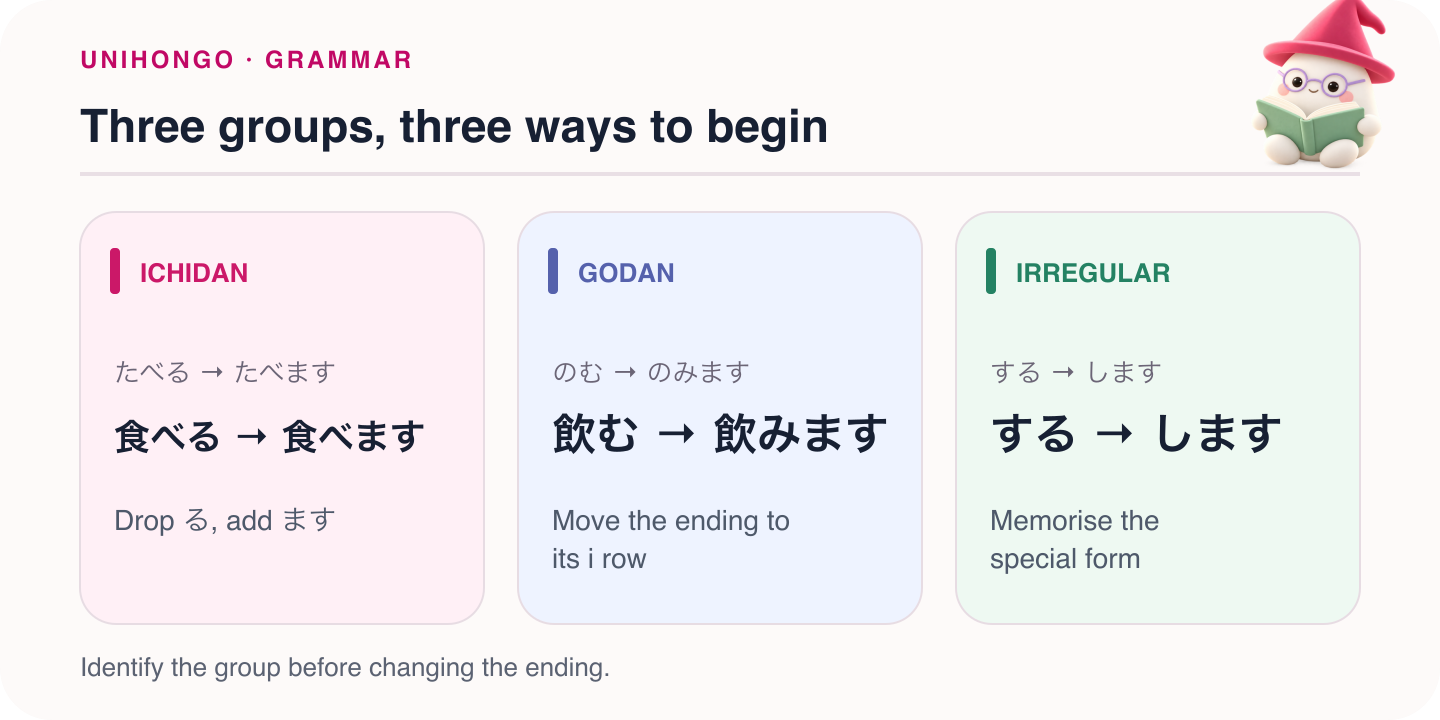
| Group | How it behaves | Examples |
|---|---|---|
| Ichidan | Remove final る and add the new ending | 食べる taberu, 見る miru, 起きる okiru |
| Godan | Change the final kana within its vowel row | 書く kaku, 話す hanasu, 読む yomu |
| Irregular | Memorise the stems | する suru, 来る kuru |
Most verbs ending in an e-sound + ru are ichidan, and many ending in i-sound + ru are too, but exceptions such as kaeru 'to return', hashiru 'to run', and hairu 'to enter' are godan. Learn uncertain verbs with one conjugated form—kaeru/kaerimasu—not as a label alone.
The core forms at a glance
| Function | 食べる taberu | 書く kaku | する suru |
|---|---|---|---|
| Plain non-past | 食べる | 書く | する |
| Polite non-past | 食べます | 書きます | します |
| Plain negative | 食べない | 書かない | しない |
| Plain past | 食べた | 書いた | した |
| Te-form | 食べて | 書いて | して |
| Potential | 食べられる | 書ける | できる |
| Volitional | 食べよう | 書こう | しよう |
Non-past covers habitual and future actions: mainichi taberu means 'I eat every day', while ashita taberu means 'I will eat tomorrow'. Japanese has no separate future conjugation. Polite negatives and past forms build regularly from masu: masen, mashita, and masen deshita.
How ichidan verbs conjugate
Remove the final る from 食べる to reveal the stable stem 食べ. Add ます for polite speech, ない for negative, た for past, て for te-form, られる for potential, and よう for volitional. 見る behaves the same way: 見ます, 見ない, 見た, 見て, 見られる, 見よう.
In casual speech, many speakers shorten the potential 食べられる to 食べれる. The shorter form is common but is not always preferred in formal writing or careful speech. Learn the full form first so you also recognise the passive-looking shape in context.
How godan verbs change rows
For the polite stem, move the final kana to its i-row: 書く becomes 書きます, 読む becomes 読みます, and 話す becomes 話します. For plain negative, move to the a-row and add ない: 書かない, 読まない, 話さない. Verbs ending in う use わ, so 買う becomes 買わない.
Potential moves the final kana to the e-row plus る: 書ける, 読める, 話せる, 買える. Volitional moves to the o-row plus う: 書こう, 読もう, 話そう, 買おう. Seeing these as vowel-row movements is easier than memorising every verb separately.
The godan te-form and past-form sound groups
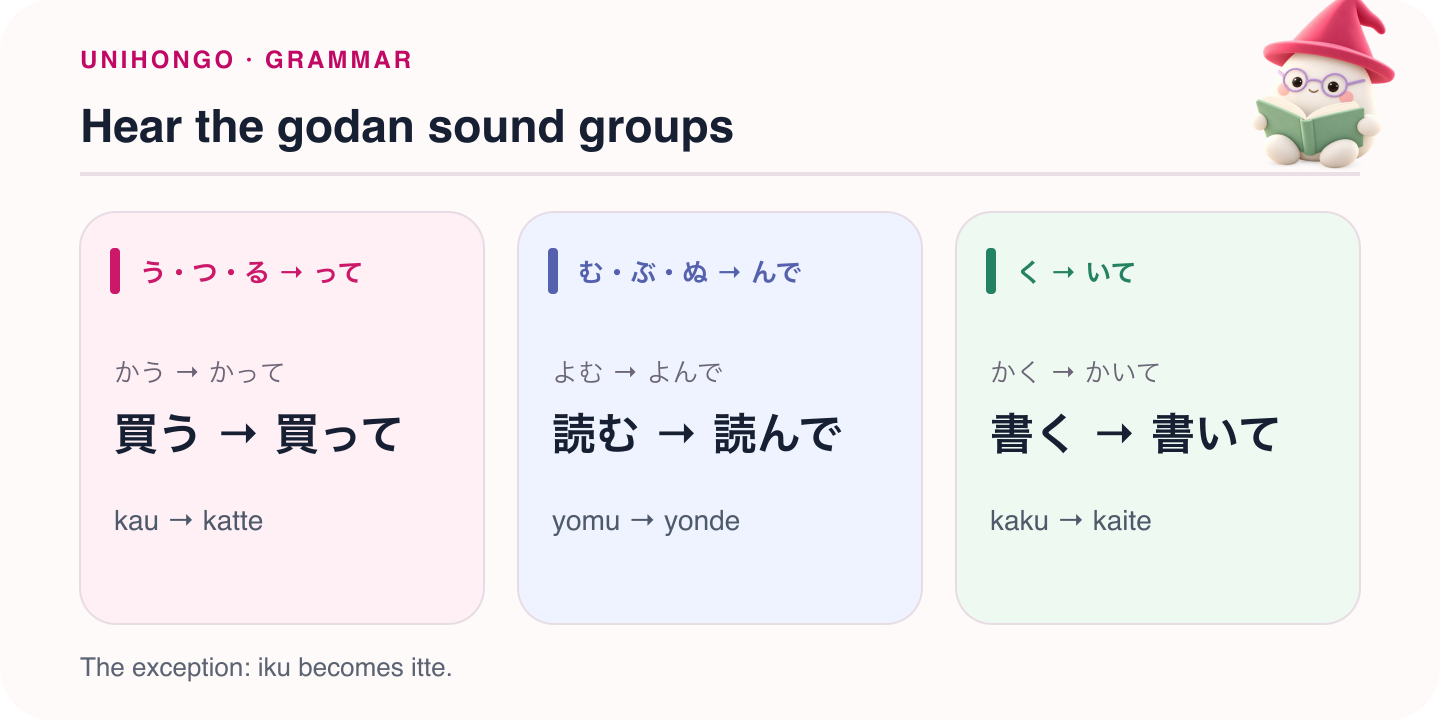
| Dictionary ending | Te-form | Past form | Example |
|---|---|---|---|
| う・つ・る | って | った | 待つ → 待って / 待った |
| む・ぶ・ぬ | んで | んだ | 読む → 読んで / 読んだ |
| く | いて | いた | 書く → 書いて / 書いた |
| ぐ | いで | いだ | 泳ぐ → 泳いで / 泳いだ |
| す | して | した | 話す → 話して / 話した |
The important exception is 行く iku: 行って itte and 行った itta, not iite and iita. The past form mirrors the te-form by replacing te/de with ta/da. Learning those two forms together cuts the memory work in half.
What the te-form actually does
| Japanese | Romaji | Meaning |
|---|---|---|
| ちょっと待ってください。 | Chotto matte kudasai. | Please wait a moment. |
| 日本語を勉強しています。 | Nihongo o benkyō shite imasu. | I am studying Japanese. |
| ここで食べてもいいです。 | Koko de tabete mo ii desu. | You may eat here. |
| 写真を撮ってはいけません。 | Shashin o totte wa ikemasen. | You must not take photos. |
| 朝ご飯を食べて、出かけました。 | Asagohan o tabete, dekakemashita. | I ate breakfast and went out. |
Think of te-form as a connector. The expression after it determines the function. That is why memorising tabete as a translation such as 'eating' creates confusion; tabete kudasai, tabete iru, and tabete mo ii do different jobs.
Polite and plain speech are not separate grammars
Plain forms appear with friends, family, inner thoughts, quoted clauses, and many grammar patterns. Polite masu forms manage the social relationship of the main sentence. Beginners sometimes learn only masu and then cannot recognise plain forms in listening; others copy casual media speech and sound abrupt with strangers. Study both from the beginning.
A useful transformation drill keeps meaning constant: ashita iku, ashita ikimasu, ashita ikanai, kinō itta. Then place each in an exchange. Ask ashita ikimasu ka, answer un, iku or iie, ikimasen, and add a reason. Context makes the form choice meaningful.
A seven-day conjugation practice plan
- Day 1: identify group and make masu forms for ten frequent verbs.
- Day 2: make plain and polite negatives inside true sentences about your life.
- Day 3: contrast non-past and past in a spoken daily diary.
- Day 4: group godan te-forms by sound and add the iku exception.
- Day 5: use te-form in requests, ongoing actions, and permission.
- Day 6: add potential and volitional forms to plans and abilities.
- Day 7: hold a ten-minute conversation and note which form choices still pause you.