
One kanji, two readings
何 is written the same way whichever reading you use, so the kanji gives you no clue. What decides the reading is the sound that comes next. Japanese, like every language, shifts word shapes to make sequences easier to say, and nani loses its final vowel in exactly the environments where keeping it would be awkward. The result is a pair of forms that a native speaker never thinks about and a learner has to be told once.
There is a practical payoff to learning this early. Question words are the engine of a conversation, and 何 is the busiest of them. If you hesitate over the reading, you hesitate at the start of the sentence, which is the worst place to stall. Fixing the rule now means the rest of the question comes out cleanly.
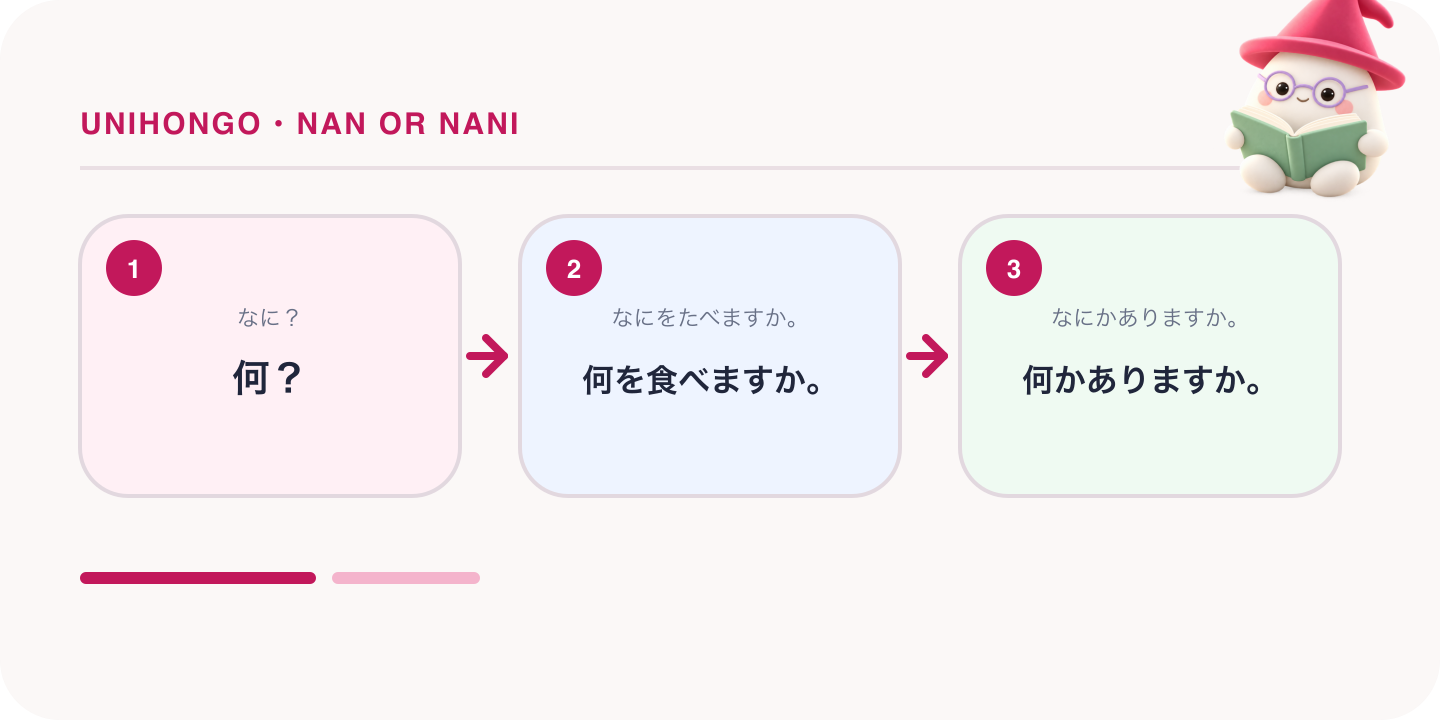
The rule in one table
| Context | Reading | Example | English |
|---|---|---|---|
| Standing alone | nani | 何? | What? |
| Before を or が | nani | 何を食べますか。 | What will you eat? |
| Before に, か, も, より | nani | 何かありますか。 | Is there anything? |
| Before です, だ, でしょう | nan | これは何ですか。 | What is this? |
| Before any counter | nan | 今、何時ですか。 | What time is it now? |
| Before と when quoting | nan | 日本語で何と言いますか。 | How do you say it in Japanese? |
| Before の | nan | 何の本ですか。 | What kind of book is it? |
| Before で meaning why | nan | 何で来なかったの? | Why did you not come? (casual) |
Read the table as one instruction with a list of exceptions rather than eight separate facts. The instruction is that nan appears where 何 is fused to what follows, and nani appears where 何 is a standalone word with a particle after it. The particles ni, ka, mo and yori keep nani even though they are short, because they stay separate words.
Nani before particles
This is the form most beginners learn first, and it covers the everyday questions about objects and preferences. 何 keeps its full shape because the particle after it is a separate piece of the sentence, not part of the word. Note that the answer usually repeats the particle, so nani ga suki desu ka is answered with something plus ga suki desu, which makes these pairs easy to drill in both directions.
| Japanese | Romaji | Meaning |
|---|---|---|
| 何を飲みますか。 | Nani o nomimasu ka? | What will you drink? |
| お茶をお願いします。 | O-cha o onegaishimasu. | Tea, please. (a likely reply) |
| 何が好きですか。 | Nani ga suki desu ka? | What do you like? |
| 寿司が好きです。 | Sushi ga suki desu. | I like sushi. (a likely reply) |
| 何に興味がありますか。 | Nani ni kyōmi ga arimasu ka? | What are you interested in? |
| 何かありましたか。 | Nani ka arimashita ka? | Did something happen? |
| 何も食べていません。 | Nani mo tabete imasen. | I have not eaten anything. |
| 何から始めますか。 | Nani kara hajimemasu ka? | What shall we start with? |
| 何より健康が大切です。 | Nani yori kenkō ga taisetsu desu. | Health matters more than anything. |
| 何をしていますか。 | Nani o shite imasu ka? | What are you doing? |
Nan before desu and before counters
Nan desu ka is the single most common question in beginner Japanese, and it is where learners first notice the shift. The same nan appears in the plain forms nan da and nan darō, and in the polite guess nan deshō. From there the pattern extends to every counter: the counter is welded onto 何 to make one word, so the shortened form is the only option.
Counters are where this rule earns its keep, because Japanese asks about quantity constantly. Nanji for time, nannin for people, nanmai for flat things, nanbon for long things. If you know the counter, you know the question, and the reading never varies. The counters themselves are covered in the numbers and counters guide; here the point is only that 何 in front of one is always nan.
| Japanese | Romaji | Meaning |
|---|---|---|
| これは何ですか。 | Kore wa nan desu ka? | What is this? |
| お名前は何ですか。 | O-namae wa nan desu ka? | What is your name? |
| 日本語で何と言いますか。 | Nihongo de nan to iimasu ka? | How do you say it in Japanese? |
| 何の本ですか。 | Nan no hon desu ka? | What kind of book is it? |
| 今、何時ですか。 | Ima, nan-ji desu ka? | What time is it now? |
| 三時です。 | San-ji desu. | It is three o'clock. (a likely reply) |
| 何人家族ですか。 | Nan-nin kazoku desu ka? | How many people are in your family? |
| 四人家族です。 | Yo-nin kazoku desu. | There are four of us. (a likely reply) |
| 何枚いりますか。 | Nan-mai irimasu ka? | How many sheets do you need? |
| 二枚お願いします。 | Ni-mai onegaishimasu. | Two, please. (a likely reply) |
| 何階ですか。 | Nan-gai desu ka? | What floor is it? |
| 全部で何円ですか。 | Zenbu de nan-en desu ka? | How many yen is it altogether? |
For prices, ikura desu ka is the more natural everyday question, and nan-en is used when you want the figure in yen specifically. Both are correct, but a shop assistant will expect ikura.
The counter compounds you meet daily
| Japanese | Reading | Meaning |
|---|---|---|
| 何時 | nan-ji | What time |
| 何分 | nan-pun | How many minutes, what minute |
| 何日 | nan-nichi | What day of the month, how many days |
| 何月 | nan-gatsu | What month |
| 何年 | nan-nen | What year, how many years |
| 何曜日 | nan'yōbi | What day of the week |
| 何人 | nan-nin | How many people |
| 何歳 | nan-sai | How old |
| 何番 | nan-ban | What number |
| 何回 | nan-kai | How many times |
| 何度 | nan-do | How many times, how many degrees |
| 何枚 | nan-mai | How many flat things |
| 何本 | nan-bon | How many long things |
| 何個 | nan-ko | How many small items |
| 何冊 | nan-satsu | How many books |
| 何匹 | nan-biki | How many small animals |
| 何台 | nan-dai | How many machines or vehicles |
| 何杯 | nan-bai | How many cupfuls or glasses |
| 何階 | nan-gai | What floor |
| 何円 | nan-en | How many yen |
| 何キロ | nan-kiro | How many kilos or kilometres |
| 何色 | nani-iro | What colour (exception, keeps nani) |
| 何語 | nani-go | What language (exception, keeps nani) |
| 何人 | nani-jin | What nationality (exception, keeps nani) |
| 何料理 | nani-ryōri | What kind of cuisine (exception, keeps nani) |
The last four rows are worth a second look. They are not counters, they are questions about kind, so the base form survives. The pair 何人 is the one to be careful with: nan-nin asks how many people and nani-jin asks what nationality, written identically. Context and the rest of the sentence tell them apart, and nani-jin desu ka can sound blunt, so o-kuni wa dochira desu ka is the softer way to ask where someone is from.
Why the reading changes at all
The consonants that trigger nan are d, t and n, the ones made by putting the tip of your tongue against the ridge behind your upper teeth. Say nani desu slowly and you will feel your tongue leave that ridge for the i and come straight back for the d. Dropping the i removes the wasted movement, and nan desu comes out in one gesture. The same happens with nan to, nan no, nan da and the counters beginning with those sounds.
You do not need this explanation to use the rule, but it makes the list of contexts feel like one thing rather than several. It also predicts new cases. When you meet an unfamiliar counter starting with t, d or n, you can be confident it takes nan without having heard the word before. The particles ni and mo are the memorable exceptions, and they are worth learning as exceptions rather than reasoning about.
Nande, naze and dōshite
何で read as nande is the casual way to ask why, and it is extremely common in speech among friends and family. It is not rude in itself, but it is direct, and pointed at a manager or a customer it can sound like a challenge. Dōshite is the neutral spoken form and the safest default for a learner. Naze is the formal one, at home in writing, reports and presentations, and it sounds heavy in casual chat.
There is a genuine ambiguity to be aware of. 何で can also mean by what means, in which case it is read nani de. Because nande has taken over the why meaning so strongly in speech, speakers often say nani de deliberately, or avoid the question altogether with dōyatte for how. If someone asks nan de kimashita ka and you answer densha de, and they laugh, you have answered the transport question when they asked the why question.
| Japanese | Romaji | Meaning |
|---|---|---|
| どうして日本語を勉強していますか。 | Dōshite nihongo o benkyō shite imasu ka? | Why are you studying Japanese? |
| 仕事で使うからです。 | Shigoto de tsukau kara desu. | Because I use it for work. (a likely reply) |
| なぜですか。 | Naze desu ka? | Why is that? (formal) |
| 何で来なかったの? | Nande konakatta no? | Why did you not come? (casual) |
| ごめん、忙しかった。 | Gomen, isogashikatta. | Sorry, I was busy. (casual reply) |
| 何で行きますか。 | Nani de ikimasu ka? | What will you travel by? |
| 電車で行きます。 | Densha de ikimasu. | I will go by train. (a likely reply) |
| どうやって行きますか。 | Dōyatte ikimasu ka? | How do you get there? |
Nanka as filler and as a put-down
Nanka is a contraction of nani ka, and in casual speech it works as a soft filler meaning something like, sort of, or somehow. Used lightly it buys thinking time and softens a claim. Used constantly it has the same effect as filling English with like, and it reads as vague, so keep it out of formal speech and job interviews.
The second use is different. Attached to a noun, nanka dismisses it. Watashi nanka is a self-deprecating someone like me, and shukudai nanka is homework of all things. The related nante does similar work with a slightly more emphatic feel. Both are casual, and pointing nanka at another person's name or work is insulting rather than modest, so use it about yourself or about things.
| Japanese | Romaji | Meaning |
|---|---|---|
| なんか疲れました。 | Nanka tsukaremashita. | I am somehow tired. |
| なんか変ですね。 | Nanka hen desu ne. | Something feels a bit off. |
| なんか食べたいです。 | Nanka tabetai desu. | I want to eat something. |
| 私なんかまだまだです。 | Watashi nanka mada mada desu. | Someone like me still has a long way to go. |
| 宿題なんかしたくない。 | Shukudai nanka shitakunai. | I do not want to do homework of all things. (casual) |
| 嘘なんて言いません。 | Uso nante iimasen. | I would never tell a lie. |
Nani on its own, and how blunt it sounds
A bare nani with a falling tone is a flat what. Between close friends it is unremarkable, and it is what you hear when someone is called from another room. From a stranger, or aimed upward at a teacher or a boss, it lands as impatient. The polite repair when you have missed something is e, nan desu ka, or the fuller sumimasen, mō ichido onegaishimasu.
| Japanese | Romaji | Meaning |
|---|---|---|
| 何? | Nani? | What? (blunt, casual) |
| え、何ですか。 | E, nan desu ka? | Sorry, what was that? |
| すみません、もう一度お願いします。 | Sumimasen, mō ichido onegaishimasu. | Sorry, once more please. |
| 何それ。 | Nani sore. | What on earth is that? (casual) |
| 何でもないです。 | Nan demo nai desu. | It is nothing. |
| 何とかなります。 | Nan toka narimasu. | It will work out somehow. |
| 何が何だか分かりません。 | Nani ga nan da ka wakarimasen. | I have no idea what is going on. |
The last line is a useful self-test, because it contains both readings in six syllables. If you can say nani ga nan da ka at speed without stopping to think, the rule has moved from your notes into your mouth.
Questions to practise across both readings
| Japanese | Romaji | Meaning |
|---|---|---|
| すみません、これは何ですか。 | Sumimasen, kore wa nan desu ka? | Excuse me, what is this? |
| 中に何が入っていますか。 | Naka ni nani ga haitte imasu ka? | What is inside it? |
| 何時に始まりますか。 | Nan-ji ni hajimarimasu ka? | What time does it start? |
| 何曜日が空いていますか。 | Nan'yōbi ga aite imasu ka? | Which day of the week are you free? |
| 何人ぐらい来ますか。 | Nan-nin gurai kimasu ka? | About how many people are coming? |
| これは何に使いますか。 | Kore wa nani ni tsukaimasu ka? | What is this used for? |
| 何色がありますか。 | Nani-iro ga arimasu ka? | What colours do you have? |
| 何語を話しますか。 | Nani-go o hanashimasu ka? | What languages do you speak? |
| これは何と読みますか。 | Kore wa nan to yomimasu ka? | How do you read this? |
| 何か質問はありますか。 | Nani ka shitsumon wa arimasu ka? | Are there any questions? |
Ask these in pairs, one nan question followed immediately by one nani question about the same object. Alternating is what builds the switch; drilling ten of the same shape does not.
Mistakes learners make
- Saying nani desu ka instead of nan desu ka, the single most common slip with this word.
- Reading 何時 as nani-ji, which no native speaker says.
- Answering nan de kimashita ka with a means of transport when the speaker meant why.
- Using nani-jin desu ka to ask where someone is from, when o-kuni wa dochira desu ka is warmer.
- Replying to a superior with a bare nani rather than e, nan desu ka.
- Filling every sentence with nanka, which makes fluent-sounding speech say very little.