

The core meaning
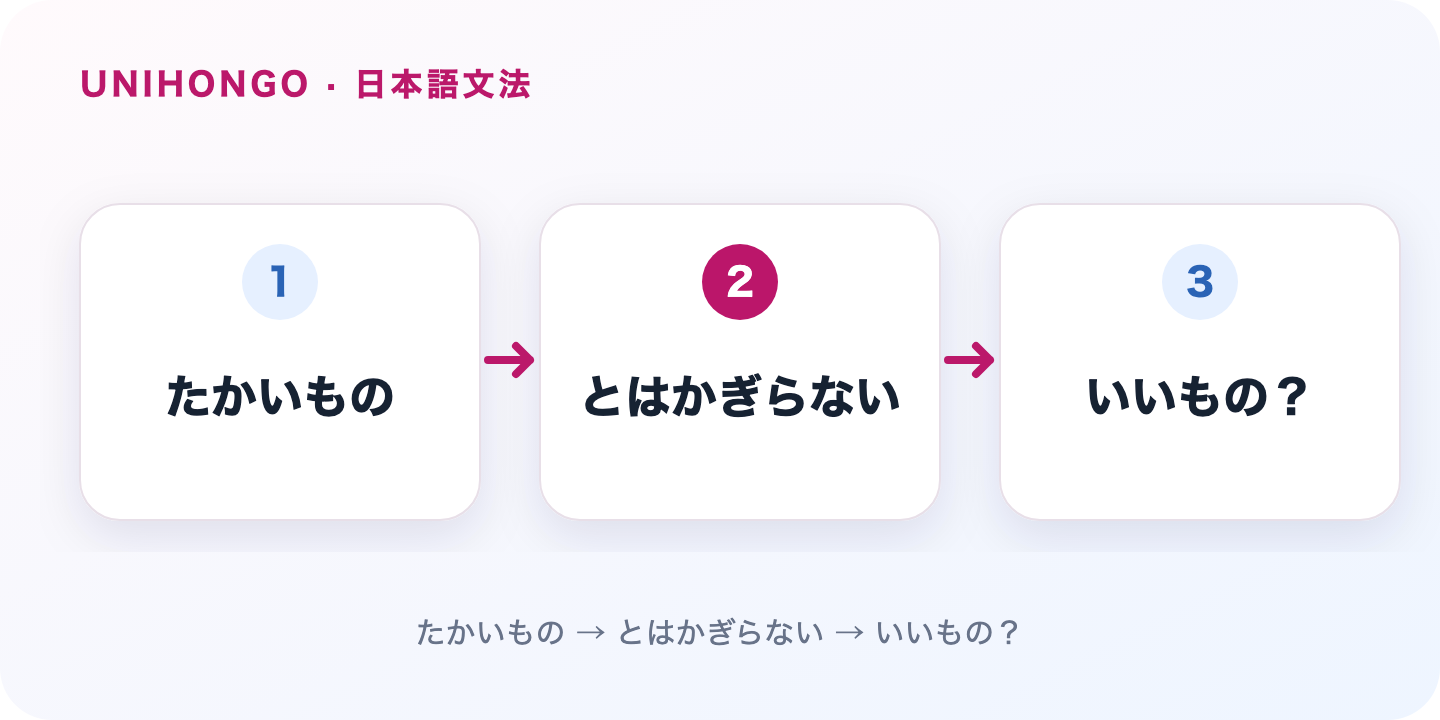
高い物が必ずしもいいとは限りません means expensive things are not always good. The speaker does not say they are bad; there may be exceptions to an assumed rule. The expression is useful when reasoning carefully about people, products, predictions or study advice, especially when a common belief sounds too absolute.
| Japanese | Romaji | Meaning |
|---|---|---|
| 高い物が必ずしもいいとは限りません。 | Takai mono ga kanarazushimo ii to wa kagirimasen. | Expensive things are not always good. |
| 毎日勉強すれば、すぐ上達するとは限りません。 | Mainichi benkyō sureba, sugu jōtatsu suru to wa kagirimasen. | Daily study doesn't guarantee quick progress. |
How to form it
Put a plain statement plus と before は限らない: 正しいとは限らない, 便利だとは限らない. Nouns and な adjectives generally need だ: 専門家だとは限らない. 必ずしも often appears before the first clause to emphasize 'not necessarily,' but the phrase works without it.
| Use | Japanese form | Meaning |
|---|---|---|
| Verb | 成功するとは限らない | Success is not guaranteed |
| な adjective | 便利だとは限らない | It is not necessarily convenient |
| Noun | 専門家だとは限らない | They are not necessarily an expert |
Natural examples
Read each sentence for the relationship between the first idea and the second. The English translation gives a natural meaning, while the Japanese wording shows exactly where the pattern attaches.
| Japanese | Romaji | Meaning |
|---|---|---|
| 有名だから、おいしいとは限らない。 | Yūmei da kara, oishii to wa kagiranai. | Being famous doesn't necessarily mean it tastes good. |
| 静かな場所が仕事に向いているとは限りません。 | Shizuka na basho ga shigoto ni muite iru to wa kagirimasen. | A quiet place is not necessarily best for work. |
Compare the nearby pattern
高い物がいいわけではない can correct a specific assumption that expensive goods must be good. 高い物がいいとは限らない focuses on the lack of a universal guarantee. Both can overlap, but とは限らない is especially natural when discussing a generalization and possible counterexamples.
| Japanese | Romaji | Meaning |
|---|---|---|
| この店は高いです。 | Kono mise wa takai desu. | This shop is expensive. |
| 高い店がおいしいとは限りません。 | Takai mise ga oishii to wa kagirimasen. | An expensive restaurant is not necessarily good. |
The two examples may describe similar situations, but they lead the listener to different conclusions. Choose the form that matches the claim you really intend to make.
Common mistake to avoid
Do not translate とは限らない as 'is never true.' A learner who says 日本人は全員静かとは限らない is simply saying some Japanese people may not be quiet, not making a new claim about everyone. Look for a universal word such as 必ず, 全員 or いつも that the phrase softens.
- It rejects a universal guarantee
- The opposite is not automatically true
- Plain clause + とは限らない
- 必ずしも commonly adds emphasis
Try it yourself
Find a stereotype about cost, age or learning time. Make a sentence with とは限らない, then give one realistic exception without claiming that the reverse is always true.
Say your sentence once slowly while looking at the Japanese pattern. Then say it again without reading. If your second clause changes from a possibility to a fact, or from advice to a requirement, revise it so the grammar still matches your meaning.