
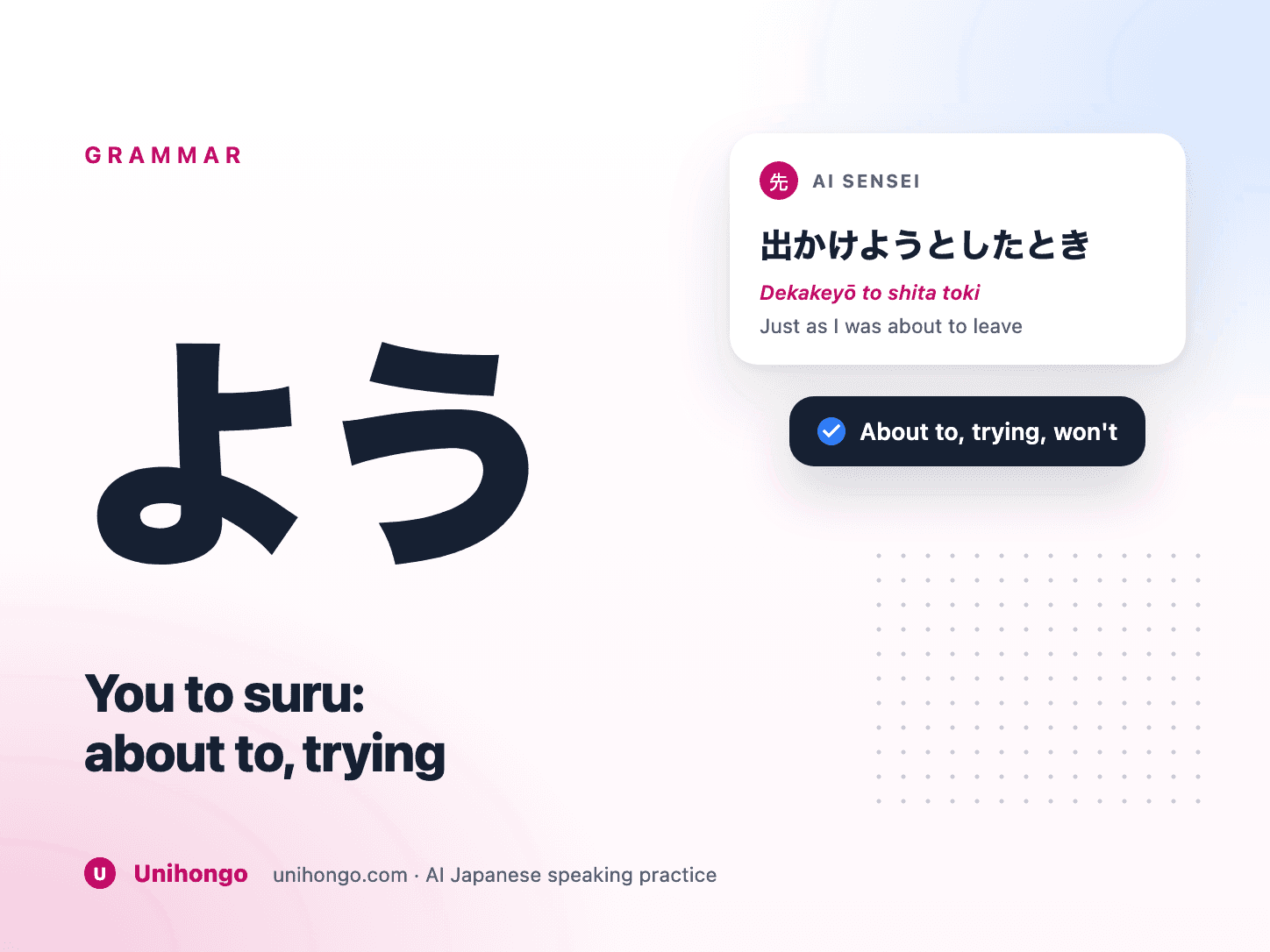
One pattern, three situations
You to suru combines the volitional form, which expresses intention, with to suru, which turns that intention into an action in progress. The result is an action that is being reached for but has not been completed.
Depending on context, that becomes about to, trying to, or, in the negative, not even trying.
| Japanese | Romaji | Meaning |
|---|---|---|
| 出かけようとしたとき、電話が鳴った。 | Dekakeyō to shita toki, denwa ga natta. | Just as I was about to go out, the phone rang. |
| 何度も思い出そうとしたけど、だめだった。 | Nando mo omoidasō to shita kedo, dame datta. | I tried many times to remember, but it was no use. |
| 子どもが野菜を食べようとしない。 | Kodomo ga yasai o tabeyō to shinai. | My child will not even try to eat vegetables. |
Building the volitional first
The plain volitional is the only form you need to build. It is the same form used for casual let us suggestions, so if you already say ikō, you have the first half.
| Japanese | Romaji | Meaning |
|---|---|---|
| 書こうとする | kakō to suru | To be about to write, to try to write |
| 寝ようとする | neyō to suru | To be about to sleep, to try to sleep |
| 説明しようとする | setsumei shiyō to suru | To try to explain |
| Verb group | How to form it | Example change |
|---|---|---|
| Godan verbs | Change the final u sound to an ō sound | kaku becomes kakō |
| Ichidan verbs | Replace ru with yō | taberu becomes tabeyō |
| Irregular: suru | Becomes shiyō | benkyō suru becomes benkyō shiyō |
| Irregular: kuru | Becomes koyō | kuru becomes koyō |
About to: the moment just before
With toki or tokoro, you to shita marks the instant before an action, usually when something interrupts it. This is one of the most natural uses in storytelling.
It also describes objects on the verge of moving, which English expresses with about to.
| Japanese | Romaji | Meaning |
|---|---|---|
| 寝ようとしたところに、メールが来た。 | Neyō to shita tokoro ni, mēru ga kita. | Just as I was going to sleep, an email came in. |
| ドアが閉まろうとしていた。 | Doa ga shimarō to shite ita. | The door was about to close. |
| 電車が出ようとしている。 | Densha ga deyō to shite iru. | The train is about to leave. |
Trying: effort that may not work
When you describe an attempt with you to shita, listeners usually hear that it did not succeed, or at least that it was difficult. The follow-up clause often confirms it with kedo or ga.
This makes it perfect for describing the frustrations of learning, like reaching for a word that will not come.
| Japanese | Romaji | Meaning |
|---|---|---|
| 開けようとしたけど、開かなかった。 | Akeyō to shita kedo, akanakatta. | I tried to open it, but it would not open. |
| 日本語で説明しようとしましたが、言葉が出てきませんでした。 | Nihongo de setsumei shiyō to shimashita ga, kotoba ga dete kimasen deshita. | I tried to explain in Japanese, but the words would not come. |
| 忘れようとしても、忘れられない。 | Wasureyō to shite mo, wasurerarenai. | Even when I try to forget, I cannot. |
You to shinai: will not even try
In the negative, the pattern describes refusal or reluctance: someone does not make the attempt at all. It is most often used about other people and animals, and it frequently carries frustration.
| Japanese | Romaji | Meaning |
|---|---|---|
| 彼は人の話を聞こうとしない。 | Kare wa hito no hanashi o kikō to shinai. | He will not listen to anyone. |
| 猫が薬を飲もうとしない。 | Neko ga kusuri o nomō to shinai. | The cat will not take its medicine. |
| 誰も手伝おうとしなかった。 | Dare mo tetsudaō to shinakatta. | Nobody even tried to help. |
You to suru or te miru?
Both translate as try, which is why learners mix them up. Te miru means you actually did the action to see what it would be like. You to suru means you aimed at it, and often did not complete it.
The minimal pair below is worth memorising, because it changes what your listener thinks happened.
| Japanese | Romaji | Meaning |
|---|---|---|
| 納豆を食べてみました。 | Nattō o tabete mimashita. | I tried natto. (I actually ate some) |
| 納豆を食べようとしましたが、無理でした。 | Nattō o tabeyō to shimashita ga, muri deshita. | I tried to eat natto, but I could not. |
| 毎日話すようにしています。 | Mainichi hanasu yō ni shite imasu. | I make a point of speaking every day. (a habit, not an attempt) |
- Use te miru for trying something out that you actually did.
- Use you to suru for an attempt, or for the moment just before.
- Use yō ni suru for an ongoing effort to build a habit.
- Use you to omou for an intention you are only considering.