
Why sanji and sanjikan are two different words
English uses the same noun for both jobs. Three o'clock and three hours share the word three, and the difference lives in o'clock and hours. Japanese does the same thing, but the marker is a suffix that learners often treat as decoration. Ji names a position on the clock face. Jikan names a measured quantity of time. Once you hear them as two separate nouns rather than one noun with an optional ending, the rest of the system falls into place quickly.
This matters because the two nouns then take different particles and answer different questions. Nanji desu ka asks for a clock reading and expects sanji desu. Nanjikan desu ka asks for a length and expects sanjikan desu. If you answer a how-long question with a clock reading, a Japanese listener will hear an appointment time and wait for the rest of the sentence that never comes.
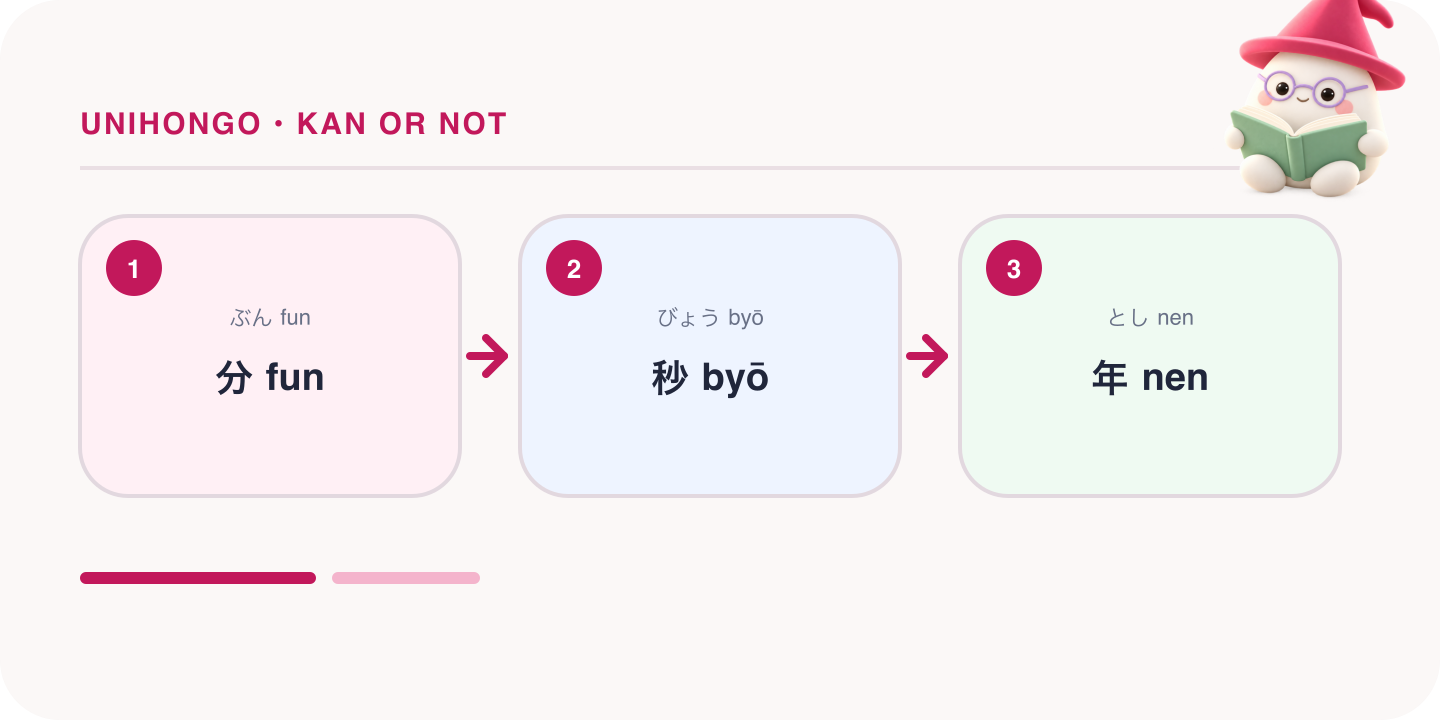
The time word map
| Unit | Point in time | Duration |
|---|---|---|
| Second | 十時五分三十秒 jūji gofun sanjūbyō (10:05:30) | 三十秒間 sanjūbyōkan (for thirty seconds) |
| Minute | 三時五分 sanji gofun (3:05) | 五分間 gofunkan (for five minutes) |
| Hour | 三時 sanji (three o'clock) | 三時間 sanjikan (three hours) |
| Day | 三日 mikka (the third of the month) | 三日間 mikkakan (three days) |
| Week | 今週 konshū (this week) | 三週間 sanshūkan (three weeks) |
| Month | 三月 sangatsu (March) | 三ヶ月 sankagetsu (three months) |
| Year | 二千二十六年 nisen nijūroku-nen (the year 2026) | 三年間 sannenkan (three years) |
Read the two columns as separate vocabulary lists rather than as one list with a modification. Sangatsu and sankagetsu are not variants of each other; one is the name of a month and the other is a quantity of months. The same goes for mikka meaning the third of the month and mikka meaning three days, which are genuinely the same word doing two jobs, and only the sentence tells you which.
When kan is required, optional, or wrong
| Counter | Kan status | Example |
|---|---|---|
| 時 ji / 時間 jikan | Required for a duration | 五時間 gojikan; 五時 goji can only mean five o'clock |
| 週 shū / 週間 shūkan | Required for a duration | 二週間 nishūkan; 二週 nishū is not used on its own |
| 分 fun | Optional | 十分 juppun or 十分間 juppunkan |
| 秒 byō | Optional | 三十秒 sanjūbyō or 三十秒間 sanjūbyōkan |
| 日 nichi / ka | Optional from two days upward | 三日 mikka or 三日間 mikkakan |
| ヶ月 kagetsu | Optional | 六ヶ月 rokkagetsu or 六ヶ月間 rokkagetsukan |
| 年 nen | Optional and very common | 五年 gonen or 五年間 gonenkan |
| 一日 ichinichi | No kan | 一日 ichinichi is one day; ichinichikan is not natural |
Where kan is optional it is not meaningless. Adding it pushes the phrase toward a measured, deliberate span: gonen Nihon ni imashita reports five years in Japan, while gonenkan Nihon ni imashita frames those five years as a continuous stretch you are counting. In speech people drop it constantly, especially with days and months, so treat the optional column as a stylistic dial rather than a rule to enforce.
The two required rows are where beginners lose marks. Ji without kan is always a clock reading, and shū without kan does not stand alone as a counter at all. If you want to say for two weeks, nishūkan is the only option.
The particle rule that finishes the job
| Expression | Particle | Example |
|---|---|---|
| Clock time, date, month, year | に ni | 七時に起きます shichiji ni okimasu |
| Day of the week | に ni, often dropped in speech | 月曜日に休みます getsuyōbi ni yasumimasu |
| Today, tomorrow, this week, next year | No particle | 明日行きます ashita ikimasu |
| Every day, every morning, every week | No particle | 毎日話します mainichi hanashimasu |
| Any duration | No particle | 三時間話しました sanjikan hanashimashita |
| Frequency inside a period | に ni on the period | 一週間に二回 isshūkan ni nikai |
The pattern behind the table is simple. Ni pins a fixed, absolute point that you could write on a calendar or a clock. Words that shift with the moment of speaking, such as kyō, ashita, konshū and rainen, do not take it, and neither do repeated periods such as mainichi. A duration is not a point at all, so there is nothing for ni to pin, and it attaches directly to the verb.
The last row is the useful exception. When you count how often something happens inside a stretch of time, the stretch does take ni: isshūkan ni sankai jimu ni ikimasu means I go to the gym three times a week. Here the week is not a duration of the going, it is the frame the count sits inside. Our general particles guide covers ni's other jobs if you want the wider picture.
Minimal pairs to say out loud
These pairs change one thing only: the time expression. Say them in sequence and let your mouth learn that the second line of each pair has nothing between the number and the verb. The most persistent learner error is not choosing the wrong counter, it is adding ni to a perfectly good duration out of habit.
| Japanese | Romaji | Meaning |
|---|---|---|
| 三時に起きます。 | Sanji ni okimasu. | I get up at three. |
| 三時間寝ました。 | Sanjikan nemashita. | I slept for three hours. |
| 一時に食べます。 | Ichiji ni tabemasu. | I eat at one. |
| 一時間待ちました。 | Ichijikan machimashita. | I waited for an hour. |
| 四時に帰ります。 | Yoji ni kaerimasu. | I go home at four. |
| 四時間かかりました。 | Yojikan kakarimashita. | It took four hours. |
| 九時に始まります。 | Kuji ni hajimarimasu. | It starts at nine. |
| 九時間働きました。 | Kujikan hatarakimashita. | I worked for nine hours. |
| 三月に行きます。 | Sangatsu ni ikimasu. | I am going in March. |
| 三ヶ月住みました。 | Sankagetsu sumimashita. | I lived there for three months. |
| 二千二十四年に来ました。 | Nisen nijūyo-nen ni kimashita. | I came in 2024. |
| 二年間住んでいます。 | Ninenkan sunde imasu. | I have been living here for two years. |
Asking and answering how long
Question words follow the same split. Nanji asks for a clock reading, nanjikan asks for a number of hours, nannichi asks for a number of days, and dono kurai asks for an unspecified amount that the answer can fill in with any unit. Dono kurai is the safe choice when you do not know whether the answer will be in minutes, days or years, and it is what people actually use most often in conversation.
| Japanese | Romaji | Meaning |
|---|---|---|
| 何時に会いますか。 | Nanji ni aimasu ka? | What time shall we meet? |
| 何時間勉強しましたか。 | Nanjikan benkyō shimashita ka? | How many hours did you study? |
| 何日かかりますか。 | Nannichi kakarimasu ka? | How many days does it take? |
| どのくらいかかりますか。 | Dono kurai kakarimasu ka? | How long does it take? |
| 駅まで十分かかります。 | Eki made juppun kakarimasu. | It takes ten minutes to the station. |
| 三十分で作れます。 | Sanjuppun de tsukuremasu. | I can make it in thirty minutes. |
| 二時間で終わりました。 | Nijikan de owarimashita. | It was finished within two hours. |
| どのくらい日本語を勉強していますか。 | Dono kurai Nihongo o benkyō shite imasu ka? | How long have you been studying Japanese? |
| 三年間です。 | Sannenkan desu. | For three years. |
Notice the de in sanjuppun de and nijikan de. That de marks the amount of time a completed action fits inside, so it means in or within rather than for. Sanjikan benkyō shimashita says you studied for three hours; sanjikan de owarimashita says the whole thing was done inside three hours. Learners who reach for de on every duration end up saying the second when they mean the first.
Spans with kara and made
Kara and made draw the two ends of a stretch, and the stretch they draw is made of points, not durations. Kuji kara goji made is nine o'clock to five o'clock, two clock readings joined into a span. You cannot build the same phrase from jikan, because a duration has no start point to mark. This is a useful sanity check: if a time word sits in front of kara or made, it should be a point word.
| Japanese | Romaji | Meaning |
|---|---|---|
| 九時から五時まで働きます。 | Kuji kara goji made hatarakimasu. | I work from nine to five. |
| 月曜日から金曜日まで授業があります。 | Getsuyōbi kara kin'yōbi made jugyō ga arimasu. | I have classes from Monday to Friday. |
| 先週から日本にいます。 | Senshū kara Nihon ni imasu. | I have been in Japan since last week. |
| 五時まで待ちます。 | Goji made machimasu. | I will wait until five. |
| 五時までに出してください。 | Goji made ni dashite kudasai. | Please submit it by five. |
| 明日までにお願いします。 | Ashita made ni onegai shimasu. | By tomorrow, please. |
The last three rows hide a third contrast. Made marks a continuous state that runs right up to a moment, while made ni marks a deadline the action must happen before. Goji made machimasu is waiting all the way to five; goji made ni dashite kudasai is submitting at any moment before five. Our dedicated made and made ni post takes that pair apart in detail, but the shortcut is that made ni almost always appears with a one-off action verb.
Approximate time: goro versus gurai
The vagueness words split along exactly the same line. Goro attaches to a point and means around that moment. Gurai, also said kurai, attaches to an amount and means roughly that much. Because both translate as about in English, learners mix them, and sanji gurai ends up meaning about three hours' worth of three o'clock, which is not a thought anyone has. Goro also normally swallows the ni, so sanji goro ikimasu is more natural than adding ni after it.
| Japanese | Romaji | Meaning |
|---|---|---|
| 三時ごろ行きます。 | Sanji goro ikimasu. | I will go around three. |
| 昼ごろ着きます。 | Hirugoro tsukimasu. | I will arrive around midday. |
| 三時間ぐらいかかります。 | Sanjikan gurai kakarimasu. | It takes about three hours. |
| 二十分ぐらい待ちました。 | Nijuppun gurai machimashita. | I waited about twenty minutes. |
| 一週間ぐらいです。 | Isshūkan gurai desu. | About a week. |
| 六時半ごろ会いましょう。 | Rokuji han goro aimashō. | Let us meet around half past six. |
Days are the awkward set
Days break the neat pattern in two ways. First, the same forms cover both jobs from the second onward: mikka is the third of the month and also three days. Second, one day has two completely different words. Tsuitachi is the first of the month, and ichinichi is a duration of one day. Ichinichi also appears in ichinichi-jū, meaning all day long, which is the phrase you will actually reach for most often.
From two days upward you can add kan freely, and futsukakan, mikkakan and yokkakan are all natural when you want the span to sound deliberate. In everyday speech people often drop it, so mikka yasumimashita and mikkakan yasumimashita both mean I took three days off, with the second sounding slightly more measured.
| Japanese | Romaji | Meaning |
|---|---|---|
| 五月一日に着きます。 | Gogatsu tsuitachi ni tsukimasu. | I arrive on the first of May. |
| 一日中歩きました。 | Ichinichi-jū arukimashita. | I walked all day. |
| 三日かかります。 | Mikka kakarimasu. | It takes three days. |
| 三日間休みました。 | Mikkakan yasumimashita. | I took three days off. |
| 二日間だけです。 | Futsukakan dake desu. | It is only two days. |
| 一日に三回飲みます。 | Ichinichi ni sankai nomimasu. | I take it three times a day. |
| 十日に会いましょう。 | Tōka ni aimashō. | Let us meet on the tenth. |
The mistakes worth hunting down
- Sanjikan ni okimashita for at three: drop the kan and the sentence becomes sanji ni okimashita.
- Sanjikan ni nemashita for slept three hours: drop the ni, because a duration never takes one.
- Isshū benkyō shimashita: shū cannot stand alone, so use isshūkan.
- Ashita ni ikimasu: relative time words such as ashita, kyō and raishū take no particle.
- Mainichi ni renshū shimasu: repeated periods take no particle either.
- Sanji gurai kakarimasu when you mean about three hours: use sanjikan gurai.
- Nijikan de hanashimashita when you mean we talked for two hours: use nijikan hanashimashita.
A five-minute daily drill
- Say your day as six point sentences, each with ni, checking that every time word is a clock reading or a date.
- Say the same day as six duration sentences with no particle at all, and pause before the verb to prove nothing is missing.
- Answer nanjikan neru no and nanji ni neru no in the same breath, so the pair stays linked.
- Convert three of your duration sentences into kara and made spans, which forces the point words back out.
- Finish with two gurai sentences and two goro sentences, and say aloud which one is an amount and which is a moment.