

The core idea: tara puts you on the far side of a finished event
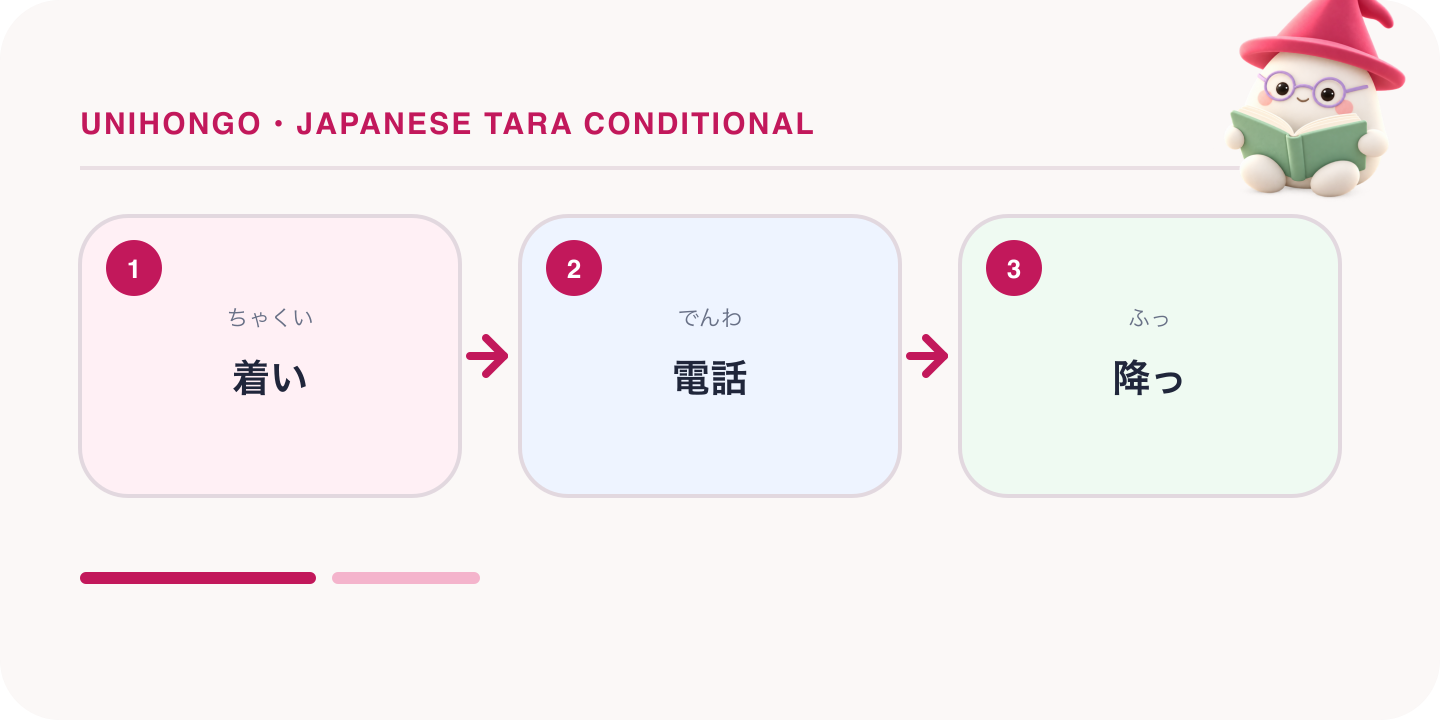
Look at what tara is made of. Tsuita means arrived, a completed action. Add ra and you get tsuitara: with the arriving done. Picture a doorway. Tara walks you through it and the rest of the sentence describes what happens on the far side. Eki ni tsuitara, denwa shimasu: literally, the arriving at the station done, I will call.
This is why the first event must always be finished before the second begins, and why English needs three translations where Japanese has one. If the doorway is certainly ahead of you, English says when. If you may never reach it, English says if. If you have already gone through, English says when I did that, I found. The form does not change. Only your distance from the doorway does.
| Japanese | Romaji | Meaning |
|---|---|---|
| 駅に着いたら、電話します。 | Eki ni tsuitara, denwa shimasu. | I'll call you when I get to the station. |
| 雨が降ったら、行きません。 | Ame ga futtara, ikimasen. | If it rains, I won't go. |
| 窓を開けたら、雪が降っていた。 | Mado o aketara, yuki ga futte ita. | When I opened the window, it was snowing. |
How tara is built: the ta form plus ra
There is one rule and no exceptions that you have not met already: make the plain past form, then add ra. Any irregularity comes from the ta form itself.
| Tara form | Reading | Built from | Meaning |
|---|---|---|---|
| 食べたら | tabetara | Verb: tabeta | Once I have eaten, if I eat |
| 行ったら | ittara | Verb: itta | Once I have gone, if I go |
| したら | shitara | Verb: shita | Once I have done it, if I do it |
| 来たら | kitara | Verb: kita | Once they have come, if they come |
| 行かなかったら | ikanakattara | Negative: ikanakatta | If I don't go |
| 高かったら | takakattara | I-adjective: takakatta | If it is expensive |
| よかったら | yokattara | I-adjective: yokatta | If it is good, if you like |
| 暇だったら | hima dattara | Na-adjective: hima datta | If you are free |
| 雨だったら | ame dattara | Noun: ame datta | If it is rain, if it rains |
| 雨じゃなかったら | ame ja nakattara | Noun negative: ame ja nakatta | If it is not raining |
The part before tara is plain even in polite speech. The politeness goes at the end: tsuitara, denwa shimasu. A polite version, mashitara, does exist, and you will hear it from staff in shops and restaurants, as in o-kimari ni narimashitara, o-yobi kudasai, please call me once you have decided.
When: events that are certain to happen
If the first event is going to happen anyway, tara means when or after. Work will end, the train will arrive, the book will be finished. There is no doubt, only order.
What makes tara so useful here is the freedom of the second half. It can be a promise, a request, an invitation or a question. Not every Japanese conditional allows that, as the last section explains.
| Japanese | Romaji | Meaning |
|---|---|---|
| 仕事が終わったら、飲みに行きませんか。 | Shigoto ga owattara, nomi ni ikimasen ka. | Shall we go for a drink when work finishes? |
| 読み終わったら、貸してください。 | Yomiowattara, kashite kudasai. | Please lend it to me when you've finished reading it. |
| 二十歳になったら、お酒が飲めます。 | Hatachi ni nattara, osake ga nomemasu. | When you turn twenty, you can drink alcohol. |
| 家に着いたら、連絡してね。 | Ie ni tsuitara, renraku shite ne. | Message me when you get home. |
| 十時になったら、出かけましょう。 | Jū-ji ni nattara, dekakemashō. | Let's go out when it gets to ten. |
If: uncertain events, and what moshi adds
When the first event may or may not happen, the same form reads as if. A friend is planning a picnic and the forecast is unclear. Nothing in the grammar changes. The doubt is in the situation.
Japanese speakers can flag that doubt early with moshi. Conditions come at the start of a Japanese sentence but the conditional ending comes late, so moshi warns the listener that a hypothetical is on its way. It is optional. It is also the word behind the very common moshi yokattara, literally if it would be good, which softens any invitation or offer.
| Japanese | Romaji | Meaning |
|---|---|---|
| もし雨が降ったら、うちで映画を見よう。 | Moshi ame ga futtara, uchi de eiga o miyō. | If it rains, let's watch a film at mine. |
| 安かったら、買います。 | Yasukattara, kaimasu. | If it's cheap, I'll buy it. |
| 暇だったら、手伝ってください。 | Hima dattara, tetsudatte kudasai. | If you're free, please help me. |
| 分からなかったら、聞いてください。 | Wakaranakattara, kiite kudasai. | If you don't understand, please ask. |
| もしよかったら、一緒に食べませんか。 | Moshi yokattara, issho ni tabemasen ka. | If you like, shall we eat together? |
| もし宝くじが当たったら、家を買います。 | Moshi takarakuji ga atattara, ie o kaimasu. | If I won the lottery, I'd buy a house. |
Minimal pairs: what one change does to a tara sentence
Each pair differs in a single element.
| Sentence | Reading | What it says |
|---|---|---|
| 春になったら、桜が咲きます。 | Haru ni nattara, sakura ga sakimasu. | Once spring comes, the cherry trees will bloom. The speaker is thinking of this coming spring. |
| 春になると、桜が咲きます。 | Haru ni naru to, sakura ga sakimasu. | When spring comes, the cherry trees bloom. A general fact, true every year. |
| ドアを開けたら、猫が逃げる。 | Doa o aketara, neko ga nigeru. | If you open the door, the cat will escape. A warning about the future. |
| ドアを開けたら、猫が逃げた。 | Doa o aketara, neko ga nigeta. | When I opened the door, the cat escaped. A report of what happened. |
| 京都に行ったら、連絡して。 | Kyōto ni ittara, renraku shite. | Get in touch once you are in Kyoto. The message is sent from there. |
| 京都に行くなら、連絡して。 | Kyōto ni iku nara, renraku shite. | If you are going to Kyoto, get in touch. The message is sent before the trip. |
In the first pair tara looks at one occasion, one doorway, while to states a standing rule. In the second, the tense at the very end decides whether the doorway is ahead of you or behind you. The third shows the limit of tara: because the first event must be complete, tara cannot ask for something to be done beforehand. That job belongs to nara.
Beyond the basics: discovery in the past
Put the ending in the past and tara stops being a condition at all. Mado o aketara, yuki ga futte ita: you went through the doorway and this is what was waiting. The second half is something you found, noticed or had happen to you.
That explains the restriction. The second event must be outside the speaker's control. If you did both things on purpose, there was nothing to discover, so tara sounds unnatural and the te form is used: uchi ni kaette, shukudai o shimashita, I went home and did my homework. With tara, the homework would have to be a surprise.
Below, you are telling a friend about a strange day.
| Japanese | Romaji | Meaning |
|---|---|---|
| 家に帰ったら、荷物が届いていました。 | Ie ni kaettara, nimotsu ga todoite imashita. | When I got home, a parcel had arrived. |
| 駅に着いたら、電車はもう出ていた。 | Eki ni tsuitara, densha wa mō dete ita. | When I got to the station, the train had already left. |
| 薬を飲んだら、すぐ治りました。 | Kusuri o nondara, sugu naorimashita. | I took the medicine and got better straight away. |
| 食べてみたら、おいしかった。 | Tabete mitara, oishikatta. | I tried it, and it was delicious. |
Tara dō desu ka: making a suggestion
Ask how things would be on the far side of the doorway and you have a suggestion. Sukoshi yasundara dō desu ka. Literally: if you rested a little, how would it be? In natural English, why don't you take a short rest? A colleague has been staring at the same spreadsheet for two hours, and this is what you say.
Among friends and family the pattern loses its ending step by step: yasundara dō desu ka, yasundara dō, and finally yasundara with a rising tone. Be a little careful upwards. The pattern tells the listener what to do, and said flatly it can sound impatient, as if the solution were obvious. With a manager or a customer, te mite wa ikaga deshō ka is the softer choice. The separate guide to tara ii and ba ii covers asking for advice.
| Japanese | Romaji | Meaning |
|---|---|---|
| 少し休んだらどうですか。 | Sukoshi yasundara dō desu ka. | Why don't you take a short rest? |
| 先生に聞いてみたらどう? | Sensei ni kiite mitara dō? | How about asking the teacher? |
| 病院に行ったら? | Byōin ni ittara? | Why not go to the doctor? |
Common mistakes with tara and what causes them
The first mistake is building tara on the dictionary form: taberu tara is wrong. Learners copy the pattern of nara, which does follow the dictionary form. Tara has the past form inside it: tabetara.
The second is the adjective ii. Ii tara and ikattara are both wrong. The past of ii is yokatta, so the tara form is yokattara. Na-adjectives cause the opposite slip: kirei kattara is wrong, because kirei is not an i-adjective. Say kirei dattara.
The third comes from translating when as toki. Eki ni tsuku toki, denwa shimasu is wrong if you mean that you will call after arriving. Toki marks the time around an event, and with a dictionary form it points to the moment before completion. A sequence needs tara: eki ni tsuitara, denwa shimasu.
The fourth is using tara for two deliberate actions in the past. Depāto ni ittara, kutsu o kaimashita sounds unnatural if buying shoes was the plan. Use the te form, depāto ni itte, kutsu o kaimashita. The fifth is moshi with a certainty: moshi jū-ji ni nattara sounds odd, since ten o'clock is not in doubt. Drop moshi.
Neighbours and spoken reality: why tara is the safest choice
Tara has three neighbours, and the overview of all four conditionals on this blog compares them in detail. To states automatic results and cannot be followed by a request, an invitation or a plan. Ba also has limits on what may follow in some sentences. Nara replies to a premise and cannot express a sequence. Tara asks one thing only, that the first event be complete, and then accepts any ending. If you are speaking and unsure, tara is very rarely wrong.
It does have weaker spots. For general truths and instructions, to sounds more natural. In formal writing, ba is more common. For advice that must be acted on before the event, only nara works. In conversation, though, tara is everywhere, and speakers in the Kansai region are often said to use it even more widely than Tokyo speakers do.
A few fixed expressions are worth learning whole. Sō shitara, literally if one does so, works as then or in that case at the start of a sentence. Yokattara softens offers, and nani ka attara covers any trouble that might come up.
| Japanese | Romaji | Meaning |
|---|---|---|
| よかったら、どうぞ。 | Yokattara, dōzo. | Please have some, if you like. |
| 何かあったら、言ってね。 | Nani ka attara, itte ne. | If anything comes up, tell me. |
| そうしたら、明日また来ます。 | Sō shitara, ashita mata kimasu. | In that case, I'll come again tomorrow. |
| お決まりになりましたら、お呼びください。 | O-kimari ni narimashitara, o-yobi kudasai. | Please call me when you have decided. |