

What tte iu ka actually does
To iu ka is built from to iu, to say, and the question particle ka. The literal sense is should I say that, or, and the sentence that follows supplies the better alternative. In speech the quoting to becomes tte, which is why you hear tte iu ka far more than to iu ka in daily conversation. It attaches directly to the word being replaced, with no particle between them.
What makes tte iu ka useful is that it corrects without cancelling. When you say kirai tte iu ka, nigate, the listener understands that hate was close but that not good with it is more honest. English speakers do the same with well, more like, and the tone is identical: relaxed, thinking aloud, adjusting in real time.
| Japanese | Romaji | Meaning |
|---|---|---|
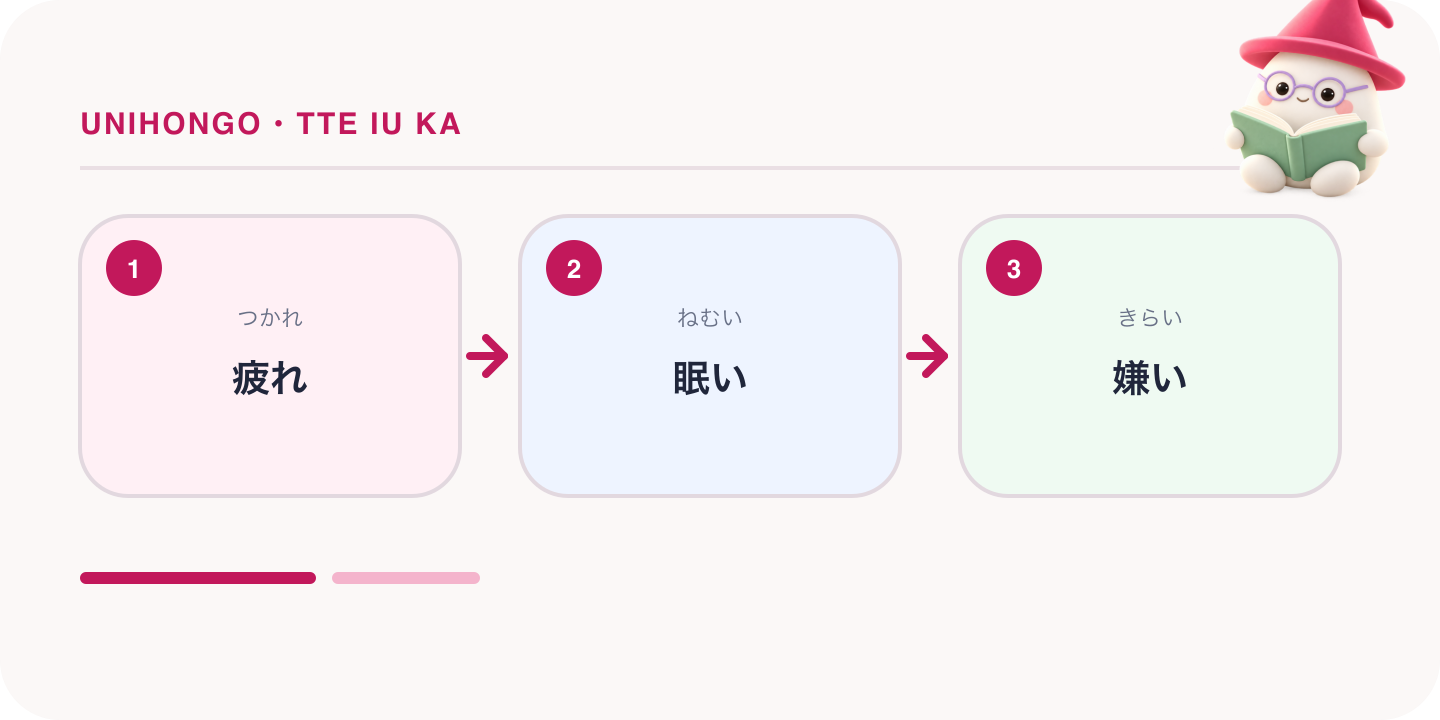
| 疲れたっていうか、眠いだけかも。 | Tsukareta tte iu ka, nemui dake kamo. | I'm tired, or actually maybe just sleepy. |
| 嫌いっていうか、苦手なんだよね。 | Kirai tte iu ka, nigate na n da yo ne. | It's not that I hate it, I'm just not good with it. |
| 友達っていうか、同僚です。 | Tomodachi tte iu ka, dōryō desu. | A friend, or rather a colleague. |
| 昨日、渋谷っていうか、原宿に行ったんだ。 | Kinō, Shibuya tte iu ka, Harajuku ni itta n da. | Yesterday I went to Shibuya, well, Harajuku. |
| 高いというか、私には無理な値段です。 | Takai to iu ka, watashi ni wa muri na nedan desu. | Expensive, or rather a price I simply can't pay. |
Swapping one word for a better one
The most frequent job of tte iu ka is upgrading a single word. You reach for a common adjective, realise it is too strong or too vague, and offer a more precise one. The structure is always A tte iu ka B, and B can be longer than A: ōkii tte iu ka, hitori ni wa hirosugiru, big, or rather too big for one person.
Tte iu ka also softens. If a friend asks whether you liked a restaurant and the honest answer is no, oishikunakatta tte iu ka, futsū datta, it was not good, well, it was ordinary, lets you land on a milder judgement. The first word shows your real reaction and the second shows your manners.
| Japanese | Romaji | Meaning |
|---|---|---|
| おいしくなかったっていうか、普通だった。 | Oishikunakatta tte iu ka, futsū datta. | It wasn't good, well, it was ordinary. |
| 忙しいっていうか、時間の使い方が下手なだけ。 | Isogashii tte iu ka, jikan no tsukaikata ga heta na dake. | Busy, or really just bad at managing time. |
| 怒ってるっていうか、がっかりしてる。 | Okotteru tte iu ka, gakkari shiteru. | Not angry exactly, more disappointed. |
| 安いっていうか、ちょうどいい値段だね。 | Yasui tte iu ka, chōdo ii nedan da ne. | Cheap, or rather just the right price. |
| 行きたくないっていうか、行けないんです。 | Ikitakunai tte iu ka, ikenai n desu. | It's not that I don't want to go, I can't. |
To iu yori: not so much A as B
To iu yori is the deliberate cousin of to iu ka. Yori means than, so A to iu yori B says that B is a better description than A. Unlike tte iu ka, which sounds like an on-the-spot fix, to iu yori presents both labels as considered and then ranks them. That makes it the natural choice when you want to correct someone else's word politely: yasashii to iu yori, amai n desu, not so much kind as soft on people.
The pattern is at home in polite speech and writing as well as casual talk, and the casual tte iu yori exists too. A related article on this site covers to ieba and to iu to, which introduce a topic rather than reframe one. To iu yori often takes mushiro, rather, before B for emphasis: shumi to iu yori, mushiro shigoto desu, less a hobby than, frankly, a job.
| Japanese | Romaji | Meaning |
|---|---|---|
| 彼は優しいというより、甘いんです。 | Kare wa yasashii to iu yori, amai n desu. | He's not so much kind as soft. |
| 趣味というより、仕事に近いです。 | Shumi to iu yori, shigoto ni chikai desu. | It's closer to work than a hobby. |
| 寒いっていうより、痛いレベルだよ。 | Samui tte iu yori, itai reberu da yo. | It's not cold so much as painful. |
| 休みというより、ただの移動日でした。 | Yasumi to iu yori, tada no idōbi deshita. | Less a day off than a travel day. |
| 安いというより、値段相応ですね。 | Yasui to iu yori, nedan sōō desu ne. | Not so much cheap as fairly priced. |
Tte iu no wa: defining and explaining
Tte iu no wa turns a word into a topic so that you can explain it. X tte iu no wa means the thing called X, or as for what X means, and it is how Japanese people define slang, explain a decision or ask what a term means. Tsundoku tte iu no wa, dō iu imi desu ka asks what tsundoku means.
At the start of a sentence, to iu no wa without a preceding word means the thing is, or the reason is, and it introduces background the listener needs. To iu no wa, kinō denwa ga atta n desu, well, the thing is, I got a call yesterday. This opener buys time politely: it signals that an explanation is coming and gives you a beat to organise it.
| Japanese | Romaji | Meaning |
|---|---|---|
| 「積読」っていうのは、どういう意味ですか。 | Tsundoku tte iu no wa, dō iu imi desu ka. | What does the word tsundoku mean? |
| ワンオペっていうのは、一人で全部やることです。 | Wanope tte iu no wa, hitori de zenbu yaru koto desu. | Wanope means doing everything alone. |
| 日本で働くっていうのは、思ったより大変です。 | Nihon de hataraku tte iu no wa, omotta yori taihen desu. | Working in Japan is harder than I expected. |
| それっていうのは、つまり無理ってこと? | Sore tte iu no wa, tsumari muri tte koto? | So what you mean is, it's impossible? |
| というのは、昨日電話があったんです。 | To iu no wa, kinō denwa ga atta n desu. | The thing is, I got a call yesterday. |
How natives restart a sentence and buy time
The tools natives use to rebuild a sentence are few and worth learning as a set. Ja nakute, not that but, cancels a wrong word and supplies the right one: raishū, ja nakute saraishū. Chigau chigau, no no, wipes a whole sentence among friends. Nan te iu ka, how should I put it, and nan darō, what is it, fill the gap while you search. Etto and ano are the plain fillers that hold the floor.
Tte iu ka joins this set as the topic changer. Placed at the front of a sentence with no preceding word, it means actually or anyway and steers the conversation somewhere new: tte iu ka, mō kaeranai? The youth forms te yūka and tsūka do the same job with a bored or impatient flavour. Silence while you think reads as confusion; a well-placed nan te iu ka reads as fluency.
| Japanese | Romaji | Meaning |
|---|---|---|
| えっと、来週、じゃなくて再来週です。 | Etto, raishū, ja nakute saraishū desu. | Let's see, next week, no, the week after. |
| 違う違う、そうじゃなくて。 | Chigau chigau, sō ja nakute. | No no, that's not what I mean. |
| あの、何ていうか、ちょっと違う気がして。 | Ano, nan te iu ka, chotto chigau ki ga shite. | Um, how can I put it, it feels a bit off. |
| なんだろう、うまく言えないけど。 | Nan darō, umaku ienai kedo. | How do I say it, I can't put it well, but. |
| ていうか、そもそも何の話だっけ? | Te iu ka, somosomo nan no hanashi dakke? | Wait, what were we even talking about? |
| つーか、腹減った。 | Tsūka, hara hetta. | Anyway, I'm starving. |
The reframing family by register
The forms below all come from to iu, and the differences are mostly about who you are talking to. Read the Japanese with its reading until you can hear the shift from the neutral to iu ka down to the rough tsūka.
| Expression | Reading | Register and use |
|---|---|---|
| というか | to iu ka | Neutral, spoken and written, or rather |
| っていうか | tte iu ka | Casual spoken, I mean, the everyday form |
| ていうか | te iu ka | Very casual, the small tsu dropped |
| てゆうか | te yūka | Youth speech, often opens a topic change |
| つーか | tsūka | Rough, mostly male, blunt or impatient |
| というより | to iu yori | Not so much A as B, polite and written |
| っていうより | tte iu yori | Casual version of the same contrast |
| というのは | to iu no wa | Defining a term, or the thing is |
| っていうのは | tte iu no wa | Casual definition or clarification |
| 何ていうか | nan te iu ka | How should I put it, a filler for word searches |
| じゃなくて | ja nakute | Not X, correcting a slip outright |
| と申しますか | to mōshimasu ka | Humble, customer service and formal speech |
In a formal setting you may also hear seikaku ni iu to, to be precise, and tadashiku wa, correctly speaking. Both correct a word without the conversational feel of to iu ka and suit presentations and written reports.
Near-synonyms and what each one signals
Several other expressions sit near tte iu ka, and choosing the wrong one changes how deliberate you sound. The list places each against the others.
- Tte iu ka: a spontaneous fix, the first word was close but not right
- To iu yori: a weighed comparison, both labels considered, the second wins
- Ja nakute: a flat correction of an error, no shade of meaning kept
- Mushiro: rather, strengthens the second label, often after to iu yori
- Tsumari: in other words, restates rather than corrects
- Yō suru ni: in short, sums up a long explanation
Mistakes that turn a correction into a stumble
The first mistake is chaining. Tte iu ka, tte iu ka, tte iu ka in one sentence tells the listener you have no idea what you mean; natives allow one, occasionally two. The second is using tte iu ka for plain errors: Ōsaka tte iu ka, Kyōto, when you simply said the wrong city, sounds odd because there is no shade of meaning to adjust. Use ja nakute there.
The third is register. Tte iu ka to a customer, or te yūka to a manager, sounds careless; switch to to iu ka or to mōshimasu ka. The fourth is the reverse: to iu yori in a chat with friends makes a casual remark sound like an essay. Finally, tte iu ka already carries the contrast, so demo before it is redundant.
| Japanese | Romaji | Meaning |
|---|---|---|
| 大阪じゃなくて、京都です。 | Ōsaka ja nakute, Kyōto desu. | Not Osaka, Kyoto. (Not Ōsaka tte iu ka.) |
| 大きいというより、広いですね。 | Ōkii to iu yori, hiroi desu ne. | Not so much big as spacious. |
| 正確に申しますと、来週の火曜日です。 | Seikaku ni mōshimasu to, raishū no kayōbi desu. | To be precise, next Tuesday. |
| 疲れたっていうか、飽きた。 | Tsukareta tte iu ka, akita. | Tired, or actually bored. (One correction is enough.) |