
Two verbs, two different jobs
Both verbs are godan verbs, so the forms are regular: shiru gives shirimasu, shitte, shitta, shiranai; wakaru gives wakarimasu, wakatte, wakatta, wakaranai. The difficulty is never the conjugation. It is that English collapses two ideas into the single word know, and Japanese keeps them apart. Shiru is the moment a piece of information enters your head, and by extension the state of holding it. Wakaru is the moment something becomes clear, whether that is a word, a route, a bill, or another person's mood.
A quick test that works most of the time: if you could have read the answer somewhere, it is shiru territory. If you had to follow, decode, or work the answer out, it is wakaru territory. That is why you know a phone number but you understand a meaning, and why nobody says they shiru how to solve a problem.
| Verb | Core idea | Particle | Typical object |
|---|---|---|---|
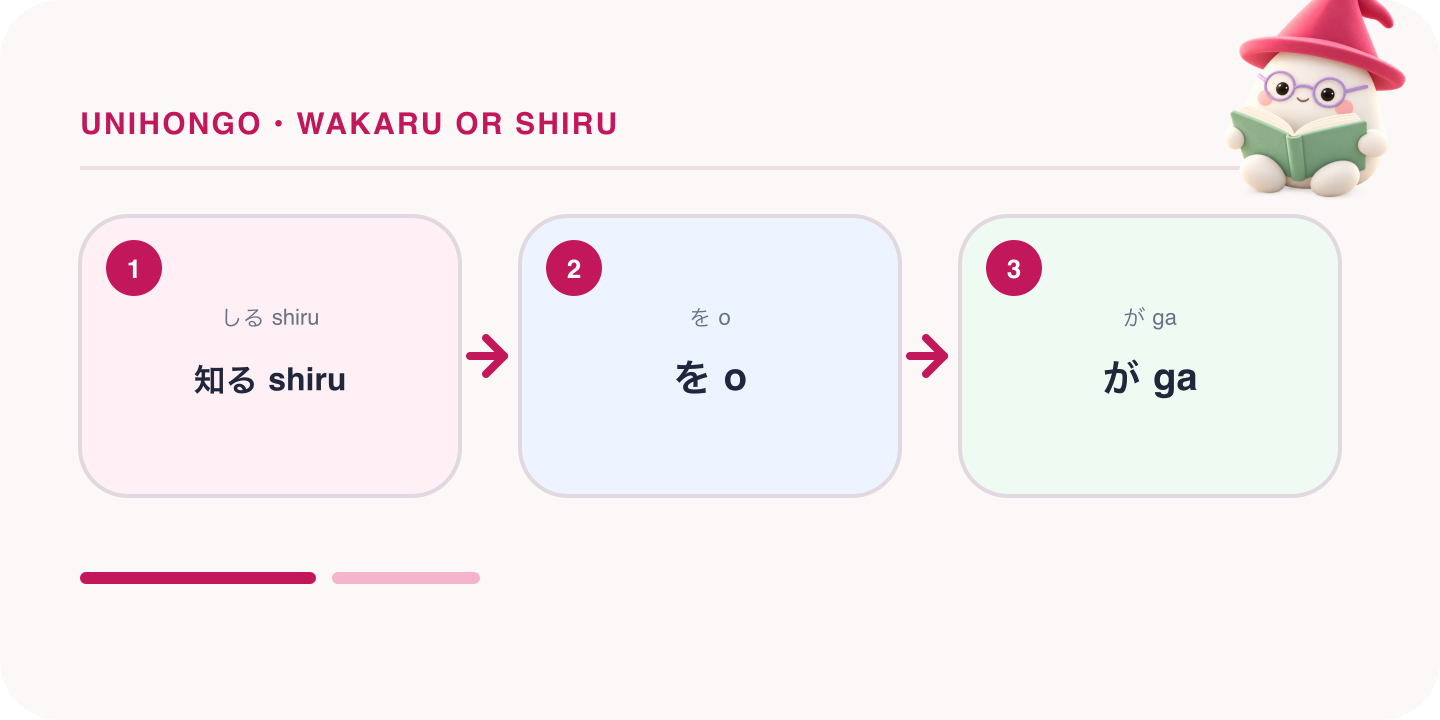
| 知る shiru | Acquire or hold a piece of information | を o | A name, an address, a fact, a person |
| 分かる wakaru | Something becomes clear or works out | が ga | A meaning, a reason, a way, a feeling |
| 知っています shitte imasu | I have that information now | を o | The normal affirmative answer |
| 分かります wakarimasu | That is clear to me | が ga | Language, explanations, situations |
Why the affirmative is almost always shitte imasu
Shiru describes a change: not knowing, then knowing. Japanese uses the te-iru form to express the state that follows such a change, exactly as with kekkon shite imasu for being married. So the answer to do you know is shitte imasu, literally I have come to know and remain in that condition. Shirimasu on its own points forward to the moment of finding out, which is why it sounds odd as a plain answer and normal in a sentence like ashita kekka o shirimasu.
Keep the particle straight while you are at it. Shiru takes o for the thing known, so it is denwa bangō o shitte imasu, never bangō ga shitte imasu. Learners who have just studied wakaru often carry ga across and produce a sentence that sounds broken to a native ear.
| Japanese | Romaji | Meaning |
|---|---|---|
| その店を知っています。 | Sono mise o shitte imasu. | I know that shop. |
| 田中さんの電話番号を知っていますか? | Tanaka-san no denwa bangō o shitte imasu ka? | Do you know Tanaka's phone number? |
| はい、知っています。 | Hai, shitte imasu. | Yes, I do. |
| いいえ、知りません。 | Iie, shirimasen. | No, I don't. |
| ニュースで知りました。 | Nyūsu de shirimashita. | I found out from the news. |
| その話は知りませんでした。 | Sono hanashi wa shirimasen deshita. | I hadn't heard about that. |
| 彼のことは名前だけ知っています。 | Kare no koto wa namae dake shitte imasu. | I only know his name. |
Wakaru takes ga, not o
Wakaru works like a verb of happening rather than a verb of doing. The thing that becomes clear is treated as the subject and marked with ga, so you say nihongo ga wakarimasu, the Japanese language is clear to me. Speakers do sometimes say nihongo wa wakarimasu with wa when they are contrasting or softening, and casual speech occasionally slips in o, but ga is the form to build your habits on.
Unlike shiru, wakaru accepts wakatte imasu and wakatte imasen quite happily. Gen'in wa mada wakatte imasen means the cause has still not been established, and it is the ordinary way to report an unfinished investigation. If you learn one asymmetry today, learn this one: shitte imasen is wrong, wakatte imasen is fine.
| Japanese | Romaji | Meaning |
|---|---|---|
| 日本語が分かります。 | Nihongo ga wakarimasu. | I understand Japanese. |
| 意味が分かりません。 | Imi ga wakarimasen. | I don't understand the meaning. |
| この漢字の読み方が分かりません。 | Kono kanji no yomikata ga wakarimasen. | I can't work out how to read this kanji. |
| 説明を聞いて、やっと分かりました。 | Setsumei o kiite, yatto wakarimashita. | After the explanation, it finally made sense. |
| 原因はまだ分かっていません。 | Gen'in wa mada wakatte imasen. | The cause still hasn't been established. |
| 少しずつ分かるようになりました。 | Sukoshi zutsu wakaru yō ni narimashita. | It has gradually started to make sense. |
The negative that decides your impression
This is the part worth memorising socially. Shirimasen is grammatically neutral, but because it says I do not hold that information, it can be heard as I have no involvement with this, which in a shop, an office, or a conversation with a stranger reads as brushing the person off. Wakarimasen says only that you cannot work something out, so it carries no distance.
The safe habit is to soften whichever one you need. Add sumimasen in front, add chotto to blur the edge, and add a next step so the person is not left with nothing. Even a blunt fact becomes courteous when it ends with kakunin shimasu, I will check. In business Japanese, wakarikanemasu is the polished way to say the answer is beyond you, and it never sounds cold.
| Japanese | Romaji | Meaning |
|---|---|---|
| すみません、分かりません。 | Sumimasen, wakarimasen. | Sorry, I don't understand. |
| すみません、ちょっと分からないですね。 | Sumimasen, chotto wakaranai desu ne. | Sorry, I'm not quite sure. |
| すみません、私には分かりかねます。 | Sumimasen, watashi ni wa wakarikanemasu. | I'm afraid I am not able to say. |
| 申し訳ありません、確認いたします。 | Mōshiwake arimasen, kakunin itashimasu. | I'm very sorry, I will check for you. |
| すみません、それは知らないんです。 | Sumimasen, sore wa shiranai n desu. | Sorry, I actually don't know that one. |
| 存じません。 | Zonjimasen. | I do not know. (humble) |
| ご存じですか? | Go-zonji desu ka? | Do you happen to know? (honorific) |
Note the last two rows. Zonjiru is the humble verb behind shiru, used about yourself, and go-zonji desu is the honorific version used about the listener. In a hotel, a bank, or a client meeting you will hear go-zonji desu ka far more often than shitte imasu ka, and answering zonjimasen sounds far more careful than a bare shirimasen.
Not catching it versus not having the information
Learners reach for wakarimasen when the real problem is audio. If you heard the sentence but the sounds did not resolve, the accurate verb is kikitoreru, to be able to catch what was said, and its negative kikitoremasen deshita. This matters because wakarimasen invites the other person to explain the idea again, while kikitoremasen deshita invites them to repeat it more slowly, which is what you actually want.
| Japanese | Romaji | Meaning |
|---|---|---|
| すみません、ちょっと聞き取れませんでした。 | Sumimasen, chotto kikitoremasen deshita. | Sorry, I didn't catch that. |
| もう一度お願いします。 | Mō ichido onegai shimasu. | Once more, please. |
| もう少しゆっくり話していただけますか? | Mō sukoshi yukkuri hanashite itadakemasu ka? | Could you speak a little more slowly? |
| 最後の言葉が分かりませんでした。 | Saigo no kotoba ga wakarimasen deshita. | I didn't understand the last word. |
| それはどういう意味ですか? | Sore wa dōiu imi desu ka? | What does that mean? |
Which verb in which situation
| Situation | Say this | Why |
|---|---|---|
| Asked for a phone number you have | 知っています Shitte imasu | You hold the information |
| Asked for a phone number you lack | すみません、分からないです Sumimasen, wakaranai desu | Softer than a bare shirimasen |
| Asked whether you speak Japanese | 少し分かります Sukoshi wakarimasu | Comprehension, not information |
| A word you have never met | この言葉は知りません Kono kotoba wa shirimasen | You have not learned it |
| A word you know but cannot parse here | 意味が分かりません Imi ga wakarimasen | You have it but it will not resolve |
| Given an instruction at work | 承知しました Shōchi shimashita | Accepts and promises action |
| A customer asks something off your desk | 確認いたします Kakunin itashimasu | Never leave them with only a negative |
| A friend describes a bad day | 気持ち、分かるよ Kimochi, wakaru yo | Empathy always takes wakaru |
Reading down that table, one pattern repeats: shiru answers do you have it, and wakaru answers can you follow it. When you genuinely do not have the information and the setting is formal, replace the negative with a next step. Japanese service language almost never ends on shirimasen, because the sentence after it is what shows care.
Wakarimashita, and the politer ways to accept
Wakarimashita is past tense in form but present in effect: it reports that the thing has just become clear. After an explanation it means that is clear now, thank you. After an instruction it means I accept and I will act, which is why you should not use it as a filler while you are still confused. If you say wakarimashita to your manager, you have agreed to do the task.
If you are only halfway there, say so rather than nodding along. Nantonaku wakarimashita signals rough understanding without pretending to more, and mō ichido oshiete itadakemasu ka asks for another pass in a way no reasonable colleague minds. Both are received far better than an agreement you cannot honour, because the cost of a task done wrong is always higher than the cost of one more question.
Register matters too. Wakarimashita is polite enough among colleagues, but toward a customer or a client it is slightly plain, since it describes your own comprehension rather than your acceptance of their request. Service Japanese prefers kashikomarimashita, which is what staff say when taking an order, while business Japanese prefers shōchi shimashita, or the humbler shōchi itashimashita in email and toward senior people. Ryōkai desu sits one step down, among peers and in internal chat, and can read as flippant if you send it upward.
| Japanese | Romaji | Meaning |
|---|---|---|
| 分かりました。 | Wakarimashita. | Understood. |
| はい、分かりました。すぐやります。 | Hai, wakarimashita. Sugu yarimasu. | Understood. I'll do it right away. |
| よく分かりました。ありがとうございます。 | Yoku wakarimashita. Arigatō gozaimasu. | That's very clear now. Thank you. |
| なんとなく分かりました。 | Nantonaku wakarimashita. | I roughly follow. |
| すみません、もう一度教えていただけますか? | Sumimasen, mō ichido oshiete itadakemasu ka? | Sorry, could you explain it once more? |
| かしこまりました。 | Kashikomarimashita. | Certainly. (service staff) |
| 承知しました。 | Shōchi shimashita. | Understood. (business) |
| 承知いたしました。すぐに手配いたします。 | Shōchi itashimashita. Sugu ni tehai itashimasu. | Understood. I will arrange it immediately. |
| 了解です。 | Ryōkai desu. | Got it. (among colleagues) |
| かしこまりました。少々お待ちください。 | Kashikomarimashita. Shōshō omachi kudasai. | Certainly. One moment, please. |
Order them in your head from most deferential to least: shōchi itashimashita, kashikomarimashita, shōchi shimashita, wakarimashita, ryōkai desu. If you work in a Japanese company, make shōchi shimashita your default reply to instructions and keep wakarimashita for explanations you have just followed.
Casual wakatta and the impatient wakatta yo
The plain form wakatta is the everyday reply between friends and family, and it is warm enough on its own. Adding yo changes it. Wakatta yo insists that you have already got the point, so it reads as fine, I heard you, and wakatteru yo, from wakatte iru, is stronger still and sounds like stop nagging me. Neither is rude between close friends, but neither belongs in a workplace.
The other casual form worth recognising is wakannai, a relaxed contraction of wakaranai. You will hear it constantly in speech. Say it with friends, keep it out of an interview, and note that shiranai in the same register carries the same coldness as shirimasen, only more so. The full contrast between plain and polite registers is covered in the polite-versus-casual guide.
| Japanese | Romaji | Meaning |
|---|---|---|
| 分かった。 | Wakatta. | Got it. |
| 分かったよ。 | Wakatta yo. | All right, I heard you. |
| 分かってるよ。 | Wakatteru yo. | I know already. |
| 分かんない。 | Wakannai. | No idea. |
| 知ってる? | Shitteru? | Do you know? |
| うん、知ってる。 | Un, shitteru. | Yeah, I know it. |
| ううん、知らない。 | Uun, shiranai. | Nope, never heard of it. |
Wakaru about people and feelings
Wakaru extends naturally to people, moods, and situations, which shiru cannot do. Kimochi ga wakarimasu is the standard way to say I know how you feel, and it is one of the most useful sympathetic lines in the language. Kare no koto ga wakarimasen means he is hard for me to read, whereas kare no koto o shirimasen simply means I have not met him or know nothing about him.
Keep the empathy version modest. Yoku wakarimasu is warm, but claiming full understanding of a difficult experience can sound presumptuous, so many speakers soften it to nantonaku wakarimasu or o-kimochi wa wakarimasu. When a colleague is venting, the aizuchi-style short reply wakarimasu, together with a nod, does more work than a long sentence.
| Japanese | Romaji | Meaning |
|---|---|---|
| お気持ち、よく分かります。 | O-kimochi, yoku wakarimasu. | I understand how you feel. |
| 気持ち、分かるよ。 | Kimochi, wakaru yo. | I know how you feel. (casual) |
| 言いたいことは分かります。 | Iitai koto wa wakarimasu. | I see what you're trying to say. |
| 彼のことがよく分かりません。 | Kare no koto ga yoku wakarimasen. | I can't quite read him. |
| 彼のことをよく知りません。 | Kare no koto o yoku shirimasen. | I don't know much about him. |
| 日本の習慣がまだ分かりません。 | Nihon no shūkan ga mada wakarimasen. | Japanese customs still don't quite make sense to me. |
Minimal pairs where the choice changes the impression
| Japanese | Romaji | Meaning |
|---|---|---|
| 道が分かりません。 | Michi ga wakarimasen. | I can't work out the way. (lost, asking for help) |
| 道を知りません。 | Michi o shirimasen. | I don't know the road. (flat, unhelpful) |
| 名前が分かりません。 | Namae ga wakarimasen. | I can't make out the name. (on a form or sign) |
| 名前を知りません。 | Namae o shirimasen. | I don't know their name. |
| そのニュースは知っています。 | Sono nyūsu wa shitte imasu. | I have seen that news. |
| そのニュースの意味が分かりません。 | Sono nyūsu no imi ga wakarimasen. | I don't understand what that news means. |
| 値段が分かりません。 | Nedan ga wakarimasen. | I can't tell what the price is. |
| 値段を知りません。 | Nedan o shirimasen. | I don't know the price. (I was never told) |
| 理由が分かりません。 | Riyū ga wakarimasen. | I can't work out why. |
| 理由は知りません。 | Riyū wa shirimasen. | I wasn't told the reason. (can sound curt) |
Read each pair aloud back to back and listen to yourself. The wakaru line invites help, because you are describing your own struggle. The shiru line closes the topic, because you are describing an absence of data. Both are correct Japanese, and in a friendly conversation nobody will take offence, but in customer-facing work the difference is the difference between sounding willing and sounding uninterested.
Fixing the four common mistakes
- Saying shitte imasen for I do not know. Use shirimasen; only wakaru allows wakatte imasen.
- Saying nihongo o wakarimasu. The thing understood takes ga, so it is nihongo ga wakarimasu.
- Answering a stranger's question with a bare shirimasen. Add sumimasen in front and a next step behind, or switch to wakaranai desu.
- Using wakarimashita as a filler while still lost. It commits you to the instruction, so say nantonaku wakarimashita or ask for one more explanation instead.