
What the quotation particle actually does
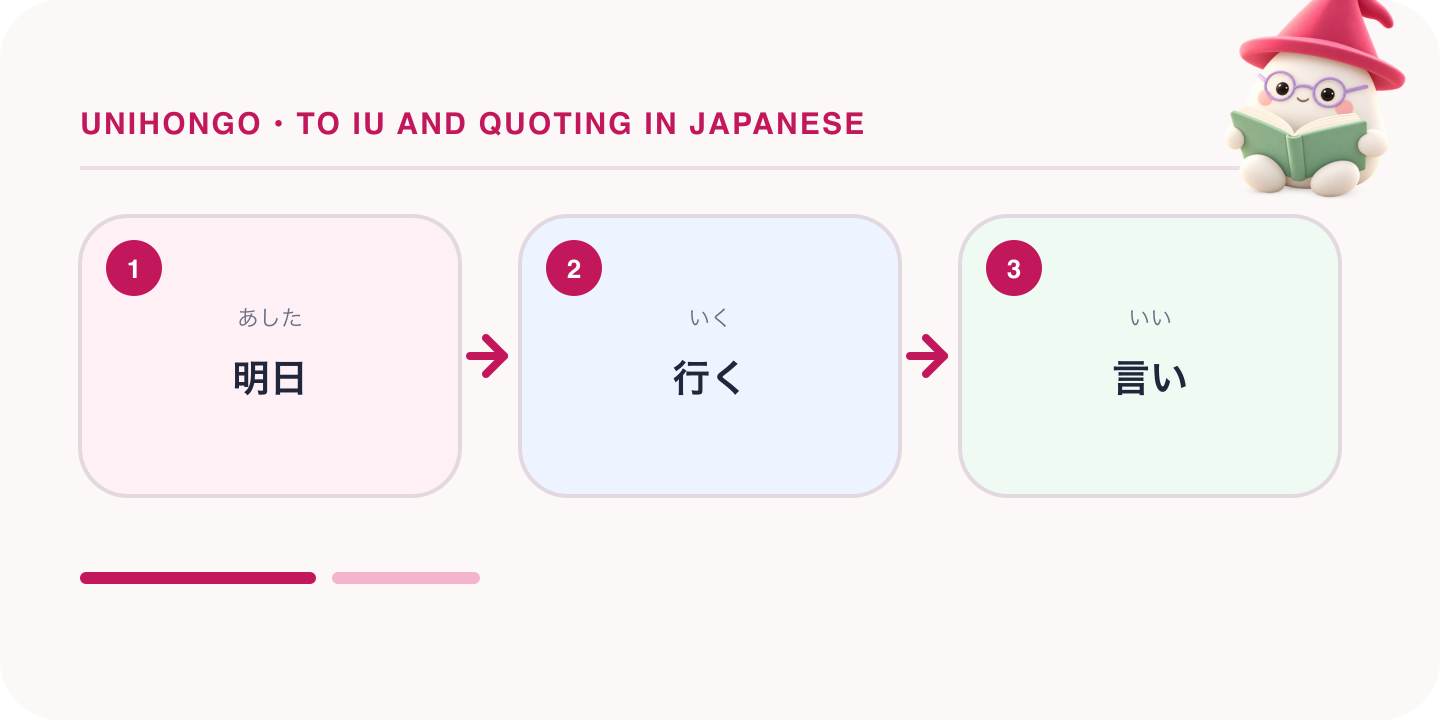
To is a bracket closer. It marks the end of a stretch of content and hands that content to the verb that follows. Ashita iku to iimashita has three parts: ashita iku is the content, to closes it, and iimashita says what happened to it. Once you see the shape, the same frame accepts a long list of verbs, not only say, because thinking, hearing, writing, deciding, and asking all take content in exactly the same way.
This is why the particles guide lists to under quotation as well as under joining nouns. The two uses look alike on the page but never compete in practice, because a quotation is a whole clause and a companion is a single noun. If a clause with a verb sits in front of to, you are looking at a quotation.
| Japanese | Romaji | Meaning |
|---|---|---|
| 明日行くと言いました。 | Ashita iku to iimashita. | He said he would go tomorrow. |
| 面白いと思います。 | Omoshiroi to omoimasu. | I think it is interesting. |
| 雨が降ると聞きました。 | Ame ga furu to kikimashita. | I heard that it will rain. |
| 行かないと決めました。 | Ikanai to kimemashita. | I decided not to go. |
| ここに来ると書いてあります。 | Koko ni kuru to kaite arimasu. | It says here that they will come. |
The plain form rule before to
Whatever politeness you are using in the sentence as a whole, the clause inside the quotation goes into plain form. You can say ikimasu at the end and iku before to in the same breath, and that is correct rather than inconsistent. The politeness of a Japanese sentence is decided by its final predicate, so the inside of a quotation stays neutral.
Nouns and na-adjectives need da before to, which learners drop constantly. Gakusei to omoimasu is wrong; gakusei da to omoimasu is right, and so is benri da to omoimasu. I-adjectives and verbs attach directly, so takai to omoimasu and iku to omoimasu need nothing extra. The negative and past live inside too, giving konai to and omoshirokatta to.
| Japanese | Romaji | Meaning |
|---|---|---|
| 彼は来ないと言いました。 | Kare wa konai to iimashita. | He said he would not come. |
| 面白かったと言っていました。 | Omoshirokatta to itte imashita. | She said it was interesting. |
| 田中さんは学生だと思います。 | Tanaka-san wa gakusei da to omoimasu. | I think Tanaka is a student. |
| この駅は便利だと思います。 | Kono eki wa benri da to omoimasu. | I think this station is convenient. |
| 大丈夫だと言っていました。 | Daijōbu da to itte imashita. | He said it was fine. |
| 少し高いと思います。 | Sukoshi takai to omoimasu. | I think it is a little expensive. |
Direct quotation with kagi-kakko
A direct quotation keeps the speaker's exact words, including their politeness, and is written between the corner brackets 「 and 」, called kagi-kakko. Because the words are preserved, masu and desu can appear right before to, which is the one place they legitimately do. In speech there are no brackets, so you signal the quotation by pausing slightly before to and often by shifting your tone for the quoted line.
Direct quotation is common when the exact wording matters: an instruction from a manager, a warning on a sign, or something said in a memorable way. For ordinary reporting it can sound theatrical, so most everyday conversation uses the indirect form instead.
| Japanese | Romaji | Meaning |
|---|---|---|
| 田中さんは「今から行きます」と言いました。 | Tanaka-san wa "Ima kara ikimasu" to iimashita. | Tanaka said, "I am leaving now." |
| 部長は「明日までにお願いします」とおっしゃいました。 | Buchō wa "Ashita made ni onegai shimasu" to osshaimashita. | The manager said, "Please have it by tomorrow." |
| 母は「気をつけてね」と言いました。 | Haha wa "Ki o tsukete ne" to iimashita. | My mother said, "Take care." |
| 店員さんは「売り切れです」と言いました。 | Ten'in-san wa "Urikire desu" to iimashita. | The shop assistant said, "It is sold out." |
The same sentence direct and reported
| Direct quotation | Reported version | English |
|---|---|---|
| 「明日行きます」と言いました。 | 明日行くと言いました。 | He said he will go tomorrow. |
| 「疲れた」と言いました。 | 疲れたと言っていました。 | She said she was tired. |
| 「これは高いです」と言いました。 | これは高いと言っていました。 | He said this one is expensive. |
| 「田中です」と言いました。 | 田中だと言いました。 | She said she was Tanaka. |
| 「行きたくない」と言いました。 | 行きたくないと言っていました。 | She said she did not want to go. |
| 「ここは静かです」と言いました。 | ここは静かだと言っていました。 | He said it is quiet here. |
| 「元気ですか」と聞きました。 | 元気かどうか聞きました。 | He asked whether I was well. |
Notice what does not happen. English pushes a quoted present into the past, so he says I will go becomes he said he would go. Japanese leaves the quoted clause exactly as the speaker framed it, so iku stays iku even when the reporting verb is iimashita. Learners who back-shift produce itta to iimashita and accidentally report a past event instead of a future plan.
The other thing to notice is the desu and masu disappearing on the right. Politeness is stripped from the content and carried only by the final verb, which is why the reported column reads plainer even though the sentences are equally polite.
To iimashita against to itte imashita
Both are correct, and Japanese speakers pick between them constantly. To iimashita reports the act of speaking as an event: it happened, at a moment, and often you were there. It is the natural choice when you quote yourself, when the fact of having said something is the point, or when you are confirming what was stated in a meeting.
To itte imashita frames the words as something you received and are now passing on. It puts a small distance between you and the claim, which is exactly what you want when relaying a third person's message: you are not vouching for it, only reporting it. For that reason it is usually the more natural and more polite option in an office, and using to iimashita for a colleague's message can sound oddly blunt, as though you are pinning them to it.
| Japanese | Romaji | Meaning |
|---|---|---|
| 田中さんは今日休むと言っていました。 | Tanaka-san wa kyō yasumu to itte imashita. | Tanaka said he is off today. |
| 先生が明日テストがあると言っていました。 | Sensei ga ashita tesuto ga aru to itte imashita. | The teacher said there is a test tomorrow. |
| さっきそう言いましたよね。 | Sakki sō iimashita yo ne. | You did say that a moment ago, did you not? |
| 私は行くと言いました。 | Watashi wa iku to iimashita. | I said I would go. |
| 会議は三時からだと言っていました。 | Kaigi wa san-ji kara da to itte imashita. | They said the meeting starts at three. |
To omoimasu and to omotte imasu
To omoimasu expresses your opinion as you form it, and it is the standard way to soften any statement in Japanese. Ii desu is a verdict; ii to omoimasu is an opinion offered for consideration, and in meetings the second is far more common. The negative goes on omou, not on the content, so you say sō omoimasen rather than sō ja nai to omoimasu when you simply disagree.
To omotte imasu describes a thought being held rather than formed. That is why it is required for other people: you cannot report someone else's mind as a fresh act of thinking, so kare wa ryūgaku shitai to omotte imasu is correct and to omoimasu is not. It also works for your own settled intentions, especially with the volitional, as in ikō to omotte imasu, which sounds more considered than ikō to omoimasu.
| Japanese | Romaji | Meaning |
|---|---|---|
| いいと思います。 | Ii to omoimasu. | I think that is good. |
| 私はそう思いません。 | Watashi wa sō omoimasen. | I do not think so. |
| 来年、日本に行こうと思っています。 | Rainen, Nihon ni ikō to omotte imasu. | I am thinking of going to Japan next year. |
| 彼は留学したいと思っています。 | Kare wa ryūgaku shitai to omotte imasu. | He wants to study abroad. |
| 難しいと思いますが、やってみます。 | Muzukashii to omoimasu ga, yatte mimasu. | I think it will be hard, but I will try. |
Tte, the casual quotation marker
In everyday speech to shrinks to tte, and it does two jobs at once. It replaces the quotation particle, so iku tte itteta means they said they were going, and it also replaces to iu entirely, so ashita ame da tte means apparently it will rain tomorrow with no verb of saying at all. That second use is how most casual hearsay is delivered.
Tte attaches straight to plain forms, and after a noun you will hear both ame datte and the bare ame tte depending on speed and speaker. Keep it out of writing and out of formal speech; the polite equivalent is simply to plus a reporting verb.
| Japanese | Romaji | Meaning |
|---|---|---|
| 明日は雨だって。 | Ashita wa ame datte. | Apparently it will rain tomorrow. (casual) |
| 田中さん、来ないって。 | Tanaka-san, konai tte. | Tanaka says he is not coming. (casual) |
| 行くって言ってた。 | Iku tte itteta. | He said he was going. (casual) |
| それ、高いって聞いたよ。 | Sore, takai tte kiita yo. | I heard that one is expensive. (casual) |
To iu as a naming device
To iu also introduces a name or a label, and this use appears far more often than the quotation use in daily life. X to iu Y means a Y called X, so Sakura to iu mise is a shop called Sakura. Use it whenever you mention something the listener probably does not know yet, because dropping it and saying only Sakura no mise sounds as though you assume they already know the place.
The same frame gives you the single most useful question in a learner's toolkit. Kore wa nihongo de nan to iimasu ka asks what something is called in Japanese, and the answer arrives in the same shape. Notice that nan to iimasu ka is the polite version and nan te iimasu ka the relaxed one.
| Japanese | Romaji | Meaning |
|---|---|---|
| 「さくら」という店に行きました。 | "Sakura" to iu mise ni ikimashita. | I went to a shop called Sakura. |
| これは日本語で何と言いますか。 | Kore wa nihongo de nan to iimasu ka. | What is this called in Japanese? |
| ジョンという名前です。 | Jon to iu namae desu. | My name is John. |
| 「もったいない」という言葉が好きです。 | "Mottainai" to iu kotoba ga suki desu. | I like the word mottainai. |
| 山田さんという方から電話がありました。 | Yamada-san to iu kata kara denwa ga arimashita. | There was a call from someone called Yamada. |
Tte iu ka, and asking what someone said
To iu ka literally asks how to put it, and in practice it introduces a better version of what you have just said. Japanese speakers use it constantly as a repair tool, either to soften a claim, to reframe the topic, or to admit that the first wording was off. In casual speech it becomes tte iu ka or simply tte ka, and the polite spoken form is to iimasu ka. For a learner it is genuinely useful, because it gives you a legitimate way to restart a tangled sentence without falling silent or apologising.
The same frame also supplies the repair question for the other direction. Nan to iimashita ka asks what was said, and it is more precise than a bare sumimasen because it tells the speaker to repeat words rather than to explain. Toward a superior the honorific appears, so nan to osshaimashita ka asks a manager. Pair it with mō ichido onegai shimasu for a repeat, or yukkuri onegai shimasu for a slower one.
| Japanese | Romaji | Meaning |
|---|---|---|
| というか、私のミスです。 | To iu ka, watashi no misu desu. | Or rather, it was my mistake. |
| っていうか、今日は時間がないんです。 | Tte iu ka, kyō wa jikan ga nai n desu. | Actually, I have no time today. (casual) |
| 嫌いと言いますか、少し苦手です。 | Kirai to iimasu ka, sukoshi nigate desu. | It is not that I dislike it; I am just not very good with it. |
| 何と言えばいいでしょうか。 | Nan to ieba ii deshō ka. | How should I put this? |
| 今、何と言いましたか。 | Ima, nan to iimashita ka. | What did you just say? |
| 部長は何とおっしゃいましたか。 | Buchō wa nan to osshaimashita ka. | What did the manager say? |
| すみません、もう一度お願いします。 | Sumimasen, mō ichido onegai shimasu. | Sorry, once more please. |
| もう少しゆっくりお願いします。 | Mō sukoshi yukkuri onegai shimasu. | A little more slowly, please. |
| 何て言った? | Nan te itta? | What did you say? (casual) |
Reporting a question with ka dō ka
A quoted statement takes to, but a quoted question takes ka instead. For a yes or no question the pattern is ka dō ka, meaning whether or not: kuru ka dō ka wakarimasen says I do not know whether they are coming. For a question that already contains a question word, the ka alone is enough, so doko de katta ka oshiete kudasai asks where it was bought.
One detail saves a lot of errors. The da you add before to disappears before ka, so hitsuyō da to omoimasu is right but the reported question is hitsuyō ka dō ka, never hitsuyō da ka dō ka. Verbs and i-adjectives behave normally in both. The question-word patterns themselves are covered in the question words guide; here they simply slot in front of ka.
| Japanese | Romaji | Meaning |
|---|---|---|
| 来るかどうか分かりません。 | Kuru ka dō ka wakarimasen. | I do not know whether they are coming. |
| 行けるかどうか、明日連絡します。 | Ikeru ka dō ka, ashita renraku shimasu. | I will let you know tomorrow whether I can go. |
| 予約が必要かどうか聞いてみます。 | Yoyaku ga hitsuyō ka dō ka kiite mimasu. | I will ask whether a booking is needed. |
| どこで買ったか教えてください。 | Doko de katta ka oshiete kudasai. | Please tell me where you bought it. |
| 何時に始まるか知っていますか。 | Nan-ji ni hajimaru ka shitte imasu ka. | Do you know what time it starts? |
| 誰が来るか聞いていません。 | Dare ga kuru ka kiite imasen. | I have not heard who is coming. |
A five-minute quoting drill
- Take any three sentences you said today and convert each into iku to iimashita form, checking that the inside is plain.
- Convert the same three into to itte imashita and say which version fits passing on a message.
- Add da to any that end in a noun or na-adjective, and say the whole sentence again without pausing.
- Turn one of them into a question and report it twice, once with ka dō ka and once with a question word plus ka.
- Finish by saying each line casually with tte, so you can hear the register change in your own voice.