
Reasons come before results in Japanese
English lets you lead with the conclusion and add the reason afterwards: I will be late, because the train stopped. Japanese normally runs the other way. The reason clause comes first, the connector sits at its end, and the result closes the sentence. Densha ga tomatta node, okuremasu. If you translate your English order directly you will produce a result, a pause, and then a reason bolted on, which sounds like an afterthought or an excuse invented on the spot.
That ordering matters most when you want something. A Japanese listener expects to hear the circumstance first so that the request arrives already justified. Saying the request first and defending it afterwards puts the other person in the position of having to judge you. Get into the habit of building every reason sentence as circumstance, connector, request, and you will sound organised even when your vocabulary is small.
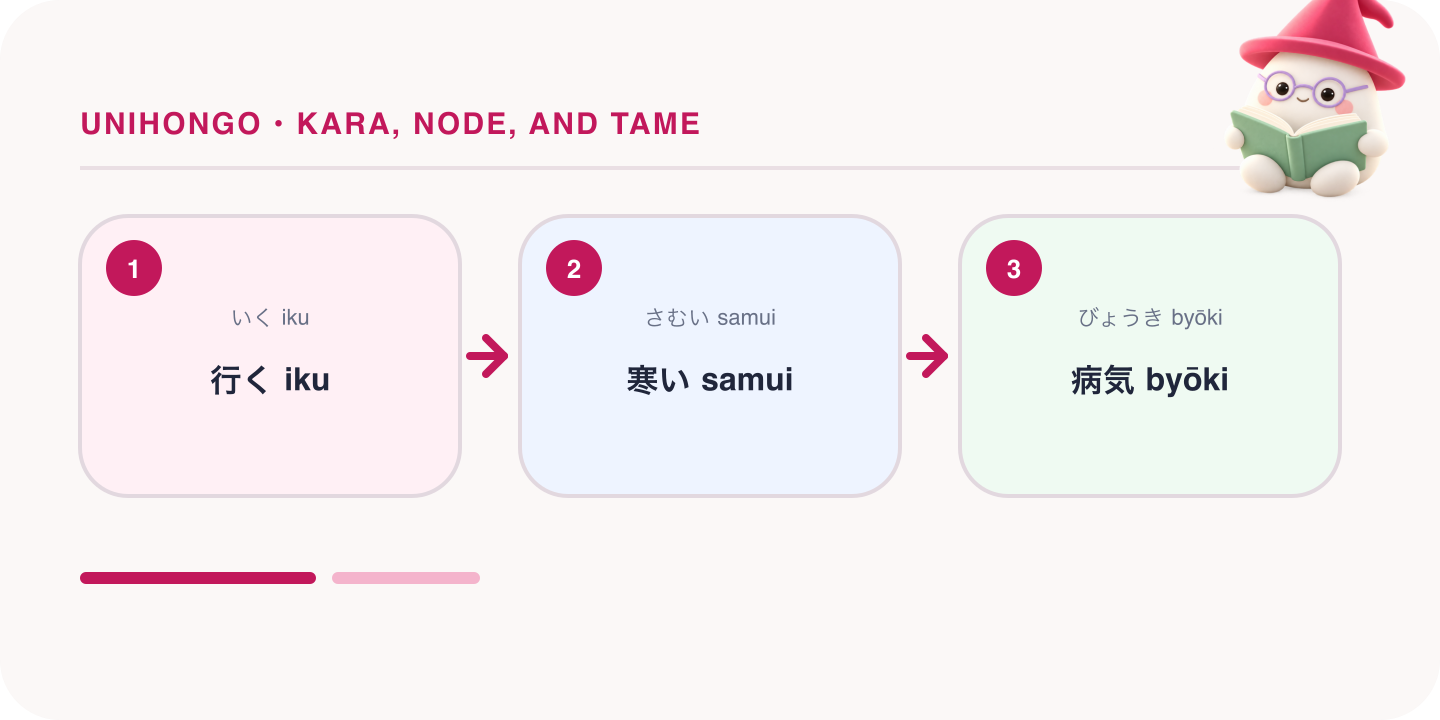
How each connector attaches
| Word type | Base form | With kara | With node | With tame |
|---|---|---|---|---|
| Verb, plain | 行く iku | 行くから iku kara | 行くので iku node | 行くため iku tame |
| Verb, polite | 行きます ikimasu | 行きますから ikimasu kara | 行きますので ikimasu node | Not used in polite form |
| Verb, past | 遅れた okureta | 遅れたから okureta kara | 遅れたので okureta node | 遅れたため okureta tame |
| Verb, negative | 分からない wakaranai | 分からないから wakaranai kara | 分からないので wakaranai node | 分からないため wakaranai tame |
| I-adjective | 寒い samui | 寒いから samui kara | 寒いので samui node | 寒いため samui tame |
| Na-adjective | 静か shizuka | 静かだから shizuka da kara | 静かなので shizuka na node | 静かなため shizuka na tame |
| Noun, plain | 病気 byōki | 病気だから byōki da kara | 病気なので byōki na node | 病気のため byōki no tame |
| Noun, polite | 病気です byōki desu | 病気ですから byōki desu kara | 病気ですので byōki desu node | Use no tame instead |
Three joins carry almost all the mistakes. A na-adjective needs na before node and before tame, so shizuka na node and shizuka na tame are correct while shizuka da node is not. A noun needs na before node but no before tame, which is why byōki na node and byōki no tame sit in the same row without matching. And kara is the only one of the three that attaches comfortably to a full polite predicate, giving ikimasu kara and desu kara.
Kara: the reason you are willing to own
Kara marks a reason you personally stand behind. It works with judgements, preferences, and decisions, and it is the connector children learn first. In casual speech it is everywhere. In polite speech it is still correct, but because it presents the reason as your own position it can sound slightly firm when you are explaining yourself to a customer or a superior.
Note that this is the same kara that means from after a noun, as in ku-ji kara hatarakimasu. There is no ambiguity in practice: after a noun it means from, and after a verb or an adjective it means because. The particles guide on this blog covers the from use in more detail.
| Japanese | Romaji | Meaning |
|---|---|---|
| 今日は忙しいから、明日にします。 | Kyō wa isogashii kara, ashita ni shimasu. | I am busy today, so let us make it tomorrow. |
| 安いから、これにします。 | Yasui kara, kore ni shimasu. | It is cheap, so I will take this one. |
| 好きだから、毎日聞いています。 | Suki da kara, mainichi kiite imasu. | I like it, so I listen to it every day. |
| 明日は休みですから、ゆっくりできます。 | Ashita wa yasumi desu kara, yukkuri dekimasu. | Tomorrow is a day off, so I can take it easy. |
| 九時から働きます。 | Ku-ji kara hatarakimasu. | I work from nine. (kara meaning from) |
| どうして休んだんですか。 | Dōshite yasunda n desu ka? | Why did you take the day off? (what you hear) |
| 熱があったからです。 | Netsu ga atta kara desu. | Because I had a fever. |
The last pair shows the short answer pattern. When someone asks dōshite, you may answer with the reason plus kara desu and stop there. Kara desu is a complete polite answer, so netsu ga atta kara desu needs nothing after it. Learners often try to repeat the whole result clause and lose the sentence halfway.
Ending a sentence on kara
Kara can close a sentence with the result left unsaid. This is not laziness; it is a softening device. Saki ni itte kudasai, ato de ikimasu kara means go on ahead, since I will follow, and the unspoken part is roughly so do not worry about me. The listener completes it. Because the conclusion is never stated, nothing is forced on them.
| Japanese | Romaji | Meaning |
|---|---|---|
| 先に行ってください。あとで行きますから。 | Saki ni itte kudasai. Ato de ikimasu kara. | Please go ahead. I will come along later. |
| 大丈夫です。私がやりますから。 | Daijōbu desu. Watashi ga yarimasu kara. | It is fine. I will take care of it. |
| もう少し待ってね。すぐ終わるから。 | Mō sukoshi matte ne. Sugu owaru kara. | Wait a little longer. It will be done soon. (casual) |
| 心配しないでください。私がいますから。 | Shinpai shinaide kudasai. Watashi ga imasu kara. | Please do not worry. I am here. |
Said with a falling, gentle tone this is warm and reassuring. Said sharply, the same trailing kara turns into a rebuke, because the unspoken conclusion becomes so stop asking. Tone is doing the work, which is why this is a pattern to practise aloud rather than read.
Node: the safer connector at work
Node presents the reason as a circumstance rather than as your opinion. That small shift is why it dominates service language, workplace apologies, and requests. Compare samui kara mado o shimete mo ii desu ka with samui node mado o shimete mo ii desu ka: both are grammatical, but the node version sounds as though the cold is a shared fact rather than your personal complaint.
Node also joins to a polite predicate as desu node or masu node, which is what announcements use. Honjitsu wa manseki desu node is standard shop and restaurant language. In casual speech node contracts to n de, so samui n de, kaerō is normal among friends and should be recognised even if you do not use it yet.
| Japanese | Romaji | Meaning |
|---|---|---|
| 電車が遅れているので、少し遅れます。 | Densha ga okurete iru node, sukoshi okuremasu. | The train is delayed, so I will be a little late. |
| 少し寒いので、窓を閉めてもいいですか。 | Sukoshi samui node, mado o shimete mo ii desu ka? | It is a little cold, so may I close the window? |
| 本日は満席ですので、少々お待ちください。 | Honjitsu wa manseki desu node, shōshō omachi kudasai. | We are fully booked today, so please wait a moment. (staff line) |
| 体調が悪いので、早退してもよろしいでしょうか。 | Taichō ga warui node, sōtai shite mo yoroshii deshō ka? | I am unwell, so would it be all right to leave early? |
| 静かなので、集中できます。 | Shizuka na node, shūchū dekimasu. | It is quiet, so I can concentrate. |
| 初めてなので、教えていただけますか。 | Hajimete na node, oshiete itadakemasu ka? | It is my first time, so could you show me how? |
| 日本語がまだ下手なので、ゆっくり話していただけますか。 | Nihongo ga mada heta na node, yukkuri hanashite itadakemasu ka? | My Japanese is still poor, so could you speak slowly? |
Tame and tame ni: the written reason
Tame belongs to notices, station announcements, and formal reports. Jiko no tame, densha ga okurete orimasu is exactly what you hear on a platform, and kōji no tame, honjitsu wa kyūgyō itashimasu is what the sign on a closed shop says. Spoken between friends it sounds absurdly stiff, so treat it as a register you read and hear rather than one you produce in daily chat.
Tame has a second job that learners confuse with the first. After a dictionary-form verb or a noun plus no, tame ni usually means in order to or for the sake of, which is purpose rather than cause. Nihongo o benkyō suru tame ni Nihon e kimashita is purpose. Ōyuki no tame densha ga tomarimashita is cause. The clue is whether the result is something someone chose or something that simply happened.
| Japanese | Romaji | Meaning |
|---|---|---|
| 大雪のため、電車が止まりました。 | Ōyuki no tame, densha ga tomarimashita. | Because of heavy snow, the trains stopped. (cause) |
| 事故のため、電車が遅れております。 | Jiko no tame, densha ga okurete orimasu. | Due to an accident, the trains are delayed. (announcement) |
| 工事のため、本日は休業いたします。 | Kōji no tame, honjitsu wa kyūgyō itashimasu. | Due to construction work, we are closed today. (notice) |
| 体調不良のため、本日は欠席いたします。 | Taichō furyō no tame, honjitsu wa kesseki itashimasu. | Owing to poor health, I will be absent today. (written message) |
| 日本語を勉強するために、日本へ来ました。 | Nihongo o benkyō suru tame ni, Nihon e kimashita. | I came to Japan in order to study Japanese. (purpose) |
| 家族のために働いています。 | Kazoku no tame ni hataraite imasu. | I work for my family. (purpose) |
One practical use for a beginner is the absence message. Writing taichō furyō no tame, honjitsu wa oyasumi o itadakimasu to a manager reads as proper and adult, while the same content with kara would read as casual. Keep one such sentence saved on your phone and change only the reason noun.
Desu kara or da kara
Da kara is the plain form and belongs with friends. Because it states a reason as flat fact, it can come across as blunt or even childish in a disagreement, which is why an adult explaining themselves at work does not open with dakara. Desu kara is polite and perfectly correct, but it still carries the assertive edge of kara, so in a tense moment it can sound like insisting.
Desu node is the softest of the polite options and is the safe default when you are asking for something or apologising. A simple ladder is useful here: da kara for friends, desu kara when you genuinely want to press a point politely, desu node when you want the other person to feel free to say yes. The polite-versus-casual guide on this blog covers the wider register system.
| Japanese | Romaji | Meaning |
|---|---|---|
| 寒いから、窓を閉めるね。 | Samui kara, mado o shimeru ne. | It is cold, so I will close the window. (casual) |
| 寒いですから、窓を閉めます。 | Samui desu kara, mado o shimemasu. | It is cold, so I will close the window. (polite, assertive) |
| 寒いので、窓を閉めてもよろしいですか。 | Samui node, mado o shimete mo yoroshii desu ka? | It is cold, so would it be all right to close the window? (polite, soft) |
Reason first, request second
This is the pattern to drill until it is automatic: circumstance, node, request. It works for asking a favour, asking for time off, asking for a repeat, and apologising. Notice that the request itself does most of the politeness work through itadakemasen ka or onegai shimasu, while node simply prepares the ground.
| Japanese | Romaji | Meaning |
|---|---|---|
| すみません、道が分からないので、教えていただけませんか。 | Sumimasen, michi ga wakaranai node, oshiete itadakemasen ka? | Excuse me, I do not know the way, so could you tell me? |
| 明日は面接があるので、休みをいただけますか。 | Ashita wa mensetsu ga aru node, yasumi o itadakemasu ka? | I have an interview tomorrow, so may I take the day off? |
| まだ慣れていないので、もう一度お願いします。 | Mada narete inai node, mō ichido onegai shimasu. | I am not used to it yet, so once more, please. |
| 荷物が多いので、手伝ってもらえませんか。 | Nimotsu ga ōi node, tetsudatte moraemasen ka? | I have a lot of luggage, so could you help me? |
| かしこまりました。どうぞ。 | Kashikomarimashita. Dōzo. | Certainly. Go ahead. (the reply you hope for) |
| 申し訳ありませんが、今日は難しいです。 | Mōshiwake arimasen ga, kyō wa muzukashii desu. | I am sorry, but today is difficult. (a refusal you may hear) |
The same excuse in three registers
| Situation | Japanese | Romaji | How it lands |
|---|---|---|---|
| Texting a friend | 電車が遅れてるから、ちょっと遅れる。 | Densha ga okureteru kara, chotto okureru. | Plain forms and kara; quick and unceremonious |
| Calling a colleague | 電車が遅れているので、少し遅れます。すみません。 | Densha ga okurete iru node, sukoshi okuremasu. Sumimasen. | Standard workplace apology; node keeps it neutral |
| Written notice or report | 電車遅延のため、到着が遅れます。 | Densha chien no tame, tōchaku ga okuremasu. | Impersonal and formal; reads like a posted announcement |
The content is identical in all three lines. What changes is who is being asked to feel something. Kara puts you and your judgement in the sentence, node presents the delay as a fact of the world, and no tame removes the speaker entirely by compressing the reason into a noun, densha chien. Building this ladder for two or three of your own recurring excuses is more useful than memorising ten unrelated examples.
Nazenara, sore de, dakara and sono tame
These are the sentence-level partners of the connectors. Nazenara opens a reason as a separate sentence and normally closes with kara desu, so it comes in a pair. Sore de means and so, and reports a consequence neutrally. Dakara means therefore and can sound impatient, especially when repeating something. Sono tame is its formal written equivalent.
| Japanese | Romaji | Meaning |
|---|---|---|
| 日本語を勉強しています。なぜなら、日本で働きたいからです。 | Nihongo o benkyō shite imasu. Nazenara, Nihon de hatarakitai kara desu. | I am studying Japanese. The reason is that I want to work in Japan. |
| アニメが好きでした。それで、日本語を始めました。 | Anime ga suki deshita. Sore de, Nihongo o hajimemashita. | I liked anime. That is how I came to start Japanese. |
| だから、今日は早く帰ります。 | Dakara, kyō wa hayaku kaerimasu. | So I am going home early today. (can sound curt) |
| ですから、来週にしていただけると助かります。 | Desu kara, raishū ni shite itadakeru to tasukarimasu. | For that reason, it would help if we could make it next week. |
| そのため、開始時間を変更いたします。 | Sono tame, kaishi jikan o henkō itashimasu. | For that reason, we will change the start time. (written) |
Drills that fix the joins
- Say six sentences in a row with node, one for each word type in the formation table, so na node and desu node become reflexes.
- Take one reason and attach it to three different requests: mado o shimete mo ii desu ka, mō ichido onegai shimasu, tetsudatte moraemasen ka.
- Practise ending three sentences on kara with a falling tone, then say the same three sharply and notice how the meaning turns into a rebuke.
- Rewrite two station announcements you have heard into the no tame pattern, then say the same content to a friend using kara.
- Record yourself answering dōshite three times and check that every answer finishes with kara desu rather than trailing off.