

The measuring tape and the tongue: one idea for sa and mi
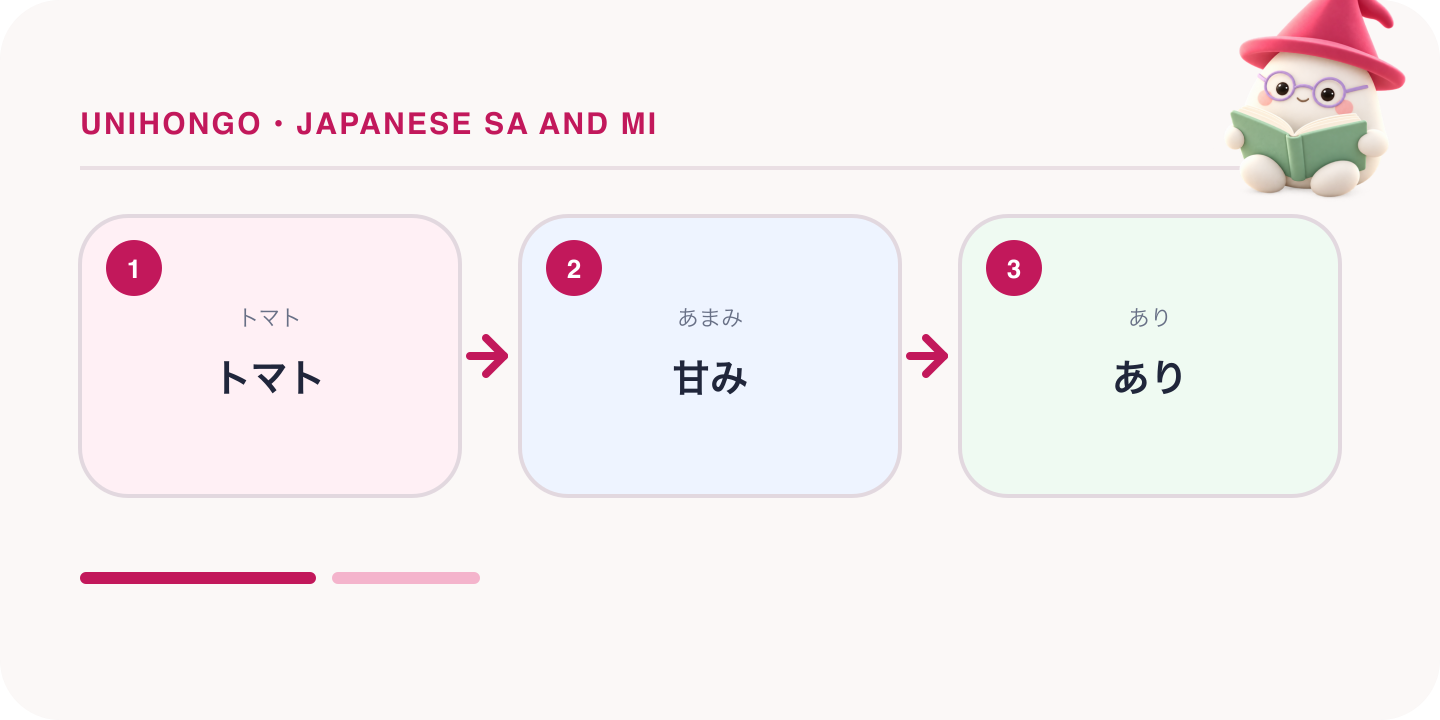
Stand at a market stall. The seller puts tomatoes on a scale and reads off the weight. That reading is sa: omosa, a position on a scale that anyone can check. Then the seller hands you a slice. What you notice in your mouth is mi: amami, a quality that is there in the tomato and that you sense.
Keep both halves of the picture. Sa answers how much. Mi answers what you can feel in it. When you meet a new word ending in sa or mi, ask which of the two questions it answers, and the meaning usually follows.
| Japanese | Romaji | Meaning |
|---|---|---|
| この箱の重さは五キロです。 | Kono hako no omosa wa go-kiro desu. | This box weighs five kilos. (Literally: the heaviness of this box is five kilos.) |
| このトマトは甘みがあります。 | Kono tomato wa amami ga arimasu. | This tomato tastes sweet. (Literally: as for this tomato, sweetness exists.) |
How sa and mi nouns are built
The formation is the same for both endings. Remove what makes the word an adjective, the final i or the na, and attach sa or mi to what is left. The result is an ordinary noun. It takes particles, and the thing that has the quality is linked to it with no.
| Adjective | Reading | Noun form | Meaning |
|---|---|---|---|
| 高い | takai | takasa | Height, or how expensive something is |
| 重い | omoi | omosa, omomi | Weight; weightiness |
| 寒い | samui | samusa | The cold, coldness |
| 便利な | benri na | benrisa | Convenience |
| 大切な | taisetsu na | taisetsusa | Importance |
| いい | ii | yosa | Goodness, good points |
| 甘い | amai | amasa, amami | Degree of sweetness; sweet taste |
| 使いやすい | tsukaiyasui | tsukaiyasusa | Ease of use |
The last row shows how far sa reaches. Anything that conjugates like an i-adjective can take it, including yasui and nikui endings, rashii, and even the tai form in set expressions. One irregular word is worth knowing: the usual noun from shizuka is shizukesa, stillness, though shizukasa also exists.
Sa for degree: takasa, omosa, hirosa, benrisa
The most common sa words are the dimensions: nagasa, length, takasa, height, hirosa, area, ōkisa, size, omosa, weight, hayasa, speed, fukasa, depth. You need them whenever you ask how big, how long or how heavy. Flat hunting is a good example. You are standing in an empty room with an estate agent, and nearly every question you have is a sa question.
| Japanese | Romaji | Meaning |
|---|---|---|
| 部屋の広さはどのくらいですか。 | Heya no hirosa wa dono kurai desu ka. | How big is the room? |
| 天井の高さは二メートル半です。 | Tenjō no takasa wa ni-mētoru han desu. | The ceiling is two and a half metres high. |
| この机の大きさがちょうどいいです。 | Kono tsukue no ōkisa ga chōdo ii desu. | The size of this desk is just right. |
| 荷物の重さを量ってください。 | Nimotsu no omosa o hakatte kudasai. | Please weigh the luggage. |
| 駅からの近さで決めました。 | Eki kara no chikasa de kimemashita. | I chose it for how close it is to the station. |
Sa does not need a number to be a degree. Benrisa, taisetsusa and yasashisa cannot be read from an instrument, but you can still have more or less of them, and that is enough.
Sa for weather, feelings and good points
Once you know the pattern, sa lets you talk about qualities as things: the heat of summer, the kindness of a friend, the good side of a town. A colleague who has just moved from Hokkaido to Tokyo is comparing the two over lunch.
| Japanese | Romaji | Meaning |
|---|---|---|
| 東京の夏の暑さに驚きました。 | Tōkyō no natsu no atsusa ni odorokimashita. | I was surprised by how hot summer is in Tokyo. |
| 寒さには強いです。 | Samusa ni wa tsuyoi desu. | I handle the cold well. (Literally: towards coldness, I am strong.) |
| この町の良さは人の温かさです。 | Kono machi no yosa wa hito no atatakasa desu. | The good thing about this town is the warmth of its people. |
| 健康の大切さが分かりました。 | Kenkō no taisetsusa ga wakarimashita. | I came to understand how important health is. |
| 友達の優しさがうれしかったです。 | Tomodachi no yasashisa ga ureshikatta desu. | I was touched by my friend's kindness. |
Mi for what you sense: amami, itami, tsuyomi, yowami
Why can only some adjectives take mi? Because mi needs a quality that can be sensed as present inside something, the way a flavour is present in food. That limits it to a few fields: tastes, bodily sensations, emotions, colours, and the physical feel of objects. Size and price are readings, not sensations, so ōkii and yasui have no mi form.
Mi words are usually used with ga aru, to have, or with verbs of feeling and increasing. At a clinic, the doctor asks about itami, not itasa, because pain is something you feel in your body, not a figure on a chart.
| Japanese | Romaji | Meaning |
|---|---|---|
| 痛みはありますか。 | Itami wa arimasu ka. | Do you have any pain? |
| 腕にかゆみがあります。 | Ude ni kayumi ga arimasu. | My arm is itchy. (Literally: on the arm, itchiness exists.) |
| このコーヒーは苦みが強いです。 | Kono kōhī wa nigami ga tsuyoi desu. | This coffee has a strong bitterness. |
| 顔に赤みがあります。 | Kao ni akami ga arimasu. | There is some redness in the face. |
| 私の強みは粘り強さです。 | Watashi no tsuyomi wa nebarizuyosa desu. | My strong point is persistence. |
| 手作りの温かみがあります。 | Tezukuri no atatakami ga arimasu. | It has a handmade warmth to it. |
The fifth sentence uses both endings. Tsuyomi is a strong point you possess, and nebarizuyosa, from nebarizuyoi, is the degree of a trait. A few common words, tanoshimi, kanashimi and kurushimi, look like mi nouns and can also be explained as noun forms of the verbs tanoshimu, kanashimu and kurushimu. Either way, they behave like the rest of the group.
One ending changed: sa and mi side by side
When an adjective takes both endings, the two nouns divide the work between measurement and sensation. Each pair below differs in the ending alone.
| Sentence | Reading | What it says |
|---|---|---|
| 荷物の重さを感じます。 | Nimotsu no omosa o kanjimasu. | I feel how heavy the luggage is: the physical weight |
| 言葉の重みを感じます。 | Kotoba no omomi o kanjimasu. | I feel the weight of the words: their seriousness |
| プールの深さは二メートルです。 | Pūru no fukasa wa ni-mētoru desu. | The pool is two metres deep: a measurement |
| このスープは味に深みがあります。 | Kono sūpu wa aji ni fukami ga arimasu. | This soup has depth of flavour: a sensed richness |
| 甘さは控えめです。 | Amasa wa hikaeme desu. | The sweetness is kept low: the level of sugar |
| 甘みがあります。 | Amami ga arimasu. | It has a sweet taste: sweetness is present |
Look at what follows each noun. Sa nouns appear with numbers, with wa plus a description of level, and with verbs like hakaru, to measure. Mi nouns appear with ga aru and ga tsuyoi. You can often predict the ending from the rest of the sentence.
Mi also drifts into figurative meaning more easily than sa. Omomi is the gravity of a promise, fukami the depth of a character, atatakami the warmth of an atmosphere.
Beyond the basics: sa versus no and koto
The closest neighbours of sa are the nominalisers no and koto, which a separate post covers in full. They turn a whole clause into a noun, so the adjective stays an adjective and keeps its subject with ga. Sa turns the adjective itself into a noun, so the owner of the quality takes no. Nedan ga takai no and nedan no takasa both come out in English as how expensive it is, but the first means the fact that the price is high, and the second means the level of the price.
Choose no or koto when you are reacting to a fact. Choose sa when you are talking about the degree. Written Japanese also has a set pattern with sa for cause: amari no plus a sa noun plus ni, because of the sheer degree.
| Japanese | Romaji | Meaning |
|---|---|---|
| 値段が高いのに驚きました。 | Nedan ga takai no ni odorokimashita. | I was surprised that the price was high. |
| 値段の高さに驚きました。 | Nedan no takasa ni odorokimashita. | I was surprised at how high the price was. |
| あまりの寒さに目が覚めました。 | Amari no samusa ni me ga samemashita. | It was so cold that I woke up. |
Common mistakes with sa and mi
The first mistake is keeping the i: takaisa, samuisa. Learners produce it by adding sa to the dictionary form. It is wrong. The i must go: takasa, samusa.
The second is iisa for goodness. It follows the rule, but ii is irregular and returns to its old stem. Say yosa.
The third is inventing mi words. Ōkimi and benrimi are wrong, because size and convenience are not sensations. When in doubt, use sa: ōkisa, benrisa.
The fourth is the wrong particle before the noun. Heya ga hirosa wa dono kurai desu ka is wrong, because hirosa is a noun and must be linked with no. Say heya no hirosa.
The fifth is sa where the body is speaking. At a clinic, itasa ga arimasu sounds odd. The established word for pain as a symptom is itami, so say itami ga arimasu. In the same way, tanoshimi is something you look forward to, while tanoshisa is how enjoyable something is, so tanoshimi ni shite imasu cannot be replaced by tanoshisa.
- Drop i or na first, then add sa
- Ii becomes yosa
- No mi form in the dictionary: use sa
- Owner of the quality takes no, not ga
- Symptoms and tastes: itami, kayumi, amami
How sa and mi sound in real conversation
Sa nouns are neutral in politeness and at home in both speech and writing. In casual talk, speakers often prefer the adjective itself, saying takai ne where a report would say takasa. Sa nouns become more frequent as the language gets more formal or more precise: product descriptions, news, presentations.
Mi words are everyday vocabulary in food writing, medicine and business, and tsuyomi and yowami are standard in interviews. You may also meet playful new mi words online, where younger speakers attach mi to unexpected words for effect. That is slang and it changes quickly, so treat it as something to recognise, not to copy in polite company.
| Japanese | Romaji | Meaning |
|---|---|---|
| このアプリの良さは使いやすさです。 | Kono apuri no yosa wa tsukaiyasusa desu. | What's good about this app is how easy it is to use. |
| 速さより正確さが大切です。 | Hayasa yori seikakusa ga taisetsu desu. | Accuracy matters more than speed. |
| 富士山の高さは三千七百七十六メートルです。 | Fujisan no takasa wa sanzen nanahyaku nanajūroku-mētoru desu. | Mount Fuji is 3,776 metres high. |
| 夏休みを楽しみにしています。 | Natsuyasumi o tanoshimi ni shite imasu. | I'm looking forward to the summer holidays. |