

The core difference: direction vs arrival
E marks the direction in which something moves. Think of an arrow: towards Tokyo, heading north, off to the right. The emphasis is on the path and the orientation, not on whether you arrive.
Ni marks a point. When used with movement, that point is the destination, the place where the movement ends. Think of a map pin rather than an arrow. Ni also marks many other kinds of points: a point in time, a place where something exists, and the person or thing an action is aimed at.
The particle e is written with the hiragana へ, which normally reads he, but as a particle it is always pronounced e. You will see it in both kana and romaji texts, and it is worth getting used to reading it quickly.
| Japanese | Romaji | Meaning |
|---|---|---|
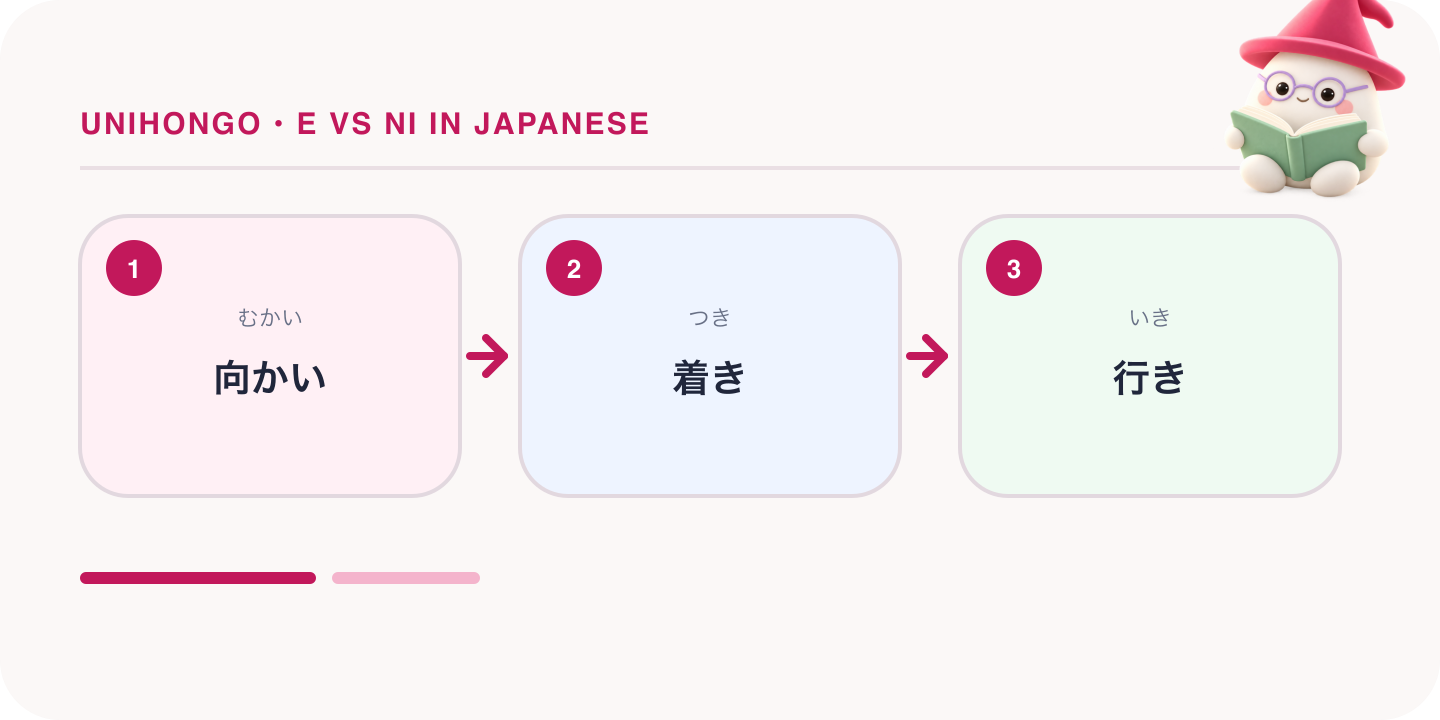
| 北へ向かいます。 | Kita e mukaimasu. | We're heading north. |
| 駅に着きました。 | Eki ni tsukimashita. | I arrived at the station. |
| 東京へ行きます。 | Tōkyō e ikimasu. | I'm going to Tokyo. (towards Tokyo) |
| 東京に行きます。 | Tōkyō ni ikimasu. | I'm going to Tokyo. (Tokyo as the destination) |
Where e and ni are interchangeable
With the main verbs of going and coming, both particles are correct and the difference in meaning is so small that most speakers do not notice it. This covers iku, to go; kuru, to come; kaeru, to return home; modoru, to go back; mukau, to head for; and similar verbs such as dekakeru and hikkosu.
In daily conversation, ni is used more often. E sounds slightly more formal or written, and it can emphasise the journey or the direction. You will also see e on signs, in announcements and in travel writing.
Direction words such as migi, right, hidari, left, ue, up, and mae, forward, also take either particle with verbs like magaru, to turn, and susumu, to go forward.
| Japanese | Romaji | Meaning |
|---|---|---|
| 来年、日本に行きます。 | Rainen, Nihon ni ikimasu. | I'm going to Japan next year. |
| 来年、日本へ行きます。 | Rainen, Nihon e ikimasu. | I'm going to Japan next year. |
| 何時に家に帰りますか。 | Nanji ni ie ni kaerimasu ka. | What time are you going home? |
| 友達がうちへ来ました。 | Tomodachi ga uchi e kimashita. | A friend came to my house. |
| 次の角を右に曲がってください。 | Tsugi no kado o migi ni magatte kudasai. | Please turn right at the next corner. |
| まっすぐ前へ進んでください。 | Massugu mae e susunde kudasai. | Please go straight ahead. |
| 大阪に引っ越しました。 | Ōsaka ni hikkoshimashita. | I moved to Osaka. |
Arrival, entering and boarding: ni is preferred
Verbs that focus on arriving at or getting into a place naturally take ni, because they are about the point of contact. Tsuku, to arrive, hairu, to enter, noru, to get on, suwaru, to sit, and tomaru, to stay, all use ni.
With tsuku and hairu you may occasionally see e in writing, especially in older or literary texts, but ni is the normal choice. With noru and suwaru, e sounds wrong: you sit on a chair, not towards it.
| Japanese | Romaji | Meaning |
|---|---|---|
| 十時に空港に着きます。 | Jūji ni kūkō ni tsukimasu. | I arrive at the airport at ten. |
| 部屋に入ってください。 | Heya ni haitte kudasai. | Please come into the room. |
| この電車に乗ってください。 | Kono densha ni notte kudasai. | Please get on this train. |
| いすに座ってください。 | Isu ni suwatte kudasai. | Please sit on the chair. |
| 今夜はこのホテルに泊まります。 | Kon'ya wa kono hoteru ni tomarimasu. | I'm staying at this hotel tonight. |
Uses where only ni works
Most of the confusion between e and ni disappears once you see how many jobs ni has that e never does. E is only about direction of movement. Everything in the table below needs ni, and e would be a mistake.
| Use of ni | Example | Romaji | English |
|---|---|---|---|
| Time | 七時に起きます | shichiji ni okimasu | I get up at seven |
| Location of existence | 駅の前に銀行があります | eki no mae ni ginkō ga arimasu | There's a bank in front of the station |
| Purpose of movement | 買い物に行きます | kaimono ni ikimasu | I'm going shopping |
| Person you meet | 友達に会います | tomodachi ni aimasu | I'm meeting a friend |
| Recipient of ageru | 母に花をあげました | haha ni hana o agemashita | I gave my mother flowers |
| Surface or target | 壁にポスターを貼る | kabe ni posutā o haru | Put a poster on the wall |
| Result of change | 医者になりたい | isha ni naritai | I want to become a doctor |
| Agent in passives | 先生に褒められた | sensei ni homerareta | I was praised by the teacher |
| Frequency | 週に三回 | shū ni sankai | Three times a week |
Purpose is a common trap. In eiga o mi ni iku, I'm going to see a film, and kaimono ni iku, I'm going shopping, ni marks why you go, not where. E cannot be used here. You can of course combine both: Shibuya e kaimono ni iku, I'm going to Shibuya to shop.
E no: the combination only e can make
When you want a direction to describe a noun, you need no, and only e can be followed by no. Haha e no tegami is a letter to my mother; Tōkyō e no michi is the road to Tokyo; mirai e no kibō is hope for the future. Ni no is not possible, so this is the one place where e is required.
E also combines with the topic and additive particles: Kyōto e wa, as for Kyoto; Ōsaka e mo, to Osaka too. Ni wa and ni mo are equally common here. Only no is exclusive to e.
| Japanese | Romaji | Meaning |
|---|---|---|
| 母への手紙を書きました。 | Haha e no tegami o kakimashita. | I wrote a letter to my mother. |
| 駅への行き方を教えてください。 | Eki e no ikikata o oshiete kudasai. | Please tell me how to get to the station. |
| 先生への質問はありますか。 | Sensei e no shitsumon wa arimasu ka. | Do you have any questions for the teacher? |
| 海外への旅行は初めてです。 | Kaigai e no ryokō wa hajimete desu. | It's my first trip abroad. |
| 京都へは新幹線で行きます。 | Kyōto e wa shinkansen de ikimasu. | As for Kyoto, I'll go by shinkansen. |
| 大阪にも行きたいです。 | Ōsaka ni mo ikitai desu. | I'd like to go to Osaka too. |
E in letters, gifts and messages
A name followed by e is the standard way to address a card, a letter or a note: Tanaka-san e, to Tanaka-san. You will see it on birthday cards, on handwritten notes left on a desk, and on messages to a group. Here e is the only choice; ni on its own is not used this way.
The same pattern appears in slogans and titles to express heading towards something: mirai e, towards the future. It carries a slightly hopeful, forward-looking feeling.
With verbs of sending, such as okuru, to send, and dasu, to post, e is also possible because the letter travels towards the person: tomodachi e tegami o okuru. With ageru, to give, and with au, to meet, stick to ni.
| Japanese | Romaji | Meaning |
|---|---|---|
| 田中さんへ | Tanaka-san e | To Tanaka-san |
| お母さんへ、いつもありがとう。 | Okāsan e, itsumo arigatō. | To Mum, thank you for everything. |
| みなさんへのお知らせ | Minasan e no oshirase | A notice for everyone |
| 未来へ | Mirai e | Towards the future |
Common mistakes with e and ni
- Kaimono e iku for I'm going shopping. Purpose takes ni: kaimono ni iku.
- Tomodachi e au for I'm meeting a friend. The person you meet takes ni: tomodachi ni au.
- Shichiji e okiru for I get up at seven. Time always takes ni.
- Densha e noru for I get on the train. Boarding takes ni: densha ni noru.
- Haha ni no purezento for a present for my mother. Use e no: haha e no purezento, or add a verb: haha ni ageru purezento.
- Isha e naru for become a doctor. The result of change is ni: isha ni naru.
- Reading へ as he when it is a particle. As a particle it is always pronounced e.