

What ageku and sue ni mean
Ageku comes from the last line of a traditional linked poem, and it came to mean the very end of something. As grammar it points to the end of a long process: a lot happened, and then this. The emphasis is on the process being long, tiring or troublesome, and on the result being unsatisfying.
Sue means end or tip, as in getsumatsu, the end of the month, and sue ni means at the end of. As grammar it works exactly like ageku but without the complaint. Sue ni describes the end of a period of effort, thought or discussion, and what follows can be a success, a failure or simply a decision.
Both patterns describe things that have already happened, so the main clause is almost always in the past tense. You cannot use either to talk about plans or give instructions.
| Japanese | Romaji | Meaning |
|---|---|---|
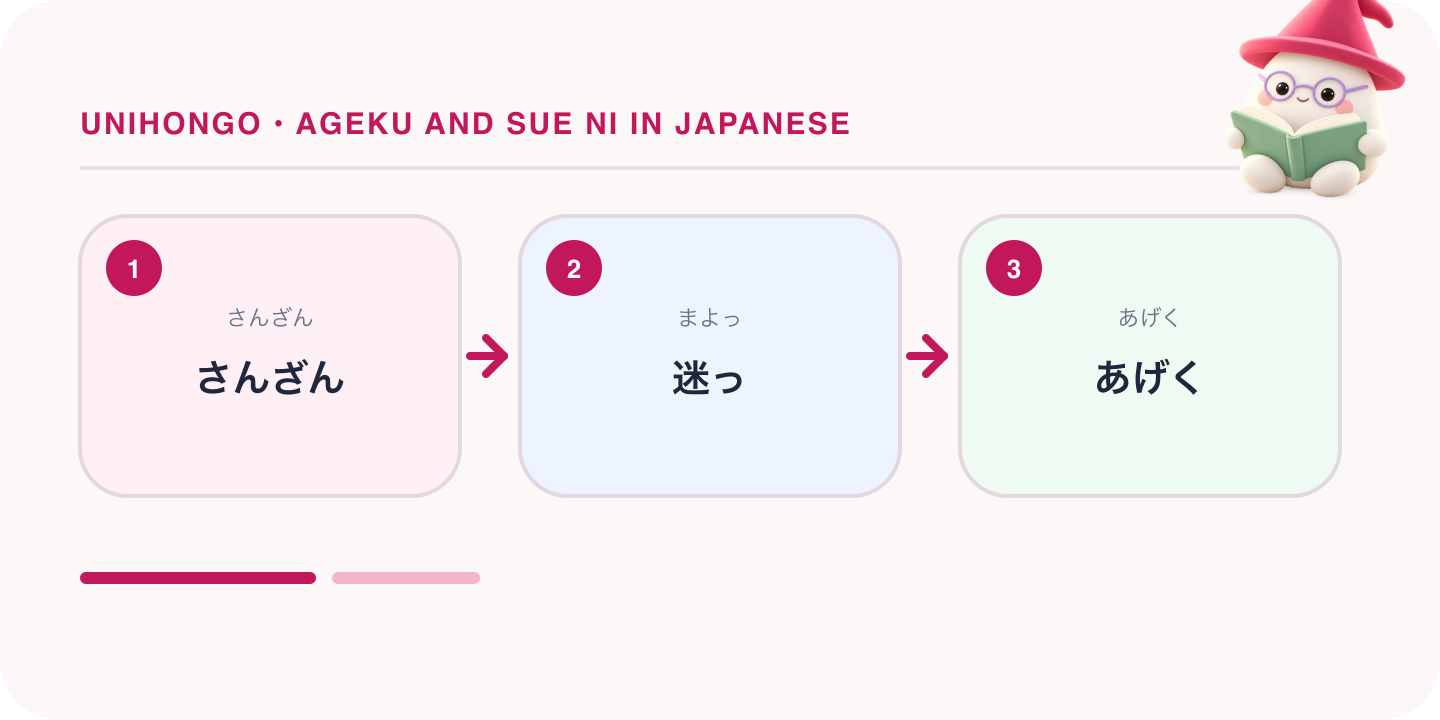
| さんざん迷ったあげく、何も買わなかった。 | Sanzan mayotta ageku, nani mo kawanakatta. | After agonising for ages, I didn't buy anything. |
| 一時間も待たされたあげく、断られた。 | Ichijikan mo matasareta ageku, kotowarareta. | After being made to wait a whole hour, I was turned down. |
| よく考えた末に、会社を辞めることにした。 | Yoku kangaeta sue ni, kaisha o yameru koto ni shita. | After thinking it over carefully, I decided to leave the company. |
| 長い議論の末、計画は中止された。 | Nagai giron no sue, keikaku wa chūshi sareta. | After a long debate, the plan was cancelled. |
| 努力の末に、ついに合格した。 | Doryoku no sue ni, tsui ni gōkaku shita. | After all that effort, I finally passed. |
Formation table
Ageku and sue are nouns, so they take the same slots: a verb in the plain past, or a noun linked with no. The particle ni after them is optional; dropping it sounds slightly more written. Before another noun, use no: nayanda ageku no ketsuron, the conclusion reached after much worrying.
| Pattern | Formation | Example | Meaning |
|---|---|---|---|
| Ageku with a verb | Verb ta form + あげく(に) | 迷ったあげく | After agonising |
| Ageku with a noun | Noun + の + あげく(に) | 口論のあげく | After a quarrel |
| Ageku before a noun | Verb ta form + あげくの + noun | 悩んだあげくの決断 | A decision made after much worry |
| To cap it all | あげくの果て(に) | あげくの果てに泣き出した | And to top it all, started crying |
| Sue ni with a verb | Verb ta form + 末(に) | 考えた末に | After much thought |
| Sue ni with a noun | Noun + の + 末(に) | 苦労の末に | After great hardship |
| Sue before a noun | Verb ta form + 末の + noun | 話し合った末の結論 | The conclusion after long talks |
Ageku: a long struggle and a bad ending
Ageku is the pattern of complaint and exasperation. The first half says what went on for a long time, often with sanzan, thoroughly, iroiro, all sorts of, or a length of time with mo. The second half gives an ending that was pointless, annoying or unfair.
Because the speaker is looking back with feeling, ageku is common in conversation, in stories about bad days and in complaints about other people. It often describes someone else's behaviour: they did all that, and then this.
The result in the second half can be something that happened to the speaker or a decision someone made. What matters is that the listener hears a note of frustration.
| Japanese | Romaji | Meaning |
|---|---|---|
| いろいろな病院に行ったあげく、原因は分からなかった。 | Iroiro na byōin ni itta ageku, gen'in wa wakaranakatta. | After going to all sorts of hospitals, they never found the cause. |
| 彼は散々文句を言ったあげく、帰ってしまった。 | Kare wa sanzan monku o itta ageku, kaette shimatta. | After complaining endlessly, he just went home. |
| 三時間も話し合ったあげく、何も決まらなかった。 | Sanjikan mo hanashiatta ageku, nani mo kimaranakatta. | After three whole hours of discussion, nothing was decided. |
| 道に迷ったあげく、雨にまで降られた。 | Michi ni mayotta ageku, ame ni made furareta. | I got lost, and on top of that I got caught in the rain. |
| 兄弟げんかのあげく、弟が泣き出した。 | Kyōdai genka no ageku, otōto ga nakidashita. | After a fight between the brothers, the younger one burst into tears. |
| 悩んだあげくの決断だから、後悔はしていない。 | Nayanda ageku no ketsudan da kara, kōkai wa shite inai. | It was a decision I agonised over, so I don't regret it. |
The last example shows that ageku can end in a neutral decision when it describes someone's own agonising. Even there, the focus is on how hard the process was.
Ageku no hate: to cap it all
Ageku no hate, where hate means the far end, intensifies ageku. It usually comes at the end of a list of bad things and introduces the worst one. You can use it as a connector at the start of a clause, ageku no hate ni, or after a verb or noun in the same position as ageku.
It sounds lively and a little dramatic, so it is common in storytelling, gossip and complaints. In formal writing it is less common, and sue ni or saigo ni would be preferred.
| Japanese | Romaji | Meaning |
|---|---|---|
| 遅刻して、宿題も忘れて、あげくの果てに授業中に寝てしまった。 | Chikoku shite, shukudai mo wasurete, ageku no hate ni jugyōchū ni nete shimatta. | He was late, forgot his homework, and to top it all off fell asleep in class. |
| 彼は借金を重ね、あげくの果てに家まで売った。 | Kare wa shakkin o kasane, ageku no hate ni ie made utta. | He ran up debt after debt and in the end even sold his house. |
| さんざん待たせたあげくの果てに、来られないと言う。 | Sanzan mataseta ageku no hate ni, korarenai to iu. | After keeping me waiting forever, they say they can't come. |
Sue ni: the formal, neutral in the end
Sue ni is the choice for news, reports, speeches and careful writing. It says a long process came to an end with a certain result, without judging whether that was good. This makes it ideal for describing hard-won successes: kurō no sue ni, after great hardship, and doryoku no sue ni, after much effort, are set phrases.
Sue ni is also common with decisions: kangaeta sue ni, after thinking it over, and nayanda sue ni, after much agonising. The noun form with no is especially frequent in headlines and reports: sessen no sue, after a close contest; nagai kōshō no sue, after long negotiations.
In conversation, sue ni sounds a little formal but not stiff, particularly with kangaeta and nayanda. For everyday chat about a simple result, kekkyoku is more natural.
| Japanese | Romaji | Meaning |
|---|---|---|
| 苦労の末、ようやく店を開くことができた。 | Kurō no sue, yōyaku mise o hiraku koto ga dekita. | After great hardship, I was finally able to open my shop. |
| いろいろ悩んだ末に、留学することにしました。 | Iroiro nayanda sue ni, ryūgaku suru koto ni shimashita. | After thinking hard about it, I decided to study abroad. |
| 長い交渉の末、両社は合意した。 | Nagai kōshō no sue, ryōsha wa gōi shita. | After long negotiations, the two companies reached an agreement. |
| 激しい接戦の末、日本チームが勝った。 | Hageshii sessen no sue, Nihon chīmu ga katta. | After a fierce, close contest, the Japanese team won. |
| 話し合った末の結論なので、変更はありません。 | Hanashiatta sue no ketsuron na node, henkō wa arimasen. | It is the conclusion we reached after discussion, so it will not change. |
Ageku and sue ni vs kekka and kekkyoku
Kekka, result, follows a verb in the ta form or a noun with no, just like ageku and sue ni: shirabeta kekka, as a result of investigating. The difference is that kekka is neutral and says nothing about how long or hard the process was. It is the standard choice for test results, survey results and investigations.
Kekkyoku is an adverb meaning in the end or after all. It sits at the start of the result clause instead of attaching to the process: iroiro kangaeta kedo, kekkyoku ikanakatta. In conversation, kekkyoku often replaces both ageku and sue ni, and it can express mild disappointment on its own.
| Pattern | Tone | Typical result | Example |
|---|---|---|---|
| あげく | Conversational, frustrated | Bad or pointless | 迷ったあげく、買わなかった |
| あげくの果てに | Dramatic | The worst thing of all | あげくの果てに泣き出した |
| 末に | Formal, neutral | Good, bad or a decision | 努力の末に合格した |
| 結果 | Neutral, factual | Any finding or outcome | 調べた結果、問題はなかった |
| 結局 | Everyday adverb | Any outcome, often a let-down | 結局、行かなかった |
A quick test: if you can add after all that trouble and the sentence still sounds right, ageku works. If you want to sound objective, choose sue ni or kekka. If you are chatting, kekkyoku is usually enough.
Common mistakes with ageku and sue ni
- Using the dictionary form: mayou ageku is wrong; it must be mayotta ageku.
- Leaving out no after a noun: giron sue ni should be giron no sue ni.
- Using ageku for a happy result: ganbatta ageku, gōkaku shita sounds sarcastic; use ganbatta sue ni or ganbatta kekka.
- Following either pattern with a plan, request or invitation: kangaeta sue ni, issho ni ikimashō is unnatural. The second half should report what happened.
- Using ageku or sue ni for a short, simple process: tabeta ageku, neta is wrong; the pattern needs a long or effortful lead-up.
- Using kekka where the speaker wants to express frustration: kekka is objective and flattens the feeling that ageku carries.
Putting them to work
Ageku shines in anecdotes, so practise it by retelling small disasters: a delayed train, a failed online order, a restaurant that turned out to be closed. Sue ni shines in self-introductions and interviews, where you explain decisions: nayanda sue ni tenshoku o kimemashita, after a lot of thought I decided to change jobs.
The two patterns also appear together in reading passages, where the writer uses sue ni in narration and a character uses ageku in dialogue. Noticing that switch is a good sign you have absorbed the difference in tone.
| Japanese | Romaji | Meaning |
|---|---|---|
| 配達を三回も延期されたあげく、荷物がなくなった。 | Haitatsu o sankai mo enki sareta ageku, nimotsu ga nakunatta. | After the delivery was postponed three times, the parcel went missing. |
| 店を探し回ったあげく、定休日だった。 | Mise o sagashimawatta ageku, teikyūbi datta. | After searching all over for the restaurant, it turned out to be its day off. |
| 悩んだ末に転職を決めました。 | Nayanda sue ni tenshoku o kimemashita. | After a lot of thought, I decided to change jobs. |
| 試行錯誤の末、新しい方法が見つかった。 | Shikō sakugo no sue, atarashii hōhō ga mitsukatta. | After much trial and error, we found a new method. |