
The particle map at a glance
| Particle | Core job | Quick cue |
|---|---|---|
| は wa | Frames a topic or contrast | As for... |
| が ga | Identifies or describes a subject | The one that... |
| を o | Marks the direct object or route | Action passes through it |
| に ni | Points to a time, target, destination, or existence | A pin on a point |
| で de | Marks where an action happens or its means | The action's stage or tool |
| へ e | Points in a direction | Heading toward... |
| の no | Connects or identifies nouns | A of B |
| と to | Quotes, joins, or marks a companion | With / and / quote |
| も mo | Adds another matching item | Also / too |
| から kara | Marks a starting point | From |
| まで made | Marks an end point | Until / as far as |
Wa and ga: frame versus focus
Wa tells the listener what the sentence is about and often links to shared context. Ga marks the grammatical subject and commonly identifies new information. In a question such as dare ga kimashita ka, ga marks the unknown person; the answer Tanaka-san ga kimashita keeps ga because Tanaka is the identifying answer.
This is a discourse choice, not a mechanical translation of the word is. Use wa to establish or contrast a topic and ga when identifying who or what, reporting something newly noticed, or using a pattern that conventionally selects ga. The dedicated wa-versus-ga guide explores the finer cases; this core contrast is enough to start speaking.
| Japanese | Romaji | Meaning |
|---|---|---|
| 私は学生です。 | Watashi wa gakusei desu. | As for me, I am a student. |
| 誰が来ましたか? | Dare ga kimashita ka? | Who came? |
| 田中さんが来ました。 | Tanaka-san ga kimashita. | Tanaka came. / It was Tanaka who came. |
| 猫がいます。 | Neko ga imasu. | There is a cat. |
O marks what the action affects
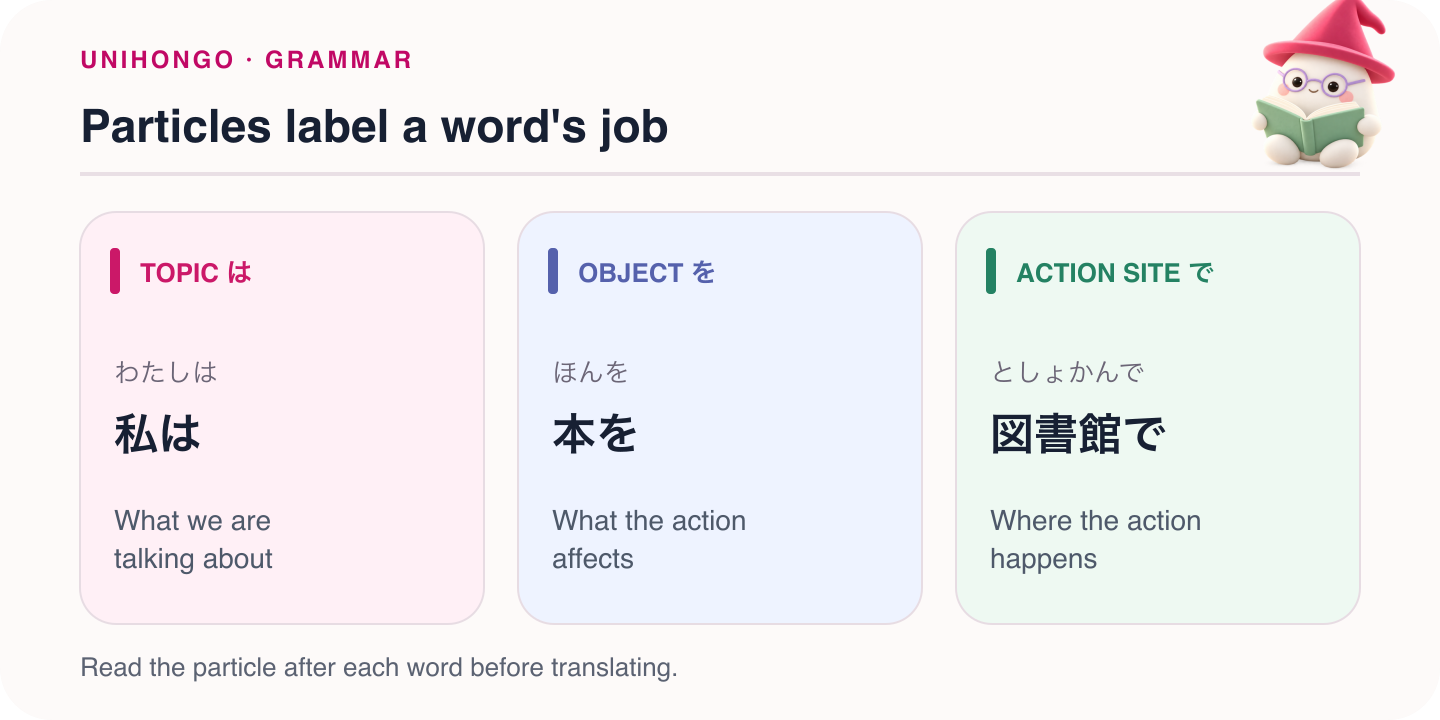
O marks the direct object of a transitive verb: the coffee you drink, the book you read, or the Japanese you study. It can also mark a route or space that movement passes through, which is why kōen o arukimasu means walk through the park rather than walk the park as an object.
| Japanese | Romaji | Meaning |
|---|---|---|
| コーヒーを飲みます。 | Kōhī o nomimasu. | I drink coffee. |
| 日本語を勉強しています。 | Nihongo o benkyō shite imasu. | I am studying Japanese. |
| 公園を歩きます。 | Kōen o arukimasu. | I walk through the park. |
Ni, de, and e: points, scenes, and direction
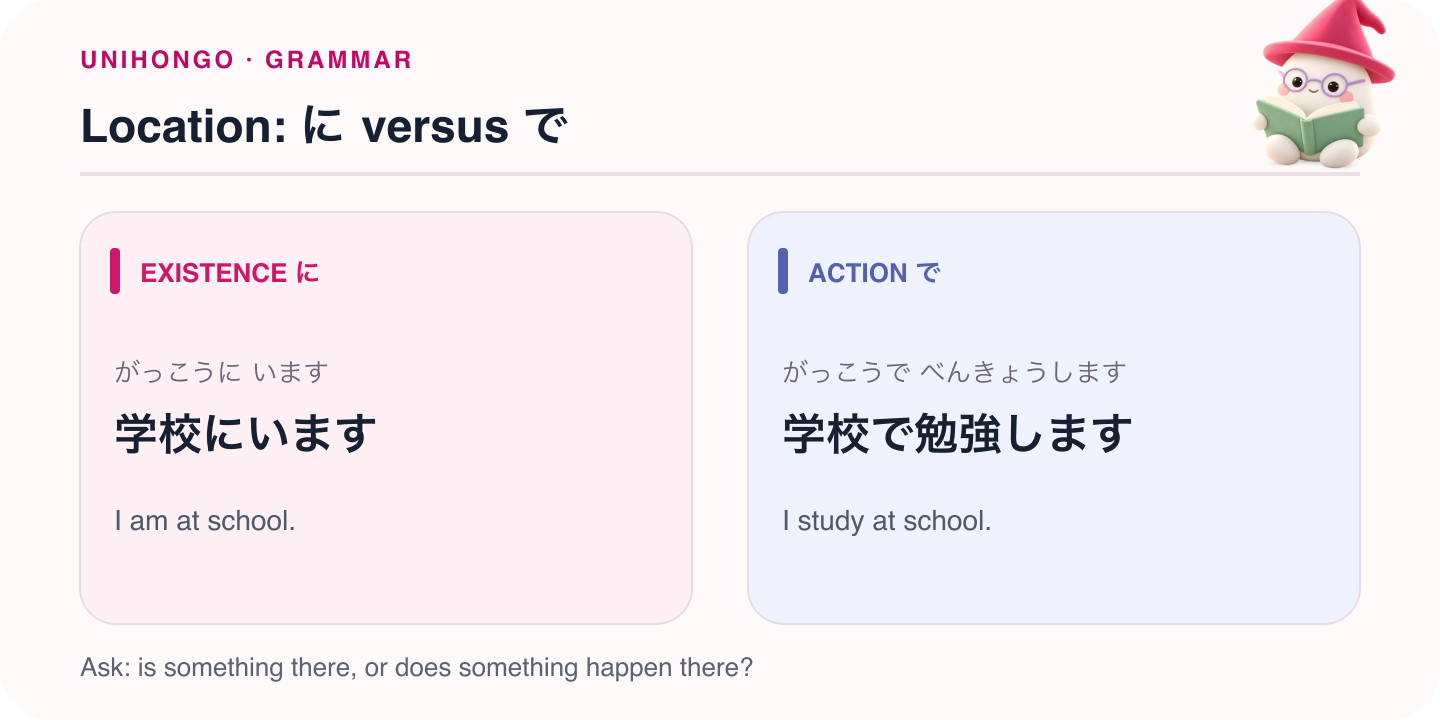
Ni places a pin on a target: seven o'clock, Tokyo as a destination, a friend as the recipient, or a room where a person exists. De sets the stage on which an action occurs or names the means used. E, written へ, emphasises direction and works with movement verbs, but it cannot replace every use of ni.
| Japanese | Romaji | Meaning |
|---|---|---|
| 七時に起きます。 | Shichi-ji ni okimasu. | I wake up at seven. |
| 東京に行きます。 | Tōkyō ni ikimasu. | I go to Tokyo. |
| 東京へ行きます。 | Tōkyō e ikimasu. | I head toward Tokyo. |
| 図書館で勉強します。 | Toshokan de benkyō shimasu. | I study at the library. |
| 電車で行きます。 | Densha de ikimasu. | I go by train. |
| 部屋に先生がいます。 | Heya ni sensei ga imasu. | The teacher is in the room. |
No, to, and mo connect ideas
| Japanese | Romaji | Meaning |
|---|---|---|
| 日本語の本です。 | Nihongo no hon desu. | It is a Japanese-language book. |
| 友達と話しました。 | Tomodachi to hanashimashita. | I spoke with a friend. |
| パンと卵を買いました。 | Pan to tamago o kaimashita. | I bought bread and eggs. |
| 明日行くと言いました。 | Ashita iku to iimashita. | I said that I would go tomorrow. |
| 私も行きます。 | Watashi mo ikimasu. | I will go too. |
No lets one noun describe or identify another; it is broader than English possession. To joins a complete list of nouns, marks the person accompanying an action, or closes a quotation. Mo replaces wa, ga, or o when it means too, but it may follow other particles in combinations such as ni mo.
Kara and made draw a range
| Japanese | Romaji | Meaning |
|---|---|---|
| 九時から働きます。 | Ku-ji kara hatarakimasu. | I work from nine. |
| 五時まで働きます。 | Go-ji made hatarakimasu. | I work until five. |
| 駅から学校まで歩きます。 | Eki kara gakkō made arukimasu. | I walk from the station to the school. |
Kara and made can appear together or separately. Unlike English from and to, they do not require a matching pair. This makes them easy to add to a sentence after the main meaning is already clear.
How to make particles automatic
- Underline the noun phrase and particle together: gakkō ni, not gakkō plus an isolated ni.
- Make contrast sets where only one relationship changes: ie ni kaerimasu, ie de tabemasu.
- Say the whole sentence before checking the answer; recognition drills do not train selection.
- Collect one natural sentence for every new use instead of extending a translation list.
- Review your conversation transcript and recast each particle mistake with two new nouns.