

What ni oite does
Ni oite comes from the verb oku, to place, in an old te form: placed in. It marks the frame within which an action or state holds. That frame can be a physical place, a point in time, an event, a situation or an abstract field such as education or economics. In all these uses, plain Japanese would use de, and ni oite is the formal replacement.
The register is the whole point. Ni oite appears in company reports, contracts, academic papers, news scripts, ceremony speeches and public announcements. It signals that the speaker or writer is in an official role. Used in a message to a friend it sounds comic, and used in a report it sounds right. Learners who have only met it in JLPT lists often miss that it is a tone marker as much as a grammar point.
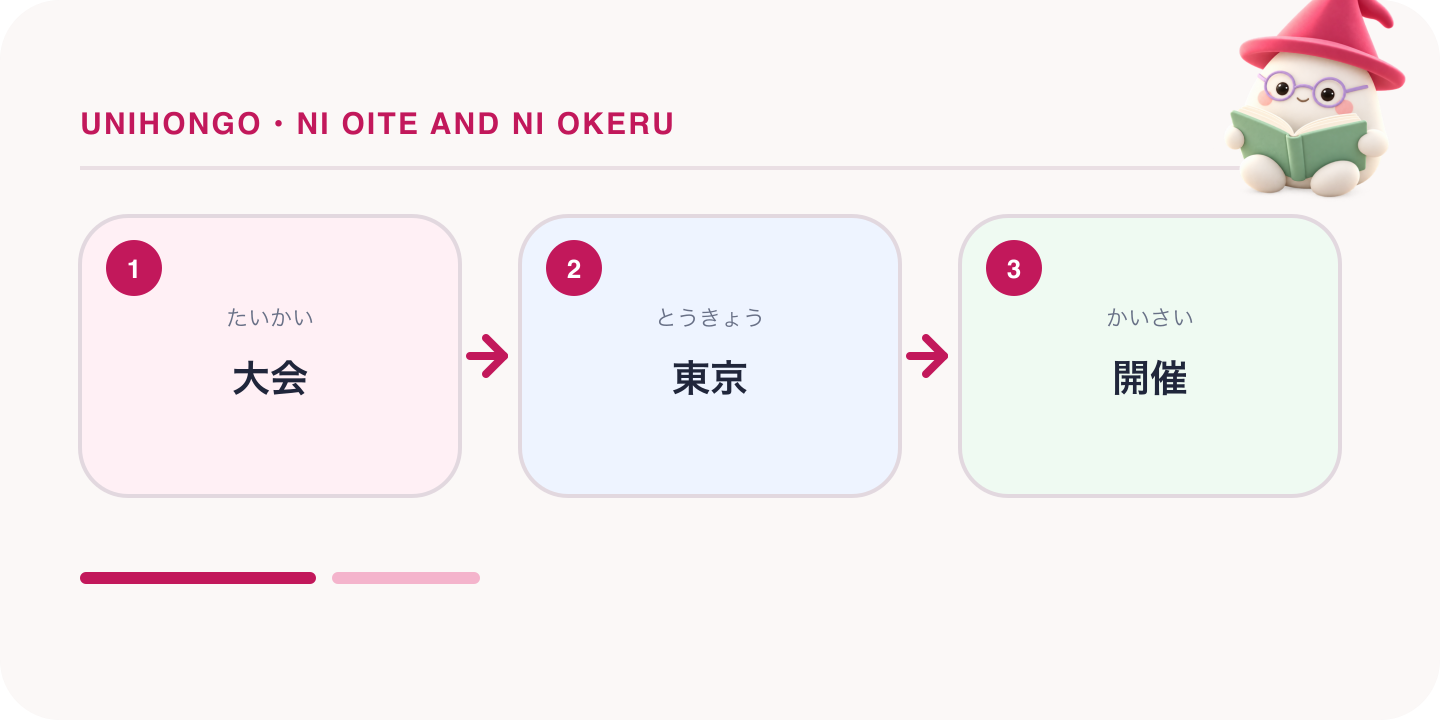
| Japanese | Romaji | Meaning |
|---|---|---|
| 本大会は東京において開催されます。 | Hontaikai wa Tōkyō ni oite kaisai saremasu. | This tournament will be held in Tokyo. |
| 会議において、新しい方針が決定されました。 | Kaigi ni oite, atarashii hōshin ga kettei saremashita. | A new policy was decided at the meeting. |
| 現代社会において、情報は重要な資源です。 | Gendai shakai ni oite, jōhō wa jūyō na shigen desu. | In modern society, information is an important resource. |
| 当時においては、それが普通でした。 | Tōji ni oite wa, sore ga futsū deshita. | At that time, that was normal. |
| 教育の分野において、経験があります。 | Kyōiku no bun'ya ni oite, keiken ga arimasu. | I have experience in the field of education. |
Ni oite versus de and ni
The meaning of ni oite is close to de, and in most sentences you can swap them with only a change in tone. The difference is in coverage. De marks a place of action or a means; ni oite marks only the setting, never the means. You cannot say densha ni oite iku for going by train. De also serves for the material something is made of, and ni oite does not.
Ni oite is not a formal version of ni. Ni marks a destination, a location of existence, a recipient or a point in time; ni oite marks the setting for an action. Tōkyō ni sunde iru, live in Tokyo, stays with ni even in a formal report, because sumu takes ni. Learners who replace every ni with ni oite produce sentences that are not just stiff but wrong. A simple test: if the plain sentence uses de, ni oite is available; if it uses ni, it usually is not.
| Japanese | Romaji | Meaning |
|---|---|---|
| 大阪で会議を行いました。 | Ōsaka de kaigi o okonaimashita. | We held the meeting in Osaka. (neutral) |
| 大阪において会議を行いました。 | Ōsaka ni oite kaigi o okonaimashita. | We held the meeting in Osaka. (formal) |
| 東京に住んでいます。 | Tōkyō ni sunde imasu. | I live in Tokyo. (ni, not ni oite) |
| 電車で会場へ向かいます。 | Densha de kaijō e mukaimasu. | We will go to the venue by train. (de, not ni oite) |
| この点においては、賛成です。 | Kono ten ni oite wa, sansei desu. | On this point, I agree. |
Ni okeru: linking the setting to a noun
When the frame needs to modify a noun rather than a verb, ni oite changes to ni okeru, the attributive form of the same old verb. Nihon ni okeru kyōiku, education in Japan; kaisha ni okeru yakuwari, one's role in the company. The structure is A ni okeru B, and it means B as it exists or happens within A.
Plain Japanese does this with de no, as in Nihon de no keiken, experience in Japan, or with a simple no. Ni okeru is the formal upgrade and is very common in titles: report titles, presentation slides, thesis chapters and news headlines. Because it packs a whole setting into a noun phrase, it lets writers front-load context: Ajia shijō ni okeru shinshutsu keikaku, the expansion plan in the Asian market.
| Japanese | Romaji | Meaning |
|---|---|---|
| 日本における少子化の現状について発表します。 | Nihon ni okeru shōshika no genjō ni tsuite happyō shimasu. | I will present the current state of the falling birth rate in Japan. |
| 職場におけるコミュニケーションが課題です。 | Shokuba ni okeru komyunikēshon ga kadai desu. | Communication in the workplace is the challenge. |
| 二十世紀における日本の経済成長。 | Nijisseiki ni okeru Nihon no keizai seichō. | Japan's economic growth in the twentieth century. |
| 海外市場における当社の売上は伸びています。 | Kaigai shijō ni okeru tōsha no uriage wa nobite imasu. | Our sales in overseas markets are growing. |
| 緊急時における対応を確認してください。 | Kinkyūji ni okeru taiō o kakunin shite kudasai. | Please confirm the response in an emergency. |
Ni oite mo, ni oite wa and ni okimashite
Ni oite combines with the same particles as de. Ni oite wa adds contrast or focus: kono ten ni oite wa, on this point at least. Ni oite mo adds also or even, and it is the natural way to extend a statement to a second setting in a report: kokunai dake de naku kaigai ni oite mo, not only domestically but also overseas.
Ni okimashite is the humble-polite form used in spoken announcements and customer-facing notices. Its typical shape is tōten ni okimashite wa, at this store, or honjitsu ni okimashite wa, today. It belongs to the voice of a company speaking to the public, so you hear it on trains, in department stores and at ceremonies. Do not use it in ordinary emails; ni oite is already formal enough.
| Japanese | Romaji | Meaning |
|---|---|---|
| 国内だけでなく、海外においても高い評価を得ています。 | Kokunai dake de naku, kaigai ni oite mo takai hyōka o ete imasu. | It is highly rated not only in Japan but also overseas. |
| 安全性においては、他社に負けません。 | Anzensei ni oite wa, tasha ni makemasen. | In terms of safety, we are second to none. |
| 当店におきましては、現金のみのお取り扱いとなります。 | Tōten ni okimashite wa, genkin nomi no o-toriatsukai to narimasu. | At this store, we accept cash only. |
| 本日は当ホテルにおきまして、ご結婚披露宴が行われます。 | Honjitsu wa tō-hoteru ni okimashite, go-kekkon hirōen ga okonawaremasu. | Today a wedding reception will be held here at this hotel. |
| いかなる場合においても、安全を最優先します。 | Ikanaru baai ni oite mo, anzen o saiyūsen shimasu. | In any situation whatsoever, safety comes first. |
Formal register: reports, academic writing and business
In business documents, ni oite and ni okeru signal that you know the conventions. A report opens with the setting, honkaigi ni oite, at this meeting, and a proposal frames its scope with ni okeru, as in shin-shisutemu dōnyū ni okeru kadai, challenges in introducing the new system. Contracts use ni oite to fix where and when obligations apply. Academic Japanese uses both constantly, especially in abstracts and titles.
Two things travel with these forms. First, the rest of the sentence should match: pair ni oite with Sino-Japanese verbs such as jisshi suru, kaisai suru and kettei suru, and with the polite or de aru style, not with casual endings. Second, in speech, formal forms need clear articulation. Ni oite is three syllables that vanish in mumbling, so slow slightly and put a small pause after it.
| Plain form | Reading | Formal replacement |
|---|---|---|
| 東京で開く | Tōkyō de hiraku | 東京において開催する, Tōkyō ni oite kaisai suru |
| 会議で決める | kaigi de kimeru | 会議において決定する, kaigi ni oite kettei suru |
| 日本での経験 | Nihon de no keiken | 日本における経験, Nihon ni okeru keiken |
| 学校での役割 | gakkō de no yakuwari | 学校における役割, gakkō ni okeru yakuwari |
| 海外でも | kaigai de mo | 海外においても, kaigai ni oite mo |
| この点では | kono ten de wa | この点においては, kono ten ni oite wa |
| うちの店では | uchi no mise de wa | 当店におきましては, tōten ni okimashite wa |
| 今の時代に | ima no jidai ni | 現代において, gendai ni oite |
| どんな場合でも | donna baai de mo | いかなる場合においても, ikanaru baai ni oite mo |
Notice how the formal column also upgrades the verbs and nouns: hiraku becomes kaisai suru, uchi no mise becomes tōten, donna becomes ikanaru. Ni oite rarely travels alone; it brings a whole register with it.
Spoken use in presentations and announcements
Although ni oite is mainly a written form, there are spoken occasions where it is expected. A presentation opening is one: honjitsu no happyō ni oite wa, in today's presentation. A ceremony speech is another, as are public address announcements, news reading and formal meeting minutes read aloud. In these settings, using de instead is not wrong, but ni oite lifts the tone to match the occasion.
The key is consistency. A speaker who opens with ni okimashite and then slips into casual endings sounds unprepared. Pick a level and hold it. In a work presentation for colleagues, ni oite with desu and masu is a comfortable middle ground. For an audience of clients or the public, ni okimashite and gozaimasu forms match. Among team members in a stand-up meeting, plain de is the natural choice.
| Japanese | Romaji | Meaning |
|---|---|---|
| 本日の発表においては、三つの点をお話しします。 | Honjitsu no happyō ni oite wa, mittsu no ten o o-hanashi shimasu. | In today's presentation, I will talk about three points. |
| 第一四半期において、売上は前年比十パーセント増となりました。 | Dai-ichi shihanki ni oite, uriage wa zennen-hi juppāsento zō to narimashita. | In the first quarter, sales rose ten percent on the previous year. |
| 当駅におきましては、エレベーターの工事を行っております。 | Tōeki ni okimashite wa, erebētā no kōji o okonatte orimasu. | At this station, lift construction work is under way. |
| この会場において、皆様をお迎えできることを嬉しく思います。 | Kono kaijō ni oite, minasama o o-mukae dekiru koto o ureshiku omoimasu. | I am delighted to welcome you all at this venue. |
| 各部署において、対策を検討してください。 | Kaku busho ni oite, taisaku o kentō shite kudasai. | Please consider measures in each department. |
Where the forms belong
The safest way to learn these forms is to link each one to the settings where native speakers actually use it. The list below pairs the forms with their natural homes, from the most formal to the least. If your situation is not on the list, de is almost certainly right.
- Ni okimashite: public announcements, shop notices, ceremony openings, hotel and station broadcasts
- Ni oite: contracts, company reports, academic papers, news scripts, formal speeches, presentation openings
- Ni okeru: titles of reports and slides, thesis chapters, headlines, formal noun phrases
- Ni oite mo: reports and speeches that extend a claim to another region, period or department
- De and de no: everything else, including meetings among colleagues, emails to people you know, and daily life
A useful self-check is to imagine the sentence printed on a document with a company logo. If it would look at home there, ni oite fits. If it belongs in a chat message, use de.
Common mistakes with ni oite and ni okeru
The first mistake is overuse. Learners who discover ni oite start using it for every de, including in casual conversation, and end up sounding like a legal notice. Match the form to the occasion. The second is confusing it with ni: sentences such as Tōkyō ni oite sunde imasu or tomodachi ni oite agemashita are wrong, because sumu and ageru take ni, not de, and ni oite only replaces de.
The third is putting ni okeru before a verb or ni oite before a noun. Nihon ni oite kyōiku wa is wrong when kyōiku is the noun being modified; it should be Nihon ni okeru kyōiku. Fourth, learners mix registers, pairing ni oite with casual verbs such as yaru or chatting endings such as ne and yo. Finally, ni oite is not a replacement for ni tsuite, about. Kono mondai ni oite is on this matter as a setting; kono mondai ni tsuite is about this problem as a topic. When you mean about, use ni tsuite or ni kanshite.
| Japanese | Romaji | Meaning |
|---|---|---|
| 日本における教育について話します。 | Nihon ni okeru kyōiku ni tsuite hanashimasu. | I will talk about education in Japan. (not ni oite kyōiku) |
| この問題については、後で説明します。 | Kono mondai ni tsuite wa, ato de setsumei shimasu. | As for this problem, I will explain later. (ni tsuite, not ni oite) |
| 昨日、渋谷で友達とご飯を食べた。 | Kinō, Shibuya de tomodachi to gohan o tabeta. | I ate with a friend in Shibuya yesterday. (de, casual) |
| 本件においては、法務部が対応します。 | Honken ni oite wa, hōmubu ga taiō shimasu. | On this matter, the legal department will respond. |
| 医療の分野における人工知能の活用が進んでいます。 | Iryō no bun'ya ni okeru jinkō chinō no katsuyō ga susunde imasu. | The use of artificial intelligence in the medical field is advancing. |