

The core meaning
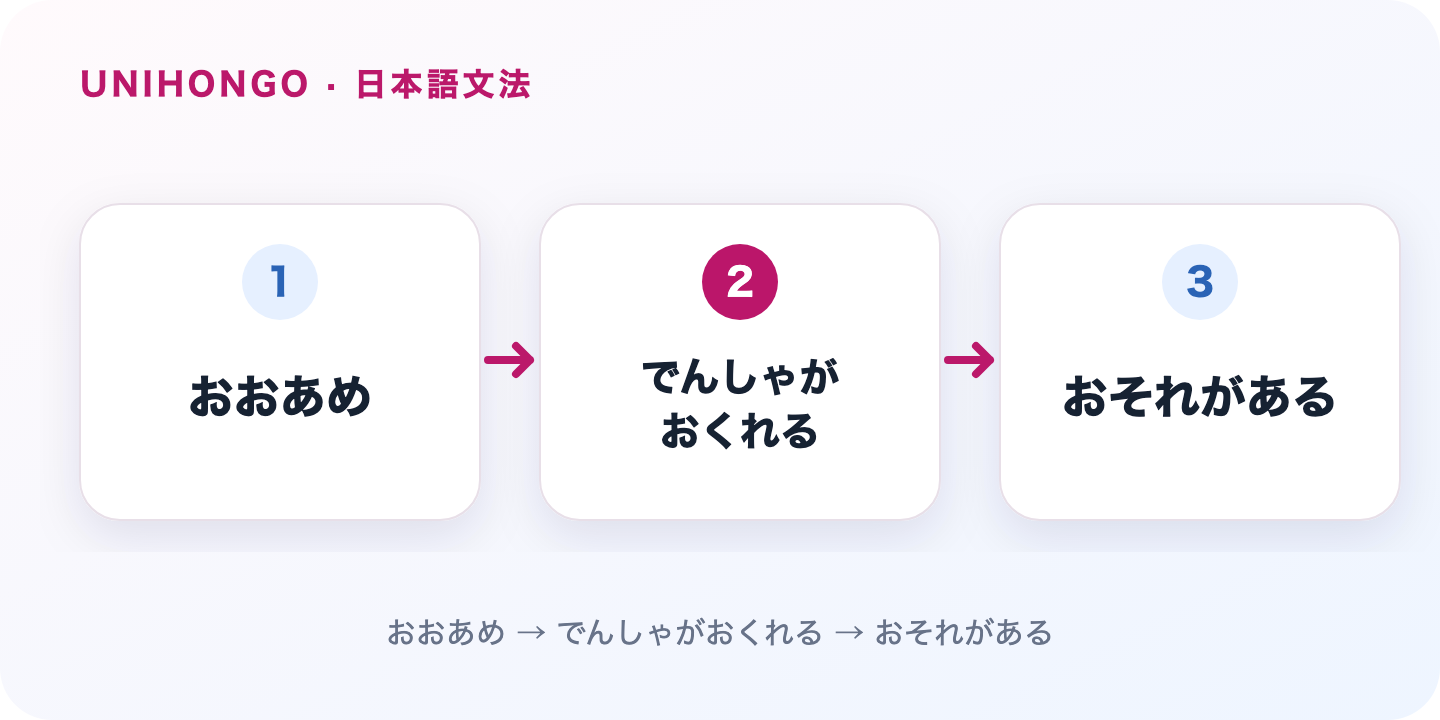
大雨で電車が遅れる恐れがあります warns that heavy rain may delay trains. The delay is a risk, not a certainty. This phrase appears in weather alerts, product notices, medical information and workplace safety reports. It is useful when the reader should prepare for a possible bad outcome without being told that it has already happened.
| Japanese | Romaji | Meaning |
|---|---|---|
| 大雨で電車が遅れる恐れがあります。 | Ōame de densha ga okureru osore ga arimasu. | Heavy rain may delay the trains. |
| この道は夜、凍結する恐れがあります。 | Kono michi wa yoru, tōketsu suru osore ga arimasu. | This road may freeze at night. |
How to form it
Use a dictionary-form verb plus 恐れがある: 遅れる恐れがある. With a noun, use の: 感染の恐れがある. The polite form is 恐れがあります. The word 恐れ here functions as 'risk' or 'possibility of harm'; it is not simply the emotion of feeling afraid.
| Use | Japanese form | Meaning |
|---|---|---|
| Verb | 遅れる恐れがある | Risk of delay |
| Noun | 感染の恐れがある | Risk of infection |
| Polite notice | 遅れる恐れがあります | There may be a delay |
Natural examples
Read each sentence for the relationship between the first idea and the second. The English translation gives a natural meaning, while the Japanese wording shows exactly where the pattern attaches.
| Japanese | Romaji | Meaning |
|---|---|---|
| 個人情報が漏れる恐れがあります。 | Kojin jōhō ga moreru osore ga arimasu. | There is a risk of personal information leaking. |
| 傷口から感染の恐れがあります。 | Kizuguchi kara kansen no osore ga arimasu. | There is a risk of infection through the wound. |
Compare the nearby pattern
遅れるかもしれません is an ordinary 'might be late,' usable in personal speech. 遅れる恐れがあります sounds like a public warning or risk assessment. かねない can also warn of a bad result but often stresses that a present action or situation may lead to it.
| Japanese | Romaji | Meaning |
|---|---|---|
| 電車が遅れるかもしれません。 | Densha ga okureru kamo shiremasen. | The train might be late. |
| 電車が遅れる恐れがあります。 | Densha ga okureru osore ga arimasu. | There is a risk of train delays. |
The two examples may describe similar situations, but they lead the listener to different conclusions. Choose the form that matches the claim you really intend to make.
Common mistake to avoid
Do not present the feared result as an established fact. 'There is a risk of flooding' does not mean flooding has begun. If damage has already occurred, report it directly. Also avoid 恐れ for a welcome possibility such as passing an exam; use 可能性 instead.
- A harmful outcome is possible, not certain
- Dictionary verb + 恐れがある
- Noun + の恐れがある
- The tone is formal and cautionary
Try it yourself
Write a short public notice about a possible delay or slippery road. State the risk with 恐れがあります, then add one concrete action a reader can take. Avoid claiming the risk has already occurred.
Say your sentence once slowly while looking at the Japanese pattern. Then say it again without reading. If your second clause changes from a possibility to a fact, or from advice to a requirement, revise it so the grammar still matches your meaning.