

The core idea: move the label from the thing to the action
An adjective is a label on a noun. A quiet room wears the label quiet. When you want to label an action instead, the word stays the same and only its ending changes, so that it can attach to a verb. You already know the vocabulary; you are learning one new ending for each adjective type.
A librarian might use the same word twice in a minute, once for the room and once for how she wants you to talk.
| Japanese | Romaji | Meaning |
|---|---|---|
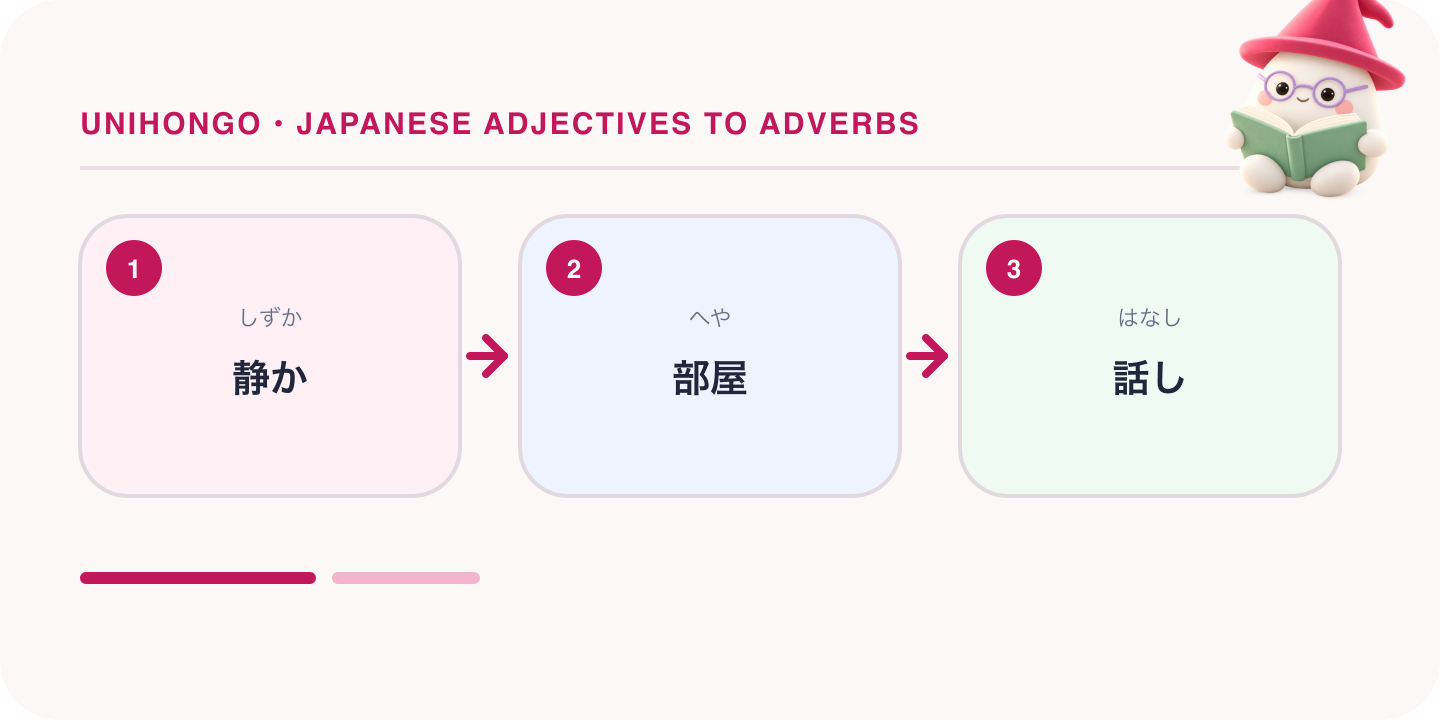
| ここは静かな部屋です。 | Koko wa shizuka na heya desu. | This is a quiet room. |
| 静かに話してください。 | Shizuka ni hanashite kudasai. | Please speak quietly. |
| 速い車ですね。 | Hayai kuruma desu ne. | That's a fast car, isn't it? |
| 速く走れますか。 | Hayaku hashiremasu ka. | Can you run fast? |
How the adverb is built
There are two regular rules and one irregular word. The adverb normally goes straight before the verb, though it can move earlier in the sentence.
| Adjective and adverb | Reading | Rule and meaning |
|---|---|---|
| 早い → 早く | hayai → hayaku | I-adjective, i becomes ku: early, quickly |
| 大きい → 大きく | ōkii → ōkiku | I-adjective, i becomes ku: in a big way, large |
| いい → よく | ii → yoku | Irregular, built on yoi: well, often |
| 静か → 静かに | shizuka → shizuka ni | Na-adjective plus ni: quietly |
| きれい → きれいに | kirei → kirei ni | Na-adjective despite the final i: neatly, cleanly |
| 丁寧 → 丁寧に | teinei → teinei ni | Na-adjective plus ni: carefully, politely |
Negative and tai forms end in i, so they follow the i-adjective rule as well: nai becomes naku and tabetai becomes tabetaku. You will need these as soon as you start talking about change.
Both types in action: a cooking lesson
Instructions are where adverbs earn their keep, because how you do something matters as much as what you do. A parent teaching a child to make curry gives one instruction after another, and nearly every one contains a ku or ni form. Notice that Japanese says cut small where English says cut into small pieces: the adverb describes the result of the cutting.
| Japanese | Romaji | Meaning |
|---|---|---|
| 手をきれいに洗いましょう。 | Te o kirei ni araimashō. | Let's wash our hands properly. |
| 野菜を小さく切ってください。 | Yasai o chiisaku kitte kudasai. | Please cut the vegetables into small pieces. (Literally: cut them small.) |
| 肉を薄く切ります。 | Niku o usuku kirimasu. | I slice the meat thinly. |
| 丁寧に混ぜてください。 | Teinei ni mazete kudasai. | Please stir it carefully. |
| 早く食べないと冷めますよ。 | Hayaku tabenai to samemasu yo. | If you don't eat soon, it will get cold. |
In speech, an adverb can stand alone as a whole utterance when the verb is obvious. Hayaku! shouted up the stairs means hurry up. Shizuka ni! from a teacher means quiet. The greeting yoroshiku onegai shimasu contains the adverb of yoroshii, good, and literally asks the listener to treat you favourably.
Minimal pairs: adjective against adverb
Each pair below differs in one ending. Watch which word the label lands on.
| Sentence | Reading | What it says |
|---|---|---|
| 早い電車に乗りました。 | Hayai densha ni norimashita. | I took an early train. The label is on the train |
| 早く電車に乗りました。 | Hayaku densha ni norimashita. | I got on the train early. The label is on the boarding |
| きれいな字を書きます。 | Kirei na ji o kakimasu. | I write beautiful characters. The label is on the characters |
| きれいに字を書きます。 | Kirei ni ji o kakimasu. | I write characters neatly. The label is on the writing |
In the first pair the facts differ: an early train is a fixed thing on the timetable, while boarding early is about your own timing. In the second pair the facts are nearly the same, and the choice is one of focus. With na you are describing the finished characters, with ni the care you take.
Adverb plus suru and naru, in brief
The same ku and ni forms combine with suru, to make something a certain way, and naru, to become that way. Grammatically nothing new happens: the label attaches to the verb suru or naru just as it would to any other verb. Separate articles cover naru and suru in depth, so four examples are enough here. A guest at a hotel front desk and a neighbour in the corridor would use the first two.
| Japanese | Romaji | Meaning |
|---|---|---|
| 音を小さくしてください。 | Oto o chiisaku shite kudasai. | Please turn the volume down. (Literally: make the sound small.) |
| 静かにしてください。 | Shizuka ni shite kudasai. | Please be quiet. |
| 部屋をきれいにしました。 | Heya o kirei ni shimashita. | I cleaned the room. |
| 急に寒くなりましたね。 | Kyū ni samuku narimashita ne. | It has suddenly turned cold, hasn't it? |
Beyond the basics: ku forms that became nouns
A few ku forms are used so often for places, times and quantities that they have become nouns. You can tell because they take particles, which an ordinary adverb never does. Chikaku is the area nearby, tōku is somewhere far away, and ōku is a large number. Hayaku and osoku do the same for time with kara and made.
The label image bends here, and it is better to admit it: these words are no longer labels on an action but names of a place or amount. The reason to learn them as a group is practical. Eki no chikai is wrong, and ōi hito is not how you say many people. Ōi and sukunai are rarely placed directly before a noun, so the noun form with no takes over.
| Japanese | Romaji | Meaning |
|---|---|---|
| 駅の近くに住んでいます。 | Eki no chikaku ni sunde imasu. | I live near the station. (Literally: in the vicinity of the station.) |
| 遠くから来ました。 | Tōku kara kimashita. | I came from far away. |
| 多くの人が来ました。 | Ōku no hito ga kimashita. | Many people came. |
| 朝早くから働いています。 | Asa hayaku kara hataraite imasu. | I work from early in the morning. |
| 夜遅くまで起きていました。 | Yoru osoku made okite imashita. | I stayed up until late at night. |
Beyond the basics: yoku, sugoku, hidoku and meanings that drift
Some adverbs wander from the meaning of their adjective. Yoku is the important one. From good it gives well, and from doing something fully it extends to doing it many times, so it also means often. It also appears in fixed phrases of welcome and praise, such as yoku dekimashita, well done.
Sugoi means amazing or dreadful, but sugoku is mostly a plain intensifier, very. Hidoi means cruel or awful, and hidoku means severely or badly, again as a measure of degree, always for something unwelcome. Karuku, from karui, light, often means casually or as a small amount.
| Japanese | Romaji | Meaning |
|---|---|---|
| 説明がよく分かりました。 | Setsumei ga yoku wakarimashita. | I understood the explanation well. |
| 週末はよく映画を見ます。 | Shūmatsu wa yoku eiga o mimasu. | I often watch films at the weekend. |
| このケーキはすごくおいしいです。 | Kono kēki wa sugoku oishii desu. | This cake is really delicious. |
| 昨日はひどく疲れました。 | Kinō wa hidoku tsukaremashita. | I was terribly tired yesterday. |
| 駅前で軽く食べましょう。 | Ekimae de karuku tabemashō. | Let's have a light bite near the station. |
Neighbours: the kute form and ready-made adverbs
The form most often confused with ku is kute, and with ni it is de. Kute and de are connectors: they join an adjective to a further description and mean and. Ku and ni attach the adjective to a verb. Yasukute oishii is cheap and tasty, two labels on one restaurant. Yasuku kaimashita is bought cheaply, one label on the buying.
Japanese also has many words that are born adverbs, such as yukkuri, sugu, totemo and hakkiri. They need no ending at all. Adding ni to them is a common slip.
| Japanese | Romaji | Meaning |
|---|---|---|
| この店は安くておいしいです。 | Kono mise wa yasukute oishii desu. | This restaurant is cheap and tasty. |
| セールで靴を安く買いました。 | Sēru de kutsu o yasuku kaimashita. | I bought shoes cheaply in the sale. |
| もう少しゆっくり話してください。 | Mō sukoshi yukkuri hanashite kudasai. | Please speak a little more slowly. |
Common mistakes with ku and ni adverbs
The first mistake is leaving the adjective unchanged. Hayai hashirimasu is wrong. English fast is both adjective and adverb, so the need for a new ending is easy to miss. Say hayaku hashirimasu.
The second is making the adverb of ii by rule. Ii dekimashita and iku dekimashita are both wrong. The forms of ii are built on yoi: yoku dekimashita.
The third is treating kirei as an i-adjective. Kireku kakimasu is wrong. The final i is part of the word, not an ending. Say kirei ni kakimasu.
The fourth is crossing the endings: hayai ni and shizukaku are wrong. Check the adjective type first. If it takes na before a noun, it takes ni before a verb.
The fifth is adding ni to a ready-made adverb. Yukkuri ni hanashimasu is wrong, an over-application of the na-adjective rule. Yukkuri hanashimasu is complete.