

The core idea: a wish placed in someone else's hands
Imagine writing your wish on a slip of paper. With the tai form you keep the slip: mado o aketai, I want to open the window, and you are the one who will get up and open it. With te hoshii you hand the slip across the table: mado o akete hoshii, I want you to open the window. The wanting stays with you, the doing moves to the other person.
That is why hoshii here is still the ordinary adjective meaning wanted. What is wanted is no longer a thing but an action, and the te form is what lets a verb stand in that position. Two flatmates on a hot evening show the contrast.
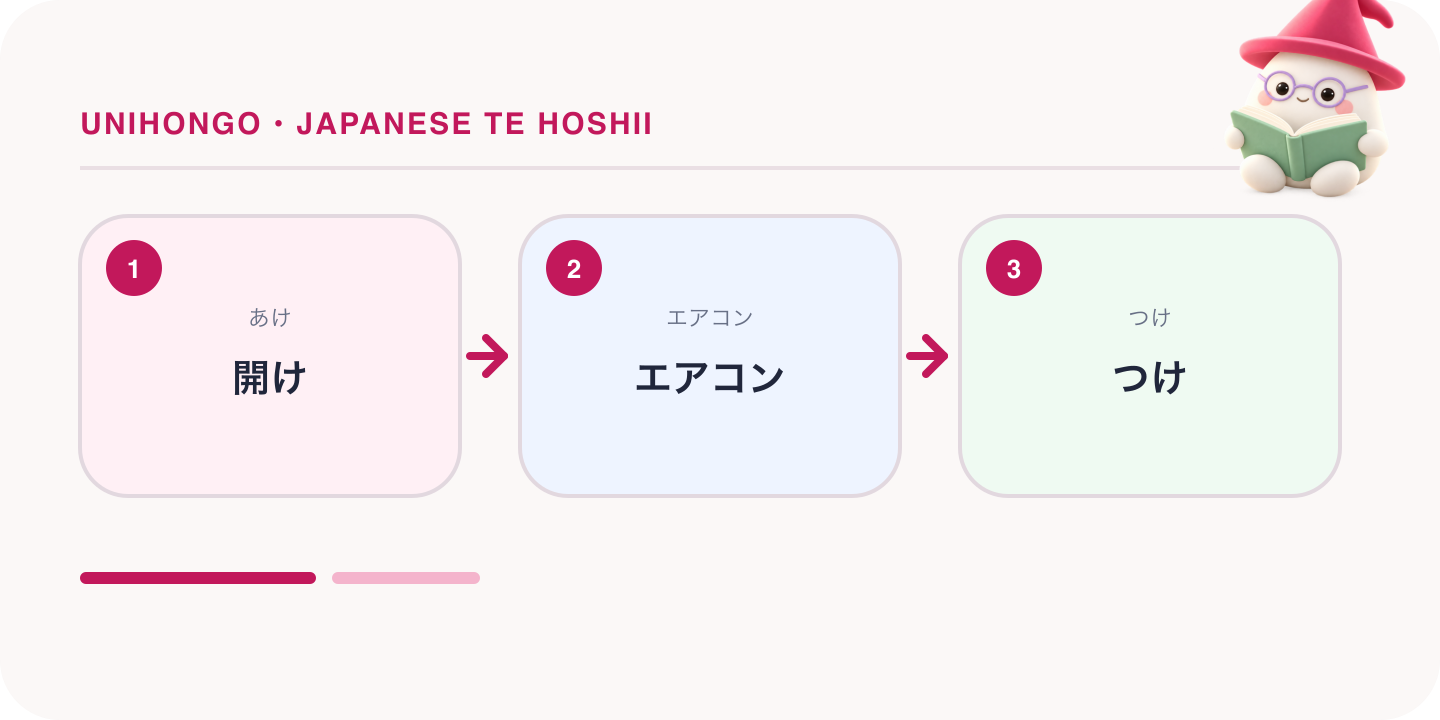
| Japanese | Romaji | Meaning |
|---|---|---|
| 窓を開けたい。 | Mado o aketai. | I want to open the window. |
| 窓を開けてほしい。 | Mado o akete hoshii. | I want you to open the window. (Literally: the window being opened is wanted.) |
| エアコンをつけてほしい。 | Eakon o tsukete hoshii. | I want you to turn on the air conditioner. |
| ちょっと待ってほしい。 | Chotto matte hoshii. | I want you to wait a moment. |
How te hoshii is built
Take the te form of any verb and add hoshii. From there hoshii behaves like every other i-adjective: desu makes it polite, katta makes it past, kunai makes it negative. The only extra pattern is the second negative, where the verb itself goes into its nai form plus de.
| Form | Reading | Meaning |
|---|---|---|
| 来てほしい | kite hoshii | I want you to come (plain) |
| 来てほしいです | kite hoshii desu | I want you to come (polite) |
| 来てほしかった | kite hoshikatta | I wanted you to come, I wish you had come |
| 来ないでほしい | konaide hoshii | I want you not to come, please don't come |
| 来てほしくない | kite hoshikunai | I don't want you to come |
| 来てほしいんですけど | kite hoshii n desu kedo | I'd like you to come, if that's all right |
The past form deserves a note. Itte hoshikatta, literally your saying it was wanted, is the usual way to voice a mild complaint after the fact: I wish you had told me.
Ni marks the person who holds the wish
When you name the person you want to act, mark them with ni. It is the same ni that marks the person in giving and receiving sentences: the one your words are directed at. The object of the verb keeps its own particle, so a full sentence can have both: otōto ni heya o katazukete hoshii, I want my younger brother to tidy his room.
When the person is the listener, you normally say nothing. Anata ni is grammatical but heavy, and the situation already makes clear whose hands the wish is in. Ni appears when you talk about someone who is not in the room, as when you tell a friend what you hope from your family.
| Japanese | Romaji | Meaning |
|---|---|---|
| 母に料理を教えてほしいです。 | Haha ni ryōri o oshiete hoshii desu. | I want my mother to teach me to cook. |
| 友達に空港まで迎えに来てほしい。 | Tomodachi ni kūkō made mukae ni kite hoshii. | I want my friend to come and meet me at the airport. |
| 弟に部屋を片づけてほしい。 | Otōto ni heya o katazukete hoshii. | I want my younger brother to tidy his room. |
| みんなにこの映画を見てほしい。 | Minna ni kono eiga o mite hoshii. | I want everyone to see this film. |
| だれに手伝ってほしいですか。 | Dare ni tetsudatte hoshii desu ka. | Who do you want to help you? |
Two negatives side by side: naide hoshii and te hoshikunai
There are two places to put a negative, because there are two parts to the wish. You can negate the action you are handing over, or you can negate your wanting. The pairs below differ in that one choice only.
| Japanese | Romaji | Meaning |
|---|---|---|
| だれにも言わないでほしい。 | Dare ni mo iwanaide hoshii. | Please don't tell anyone. |
| ここでたばこを吸わないでほしいです。 | Koko de tabako o suwanaide hoshii desu. | I'd like you not to smoke here. |
| 心配しないでほしい。 | Shinpai shinaide hoshii. | I don't want you to worry. |
| 子どもには危ないことをしてほしくない。 | Kodomo ni wa abunai koto o shite hoshikunai. | I don't want my children doing dangerous things. |
| Sentence | Reading | What it says |
|---|---|---|
| 行かないでほしい。 | Ikanaide hoshii. | A request. Literally: not going is what I want from you. Please don't go. |
| 行ってほしくない。 | Itte hoshikunai. | A feeling. Literally: your going is not wanted. I don't want you to go. |
| 触らないでほしい。 | Sawaranaide hoshii. | Asks the listener to keep their hands off, close to sawaranaide kudasai. |
| 触ってほしくない。 | Sawatte hoshikunai. | Reports that being touched is unwelcome, whoever might do it. |
Naide hoshii still hands over a slip of paper; the slip just says don't. That is why it fits requests to the person in front of you. Te hoshikunai hands over nothing. It describes your own reaction, so it suits general statements and things you cannot directly ask for. Many speakers feel it as the stronger of the two, but the line is not rigid.
Softening the request: te hoshii n desu kedo
Said flatly, te hoshii desu is a statement of desire, and statements of desire can land hard. In conversation the form almost always wears padding. N desu presents the wish as background, something you are explaining, and kedo or ga, literally but, trails off so that the listener can step in and offer. You leave the sentence unfinished on purpose.
Picture a shared office. You turn to a colleague of your own rank and need a favour. With a friend the same padding becomes n da kedo, and a wish said half to yourself ends in na.
| Japanese | Romaji | Meaning |
|---|---|---|
| この資料を見てほしいんですけど。 | Kono shiryō o mite hoshii n desu kedo. | I'd like you to look at this document, if you could. |
| 明日のシフトを代わってほしいんですが。 | Ashita no shifuto o kawatte hoshii n desu ga. | I was hoping you could swap tomorrow's shift with me. |
| ちょっと手伝ってほしいんだけど。 | Chotto tetsudatte hoshii n da kedo. | I need a bit of help, if you don't mind. |
| もっと早く言ってほしかったな。 | Motto hayaku itte hoshikatta na. | I wish you had told me sooner. |
Beyond the basics: why te hoshii is too direct for superiors
Go back to the slip of paper. Handing your wish to a friend is normal. Handing it to your manager makes your desire their job, and that runs against how Japanese handles rank: toward someone above you, you do not announce what you want, you ask whether you may receive a favour. So the verb changes from hoshii to the receiving verbs morau and itadaku, which put you in the position of the person who benefits.
For the same reason, avoid asking a superior te hoshii desu ka. Questioning someone senior about their desires sounds intrusive; offer instead with mashō ka, as in o-tetsudai shimashō ka, shall I help?
| Request | Reading | Who it suits |
|---|---|---|
| 見てくれない? | Mite kurenai? | Friends and family, casual |
| 見てほしいんですけど。 | Mite hoshii n desu kedo. | Colleagues of equal rank, people you know well |
| 見てもらいたいんですが。 | Mite moraitai n desu ga. | Neutral and polite. Literally: I want to receive your looking |
| 見ていただきたいんですが。 | Mite itadakitai n desu ga. | Humble, for a boss, teacher or client |
| 見ていただけませんか。 | Mite itadakemasen ka. | A true question, the safest request upward |
Beyond the basics: ga for situations you wish for
Sometimes there is nobody to hand the slip to. You want rain, or spring, or the weekend. Here the image reaches its limit: the wish is simply released, and the thing you hope will act is marked with ga as the subject of its verb. Ame ga futte hoshii, I want it to rain, asks nothing of anyone.
People can take ga in the same way when you are hoping rather than asking, and usage here varies between speakers. For a person, ni or ni wa remains the safe choice. A farmer's family watching a dry sky, or fans before a final, would say things like these.
| Japanese | Romaji | Meaning |
|---|---|---|
| 雨が降ってほしい。 | Ame ga futte hoshii. | I want it to rain. |
| 早く夏休みが来てほしい。 | Hayaku natsuyasumi ga kite hoshii. | I want the summer holidays to come soon. |
| 明日は晴れてほしいです。 | Ashita wa harete hoshii desu. | I hope it's sunny tomorrow. |
| この時間がずっと続いてほしい。 | Kono jikan ga zutto tsuzuite hoshii. | I want this moment to go on for ever. |
| 日本に勝ってほしい。 | Nihon ni katte hoshii. | I want Japan to win. |
Neighbours: te kudasai, te moraitai and other people's wishes
Te kudasai is an instruction aimed at the listener, and only the listener. Te hoshii describes your feeling, so it can be about anyone, present or absent. You cannot say kare ni kite kudasai about a man who is not there, but kare ni kite hoshii is fine.
Te moraitai overlaps with te hoshii almost completely. The difference is one of angle: te moraitai says you want to receive the action, so it carries a sense of benefit and sounds a shade more considerate.
Hoshii reports the speaker's own feeling. For a third person's wish, Japanese avoids claiming to know what is in their heart, so you add a marker of hearsay or appearance: te hoshii to itte imasu, te hoshii sō desu, or te hoshigatte imasu.
| Japanese | Romaji | Meaning |
|---|---|---|
| 窓を開けてください。 | Mado o akete kudasai. | Please open the window. |
| 窓を開けてもらいたいです。 | Mado o akete moraitai desu. | I'd like to have you open the window. |
| 母は私に帰ってきてほしいと言っています。 | Haha wa watashi ni kaette kite hoshii to itte imasu. | My mother says she wants me to come home. |
Common mistakes with te hoshii
The first mistake is stretching tai to cover another person. Watashi wa kare ga ikitai is wrong for I want him to go, and comes straight from English want. Tai can only be your own action: kare ni itte hoshii.
The second is marking the person with o. Tomodachi o kite hoshii is wrong. Learners reason that the friend is the object of want, but o is reserved for the object of the verb in the te form. The person takes ni: tomodachi ni kite hoshii.
The third is grammatically perfect and socially wrong: saying buchō, kore o mite hoshii desu to your department head. Adding desu does not fix the directness. Say kore o mite itadakemasen ka.
The fourth is reporting someone else's wish as if it were your own feeling. Haha wa watashi ni kekkon shite hoshii desu sounds as though you can read her mind. Add to itte imasu or use hoshigatte imasu.
The fifth is using te hoshii for your own action. Watashi wa Nihon ni itte hoshii is wrong for I want to go to Japan. Nobody is receiving the slip, so it is ikitai.