

The core idea: comparing notes
Two people each hold a copy of the same timetable. When you say something with yo ne, you lay your copy on the desk and look up to see whether the other person's says the same. The yo is your copy: this is what I have. The ne is the look: yours too? Both halves are needed. You must have a view of your own, and the listener must be someone who can be expected to have one as well.
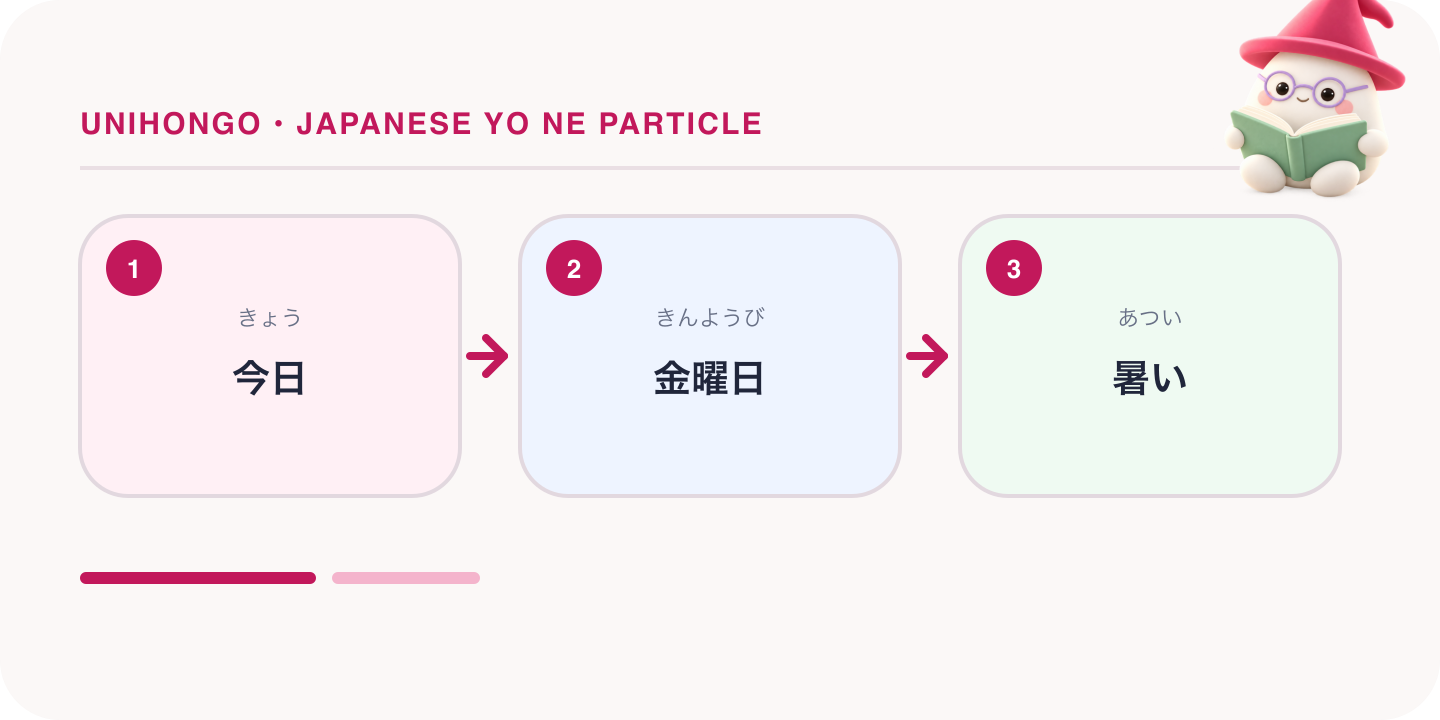
This makes yo ne the natural ending for anything you are fairly sure of but would like confirmed. You and a colleague are walking to the station on a hot Friday, and each of these lines asks for a nod.
| Japanese | Romaji | Meaning |
|---|---|---|
| 今日は金曜日ですよね。 | Kyō wa kin'yōbi desu yo ne. | Today is Friday, isn't it? |
| 駅はこっちだよね。 | Eki wa kocchi da yo ne. | The station's this way, right? |
| 日本の夏は暑いですよね。 | Nihon no natsu wa atsui desu yo ne. | Summer in Japan is hot, isn't it. |
| このパン屋、おいしいよね。 | Kono pan'ya, oishii yo ne. | This bakery is good, don't you think? |
How it is built: after any complete sentence
| Sentence | Reading | Built from | Meaning |
|---|---|---|---|
| 行くよね。 | Iku yo ne. | verb plain form + yo ne | You're going, right? |
| 行きますよね。 | Ikimasu yo ne. | verb masu form + yo ne | You are going, aren't you? |
| 寒いよね。 | Samui yo ne. | i-adjective + yo ne | It's cold, isn't it. |
| 静かだよね。 | Shizuka da yo ne. | na-adjective + da + yo ne | It's quiet, isn't it. |
| 明日ですよね。 | Ashita desu yo ne. | noun + desu + yo ne | It's tomorrow, isn't it? |
| 来ないよね。 | Konai yo ne. | plain negative + yo ne | They're not coming, are they? |
Yo ne follows a finished sentence, plain or polite, in any tense. The order never changes. Yo belongs to the statement and ne is the appeal to the listener, and an appeal has to come last, so ne yo does not exist.
The one point to watch is da. After nouns and na-adjectives in plain speech, da normally stays. Without it the sentence takes on a soft, traditionally feminine sound.
Minimal pairs: ne, yo and yo ne
| Sentence | Reading | What it says |
|---|---|---|
| この店、おいしいね。 | Kono mise, oishii ne. | We are both eating now and I share my reaction |
| この店、おいしいよ。 | Kono mise, oishii yo. | You don't know this place, so I am telling you |
| この店、おいしいよね。 | Kono mise, oishii yo ne. | I have long thought so and expect you agree |
| 会議は三時からですね。 | Kaigi wa san-ji kara desu ne. | Repeating back what I have just been told |
| 会議は三時からですよ。 | Kaigi wa san-ji kara desu yo. | Informing or correcting you |
| 会議は三時からですよね。 | Kaigi wa san-ji kara desu yo ne. | I believe it is three; please confirm |
The sentences in each group are identical up to the last particle. What changes is who holds the information. With ne it lies between you. With yo it is in your hands only. With yo ne each of you has a copy and you are checking that they match. Separate articles treat ne and yo individually; the point here is that yo ne is not yo softened or ne strengthened, but a third stance.
Checking a fact you are fairly sure of
The first everyday job is confirmation. You are leaving the flat with your housemate and then arrive at the office. In each case you think you know the answer, and you would be surprised by a no. Kagi, kaketa yo ne could be unpacked like this. (Literally: the key, you locked it, I believe, yes?)
The answer confirms or corrects. Notice that the correction uses yo alone: the other person is now informing you. Be aware that mae ni mo itta yo ne, I told you before, didn't I, can sound like a reproach, because it insists the listener already knew.
| Japanese | Romaji | Meaning |
|---|---|---|
| 鍵、かけたよね。 | Kagi, kaketa yo ne. | You locked the door, didn't you? |
| うん、かけたよ。 | Un, kaketa yo. | Yes, I did. |
| 明日は休みだよね。 | Ashita wa yasumi da yo ne. | Tomorrow's a day off, right? |
| 田中さんも来ますよね。 | Tanaka-san mo kimasu yo ne. | Ms Tanaka is coming too, isn't she? |
| 会議は三時からですよね。 | Kaigi wa san-ji kara desu yo ne. | The meeting is from three, isn't it? |
| えっ、四時からですよ。 | E, yo-ji kara desu yo. | Oh? No, it's from four. |
Sharing an opinion: da yo ne and desu yo ne
The second job is agreement on feelings and judgements. Here yo ne says: this is what I think, and I expect you think so too. It is warmer than a bare statement because it invites the listener in, and more personal than ne because it shows the opinion is truly yours.
As a reply, the sentence can be left out altogether. Desu yo ne on its own means I know, right? (Literally: it is, isn't it.) Said with a rueful laugh after a refusal, desu yo nē means you half expected the answer.
| Japanese | Romaji | Meaning |
|---|---|---|
| 最近、寒いですよね。 | Saikin, samui desu yo ne. | It's been cold lately, hasn't it. |
| あの映画、よかったよね。 | Ano eiga, yokatta yo ne. | That film was good, wasn't it. |
| やっぱり高いよね。 | Yappari takai yo ne. | It is expensive after all, isn't it. |
| ですよね。 | Desu yo ne. | I know, right? |
| だよね。 | Da yo ne. | Yeah, exactly. |
| そうですよね。私もそう思います。 | Sō desu yo ne. Watashi mo sō omoimasu. | That's true, isn't it. I think so too. |
Beyond the basics: what intonation changes
The ne carries the melody. When it rises, you are really asking and you need an answer: the fact may turn out to be different. When it stays level or falls, often lengthened to nē, you are taking agreement for granted and only sharing the feeling. The same words can be a question before a party and a sigh after an exam.
In casual male speech ne is sometimes replaced by na, giving da yo na. It is also what people say when talking to themselves.
| Japanese | Romaji | Meaning |
|---|---|---|
| 明日、来るよね? | Ashita, kuru yo ne? | You are coming tomorrow, aren't you? |
| 難しいよねえ。 | Muzukashii yo nē. | It really is hard, isn't it. |
| そうだよな。 | Sō da yo na. | Yeah, that's right. |
Neighbours: deshō and ja nai
Three endings check something with the listener, and they differ in how much room they leave. Yo ne puts the two of you on an equal footing and is easy to correct. Deshō with rising intonation leans on the speaker's assumption: it can sound like surely, or like I told you so, and towards a superior it may seem forward. Ja nai desu ka presents the fact as something the listener ought to recognise, usually as the starting point for what the speaker says next.
So choose yo ne to confirm, deshō when you are confident and the relationship allows it, and ja nai desu ka when the fact is background for your next point. Each of the two neighbours has its own article.
| Japanese | Romaji | Meaning |
|---|---|---|
| 明日は休みですよね。 | Ashita wa yasumi desu yo ne. | Tomorrow is a day off, isn't it? |
| 明日は休みでしょう? | Ashita wa yasumi deshō? | Tomorrow is a day off, surely? |
| 明日は休みじゃないですか。 | Ashita wa yasumi ja nai desu ka. | Tomorrow is a day off, as you know. |
Yo ne in polite speech, and overuse
After desu and masu, yo ne is ordinary polite Japanese, and checking a deadline with your manager this way is fine. The risk lies in what you claim to share. Assuming you know a senior person's opinion or plans can sound presuming, so for those, and with customers, ask a real question. In writing, yo ne belongs to messages between friends and not to business email.
Overuse is the other danger. A speaker who ends every sentence in yo ne keeps asking for a nod, and the listener begins to feel pushed. Native speakers mix it with plain statements, ne and questions. Aim for the same variety.
| Japanese | Romaji | Meaning |
|---|---|---|
| 締め切りは金曜日ですよね。 | Shimekiri wa kin'yōbi desu yo ne. | The deadline is Friday, isn't it? |
| 締め切りは金曜日でよろしいでしょうか。 | Shimekiri wa kin'yōbi de yoroshii deshō ka. | Would Friday be correct for the deadline? |
| 部長もいらっしゃいますか。 | Buchō mo irasshaimasu ka. | Will you be coming too, sir? |
Common mistakes with yo ne
The first mistake is using yo ne for news. Kinō Kyōto ni ikimashita yo ne, said to someone who had no idea, is wrong. It comes from treating yo ne like the English filler 'you know'. The listener holds no copy, so inform them: Kyōto ni itta n desu yo.
The second is attaching it to a real question: toire wa doko desu yo ne. This is wrong because learners equate yo ne with a question tag. It needs a statement you believe. Ask doko desu ka, or state your guess: toire wa nikai desu yo ne.
The third is ne yo, as in ii desu ne yo. It is wrong, and it happens when particles are treated as freely stackable. The appeal comes last: ii desu yo ne.
The fourth is subtler. Watching a sunset together for the first time, kirei desu yo ne suggests you already held that opinion before tonight. For a reaction born in the moment, plain ne is the natural choice: kirei desu ne.