

How Japanese conversations change direction
In English you can announce a topic change with anyway or by the way and nobody minds. Japanese conversation prefers a softer turn. The speaker takes a word that is already on the table, repeats it with a bridge phrase, and only then adds the new thing. The listener never feels dropped, because the new topic is visibly connected to the old one.
All the bridges in this guide are built on iu, to say. To ieba is literally if we say, to iu to is when we say, to ittemo is even if we say, and to iu no wa makes the saying itself a topic. The literal meaning explains why each one does its particular job.
| Japanese | Romaji | Meaning |
|---|---|---|
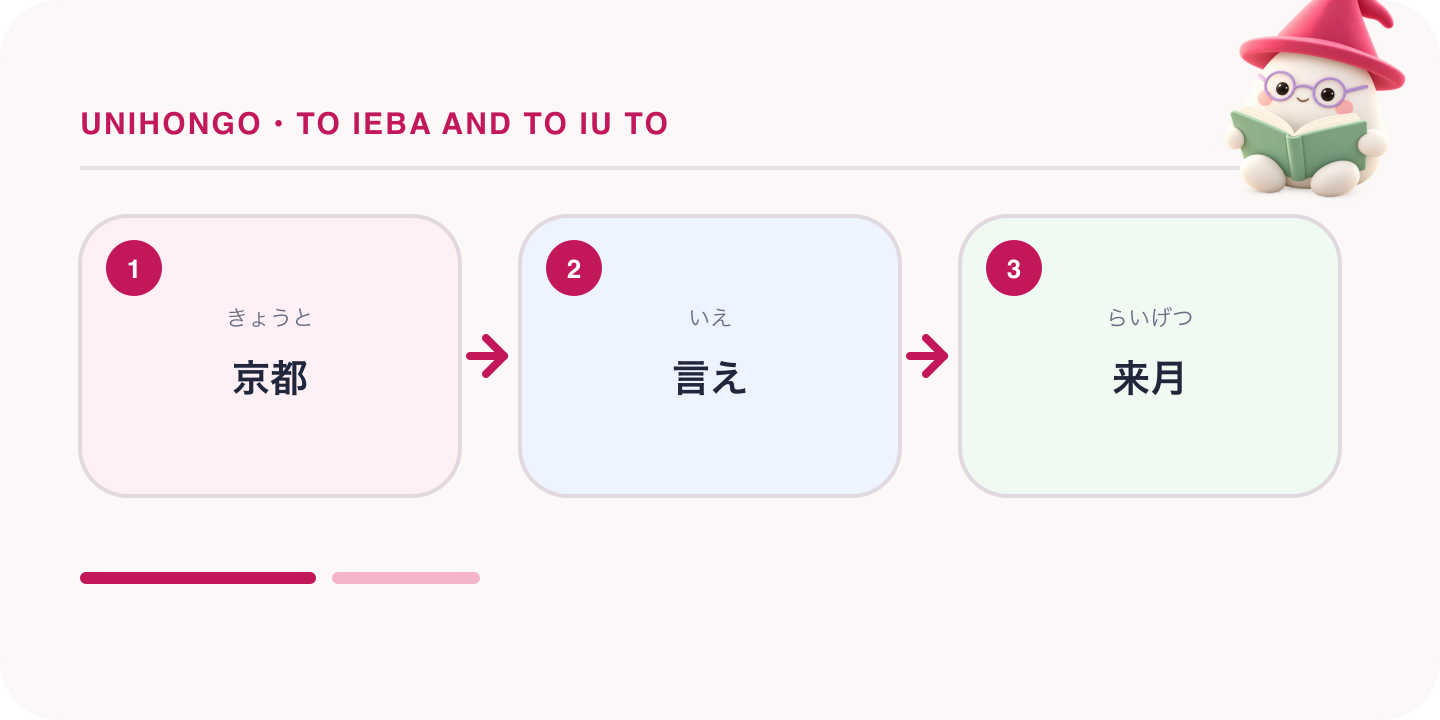
| 京都と言えば、来月行く予定なんです。 | Kyōto to ieba, raigetsu iku yotei nan desu. | Speaking of Kyoto, I'm planning to go next month. |
| 京都と言うと、お寺を思い出します。 | Kyōto to iu to, o-tera o omoidashimasu. | When you say Kyoto, I think of temples. |
| 京都に住んでいたと言っても、半年だけです。 | Kyōto ni sunde ita to ittemo, hantoshi dake desu. | I lived in Kyoto, though only for six months. |
| 京都というのは、昔の都です。 | Kyōto to iu no wa, mukashi no miyako desu. | Kyoto is the old capital. |
| そう言えば、田中さんは元気? | Sō ieba, Tanaka-san wa genki? | Come to think of it, how is Tanaka? |
To ieba: speaking of which
To ieba follows a noun that has just appeared in the conversation. It says: that word has reminded me of something related, and I am going to talk about it now. The new topic can be a question, news or a story; what matters is that the link is visible, even if thin.
The most useful form is sō ieba, literally if you say so, meaning come to think of it. It needs no specific noun; it signals that something has triggered a memory. It is one of the most common topic openers in casual Japanese and is fine at the office when followed by desu or masu.
There is also the set pattern X to ieba Y, naming the most typical example of something: Nihon no natsu to ieba hanabi, Japanese summer means fireworks. For this meaning to ieba and to iu to are interchangeable.
| Japanese | Romaji | Meaning |
|---|---|---|
| そう言えば、先週の映画、どうだった? | Sō ieba, senshū no eiga, dō datta? | Oh, that reminds me, how was last week's film? |
| ラーメンと言えば、駅前に新しい店ができたよ。 | Rāmen to ieba, ekimae ni atarashii mise ga dekita yo. | Speaking of ramen, a new place opened in front of the station. |
| 旅行と言えば、パスポートの期限は大丈夫ですか。 | Ryokō to ieba, pasupōto no kigen wa daijōbu desu ka. | Speaking of the trip, is your passport still valid? |
| 日本の夏と言えば花火ですね。 | Nihon no natsu to ieba hanabi desu ne. | Japanese summer means fireworks, doesn't it. |
| そう言えば、まだお昼を食べていなかった。 | Sō ieba, mada o-hiru o tabete inakatta. | Come to think of it, I haven't had lunch yet. |
| 田中さんと言えば、来月転勤らしいですよ。 | Tanaka-san to ieba, raigetsu tenkin rashii desu yo. | Speaking of Tanaka, I hear he is transferring next month. |
To iu to: when you say that, I think of
To iu to keeps the focus on the word itself. It introduces what that word means to the speaker, what image it brings up, or what the listener should understand by it. The pattern X to iu to, Y is the standard way to say when people say X, they usually mean Y, or X makes me think of Y. It is calmer and more explanatory than to ieba.
Because it explains, to iu to is common in teaching and in clarifying what someone else has said: Ōsaka to iu to, Ōsaka-shi no koto desu ka, when you say Osaka, do you mean the city? It also opens generalisations about what a word usually implies.
A common spoken relative is sō iu to, when you put it that way, which concedes a point. Nan to iu ka, how should I put it, is a filler that buys time while you search for words, and you will hear it constantly.
| Japanese | Romaji | Meaning |
|---|---|---|
| 日本料理と言うと、まず寿司を思い浮かべます。 | Nihon ryōri to iu to, mazu sushi o omoiukabemasu. | When you say Japanese food, sushi comes to mind first. |
| 大阪と言うと、大阪市のことですか。 | Ōsaka to iu to, Ōsaka-shi no koto desu ka. | When you say Osaka, do you mean the city? |
| 冬と言うと、やっぱり鍋ですね。 | Fuyu to iu to, yappari nabe desu ne. | Winter means hot pot, of course. |
| そう言うと、確かにそうかもしれない。 | Sō iu to, tashika ni sō kamo shirenai. | When you put it that way, you may be right. |
| 何と言うか、ちょっと違う気がする。 | Nan to iu ka, chotto chigau ki ga suru. | How should I put it, it feels a bit off. |
| 先生と言うと、厳しい人を想像しますか。 | Sensei to iu to, kibishii hito o sōzō shimasu ka. | When you hear teacher, do you imagine a strict person? |
To ittemo: having said that
To ittemo comes after a claim and pulls it back. The speaker has said something that could be taken too strongly, so they add having said that, and give the limit. It is the grammar of modesty and precision.
The first clause can be a verb, adjective or noun in plain form: hanaseru to ittemo, takai to ittemo, gakusei to ittemo. The qualification often contains dake, only, or a modest number. Sō wa ittemo, even so, opens a sentence by conceding the previous point and then pushing back.
A close relative is to ittemo ii, it is fair to say, as in seikō to ittemo ii, you could call it a success. That is an evaluation rather than a limit: if the sentence ends with ii, it means you may call it.
| Japanese | Romaji | Meaning |
|---|---|---|
| 日本語が話せると言っても、簡単な会話だけです。 | Nihongo ga hanaseru to ittemo, kantan na kaiwa dake desu. | I can speak Japanese, though only simple conversation. |
| 近いと言っても、歩いて三十分かかります。 | Chikai to ittemo, aruite sanjuppun kakarimasu. | It's close, but it still takes thirty minutes on foot. |
| 料理ができると言っても、カレーくらいです。 | Ryōri ga dekiru to ittemo, karē kurai desu. | I can cook, but only things like curry. |
| そうは言っても、締め切りは明日ですよ。 | Sō wa ittemo, shimekiri wa ashita desu yo. | Even so, the deadline is tomorrow. |
| ほぼ完成と言ってもいいでしょう。 | Hobo kansei to ittemo ii deshō. | You could fairly say it's almost finished. |
To iu no wa: defining and asking
To iu no wa turns a word or a whole phrase into a topic so you can explain it. The pattern X to iu no wa, Y desu or Y to iu imi desu means X means Y. It is the form for definitions, explanations of names, and telling someone what you meant. When you do not know a word, the same pattern becomes the question: X to iu no wa dō iu imi desu ka.
In speech, to iu no wa shrinks to tte: kore tte nani, what is this. The full to iu no wa is more careful and suits a teacher, a client or writing.
At the start of a sentence, to iu no wa means the thing is, and introduces a reason for what you just said. In writing this becomes to iu no mo, the reason being.
| Japanese | Romaji | Meaning |
|---|---|---|
| 「お疲れ様」というのは、どういう意味ですか。 | Otsukaresama to iu no wa, dō iu imi desu ka. | What does otsukaresama mean? |
| 残業というのは、決められた時間の後も働くことです。 | Zangyō to iu no wa, kimerareta jikan no ato mo hataraku koto desu. | Overtime means working after the set hours. |
| これって、何て読むの? | Kore tte, nante yomu no? | How do you read this? |
| 行けないというのは、仕事があるからです。 | Ikenai to iu no wa, shigoto ga aru kara desu. | The reason I can't go is that I have work. |
| というのは、実は先約があるんです。 | To iu no wa, jitsu wa sen'yaku ga aru n desu. | The thing is, I actually have a prior engagement. |
The iu family side by side
The forms are easiest to keep apart when you see what each attaches to and what it does to the conversation. The table lines them up with a typical opening and the job it performs.
| Form | Reading | What it does in conversation |
|---|---|---|
| と言えば | to ieba | Picks up a noun and opens a related new topic |
| そう言えば | sō ieba | Come to think of it; opens a topic the chat triggered |
| と言うと | to iu to | Explains what a word brings to mind or means |
| そう言うと | sō iu to | When you put it that way; concedes a point |
| 何と言うか | nan to iu ka | How should I put it; a filler while thinking |
| と言っても | to ittemo | Having said that; limits the previous claim |
| そうは言っても | sō wa ittemo | Even so; concedes then pushes back |
| と言ってもいい | to ittemo ii | It is fair to say; an evaluation |
| というのは | to iu no wa | Defines a term or asks its meaning |
| って | tte | Casual form of to iu no wa and quoted to |
| というのも | to iu no mo | The reason being; written elaboration |
Two of the rows overlap. For naming the typical example of something, X to ieba Y and X to iu to Y are interchangeable. Everywhere else, keep them separate: to ieba moves on, to iu to stays and explains.
Spoken versus written register
In conversation, these bridges are frequent and short, and dropping polite endings is normal among friends. At work you keep the same phrases but finish with desu and masu, and use the full to iu no wa rather than tte with a client.
In formal writing, sō ieba is too chatty; writers prefer ni kanshite, regarding, or tsugi ni, next. To iu to and to iu no wa survive because they explain, and to ittemo is fine in an argument. In a presentation, announce topic changes with tsugi ni or sate rather than sō ieba.
- Friends: sō ieba, tte, nan to iu ka, sō iu to, no polite endings
- Office chat: the same phrases with desu and masu
- Explaining to a client: to iu no wa, to iu to, not tte
- Presentations: to ittemo and to iu to are fine; use tsugi ni for topic changes
- Reports and formal email: ni kanshite, tsugi ni, to iu no mo; avoid sō ieba
Common mistakes when shifting topics
The first mistake is using to ieba to introduce a topic with no link to what came before. Kyōto to ieba only works if Kyoto, travel, temples or something related has come up. For a completely fresh subject, use tokoro de or sō ieba, both of which allow a looser connection.
The second is finishing to iu to with a consequence, as if it were a plain conditional. In the bridge use, what follows is an association or explanation. Third, learners overuse to ittemo until every claim is hedged, which sounds evasive; one hedge per topic is plenty.
Finally, watch the difference between to iu no wa and to iu koto wa. To iu koto wa means so that means, or in other words, and draws a conclusion: kuru to iu koto wa, denwa shita n desu ne, so you're coming, which means you called. To iu no wa defines; to iu koto wa deduces.
| Japanese | Romaji | Meaning |
|---|---|---|
| ところで、週末は何か予定がありますか。 | Tokoro de, shūmatsu wa nani ka yotei ga arimasu ka. | By the way, do you have any plans for the weekend? |
| ちなみに、この店は火曜日が休みです。 | Chinami ni, kono mise wa kayōbi ga yasumi desu. | Incidentally, this shop is closed on Tuesdays. |
| 来ないということは、忙しいんですね。 | Konai to iu koto wa, isogashii n desu ne. | So you're not coming; that means you're busy, then. |
| 話は変わりますが、来月の予定はどうですか。 | Hanashi wa kawarimasu ga, raigetsu no yotei wa dō desu ka. | To change the subject, how is next month looking? |
| それはさておき、本題に入りましょう。 | Sore wa sate oki, hondai ni hairimashō. | Setting that aside, let's get to the main topic. |