
Datte and mon in one minute
Datte (だって) at the start of a sentence answers a complaint or a why question: but... or because.... Mon (もん) at the end of the sentence marks what came before as your reason, with a personal, slightly pouting tone. You can use either one alone, but the two together form the classic excuse frame: datte + reason + mon.
The four lines below cover most of what you will hear. The first is the model excuse; the others show the same tone with different reasons.
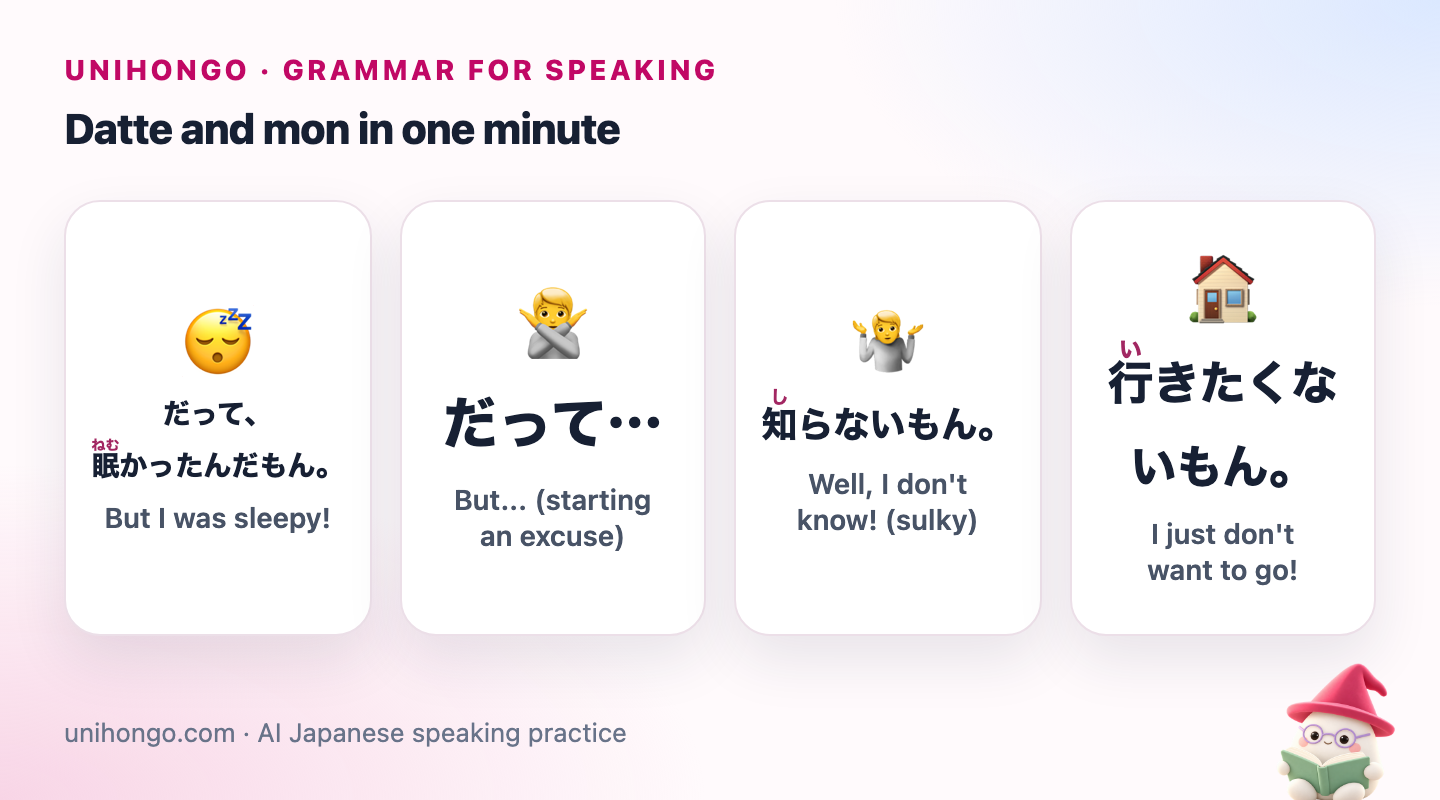
| Japanese | Romaji | Meaning |
|---|---|---|
| だって、眠かったんだもん。 | Datte, nemukatta n da mon. | But I was sleepy! |
| だって… | Datte... | But... (starting an excuse) |
| 知らないもん。 | Shiranai mon. | Well, I don't know! (sulky) |
| 行きたくないもん。 | Ikitakunai mon. | I just don't want to go! |
| だって、そうだもん。 | Datte, sō da mon. | But that's just how it is! |
Datte as an excuse opener
Datte usually reacts to something the other person said: a question like why didn't you come?, a complaint like you're late again, or an order like eat your vegetables. It means I have a reason, and here it comes. Because it pushes back, it carries a hint of protest. Said with a smile it is playful; said with a frown it is defensive.
Often the reason that follows ends in kara (because) or n da (it's that...), and in the most casual speech in mon. All three are possible: datte, isogashikatta kara is a neutral explanation, while datte, isogashikatta n da mon sounds more like a pout.
| Japanese | Romaji | Meaning |
|---|---|---|
| なんで遅れたの? | Nande okureta no? | Friend: Why were you late? |
| だって、電車が止まったんだもん。 | Datte, densha ga tomatta n da mon. | You: But the train stopped! |
| だって、忙しかったから。 | Datte, isogashikatta kara. | Because I was busy. (neutral) |
| だって、高いんだもん。 | Datte, takai n da mon. | But it's expensive! |
How mon attaches: plain forms and n da mon
Mon is a casual, spoken form of mono (もの), thing. At the end of a sentence it attaches to the plain (dictionary-style) form, never to masu. You can add it directly, or put the explanatory n da in front of it. The n da mon version is very common in excuses because n da already means the thing is, you see.
| Japanese | Romaji | Meaning |
|---|---|---|
| 寒いんだもん。 | Samui n da mon. | It's cold, that's why! |
| 疲れたんだもん。 | Tsukareta n da mon. | I'm tired, okay? |
| 好きなんだもん。 | Suki na n da mon. | I just like it! |
| 子供じゃないもん。 | Kodomo ja nai mon. | I'm not a kid! |
| Word type | Direct | With n da |
|---|---|---|
| Verb | iku mon (I'm going, so there) | iku n da mon |
| Negative verb | ikanai mon | ikanai n da mon |
| I-adjective | samui mon (it's cold!) | samui n da mon |
| Past | tsukareta mon | tsukareta n da mon |
| Noun | kodomo da mon (I'm a kid!) | kodomo na n da mon |
| Na-adjective | suki da mon (I like it!) | suki na n da mon |
Notice the da after nouns and na-adjectives in the direct form, and the na before n da mon. Saying suki mon without da is a classic learner slip.
Mon ne and mono: softer and more grown-up versions
Add ne and the sulk disappears. Mon ne (もんね) turns the reason into something you expect the listener to share: after all, right? It often closes an argument gently. Sō da mon ne means that's how it is, isn't it, with a nod of agreement, and yakusoku shita mon ne means we did promise, after all.
The full form mono (もの) sounds softer and a little more grown-up. In the polite version desu mono you may hear it in films or from some older speakers, especially women, with a gentle, slightly old-fashioned feel. Most learners never need to produce it, but it helps to recognise it.
Finally, a related phrase describes the habit itself: demo demo datte (でもでもだって) is a teasing label for someone who answers every suggestion with but... and because.... Parents use the same idea when they tell a child to stop making excuses.
| Japanese | Romaji | Meaning |
|---|---|---|
| そうだもんね。 | Sō da mon ne. | That's how it is, right? |
| 約束したもんね。 | Yakusoku shita mon ne. | We did promise, after all. |
| 子供ですもの。 | Kodomo desu mono. | After all, they are children. (soft) |
| でもとかだってとか言わないの。 | Demo toka datte toka iwanai no. | Parent: No buts and no becauses. |
Cute, childish or annoying? Who says it to whom
The same sentence can land in very different ways. Between close friends, a pouting datte, nemukatta n da mon usually gets a laugh and a mō! in reply. From a small child it is simply how children talk. From an adult to a boss, it sounds like a child who refuses to take responsibility. Many people also associate mon with a cute, soft style, so in some groups it can sound like you are acting cute on purpose, which is fine as a joke and odd as a habit.
| Situation | How datte... mon sounds | Better choice |
|---|---|---|
| Close friend, playful | Natural and funny | Use it freely |
| Partner or family | Affectionate or sulky, depending on tone | Use it with a smile |
| Classmate you barely know | A bit too familiar | Plain kara: nemukatta kara |
| Teacher, boss, customer | Childish and irresponsible | Sumimasen + short reason |
Scenario: why didn't you come last night?
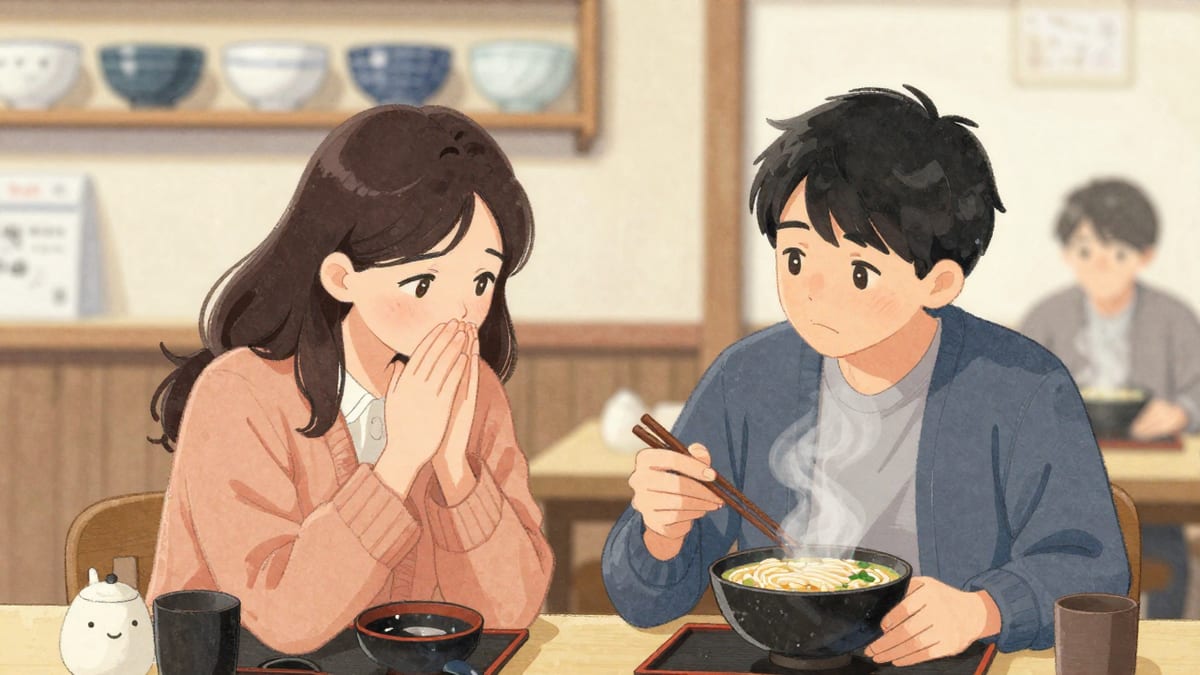
Your friend Yui organised a karaoke night. You promised to come, then fell asleep on the sofa. The next day she catches you at lunch. This is exactly the moment for datte, but notice how the conversation still ends with a real apology.
| Japanese | Romaji | Meaning |
|---|---|---|
| 昨日、なんで来なかったの? | Kinō, nande konakatta no? | Yui: Why didn't you come yesterday? |
| ごめん!だって、眠かったんだもん。 | Gomen! Datte, nemukatta n da mon. | You: Sorry! But I was sleepy! |
| え、それだけ? | E, sore dake? | Yui: What, that's it? |
| だって、朝まで仕事だったんだもん。 | Datte, asa made shigoto datta n da mon. | You: But I worked until morning! |
| もう、しょうがないなあ。 | Mō, shō ga nai nā. | Yui: Honestly, what can I do with you. |
| 次は絶対行くね。 | Tsugi wa zettai iku ne. | You: I'll definitely come next time. |
Shō ga nai nā, roughly oh well, it can't be helped, is the usual sign that the excuse has been accepted. The promise at the end matters: a datte excuse with no apology at all can sound selfish even between friends.
Common mistakes and the polite alternative
When you need the grown-up version, the structure flips: the apology comes first, the reason is short and plain, and there is no datte. Japanese listeners tend to value a clear apology over a long justification.
| Japanese | Romaji | Meaning |
|---|---|---|
| すみません、寝坊してしまいました。 | Sumimasen, nebō shite shimaimashita. | I'm sorry, I overslept. (polite) |
| 電車が遅れていました。 | Densha ga okurete imashita. | The train was delayed. (polite) |
| 次から気をつけます。 | Tsugi kara ki o tsukemasu. | I'll be careful from now on. |
- Using mon with masu: ikimasu mon is not standard. Use the plain form, or drop mon and speak politely.
- Dropping da after nouns and na-adjectives: say suki da mon or suki na n da mon, not suki mon.
- Confusing the three datte: excuse at the start, even after a noun, I heard at the end.
- Using datte with a teacher or boss: it sounds like talking back. Apologise first, then explain.
- Ending every reason with mon: once is cute, five times in a row sounds like a sulking child.