

Three endings, three jobs
All three patterns start from the masu stem: the form you get by taking the masu off a polite verb. Shimasu gives shi, wakarimasu gives wakari, okuremasu gives okure. From that stem you can build shikaneru, shikanenai and shiyō ga nai, and each means something different.
Kaneru is a formal way to say that you cannot or are not in a position to do something. It usually appears in its polite form, kanemasu, and often in the humble form itashikanemasu. Kanenai means that an undesirable thing could well happen; it is a warning, not a refusal. Yō ga nai means there is no way, no means or no method to do the action. Keep those three glosses in mind and the rest of the grammar falls into place.
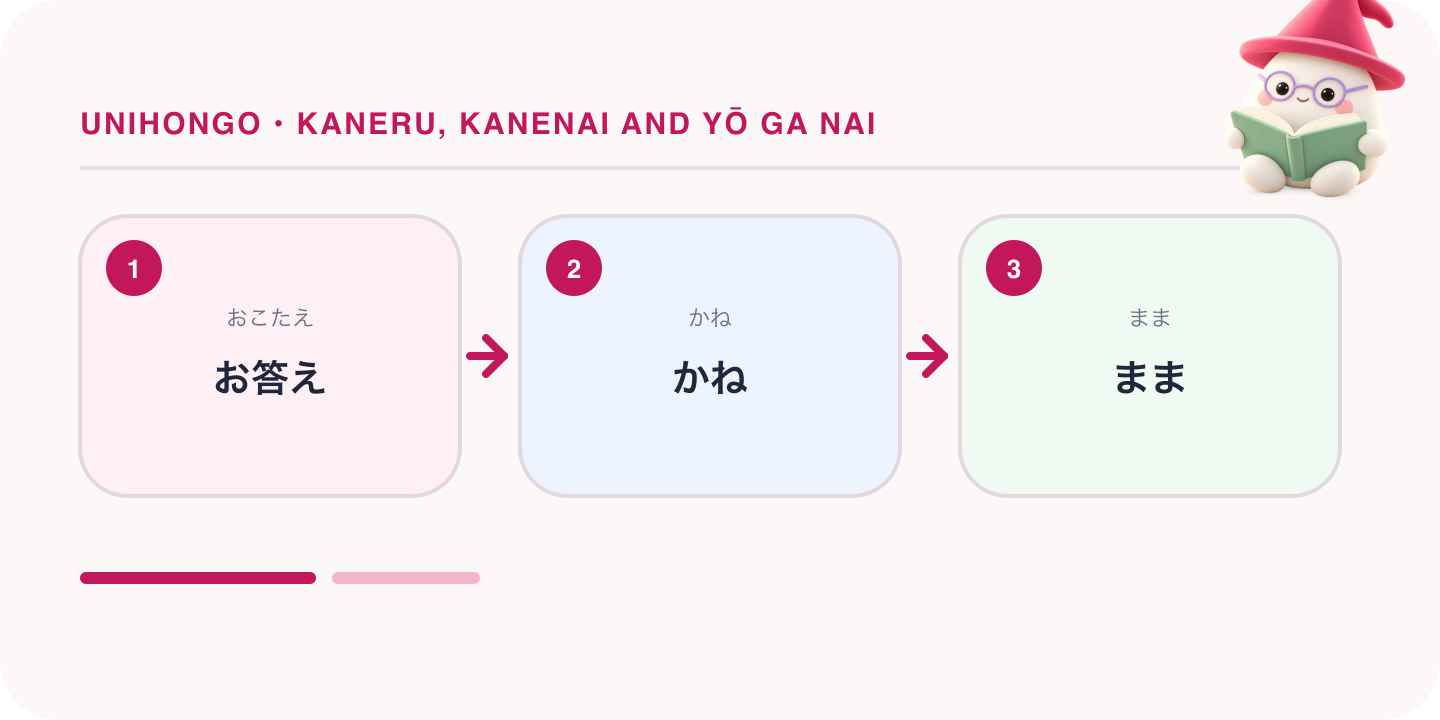
| Japanese | Romaji | Meaning |
|---|---|---|
| その件はお答えしかねます。 | Sono ken wa o-kotae shikanemasu. | I am unable to answer on that matter. |
| このままだと、納期に遅れかねません。 | Kono mama da to, nōki ni okure kanemasen. | At this rate, we could well miss the delivery date. |
| 連絡先が分からないので、連絡のしようがありません。 | Renrakusaki ga wakaranai node, renraku no shiyō ga arimasen. | I do not know their contact details, so there is no way to contact them. |
| 彼なら、そう言いかねない。 | Kare nara, sō ii kanenai. | Knowing him, he might well say that. |
Kaneru: the formal cannot
Kaneru conjugates like an ordinary ichidan verb: kaneru, kanemasu, kanemashita, and in humble form itashikanemasu when the verb is suru. You will almost never hear the plain kaneru in speech; the polite kanemasu and itashikanemasu are the forms that matter. Attach it to the stem of the action you are refusing: henkin shikanemasu, we cannot refund; o-uke shikanemasu, we cannot accept; sansei shikanemasu, I cannot agree.
The meaning is closer to I am not in a position to than to it is impossible. That nuance is exactly why offices like it: it refuses without blaming anyone and without saying the thing can never happen. Dekimasen states a hard fact; kanemasu keeps a respectful distance and suggests that circumstances, rules or the speaker's role are what stop it.
Because the meaning is already negative, adding a negative is wrong. Shikanemasen is not a stronger refusal; it is the different word kanenai in polite form. Kaneru is also only for what you or your company cannot do, never for the listener's inability.
| Japanese | Romaji | Meaning |
|---|---|---|
| 申し訳ございませんが、返金はいたしかねます。 | Mōshiwake gozaimasen ga, henkin wa itashikanemasu. | I am very sorry, but we are unable to issue a refund. |
| あいにく、その日程では対応しかねます。 | Ainiku, sono nittei de wa taiō shikanemasu. | Unfortunately, we cannot accommodate that schedule. |
| 現時点では判断しかねます。 | Genjiten de wa handan shikanemasu. | I cannot make a judgement at this point. |
| その条件には賛成しかねます。 | Sono jōken ni wa sansei shikanemasu. | I am unable to agree to those terms. |
| 恐れ入りますが、こちらでは分かりかねます。 | Osoreirimasu ga, kochira de wa wakari kanemasu. | I am afraid I am unable to say from here. |
Kanenai: might well, and never good news
Kanenai is a fixed negative form with no affirmative partner in this meaning. It attaches to the masu stem and says that the action could easily happen, with the clear implication that you would rather it did not. The polite form is kanemasen; the plain kanenai is normal in reports and news.
The restriction to bad outcomes is not a style preference; it is part of the word. Gōkaku shikanenai, might well pass the exam, is wrong because passing is good. For welcome possibilities, use kamoshirenai or kanōsei ga aru. Kanenai is for lateness, accidents, misunderstandings, complaints, losses and anything else you want to prevent.
| Japanese | Romaji | Meaning |
|---|---|---|
| この表現は誤解を招きかねません。 | Kono hyōgen wa gokai o maneki kanemasen. | This wording could well cause a misunderstanding. |
| 無理な運転は事故につながりかねない。 | Muri na unten wa jiko ni tsunagari kanenai. | Reckless driving could easily lead to an accident. |
| 今のペースだと、予算を超えかねません。 | Ima no pēsu da to, yosan o koe kanemasen. | At the current pace, we could well go over budget. |
| 対応が遅れると、クレームになりかねない。 | Taiō ga okureru to, kurēmu ni nari kanenai. | If the response is slow, it could turn into a complaint. |
Yō ga nai: there is no way to
Yō here is the noun 様, meaning a way or manner, so stem plus yō ga nai is literally there is no way of doing it. Suru becomes shiyō ga nai, iu becomes iiyō ga nai, and setsumei suru becomes setsumei no shiyō ga nai, with no linking the noun to the verb stem. The polite form is yō ga arimasen or yō ga gozaimasen.
There are two flavours. The literal one says the means are missing: no phone number, so no way to call. The resigned one, shō ga nai or shiyō ga nai on its own, means it cannot be helped: if there is no way to do anything, all you can do is accept it.
The difference from kaneru is who is stopping you. Kaneru says the speaker is not in a position to; yō ga nai says the world offers no method at all.
| Japanese | Romaji | Meaning |
|---|---|---|
| 番号が分からないので、電話のかけようがない。 | Bangō ga wakaranai node, denwa no kakeyō ga nai. | I do not know the number, so there is no way to call. |
| 記録が残っていないため、確認のしようがございません。 | Kiroku ga nokotte inai tame, kakunin no shiyō ga gozaimasen. | No records remain, so there is no way to check. |
| こんなにひどいと、直しようがないね。 | Konna ni hidoi to, naoshiyō ga nai ne. | When it is this bad, there is no way to fix it. |
| 雨だから、しょうがないよ。 | Ame da kara, shō ga nai yo. | It is raining, so it cannot be helped. |
Softening a refusal in emails and customer service
Japanese business refusals follow a rhythm: a cushion phrase, a brief reason, the refusal itself, and an alternative or apology. Kanemasu sits in the third slot, and the cushion in front of it does most of the softening. Mōshiwake gozaimasen ga, ainiku, osoreirimasu ga and sekkaku desu ga are the usual openers. Without a cushion, even itashikanemasu can land coldly.
The reason is often kept vague on purpose: kisoku jō, for regulatory reasons; shanai kitei ni yori, under internal rules. These put the refusal on the rules rather than on the person asking. Then offer something: a different date, a written route, a colleague who can help.
| Japanese | Romaji | Meaning |
|---|---|---|
| 恐れ入りますが、規則上、お受けしかねます。何卒ご了承ください。 | Osoreirimasu ga, kisoku jō, o-uke shikanemasu. Nanitozo go-ryōshō kudasai. | I am afraid that, under our rules, we cannot accept this. We ask for your understanding. |
| せっかくですが、今回は参加しかねます。 | Sekkaku desu ga, konkai wa sanka shikanemasu. | Thank you for asking, but I am unable to take part this time. |
| 代わりに、来週でしたら対応可能です。 | Kawari ni, raishū deshitara taiō kanō desu. | Instead, we can accommodate it next week. |
- Cushion: mōshiwake gozaimasen ga, ainiku, osoreirimasu ga, sekkaku desu ga
- Reason: kisoku jō, shanai kitei ni yori, genjiten de wa, zaiko no kankei de
- Refusal: itashikanemasu, o-uke shikanemasu, taiō shikanemasu, o-kotae shikanemasu
- Alternative: kawari ni, moshi yoroshikereba, betsu no hōhō to shite
- Closing: nanitozo go-ryōshō kudasai, go-rikai no hodo onegai itashimasu
Put together: Mōshiwake gozaimasen ga, shanai kitei ni yori, go-kibō no waribiki wa itashikanemasu. Kawari ni, sōryō o muryō to sasete itadakimasu. A refusal, a reason and a gift in two sentences.
Forms at a glance
The table shows how each ending sits on common verbs. Notice that suru verbs take the stem shi, and that yō ga nai often inserts no between a noun and shiyō in written Japanese.
| Form | Reading | Meaning |
|---|---|---|
| お答えしかねます | o-kotae shikanemasu | I am unable to answer (formal refusal) |
| いたしかねます | itashikanemasu | we cannot do that (humble refusal) |
| 分かりかねます | wakari kanemasu | I am unable to say (polite I do not know) |
| 賛成しかねる | sansei shikaneru | cannot agree (plain, mostly written) |
| 遅れかねない | okure kanenai | might well be late |
| 誤解を招きかねません | gokai o maneki kanemasen | could well cause misunderstanding (polite) |
| 事故になりかねない | jiko ni nari kanenai | could easily turn into an accident |
| 言いかねない | ii kanenai | might well say (something regrettable) |
| 連絡のしようがない | renraku no shiyō ga nai | there is no way to get in touch |
| 直しようがない | naoshiyō ga nai | there is no way to fix it |
| どうしようもない | dō shiyō mo nai | nothing can be done at all |
| しょうがない | shō ga nai | it cannot be helped (casual resignation) |
Contrasts with dekinai, kamoshirenai and shikata ga nai
Dekimasen and kanemasu both refuse, and the choice is about tone. Dekimasen is plain fact and is right when the thing is genuinely impossible, such as a train that has already left. Kanemasu is the softer, more formal choice when a person or a rule is behind the refusal.
Kamoshirenai and kanenai both express possibility. Kamoshirenai is neutral and works for good and bad outcomes alike, at any register. Kanenai is formal, restricted to unwelcome outcomes, and stronger: it suggests that the conditions for the bad thing are already in place. Osoreru ga aru, there is a fear that, is a further formal alternative common in official notices.
Shikata ga nai comments on a whole situation and is often a gentle consolation; stem plus yō ga nai is tied to a specific verb and usually reports that a method is lacking.
| Japanese | Romaji | Meaning |
|---|---|---|
| 電車はもう出たので、乗れません。 | Densha wa mō deta node, noremasen. | The train has already left, so we cannot board it. |
| 明日は雨かもしれない。 | Ashita wa ame kamoshirenai. | It might rain tomorrow. |
| この道は冬に凍りかねないので注意してください。 | Kono michi wa fuyu ni kōri kanenai node chūi shite kudasai. | This road could well freeze in winter, so take care. |
| 混雑のおそれがありますので、お早めにお越しください。 | Konzatsu no osore ga arimasu node, o-hayame ni o-koshi kudasai. | There is a risk of crowding, so please come early. |
Common mistakes and how to fix them
The most damaging mistake is treating kanemasen as the polite form of kanemasu. A learner writes henkin shikanemasen intending a firm refusal, but the reader understands we might well refund, which is a promise of the opposite. If you want to refuse, the form is kanemasu, with no negative. If you want to warn, the form is kanenai, and it must describe something bad.
The second mistake is using kanenai for happy possibilities. Yūshō shikanenai, might well win the championship, sounds bizarre because winning is not a threat. Switch to kamoshirenai. The third is register: itashikanemasu to a friend, or shō ga nai in a formal apology, both jar.
Finally, kaneru is about the speaker's side, so you cannot use it to say a customer cannot do something; use the potential form instead. Yō ga nai needs a verb stem, and with a suru noun it takes no in careful writing: setsumei no shiyō ga nai, not setsumei shiyō ga nai, which sounds like the volitional.
| Japanese | Romaji | Meaning |
|---|---|---|
| 返金はいたしかねます。 | Henkin wa itashikanemasu. | We cannot issue a refund. (correct refusal) |
| 優勝するかもしれない。 | Yūshō suru kamoshirenai. | They might win the championship. (not kanenai) |
| お客様のほうで変更していただくことは可能です。 | O-kyakusama no hō de henkō shite itadaku koto wa kanō desu. | It is possible for you to make the change yourself. (not kaneru for the listener) |
| 説明のしようがない。 | Setsumei no shiyō ga nai. | There is no way to explain it. (no links the noun) |