

The rule: the speaker is the centre
Iku describes movement away from where the speaker is, and kuru describes movement towards where the speaker is. That is the whole rule. What makes it hard is that English come is more flexible: it can point at the listener (I'll come to you), at a shared destination (are you coming to the party) or at the speaker. Japanese kuru only ever points at the speaker.
So watashi wa gakkō ni ikimasu, I go to school, uses iku because school is away from where I am speaking. Tomodachi ga uchi ni kimasu, a friend is coming to my house, uses kuru because the friend moves towards me. If I am already at school and describe a friend arriving there, it is kimasu, because the friend is moving towards where I am now.
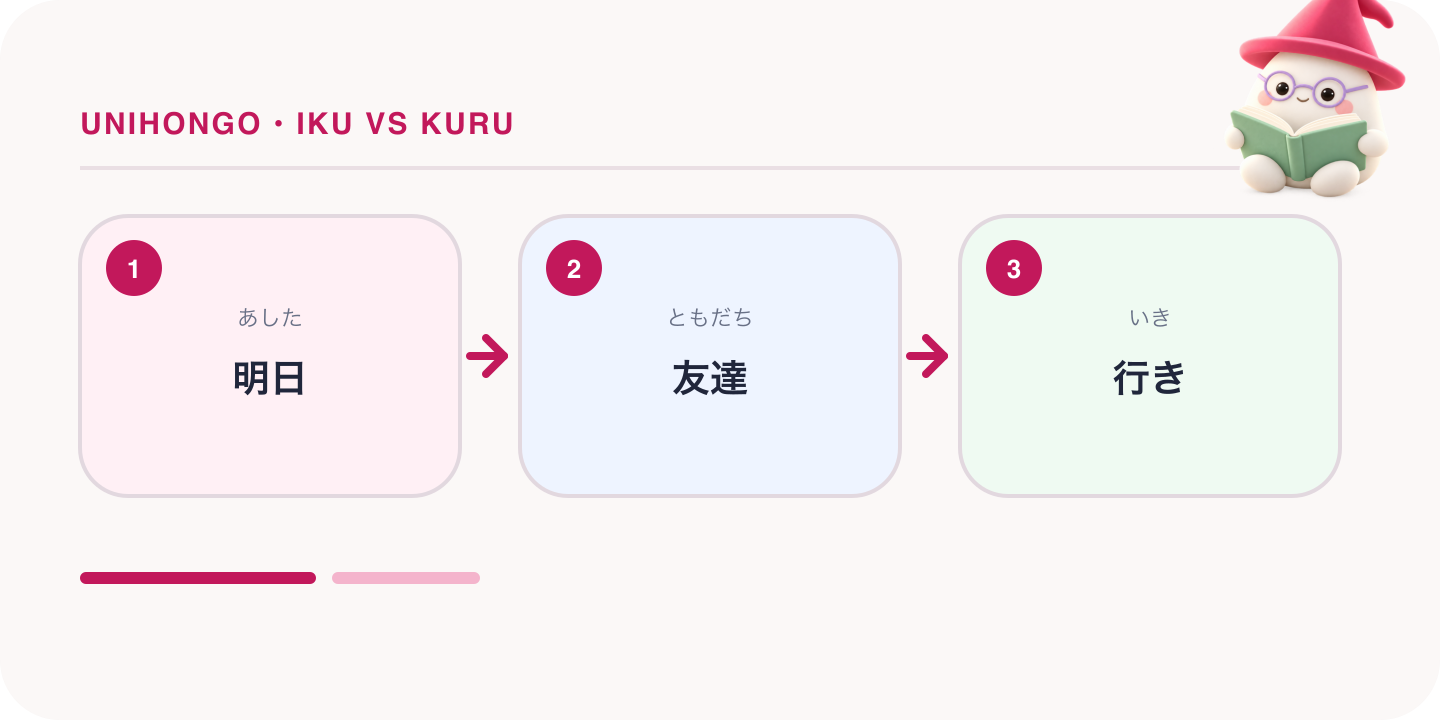
| Japanese | Romaji | Meaning |
|---|---|---|
| 明日、友達が家に来ます。 | Ashita, tomodachi ga uchi ni kimasu. | Tomorrow a friend is coming to my house. |
| 明日、友達の家に行きます。 | Ashita, tomodachi no ie ni ikimasu. | Tomorrow I am going to my friend's house. |
| 先生はもう教室に来ています。 | Sensei wa mō kyōshitsu ni kite imasu. | The teacher is already here in the classroom. (I am there too) |
| 先生はもう教室に行っています。 | Sensei wa mō kyōshitsu ni itte imasu. | The teacher has already gone to the classroom. (I am elsewhere) |
| 日本に来て三年になります。 | Nihon ni kite sannen ni narimasu. | It has been three years since I came to Japan. (I am in Japan) |
Ima ikimasu: answering a call from another room
The sentence that surprises every learner is the answer to being called. Your host calls gohan desu yo from the kitchen, and you reply ima ikimasu. In English you would say coming, but you are the one who will move away from your current spot towards the caller, so from your own position it is going. Ima kimasu would mean someone is about to arrive where you are.
The same logic covers a doorbell, a colleague waving you over, and a shop assistant calling your number. Sugu ikimasu, I will be right there; ima mukaimasu, I am heading over now. Notice that Japanese does not switch to the listener's viewpoint even out of politeness; the direction stays with the speaker.
There is one polite exception you will hear from staff: mairimasu, the humble form of both iku and kuru. Tadaima mairimasu, I will be with you right away, avoids the choice altogether, which is one reason it is so common in shops and hotels.
| Japanese | Romaji | Meaning |
|---|---|---|
| はい、今行きます。 | Hai, ima ikimasu. | Yes, coming! |
| すぐ行きますから、待っていてください。 | Sugu ikimasu kara, matte ite kudasai. | I will be right there, so please wait. |
| ちょっと待って、今そっちに行く。 | Chotto matte, ima sotchi ni iku. | Hang on, I am coming over to you now. |
| ただいま参ります。 | Tadaima mairimasu. | I will be with you right away. (humble) |
| 呼ばれたので、受付に行ってきます。 | Yobareta node, uketsuke ni itte kimasu. | They called me, so I am going to the reception desk and will be back. |
Phone calls and text messages
On the phone, the two speakers are in different places, and each keeps their own viewpoint. If your friend is at the café and you are at home, you say ima kara ikimasu, and your friend says matte iru kara, hayaku kite, wait, come quickly. Both are correct at once, because each sentence is anchored to its own speaker.
Japanese speakers do sometimes shift their viewpoint to the listener's location, especially when reassuring someone: sugu iku kara from the caller's side, but also sugu kuru? asked by the person waiting. What you should avoid is describing your own movement towards the listener with kuru, as in ima kimasu, which sounds like a translation.
In texts, the safest verbs are tsuku, to arrive, and mukau, to head towards, because neither depends on direction. Mō sugu tsuku, arriving soon; ima mukatte iru, on my way; eki ni tsuita, I am at the station. These are the messages Japanese friends actually send.
| Japanese | Romaji | Meaning |
|---|---|---|
| 今から行くね。十分くらいで着く。 | Ima kara iku ne. Juppun kurai de tsuku. | I am leaving now. I will be there in about ten minutes. |
| もう着いた?こっちは駅の北口にいるよ。 | Mō tsuita? Kotchi wa eki no kitaguchi ni iru yo. | Have you arrived? I am at the north exit of the station. |
| ごめん、少し遅れる。先に店に入っていて。 | Gomen, sukoshi okureru. Saki ni mise ni haitte ite. | Sorry, I will be a bit late. Go into the shop ahead of me. |
| 何時ごろ来られますか。 | Nanji goro koraremasu ka. | About what time can you come? (asked by the person waiting) |
| 今向かっています。 | Ima mukatte imasu. | I am on my way now. |
Motte iku and motte kuru: carrying things
Motsu, to hold, in its te form plus iku or kuru gives take and bring. Motte iku is taking something away from where you are: bentō o motte iku, take a packed lunch. Motte kuru is bringing something to where you are or will be: kasa o motte kite, bring an umbrella. The direction is judged from the speaker, exactly as before.
Requests are where this matters most. Motte kite kudasai asks someone to bring a thing to you. Motte itte kudasai asks someone to take a thing away from you, for example to another room or another office. If you are the one delivering, motte ikimasu; if you want someone to leave a document with you, motte kite kudasai. Confusing these two sends the object the wrong way.
| Japanese | Romaji | Meaning |
|---|---|---|
| 明日はお弁当を持って行きます。 | Ashita wa o-bentō o motte ikimasu. | Tomorrow I will take a packed lunch. |
| 傘を持って来るのを忘れました。 | Kasa o motte kuru no o wasuremashita. | I forgot to bring an umbrella. |
| この書類を三階に持って行ってください。 | Kono shorui o sankai ni motte itte kudasai. | Please take these documents to the third floor. |
| 書類は明日持って来てください。 | Shorui wa ashita motte kite kudasai. | Please bring the documents tomorrow. |
| 何か持って行きましょうか。 | Nanika motte ikimashō ka. | Shall I bring something? (to your place) |
Tsurete iku and tsurete kuru: bringing people
For people and animals, the verb is tsureru, to accompany, so tsurete iku is taking someone with you to another place and tsurete kuru is bringing someone to where you are. Kodomo o tsurete iku, take the children along; tomodachi o tsurete kite mo ii desu ka, may I bring a friend?
The distinction between motte and tsurete is strict: motte kuru a person sounds like carrying them under your arm. Tsurete also takes the same request forms, tsurete itte kudasai (take me with you) and tsurete kite kudasai (bring them here). Dogs, small children and friends all take tsurete; luggage and lunch take motte.
| Japanese | Romaji | Meaning |
|---|---|---|
| 週末、子どもを動物園に連れて行きます。 | Shūmatsu, kodomo o dōbutsuen ni tsurete ikimasu. | At the weekend I am taking the children to the zoo. |
| パーティーに友達を連れて来てもいいですか。 | Pātī ni tomodachi o tsurete kite mo ii desu ka. | May I bring a friend to the party? |
| 私も連れて行ってください。 | Watashi mo tsurete itte kudasai. | Please take me with you. |
| 犬を連れて来ないでください。 | Inu o tsurete konaide kudasai. | Please do not bring dogs. |
| 駅まで連れて行ってもらえますか。 | Eki made tsurete itte moraemasu ka. | Could you take me to the station? |
Kaeru, modoru and the return verbs
Kaeru means to return to your base: home, your home country, your own office. It is used whether you are moving away from the speaker or towards them, because the meaning is about the destination being your base. Uchi ni kaeru, go home; kuni ni kaeru, return to one's country. Modoru means to go back to a place you were at recently and does not need it to be your base: seki ni modoru, return to your seat.
To add direction, combine with iku or kuru. Kaette kuru is to come back to where the speaker is, which is how a parent talks about a child returning home. Kaette iku is to go back away from the speaker, used when a visitor leaves. Modotte kuru and modotte iku work the same way. Kaeru on its own from the person who is leaving is complete: sorosoro kaerimasu, I will be heading home soon.
| Verb | Reading | Direction and meaning |
|---|---|---|
| 行く | iku | away from the speaker: go |
| 来る | kuru | towards the speaker: come |
| 帰る | kaeru | return to base (home, country), any direction |
| 戻る | modoru | go back to a recent place, any direction |
| 帰って来る | kaette kuru | come back to where the speaker is |
| 帰って行く | kaette iku | go back away from the speaker |
| 持って行く | motte iku | take a thing away from the speaker |
| 持って来る | motte kuru | bring a thing to the speaker |
| 連れて行く | tsurete iku | take a person or animal away with you |
| 連れて来る | tsurete kuru | bring a person or animal to the speaker |
| 向かう | mukau | head towards, direction neutral |
| 着く | tsuku | arrive, direction neutral |
Kaeru and kuru are the verbs in the two words every household uses daily: itte kimasu (I am off, and will come back) when leaving, and tadaima and okaeri when returning. Itte kimasu is literally go and come, a promise to return to the base.
Te iku and te kuru, briefly
Attached to another verb's te form, iku and kuru become auxiliaries that add direction or a sense of time. Katte kuru means go and buy something and come back, katte iku means buy something on the way, and the same pair covers changes over time: samuku natte kita, it has been getting cold up to now; fuete iku, it will keep increasing from here on.
The spatial logic is the same as for the main verbs: kuru arrives at the speaker's here and now, iku moves away from it. A separate guide on this blog covers the te iku and te kuru auxiliaries in detail, including the tricky cases of change and continuation, so here it is enough to remember that itte kimasu and katte kimasu both promise a return to where you are.
| Japanese | Romaji | Meaning |
|---|---|---|
| ちょっとコーヒーを買って来ます。 | Chotto kōhī o katte kimasu. | I will just go and buy a coffee. (and come back) |
| 帰りにパンを買って行きます。 | Kaeri ni pan o katte ikimasu. | I will buy bread on the way home. |
| だんだん寒くなって来ました。 | Dandan samuku natte kimashita. | It has been getting colder and colder. |
| これから人口は減って行くでしょう。 | Kore kara jinkō wa hette iku deshō. | From here on the population will keep decreasing. |
Common mistakes and how to fix them
The classic mistake is ima kimasu when called, or kimasu for visiting someone. Both come from translating English come. Fix them by asking where you are standing when you speak: moving away is iku. The second mistake is the reverse, using iku for someone arriving at your location: tomodachi ga uchi ni ikimasu is wrong; the friend comes towards you, so kimasu.
Learners also mix motte and tsurete, and put objects on the wrong side of a request. If you want the thing to end up where you are, kuru; if you want it to leave, iku. With kaeru, the error is adding a destination that is not a base: seki ni kaeru is odd; seki ni modoru is right. Finally, on the phone, do not adopt the listener's viewpoint for your own movement: say ima kara ikimasu, not ima kara kimasu, even though the friend will hear it as coming.
- Called from another room: ima ikimasu, not ima kimasu
- Visiting someone: tomodachi no ie ni iku, not kuru
- Someone arriving where you are: kimasu, not ikimasu
- Bring to me: motte kite kudasai; take away: motte itte kudasai
- People and pets: tsurete, never motte
- Back to base: kaeru; back to a recent spot: modoru
- Unsure of direction in a text: use tsuku or mukau
Every one of these is the same rule applied once more: plant your feet where you are speaking from, and let iku lead away and kuru lead home.