

What ni totte means
Ni totte comes from the particle ni and toru, to take, and literally means something like taking it as regards. In practice it works as a viewpoint marker: X ni totte means as far as X is concerned, or for X. The sentence then says how something looks, feels or matters from that position.
The key idea is evaluation. Ni totte sentences answer the question how is this for that person? Kono shigoto wa watashi ni totte muzukashii, this job is difficult for me, is a typical example: the job is being judged, and ni totte tells you whose standard is being used.
Because it sets a viewpoint, ni totte pairs naturally with words such as taisetsu, important, hitsuyō, necessary, muzukashii, difficult, yūri, advantageous, mondai, a problem, and keiken, experience. It also appears in questions like anata ni totte shiawase to wa nan desu ka, what does happiness mean to you?
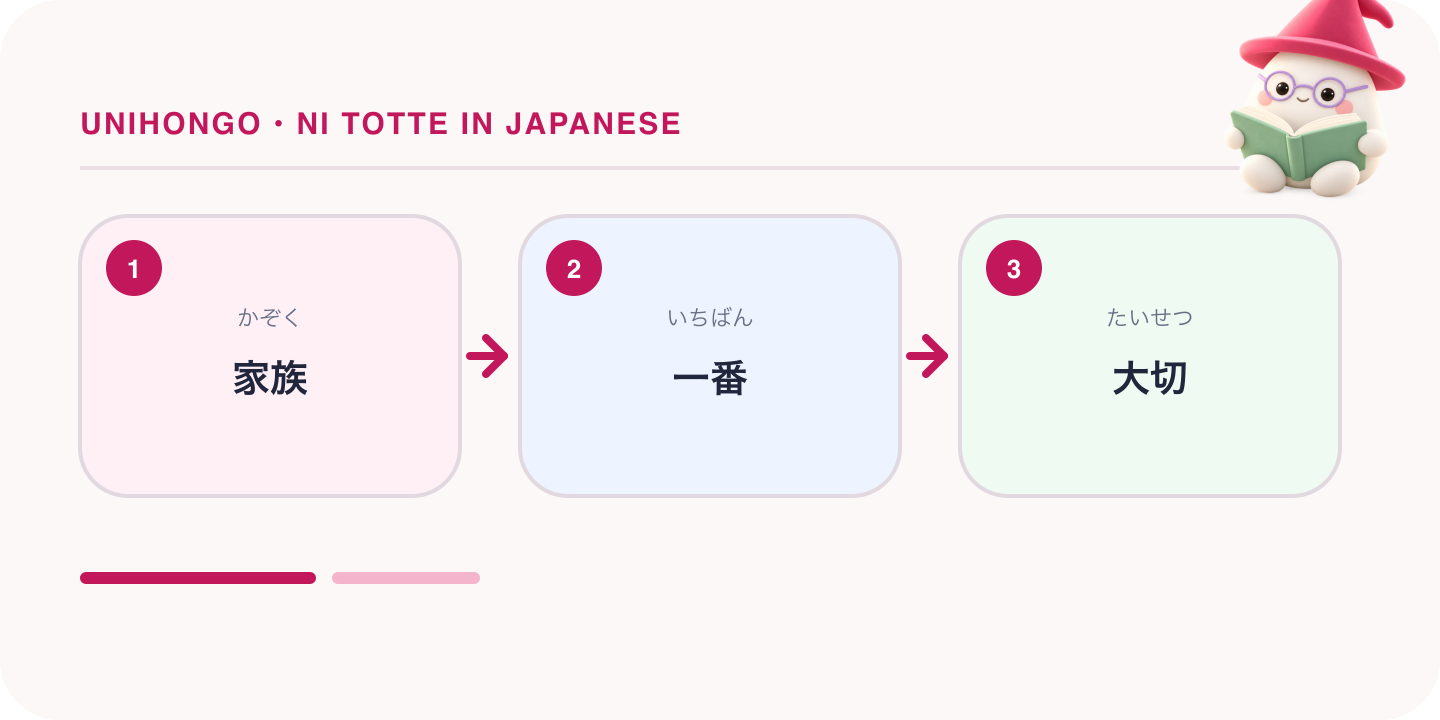
| Japanese | Romaji | Meaning |
|---|---|---|
| 私にとって、家族が一番大切です。 | Watashi ni totte, kazoku ga ichiban taisetsu desu. | For me, family is the most important thing. |
| この本は子供にとって難しすぎます。 | Kono hon wa kodomo ni totte muzukashisugimasu. | This book is too difficult for children. |
| 留学は私にとっていい経験になりました。 | Ryūgaku wa watashi ni totte ii keiken ni narimashita. | Studying abroad was a good experience for me. |
| あなたにとって幸せとは何ですか。 | Anata ni totte shiawase to wa nan desu ka. | What does happiness mean to you? |
| 水は植物にとって欠かせません。 | Mizu wa shokubutsu ni totte kakasemasen. | Water is essential for plants. |
How to form ni totte
Ni totte always follows a noun. Most of the time that noun is a person, a group or an organisation, but it can also be a living thing or something treated as having interests, such as a city, a company or the environment.
There are three common shapes. Plain ni totte begins a viewpoint. Ni totte wa adds the topic particle for contrast or emphasis. Ni totte no links to a following noun, so you can describe the thing itself. The formal version ni torimashite appears in speeches and very polite writing.
| Form | Pattern | Example | Meaning |
|---|---|---|---|
| Basic | Noun + にとって | 学生にとって大切だ | Important for students |
| Contrast | Noun + にとっては | 私にとっては簡単だ | For me, at least, it is easy |
| Emphasis | Noun + にとっても | 親にとっても嬉しい | Happy for the parents too |
| Before a noun | Noun + にとっての + noun | 私にとっての故郷 | My hometown, what home means to me |
| Very formal | Noun + にとりまして | 皆様にとりまして | For all of you (speech) |
Ni totte wa, ni totte mo and ni totte no
Adding wa gives the viewpoint the weight of a topic, often with a hint of contrast: for others it may be different, but for this person it is like this. Nihonjin ni totte wa futsū demo, gaikokujin ni totte wa mezurashii, it may be normal for Japanese people, but for foreigners it is unusual, sets two viewpoints side by side.
Ni totte mo means for this person too or even for this person. It is useful when you want to say that something applies across different groups, or that even an expert finds it hard.
Ni totte no turns the whole phrase into a modifier. Watashi ni totte no Nihon means Japan as it is for me, my Japan, and kodomo ni totte no ii kankyō means a good environment for children. It is common in titles, headlines and essays.
| Japanese | Romaji | Meaning |
|---|---|---|
| 日本人にとっては普通でも、外国人にとっては珍しい。 | Nihonjin ni totte wa futsū demo, gaikokujin ni totte wa mezurashii. | It may be normal for Japanese people, but it is unusual for foreigners. |
| 私にとっては、この仕事が一番楽しいです。 | Watashi ni totte wa, kono shigoto ga ichiban tanoshii desu. | For me, at least, this job is the most enjoyable. |
| この問題はプロにとっても難しい。 | Kono mondai wa puro ni totte mo muzukashii. | This problem is difficult even for professionals. |
| 環境にとっても経済にとってもいい方法です。 | Kankyō ni totte mo keizai ni totte mo ii hōhō desu. | It is a good method for both the environment and the economy. |
| 子供にとってのいい環境とは何でしょうか。 | Kodomo ni totte no ii kankyō to wa nan deshō ka. | What is a good environment for children? |
| 私にとっての日本は、第二の故郷です。 | Watashi ni totte no Nihon wa, daini no furusato desu. | To me, Japan is a second home. |
Ni totte vs no tame ni
This is the most common confusion, because both translate as for. The difference is between viewpoint and benefit. Ni totte says how something is from someone's standpoint. No tame ni says that an action is done for someone's benefit or for a purpose.
So kono kusuri wa kodomo ni totte kiken desu, this medicine is dangerous for children, is ni totte because it evaluates the medicine. Kodomo no tame ni kusuri o katta, I bought medicine for my child, is no tame ni because the action of buying benefits the child.
A simple test: if the sentence ends with an adjective or noun that judges something, reach for ni totte. If it ends with an action verb that someone does on behalf of someone else, reach for no tame ni.
| Japanese | Romaji | Meaning |
|---|---|---|
| 健康のために毎日歩いています。 | Kenkō no tame ni mainichi aruite imasu. | I walk every day for my health. |
| 歩くことは健康にとっていいです。 | Aruku koto wa kenkō ni totte ii desu. | Walking is good for your health. |
| 母のためにケーキを作りました。 | Haha no tame ni kēki o tsukurimashita. | I made a cake for my mother. |
| このケーキは母にとって特別な味です。 | Kono kēki wa haha ni totte tokubetsu na aji desu. | This cake has a special taste for my mother. |
Notice that kenkō appears with both patterns. For your health as a purpose of walking takes no tame ni; good for your health as a judgement of walking takes ni totte.
Ni totte vs ni taishite
Ni taishite means towards, against or in response to. It marks the target of an action or an attitude: kyaku ni taishite shitsurei da, rude to the customer, or sensei wa gakusei ni taishite yasashii, the teacher is kind to the students.
The English word to hides the difference. Ni totte is to in the sense of in the eyes of: this is important to me. Ni taishite is to in the sense of directed at: be kind to them. If the person is the one receiving someone's behaviour, use ni taishite. If the person is the one doing the judging or being affected, use ni totte.
| Sentence idea | Natural choice | Why |
|---|---|---|
| The teacher is kind to students | 先生は学生に対して優しい | Attitude directed at the students |
| The test was easy for the students | テストは学生にとって簡単だった | Judged from the students' standpoint |
| He was rude to the customer | 彼は客に対して失礼だった | Behaviour aimed at the customer |
| The delay was a problem for customers | 遅れは客にとって問題だった | How it affected the customers |
| I'm grateful to my parents | 両親に対して感謝している | Feeling directed at the parents |
Ni totte vs to shite
To shite means as, in a role or capacity: kyōshi to shite hataraku, work as a teacher. When learners want to say speaking as someone, or in my position, they sometimes use ni totte instead, but that changes the meaning.
Watashi to shite wa sansei desu means speaking for myself, I agree: it states a position. Watashi ni totte wa taisetsu desu means to me, it is important: it evaluates something. When the sentence expresses your stance, opinion or decision rather than how something affects you, to shite wa is the natural choice.
| Japanese | Romaji | Meaning |
|---|---|---|
| 私としては、その案に賛成です。 | Watashi to shite wa, sono an ni sansei desu. | Speaking for myself, I support that plan. |
| その案は私にとって有利です。 | Sono an wa watashi ni totte yūri desu. | That plan is advantageous for me. |
| 会社としては、この決定を支持します。 | Kaisha to shite wa, kono kettei o shiji shimasu. | As a company, we support this decision. |
| この決定は会社にとって大きなチャンスです。 | Kono kettei wa kaisha ni totte ōki na chansu desu. | This decision is a big opportunity for the company. |
Common mistakes with ni totte
- Using it for actions done on someone's behalf: haha ni totte ryōri o tsukutta is wrong; say haha no tame ni ryōri o tsukutta.
- Using it for attitudes towards someone: kare wa watashi ni totte shinsetsu da sounds odd; say kare wa watashi ni taishite shinsetsu da, or simply watashi ni shinsetsu da.
- Using it to state an opinion or stance: watashi ni totte hantai desu is unnatural; say watashi wa hantai desu or watashi to shite wa hantai desu.
- Putting it after a verb or adjective: attach it to a noun, or turn the phrase into a noun with hito, koto or no.
- Overusing watashi ni totte in every sentence: once the viewpoint is clear from context, Japanese usually drops it.
Ni totte in real contexts
Ni totte is common in essays, speeches, interviews and news, because those are the places where people explain what things mean to different groups. It is also everyday conversation: talking about a favourite place, a hard exam or why a job matters to you.
In job interviews, questions such as anata ni totte shigoto to wa nan desu ka, what does work mean to you, are a classic prompt, and answering with watashi ni totte, shigoto wa... is the expected frame. In speeches, the formal ni torimashite shows up in lines like minasama ni torimashite, for all of you.
| Japanese | Romaji | Meaning |
|---|---|---|
| 私にとって仕事とは、成長の場です。 | Watashi ni totte shigoto to wa, seichō no ba desu. | To me, work is a place to grow. |
| この町は観光客にとって便利です。 | Kono machi wa kankōkyaku ni totte benri desu. | This town is convenient for tourists. |
| 円安は輸出企業にとって追い風です。 | En'yasu wa yushutsu kigyō ni totte oikaze desu. | A weak yen is a tailwind for exporters. |
| 皆様にとりまして、実り多い一年となりますように。 | Minasama ni torimashite, minori ōi ichinen to narimasu yō ni. | I hope this will be a fruitful year for all of you. |
| 学生にとってアルバイトは大事な収入源です。 | Gakusei ni totte arubaito wa daiji na shūnyūgen desu. | For students, part-time work is an important source of income. |
Ni totte is generally taught at JLPT N3, and it keeps appearing in N2 and N1 reading passages, often in the ni totte no form inside longer noun phrases.