
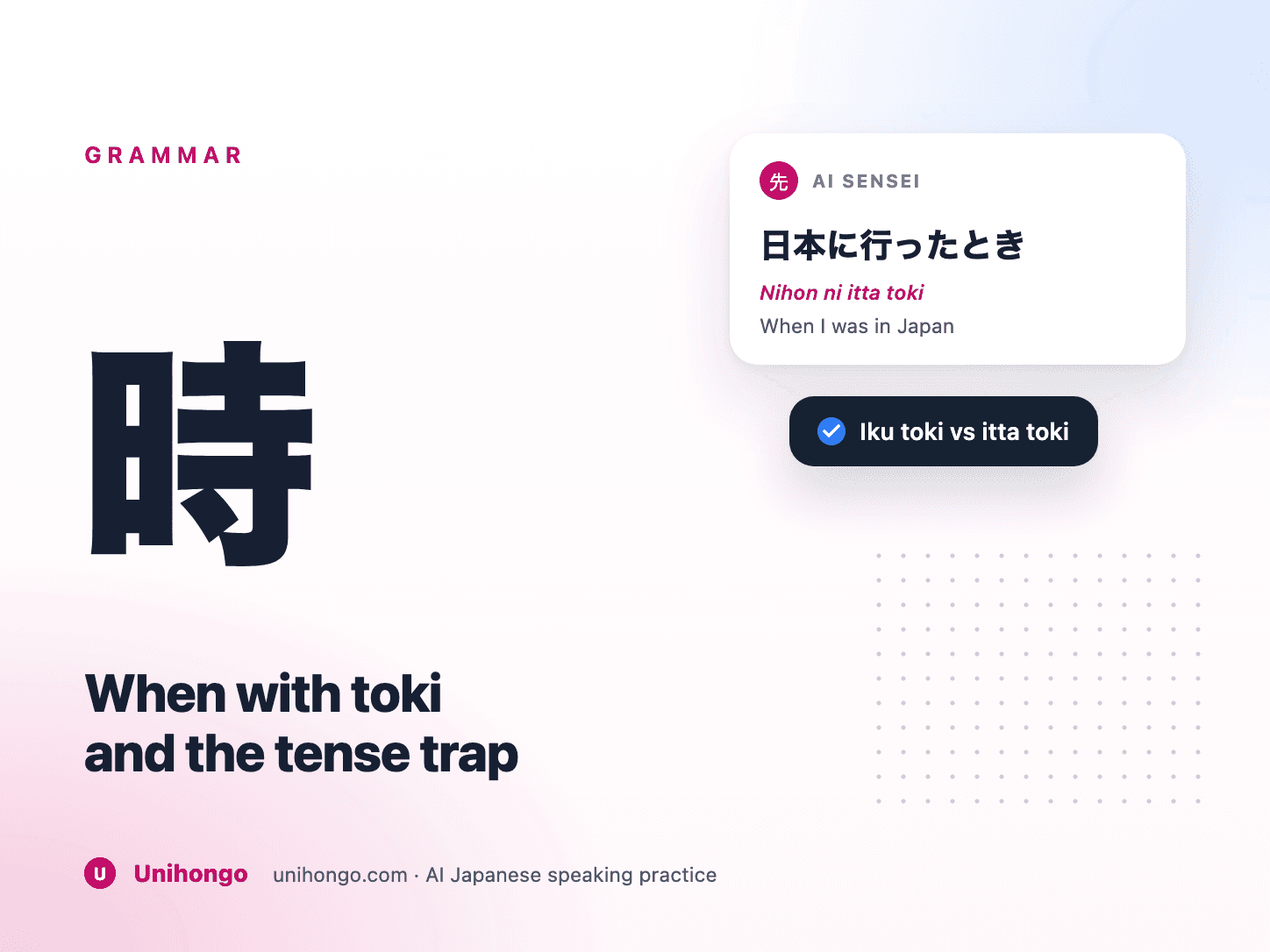
Toki attaches like a noun
Because toki is grammatically a noun meaning time, it attaches the way any noun is modified. Verbs and i-adjectives go directly in front in their plain forms. Na-adjectives keep na. Nouns take no.
The toki clause usually uses plain forms even in polite speech. Politeness belongs at the end of the sentence.
| Japanese | Romaji | Meaning |
|---|---|---|
| 寒いとき、温かいお茶を飲みます。 | Samui toki, atatakai ocha o nomimasu. | When it is cold, I drink hot tea. |
| 暇なとき、何をしますか。 | Hima na toki, nani o shimasu ka. | What do you do when you are free? |
| 学生のとき、東京に住んでいました。 | Gakusei no toki, Tōkyō ni sunde imashita. | I lived in Tokyo when I was a student. |
| わからないとき、聞いてください。 | Wakaranai toki, kiite kudasai. | Ask when you do not understand. |
| Word type | Pattern | Example meaning |
|---|---|---|
| Verb | Plain form + toki | When I go, when I went |
| I-adjective | Adjective + toki | When it is cold |
| Na-adjective | Adjective + na + toki | When I am free |
| Noun | Noun + no + toki | When I was a student |
| Negative | Nai form + toki | When you do not understand |
The tense inside toki is about completion
In English, when I go and when I went differ in time: future or past. In a Japanese toki clause, the difference is whether the action is complete at the moment of the main clause.
Non-past before toki means the action has not been completed yet: you are about to do it or in the middle of it. Past before toki means it is already done. The whole sentence can be about the past, present or future; that is shown by the final verb.
- Iku toki: before arriving, or on the way.
- Itta toki: after arriving, at the destination.
- Kaeru toki: when leaving to go home, or on the way home.
- Kaetta toki: when you have got home.
- Neru toki: when going to bed.
- Neta toki: after falling asleep.
Minimal pairs that show the difference
The clearest way to feel the rule is to compare sentences that change only one tense. The final verb is past in both, so the story is in the past either way; the toki clause decides when during that story the main action happened.
| Japanese | Romaji | Meaning |
|---|---|---|
| 日本に行くとき、空港で円に両替しました。 | Nihon ni iku toki, kūkō de en ni ryōgae shimashita. | On my way to Japan, I changed money into yen at the airport. |
| 日本に行ったとき、友達に会いました。 | Nihon ni itta toki, tomodachi ni aimashita. | When I was in Japan, I met a friend. |
| 家に帰るとき、コンビニに寄りました。 | Ie ni kaeru toki, konbini ni yorimashita. | On my way home, I stopped at a convenience store. |
| 家に帰ったとき、誰もいませんでした。 | Ie ni kaetta toki, dare mo imasen deshita. | When I got home, nobody was there. |
| 出かけるとき、鍵をかけてください。 | Dekakeru toki, kagi o kakete kudasai. | Lock the door when you go out. |
Te iru toki for while something is happening
To say something happened in the middle of an ongoing action, use te iru toki. It is the natural way to say while or when I was in the middle of doing something.
| Japanese | Romaji | Meaning |
|---|---|---|
| 電車に乗っているとき、地震がありました。 | Densha ni notte iru toki, jishin ga arimashita. | There was an earthquake while I was on the train. |
| 料理をしているとき、電話が鳴りました。 | Ryōri o shite iru toki, denwa ga narimashita. | The phone rang while I was cooking. |
| 話しているとき、スマホを見ないでください。 | Hanashite iru toki, sumaho o minaide kudasai. | Please do not look at your phone while we are talking. |
Toki ni and toki wa
Toki ni marks the specific time when something happens, like ni with a clock time. In speech it is often shortened to toki with a pause, and both are natural.
Toki wa sets up a situation as a topic, often for general advice or contrast: in that kind of situation, do this. It is very common in instructions and signs.
| Japanese | Romaji | Meaning |
|---|---|---|
| 駅に着いたときに、雨が降り始めました。 | Eki ni tsuita toki ni, ame ga furihajimemashita. | It started raining just as I reached the station. |
| 困ったときは、いつでも連絡してください。 | Komatta toki wa, itsu demo renraku shite kudasai. | Whenever you are in trouble, contact me anytime. |
| 地震のときは、机の下に入ってください。 | Jishin no toki wa, tsukue no shita ni haitte kudasai. | In an earthquake, get under a desk. |
Toki or tara?
Both can translate as when, and learners often use toki where tara sounds more natural. Tara means once something has happened, then, and it is the usual choice for a one-off future event followed by an instruction or request.
Toki is better for recurring situations, states and periods of life, where tara would sound like a condition. Past tara also covers a discovery, something you found when you did something, which toki does not express.
| Japanese | Romaji | Meaning |
|---|---|---|
| 駅に着いたら、電話してください。 | Eki ni tsuitara, denwa shite kudasai. | Call me when you get to the station. |
| 子供のとき、よく泣いていました。 | Kodomo no toki, yoku naite imashita. | I cried a lot when I was a child. |
| 窓を開けたら、雪が降っていました。 | Mado o aketara, yuki ga futte imashita. | When I opened the window, it was snowing. |
Kodomo dattara would mean if I were a child, which is why toki is the only choice for periods of life.
Making toki clauses fluent
The tense rule is easy to understand and hard to apply quickly, because English habits pull you towards matching the tense of the story. The fix is spoken repetition with pairs, not more explanation.
Travel stories and routines are the best material, because they naturally contain before, during and after moments. Tell the same short story twice, once focusing on what happened on the way and once on what happened when you arrived.
- Say one iku toki and one itta toki sentence every day for a week.
- Describe three situations with toki wa and a piece of advice.
- Replace toki with tara in any sentence that ends with a request, and compare.
- Retell a trip to your AI Sensei and ask for correction on toki tense only.