

Two layers: a label and a highlighter
Take a plain sentence: Kyōto ni ikimashita, I went to Kyoto. Ni is the label. It tells you Kyoto is the destination. Now suppose a friend asks whether you saw both Kyoto and Nara on your trip. You answer Kyōto ni wa ikimashita, literally: to Kyoto, at least, I went. The label ni is still there, doing the same job, and wa has been run over the top like a highlighter to set Kyoto against Nara.
Wa and mo never say what a noun does for the verb. They say how it sits in the conversation: wa for the topic or a contrast, mo for also. So there is no clash in using both layers at once. The order cannot be reversed, because the highlighter goes over the label, not under it. Scene: a friend is asking about your trip to Kansai.
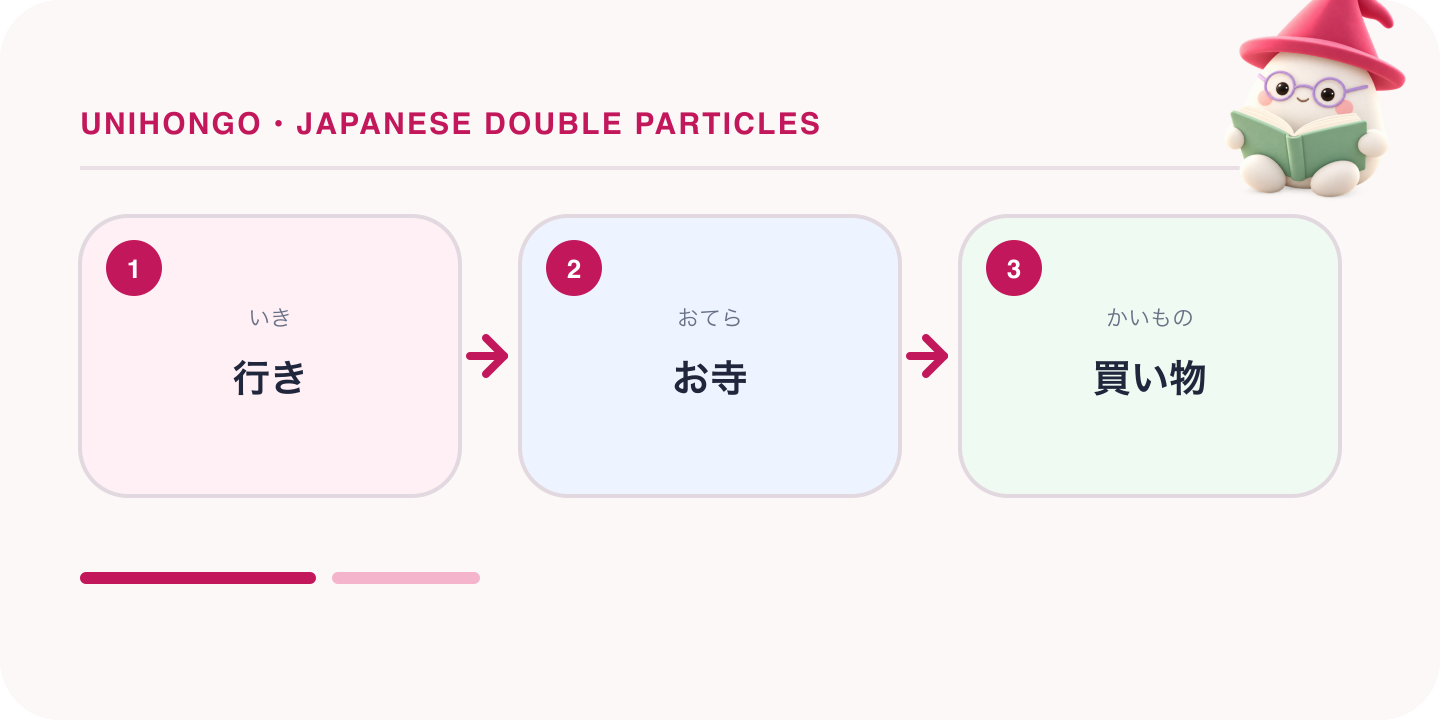
| Japanese | Romaji | Meaning |
|---|---|---|
| 京都には行きました。 | Kyōto ni wa ikimashita. | I did go to Kyoto. |
| 奈良には行きませんでした。 | Nara ni wa ikimasen deshita. | I didn't go to Nara. |
| 大阪にも行きました。 | Ōsaka ni mo ikimashita. | I went to Osaka too. |
| 京都ではお寺を見ました。 | Kyōto de wa otera o mimashita. | In Kyoto, I saw temples. |
| 大阪でも買い物をしました。 | Ōsaka de mo kaimono o shimashita. | I did some shopping in Osaka too. |
Why ga and o disappear under wa and mo
If particles stack, why is there no ga wa? Because ga and o are the two labels a verb can supply by itself. Taberu needs an eater and something eaten. Hear sakana and taberu together and you know the fish is the thing eaten, with or without o. So when wa or mo arrives, the label underneath is redundant and is dropped: sakana o tabemasu becomes sakana wa tabemasu, I do eat fish, and watashi ga ikimasu becomes watashi mo ikimasu, I am going too.
Ni, de, to, kara, e and made are different. No verb predicts them. Remove to from kare to wa hanashimashita and the listener can no longer tell whether he was your partner in the conversation or the one who spoke. Those labels carry information found nowhere else in the sentence, so they stay. Scene: a dinner where the host is checking what a guest can eat and drink.
| Japanese | Romaji | Meaning |
|---|---|---|
| 魚は食べます。 | Sakana wa tabemasu. | I do eat fish. |
| 肉も食べます。 | Niku mo tabemasu. | I eat meat too. |
| お酒は飲みません。 | Osake wa nomimasen. | I don't drink alcohol. |
| 私も行きます。 | Watashi mo ikimasu. | I'm going too. |
| 彼とは話しました。 | Kare to wa hanashimashita. | I did talk with him. |
How stacks are built: the common combinations
Each row keeps the meaning of the first particle and adds the meaning of the second. Beyond the two parts, there is nothing new to memorise.
| Example | Reading | Stack | Meaning |
|---|---|---|---|
| 東京には | Tōkyō ni wa | ni + wa | To or in Tokyo, as topic or contrast |
| 日本では | Nihon de wa | de + wa | In Japan, as topic or contrast |
| 彼とは | kare to wa | to + wa | With him, as opposed to others |
| 明日からは | ashita kara wa | kara + wa | From tomorrow on, unlike before |
| 週末にも | shūmatsu ni mo | ni + mo | At the weekend as well |
| 家でも | ie de mo | de + mo | At home as well |
| 誰とも | dare to mo | to + mo | With nobody, before a negative |
| 友達からの | tomodachi kara no | kara + no | From a friend, describing a noun |
| 母への | haha e no | e + no | To my mother, describing a noun |
| 部長との | buchō to no | to + no | With the department head, describing a noun |
| 大阪までの | Ōsaka made no | made + no | As far as Osaka, describing a noun |
| 五時までに | go-ji made ni | made + ni | By five o'clock: a deadline |
Minimal pairs: what the second particle adds
The rows below come in sets that differ by one particle only.
| Sentence | Reading | What it says |
|---|---|---|
| 京都に行きました。 | Kyōto ni ikimashita. | A plain report: I went to Kyoto |
| 京都には行きました。 | Kyōto ni wa ikimashita. | Kyoto, yes; hints that somewhere else, no |
| 友達と話しました。 | Tomodachi to hanashimashita. | I talked with my friend |
| 友達とも話しました。 | Tomodachi to mo hanashimashita. | I talked with my friend as well as others |
| 母の手紙 | haha no tegami | My mother's letter: direction unclear |
| 母への手紙 | haha e no tegami | A letter to my mother |
| 母からの手紙 | haha kara no tegami | A letter from my mother |
The first pair shows why ni wa should not become a habit. Wa after a label often sounds contrastive, so Kyōto ni wa ikimashita leaves the listener waiting for the but. The last three rows show the opposite problem: plain no is too vague to say which way the letter travelled, and the label inside the stack settles it.
Beyond the basics: kara no, to no, made no, de no
No joins one noun to another, and the first noun can bring its label along. Tōkyō kara no densha, literally: the from-Tokyo train. English puts the train from Tokyo in the opposite order and needs no linking word, which is why learners forget no. In Japanese, a phrase that describes a noun must be tied to it, and a label such as kara cannot do the tying alone.
These stacks are common in speech and everywhere in business writing: meeting titles, email subjects, signs. Scene: an office on a Monday morning, with the week being planned.
| Japanese | Romaji | Meaning |
|---|---|---|
| 東京からの電車は遅れています。 | Tōkyō kara no densha wa okurete imasu. | The train from Tokyo is running late. |
| 部長との会議は三時からです。 | Buchō to no kaigi wa san-ji kara desu. | The meeting with the department head is from three. |
| 大阪までの切符を二枚ください。 | Ōsaka made no kippu o ni-mai kudasai. | Two tickets to Osaka, please. |
| 日本での生活はどうですか。 | Nihon de no seikatsu wa dō desu ka. | How is life in Japan? |
| お客様からのメールを読みましたか。 | Okyaku-sama kara no mēru o yomimashita ka. | Have you read the email from the customer? |
Why ni no is impossible and e no takes over
By the logic so far, a letter to a friend should be tomodachi ni no tegami. It is not. Ni no is not used in Japanese, and native speakers reject it at once. Ga no and o no do not exist for the reason already given: subject and object labels give way to another particle, which leaves plain no. Ni is the odd one out. It carries real meaning, yet it cannot sit before no. Grammars describe this fact more confidently than they explain it, so treat it as a rule to learn, not one to derive.
The repair is simple. Where ni would have meant a destination or a recipient, e takes its place: tomodachi e no tegami, literally: a to-friend letter, and Kyōto e no ryokō, a trip to Kyoto. Where ni meant something else, Japanese rewords. A place of existence uses plain no, as in Tōkyō no tomodachi, a friend in Tokyo, and about or towards is expressed with longer forms such as ni tsuite no and ni taisuru.
| Japanese | Romaji | Meaning |
|---|---|---|
| 友達への手紙を書いています。 | Tomodachi e no tegami o kaite imasu. | I'm writing a letter to a friend. |
| 母へのプレゼントを探しています。 | Haha e no purezento o sagashite imasu. | I'm looking for a present for my mother. |
| 京都への旅行を計画しています。 | Kyōto e no ryokō o keikaku shite imasu. | I'm planning a trip to Kyoto. |
| 先生への質問はありますか。 | Sensei e no shitsumon wa arimasu ka. | Do you have any questions for the teacher? |
Made ni, to mo and how stacks sound in speech
Two stacks have meanings that go beyond their parts. Made ni joins made, until, with ni, a point in time, and gives a deadline: go-ji made ni dashimasu, I will hand it in by five. The article on made and made ni covers the difference. To mo after a number means all of them: futari to mo, both of them; san-nin to mo, all three.
In conversation some stacks contract. De wa becomes ja, as in the familiar ja arimasen, and ni wa can shrink to nya in rough casual speech, which you need to recognise but not produce. In polite and formal speech stacks are kept whole, and de wa opens many announcements: de wa, hajimemashō, well then, let us begin.
| Japanese | Romaji | Meaning |
|---|---|---|
| 五時までに出します。 | Go-ji made ni dashimasu. | I'll hand it in by five. |
| 二人とも来ました。 | Futari to mo kimashita. | Both of them came. |
| 日本じゃ普通だよ。 | Nihon ja futsū da yo. | In Japan that's normal. |
| では、始めましょう。 | De wa, hajimemashō. | Well then, let's begin. |
Neighbours: plain wa, and demo as one word
The first neighbour is plain wa where a stack is expected. With places, speakers often have a choice: Tōkyō wa hito ga ōi desu and Tōkyō ni wa hito ga ōi desu are both correct. Plain wa treats Tokyo as the thing being described. Ni wa keeps it as a location in which something exists. With to, kara and recipient ni there is no such choice, because removing the label changes who did what.
The second neighbour is demo as a single word, meaning even or but, which has its own article. The stack de mo is the place or means particle plus also. Koko de mo kaemasu, you can buy it here too, survives without mo. Kodomo demo wakaru, even a child understands, does not.
| Japanese | Romaji | Meaning |
|---|---|---|
| 東京には人が多いです。 | Tōkyō ni wa hito ga ōi desu. | There are a lot of people in Tokyo. |
| 東京は人が多いです。 | Tōkyō wa hito ga ōi desu. | Tokyo has a lot of people. |
| ここでも買えます。 | Koko de mo kaemasu. | You can buy it here too. |
Common mistakes with stacked particles
Tomodachi wa hanashimashita, meant as I talked with my friend, is wrong for that meaning. Learners are taught that wa replaces particles and apply it to all of them. Without to, the friend becomes the one who talked. Say tomodachi to wa hanashimashita.
Tomodachi ni no tegami is wrong, and it is produced by sound logic: ni marks the recipient, no links nouns. The language does not allow the pair. Say tomodachi e no tegami.
Tōkyō kara densha, meant as the train from Tokyo, is wrong. English links the two with from alone. Japanese needs no between a labelled noun and the noun it describes: Tōkyō kara no densha.
Ie mo de benkyō shimasu is wrong. The order is reversed, usually because mo was first learned as attaching directly to the noun. The label comes first: ie de mo benkyō shimasu.
Sakana o wa tabemasu is wrong. Having learned that labels survive, some learners keep o as well. O and ga are the two that give way: sakana wa tabemasu.