

The core idea: zu is nai in a formal coat
Japanese has had more than one way to say not. Nai is the one you learnt first and the one people use in conversation. Zu is older. It attaches to the same stem, means the same thing, and survives wherever the language dresses up: in writing, in announcements, in careful speech, and inside sayings that froze long ago. Think of one person with two coats. The person is the negative. Nai is the everyday jacket and zu is the formal coat.
You already use zu without noticing. A colleague asks how you are, you order a first drink, you explain why you are hungry at ten in the morning. In the third row, tabezu ni is literally not eating, and the ni makes it describe how you left.
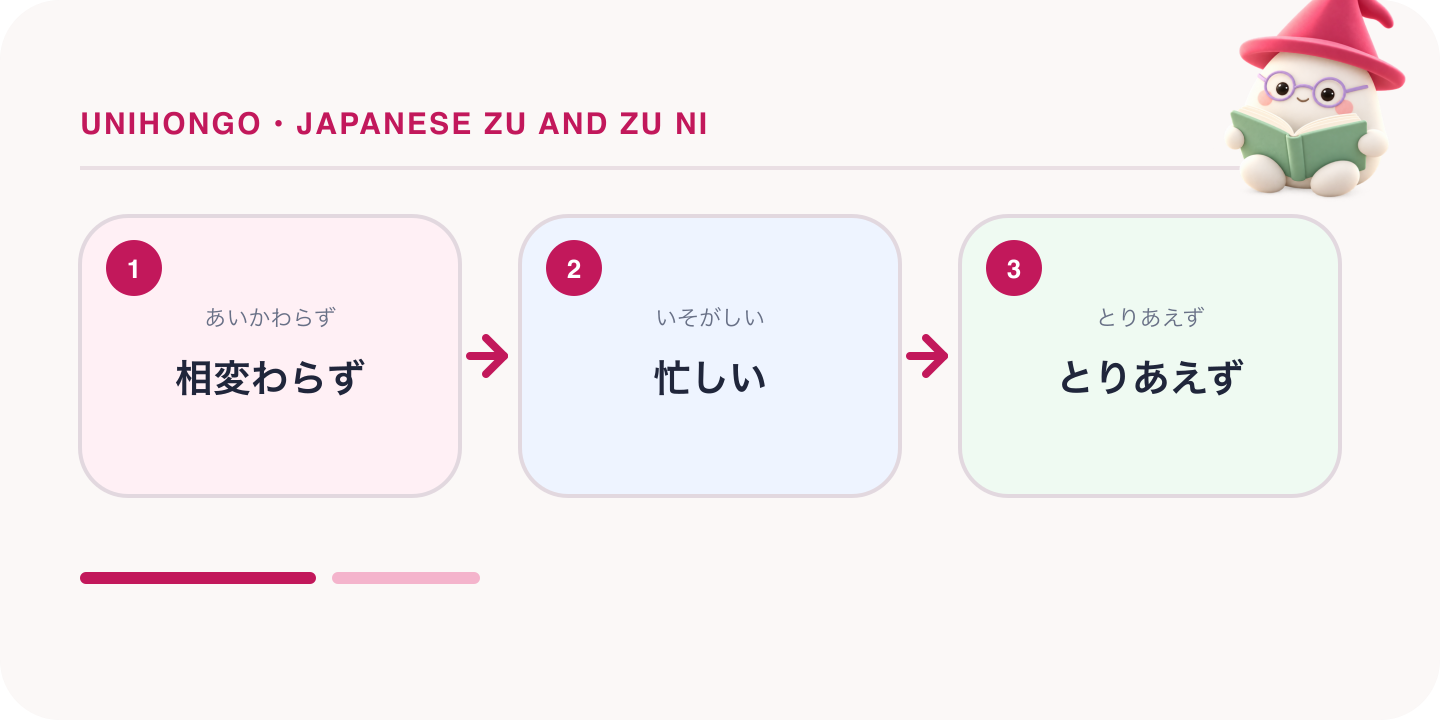
| Japanese | Romaji | Meaning |
|---|---|---|
| 相変わらず忙しいです。 | Aikawarazu isogashii desu. | I'm as busy as ever. |
| とりあえず、ビールをお願いします。 | Toriaezu, bīru o onegai shimasu. | A beer to start with, please. |
| 朝ご飯を食べずに出かけました。 | Asagohan o tabezu ni dekakemashita. | I left home without eating breakfast. |
How zu is built: the nai stem plus zu
Make the plain negative, remove nai, add zu. That is the whole rule for every verb except suru.
| Zu form | Reading | Nai form | Dictionary form |
|---|---|---|---|
| 食べず | tabezu | tabenai | taberu, to eat |
| 見ず | mizu | minai | miru, to see |
| 飲まず | nomazu | nomanai | nomu, to drink |
| 書かず | kakazu | kakanai | kaku, to write |
| 言わず | iwazu | iwanai | iu, to say |
| 待たず | matazu | matanai | matsu, to wait |
| 来ず | kozu | konai | kuru, to come |
| せず | sezu | shinai | suru, to do |
| 勉強せず | benkyō sezu | benkyō shinai | benkyō suru, to study |
Why sezu? Zu belongs to the older language, and it keeps the older stem of suru, se. Modern shinai is built on a different stem. Kuru looks irregular in most tables, but here it behaves: konai gives kozu.
Two verbs are better avoided. Aru has no nai stem in modern Japanese, its negative is simply nai, and arazu survives only in classical phrases. Iru can form izu, but in writing you will more often see orazu, from the humble verb oru.
Zu ni: doing one thing without doing another
Zu ni describes the manner of the main action by naming what did not accompany it. Kasa o motazu ni dekaketa. Literally: not holding an umbrella, I went out. One person does both halves, or to be exact, does one and leaves the other undone.
The scenes below are typical homes of zu ni in speech: a teacher giving instructions to a class, a customer phoning a restaurant, someone proudly reporting a hike. All are a step more careful than chatting. With nai de in its place, each sentence would be equally correct and more relaxed.
| Japanese | Romaji | Meaning |
|---|---|---|
| 傘を持たずに出かけてしまった。 | Kasa o motazu ni dekakete shimatta. | I went out without an umbrella, unfortunately. |
| 辞書を使わずに読んでみてください。 | Jisho o tsukawazu ni yonde mite kudasai. | Please try reading it without using a dictionary. |
| 予約せずに行っても大丈夫ですか。 | Yoyaku sezu ni itte mo daijōbu desu ka. | Is it all right to come without a reservation? |
| 一度も休まずに頂上まで登りました。 | Ichido mo yasumazu ni chōjō made noborimashita. | I climbed to the summit without resting once. |
| 彼は何も言わずに部屋を出た。 | Kare wa nani mo iwazu ni heya o deta. | He left the room without saying anything. |
| 砂糖を入れずに飲みます。 | Satō o irezu ni nomimasu. | I drink it without sugar. |
Minimal pairs: zu ni beside nai de, and zu beside nakute
Each pair keeps the facts the same and changes one form. What moves is the coat, not the person.
| Sentence | Reading | What it says |
|---|---|---|
| 朝ご飯を食べないで出かけた。 | Asagohan o tabenai de dekaketa. | I went out without eating breakfast. Everyday speech, to anyone. |
| 朝ご飯を食べずに出かけた。 | Asagohan o tabezu ni dekaketa. | The same fact. More careful or written in tone. |
| 何も言わずに帰った。 | Nani mo iwazu ni kaetta. | He went home without a word. The silence describes how he left. |
| 何も言わず、帰った。 | Nani mo iwazu, kaetta. | He said nothing, and went home. Two facts in a row, in a narrator's voice. |
| 雨が降らなくて、困っている。 | Ame ga furanakute, komatte iru. | It hasn't rained, so we're in trouble. Spoken. |
| 雨が降らず、困っている。 | Ame ga furazu, komatte iru. | The same cause and result. Written, for example in a news report. |
These are the two neighbours of zu, and the guide to nai de and nakute on this blog explains the difference between them in full. For our purposes: zu ni covers the without doing meaning of nai de, and zu with no ni covers the connecting and cause meanings of nakute. The third pair also shows why ni matters. Rain and the people in trouble are different subjects, so zu ni is impossible there.
One job of nai de is never passed to zu. Negative requests are a fixed pattern: tabenai de kudasai. There is no formal coat for it.
Beyond the basics: zu as a written connective
Remove ni and zu becomes a way of ending one clause and moving to the next. Literally, henji ga kozu is a reply not coming. What follows can be a result, a second fact or a contrast. This is the zu of newspapers, reports and novels, and above all of business email, where the first row below is close to a fixed phrase.
Because it only links clauses, this zu is free in ways that zu ni is not. The subjects may differ, and the first clause can be the cause of the second. In conversation the same sentences would use nakute.
| Japanese | Romaji | Meaning |
|---|---|---|
| 連絡が取れず、困っております。 | Renraku ga torezu, komatte orimasu. | I have been unable to reach you, and I am at a loss. |
| 返事が来ず、不安になった。 | Henji ga kozu, fuan ni natta. | No reply came, and I grew anxious. |
| 雨は降らず、風もなかった。 | Ame wa furazu, kaze mo nakatta. | It did not rain, and there was no wind either. |
| 原因は分からず、調査が続いている。 | Gen'in wa wakarazu, chōsa ga tsuzuite iru. | The cause is unknown and the investigation continues. |
Beyond the basics: zu ni sumu, zu ni iru and zu ni wa irarenai
Three verbs combine with zu ni so often that they are worth learning as patterns. Zu ni sumu means to get by without doing: the rain stopped, so you did not have to buy an umbrella. Zu ni iru means to stay in the state of not having done something. Zu ni wa irarenai means that you cannot stop yourself. Literally: I cannot remain without laughing.
All three have nai de versions, nai de sumu and so on, and as before the zu ni version is a little more formal. Zu ni wa irarenai in particular has a written, expressive feel.
| Japanese | Romaji | Meaning |
|---|---|---|
| 傘を買わずに済みました。 | Kasa o kawazu ni sumimashita. | I managed without buying an umbrella. |
| 朝から何も食べずにいます。 | Asa kara nani mo tabezu ni imasu. | I have gone without eating anything since this morning. |
| 笑わずにはいられなかった。 | Warawazu ni wa irarenakatta. | I couldn't help laughing. |
| 薬を飲まずに治したいです。 | Kusuri o nomazu ni naoshitai desu. | I'd like to get better without taking medicine. |
Set phrases where zu lives on in everyday speech
Some zu forms stopped being grammar long ago and became vocabulary. Nobody hears them as formal. Knowing the literal sense makes them easier to remember.
| Japanese | Romaji | Meaning |
|---|---|---|
| 思わず笑ってしまいました。 | Omowazu waratte shimaimashita. | I laughed before I could stop myself. |
| 明日は必ず来てください。 | Ashita wa kanarazu kite kudasai. | Please be sure to come tomorrow. |
| 駅まで十分足らずです。 | Eki made juppun tarazu desu. | It's just under ten minutes to the station. |
| やむを得ず、会議を延期しました。 | Yamu o ezu, kaigi o enki shimashita. | We had no choice but to postpone the meeting. |
| 知らず知らず、食べすぎていました。 | Shirazu shirazu, tabesugite imashita. | Without noticing, I had eaten too much. |
| Phrase | Reading | Literal sense | Meaning in use |
|---|---|---|---|
| 思わず | omowazu | Without thinking | Involuntarily, before I knew it |
| 必ず | kanarazu | Usually traced to not provisional | Without fail, certainly |
| 相変わらず | aikawarazu | Without changing | As usual, the same as ever |
| とりあえず | toriaezu | Without managing to take everything | For now, first of all |
| 足らず | tarazu | Not reaching | Just under an amount |
| やむを得ず | yamu o ezu | Not able to stop | Unavoidably, with no other choice |
| 知らず知らず | shirazu shirazu | Not knowing, not knowing | Without noticing |
| 飲まず食わず | nomazu kuwazu | Not drinking, not eating | Without food or drink |
Register: who says zu, and when
In relaxed conversation nai de is the default, and a string of zu ni among friends would sound like reading aloud. Zu ni appears when speech becomes careful: talking to a customer, a doctor or an interviewer, giving instructions, making announcements. Recorded telephone messages are a good place to hear it, as in the first row. Literally: without cutting, please wait.
A handful of zu ni expressions are common at every level of speech, among them wasurezu ni and enryo sezu ni. In speech the ni is sometimes dropped after sezu, as in ki ni sezu. Zu has no contracted form. If you hear shiran or wakaran, common in western Japan, that n descends from another form of the same old negative.
| Japanese | Romaji | Meaning |
|---|---|---|
| 切らずにお待ちください。 | Kirazu ni o-machi kudasai. | Please hold the line. |
| どうぞ、遠慮せずに食べてください。 | Dōzo, enryo sezu ni tabete kudasai. | Please go ahead and eat, don't hold back. |
| 忘れずに薬を飲んでください。 | Wasurezu ni kusuri o nonde kudasai. | Please don't forget to take your medicine. |
| 気にせず、先に行って。 | Ki ni sezu, saki ni itte. | Don't mind me, go on ahead. |
Common mistakes with zu and zu ni
The first mistake is shizu. It is wrong, and it is completely logical: shinai minus nai plus zu. The rule fails here because zu keeps the classical stem of suru. Say sezu, and benkyō sezu ni for without studying.
The second is building zu on the masu stem: nomizu ni and kakizu ni are wrong. Learners know the masu stem best and reach for it. Zu replaces nai, so it needs the nai stem: nomazu ni, kakazu ni. With ichidan verbs the two stems look identical, tabezu, which hides the problem until a godan verb appears.
The third is tabezu ni kudasai for please do not eat. It is wrong because learners treat zu ni as a formal copy of every nai de. Requests keep nai de: tabenai de kudasai.
The fourth is adding zu to adjectives or to aru: takazu and okane ga arazu are wrong in modern Japanese. Zu is a verb ending. Use takaku nakute and okane ga nakute.
The fifth is not an error of grammar but of tone: using zu ni in every casual sentence. It is correct, and it sounds stiff. Keep it for careful speech.