
Two joins that do different jobs
Nagara and tari are often taught in the same lesson because both connect activities, but they answer different questions. Nagara answers what were you doing at that moment: two actions overlap in time and one person performs both. Tari answers what sort of things do you do: it offers two or three examples and quietly implies there were others. Choosing the wrong one does not usually make you unintelligible, but it does send the wrong message about whether your list is complete.
Both patterns also attach to a form you already know. Nagara uses the masu stem, the part left when you take masu off the polite form. Tari uses the plain past, so if your ta forms are solid the pattern costs you one extra syllable. Get those two bases right and the rest of this guide is about meaning rather than conjugation.
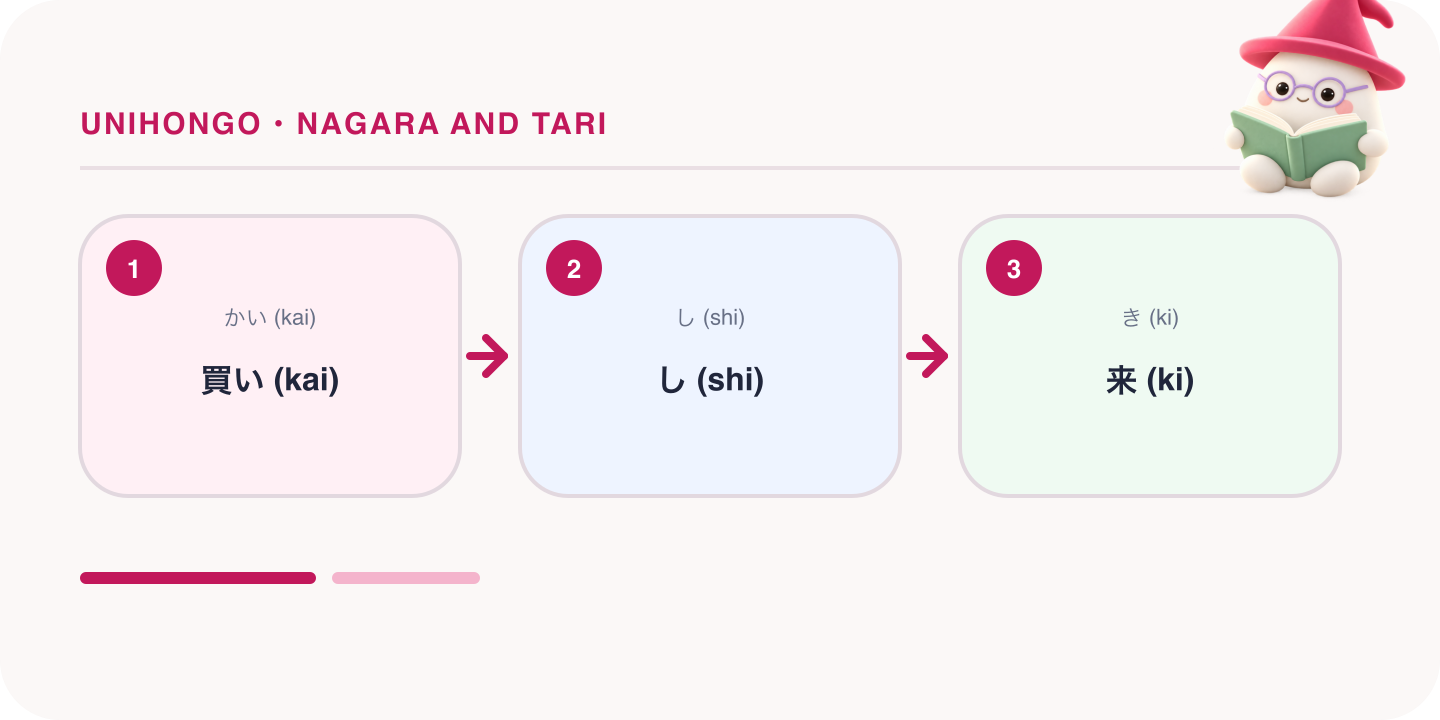
Building both forms from the dictionary form
For nagara, take the polite form, drop masu, and add nagara: kikimasu becomes kikinagara. For tari, take the plain past and add ri: kiita becomes kiitari. Godan verbs keep their usual sound changes in the past, so nomu gives nonda and nondari, oyogu gives oyoida and oyoidari, and kau gives katta and kattari. The irregulars are shinagara and shitari for suru, kinagara and kitari for kuru.
| Verb | Masu stem | Nagara form | Tari form |
|---|---|---|---|
| 聞く (kiku, listen) | 聞き (kiki) | 聞きながら (kikinagara) | 聞いたり (kiitari) |
| 食べる (taberu, eat) | 食べ (tabe) | 食べながら (tabenagara) | 食べたり (tabetari) |
| 飲む (nomu, drink) | 飲み (nomi) | 飲みながら (nominagara) | 飲んだり (nondari) |
| 話す (hanasu, speak) | 話し (hanashi) | 話しながら (hanashinagara) | 話したり (hanashitari) |
| 買う (kau, buy) | 買い (kai) | 買いながら (kainagara) | 買ったり (kattari) |
| 泳ぐ (oyogu, swim) | 泳ぎ (oyogi) | 泳ぎながら (oyoginagara) | 泳いだり (oyoidari) |
| 走る (hashiru, run) | 走り (hashiri) | 走りながら (hashirinagara) | 走ったり (hashittari) |
| 読む (yomu, read) | 読み (yomi) | 読みながら (yominagara) | 読んだり (yondari) |
| する (suru, do) | し (shi) | しながら (shinagara) | したり (shitari) |
| 来る (kuru, come) | 来 (ki) | 来ながら (kinagara) | 来たり (kitari) |
Nagara itself never conjugates. The tense and politeness of the whole sentence live in the final verb, so kikinagara benkyō shimasu and kikinagara benkyō shimashita differ only at the end. The same is true of tari, where the closing suru does all the grammatical work.
Nagara for two actions at once
A nagara sentence describes one person doing two things across the same stretch of time. Both actions have to last long enough to overlap, which is why walking, listening, eating, and talking appear in almost every example, and why an instantaneous verb sounds odd with it. In speech it is one of the most useful patterns you can own, because it answers the very common question of what you were doing at the time.
| Japanese | Romaji | Meaning |
|---|---|---|
| 音楽を聞きながら勉強します。 | Ongaku o kikinagara benkyō shimasu. | I study while listening to music. |
| コーヒーを飲みながら話しましょう。 | Kōhī o nominagara hanashimashō. | Let us talk over a coffee. |
| 歩きながら電話しないでください。 | Arukinagara denwa shinaide kudasai. | Please do not use the phone while walking. |
| テレビを見ながらご飯を食べます。 | Terebi o minagara gohan o tabemasu. | I eat while watching television. |
| 働きながら日本語を勉強しています。 | Hatarakinagara nihongo o benkyō shite imasu. | I am studying Japanese while working. |
| メモを取りながら聞いてもいいですか? | Memo o torinagara kiite mo ii desu ka? | May I listen while taking notes? |
The second clause carries the point
This is the rule that changes how your sentence lands. Whatever comes after nagara is the main action, and the nagara clause is background. Ongaku o kikinagara benkyō shimasu is a sentence about studying, with music in the background. Benkyō shinagara ongaku o kikimasu is a sentence about listening to music, with study in the background, which is a strange thing to say about a study session.
So decide first what your sentence is really about, then put that verb at the end. English lets you order the clauses either way with while, so this is a habit worth building deliberately rather than trusting your first instinct.
| Japanese | Romaji | Meaning |
|---|---|---|
| 辞書を使いながら本を読みました。 | Jisho o tsukainagara hon o yomimashita. | I read the book while using a dictionary. |
| 本を読みながら辞書を使いました。 | Hon o yominagara jisho o tsukaimashita. | I used the dictionary while reading the book. |
| 音楽を聞きながら走っています。 | Ongaku o kikinagara hashitte imasu. | I am running while listening to music. |
| 笑いながら話していました。 | Warainagara hanashite imashita. | She was talking while laughing. |
Notice the first two rows. The words barely change, but the first is a report about reading and the second is a report about dictionary use. When you are unsure, ask yourself which verb you would keep if you had to delete one, and put that one last.
Nagara meaning although
The same word has a second life as a concessive, meaning although or even though. You will meet it most often after a state rather than an action, especially after the te iru form: shitte inagara means even though he knew. It is a shade more literary than keredo or noni, so it turns up in writing and in careful speech rather than casual chat, but two set expressions are worth learning whole. Zannen nagara softens bad news, and semai nagara mo is the modest way to describe a small home.
| Japanese | Romaji | Meaning |
|---|---|---|
| 悪いと知っていながら、何も言いませんでした。 | Warui to shitte inagara, nani mo iimasen deshita. | Even though he knew it was wrong, he said nothing. |
| 残念ながら、参加できません。 | Zannen nagara, sanka dekimasen. | Regrettably, I cannot attend. |
| 狭いながらも、いい部屋です。 | Semai nagara mo, ii heya desu. | It is small, but it is a good room. |
| 三年勉強していながら、まだうまく話せません。 | San-nen benkyō shite inagara, mada umaku hanasemasen. | Although I have studied for three years, I still cannot speak well. |
Context separates the two meanings without any change of form. If both halves are actions that can overlap, it means while; if the second half contradicts what the first half would lead you to expect, it means although.
Tari for a sample of activities
Tari tari suru gives examples rather than a full account. Shūmatsu wa hon o yondari, eiga o mitari shimasu says weekends are the sort of time when I read and watch films, and among other things is built into the grammar. That implication is the reason it is the natural answer to a broad question about your free time, your holiday, or your job, where a complete list would be tedious and slightly odd.
Two clauses is the usual shape and three is the practical limit. The pattern also works with adjectives and nouns for things that alternate: atsukattari samukattari shimasu describes weather that swings, and ittari kitari is the fixed expression for going back and forth.
| Japanese | Romaji | Meaning |
|---|---|---|
| 週末は本を読んだり、映画を見たりします。 | Shūmatsu wa hon o yondari, eiga o mitari shimasu. | At the weekend I read and watch films, among other things. |
| 昨日は掃除したり、洗濯したりしました。 | Kinō wa sōji shitari, sentaku shitari shimashita. | Yesterday I did some cleaning and some laundry. |
| 休みの日は友達と話したり、料理を作ったりしています。 | Yasumi no hi wa tomodachi to hanashitari, ryōri o tsukuttari shite imasu. | On days off I chat with friends and cook, that sort of thing. |
| 最近、ドラマを見たり、シャドーイングをしたりしています。 | Saikin, dorama o mitari, shadōingu o shitari shite imasu. | Lately I have been watching dramas and doing shadowing. |
| 最近、暑かったり寒かったりしますね。 | Saikin, atsukattari samukattari shimasu ne. | The weather has been swinging hot and cold lately. |
| 部屋を行ったり来たりしていました。 | Heya o ittari kitari shite imashita. | He was pacing back and forth in the room. |
Te form when the order matters
The te form joins actions into a sequence that happened in the order you say them, and it claims the list is the account. Use it for a morning routine, a set of instructions, or a report of what you did step by step. Swapping in tari there would suggest you are only sampling, which is why a recipe or a procedure never uses it.
| Japanese | Romaji | Meaning |
|---|---|---|
| 朝起きて、シャワーを浴びて、会社に行きます。 | Asa okite, shawā o abite, kaisha ni ikimasu. | I get up, take a shower, and go to work. |
| 駅で切符を買って、電車に乗りました。 | Eki de kippu o katte, densha ni norimashita. | I bought a ticket at the station and got on the train. |
| 野菜を切って、油で炒めてください。 | Yasai o kitte, abura de itamete kudasai. | Cut the vegetables and fry them in oil. |
| 宿題をして、それから寝ました。 | Shukudai o shite, sorekara nemashita. | I did my homework and then went to bed. |
There is a fuller guide to the te form on this blog, so the point to carry away here is only the contrast. Te means and then, in this order, all of it. Tari means things like this, order unimportant, and there were more.
Shi for stacking reasons
Shi joins reasons and suggests they add up, which makes it much warmer than a single kara. It attaches to the plain form in casual speech and to the polite form in careful speech, so yasui shi and yasui desu shi are both available. Speakers often leave the conclusion unsaid, letting the reasons imply it, and that trailing shi is a very common way to soften a refusal.
| Japanese | Romaji | Meaning |
|---|---|---|
| この店は安いし、近いし、よく行きます。 | Kono mise wa yasui shi, chikai shi, yoku ikimasu. | This shop is cheap and close, so I go often. |
| 今日は疲れているし、雨も降っているし、家にいます。 | Kyō wa tsukarete iru shi, ame mo futte iru shi, ie ni imasu. | I am tired and it is raining, so I am staying home. |
| 日本語は面白いですし、仕事にも役に立ちます。 | Nihongo wa omoshiroi desu shi, shigoto ni mo yaku ni tachimasu. | Japanese is interesting, and it is useful for work too. |
| 明日は早いし、ちょっと難しいですね。 | Ashita wa hayai shi, chotto muzukashii desu ne. | I have an early start tomorrow, so it is a little difficult. |
Toki for setting the time frame
Toki means when in the sense of at the time of, and it takes a plain form in front of it: iku toki, isogashii toki, hima na toki, kodomo no toki. The tense inside the toki clause is measured against the main clause rather than against now, which is the detail that catches learners out. Iku toki places the main action before or during the trip; itta toki places it after arrival.
| Japanese | Romaji | Meaning |
|---|---|---|
| 日本に行くとき、カメラを買いました。 | Nihon ni iku toki, kamera o kaimashita. | I bought a camera before going to Japan. |
| 日本に行ったとき、カメラを買いました。 | Nihon ni itta toki, kamera o kaimashita. | I bought a camera when I was in Japan. |
| 子供のとき、よく公園で遊びました。 | Kodomo no toki, yoku kōen de asobimashita. | As a child, I often played in the park. |
| 暇なとき、日本語を勉強します。 | Hima na toki, nihongo o benkyō shimasu. | When I have free time, I study Japanese. |
| 分からないとき、聞いてください。 | Wakaranai toki, kiite kudasai. | When you do not understand, please ask. |
Choosing between te, tari, shi, and nagara
| Connector | Attaches to | Message it sends | Example |
|---|---|---|---|
| て (te) | Te form | These things, in this order, and that is the account | 起きて、食べて、行きます (Okite, tabete, ikimasu) |
| たり (tari) | Plain past plus ri | Things like these, order not important, and more besides | 読んだり、見たりします (Yondari, mitari shimasu) |
| し (shi) | Plain or polite form | Reasons that add up to a conclusion | 安いし、近いし (Yasui shi, chikai shi) |
| ながら (nagara) | Masu stem | Two actions at once by one person | 聞きながら勉強します (Kikinagara benkyō shimasu) |
| とき (toki) | Plain form or noun plus no | At the time when something happens | 行くとき (Iku toki) |
If you are ever stuck mid-sentence, te is the safe default. It is never wrong for a plain sequence, and you can upgrade to tari or shi once you know which extra message you want to send.
The three mistakes to correct first
- Two subjects with nagara: tsuma ga terebi o minagara, watashi wa ryōri shimasu is wrong. Say tsuma ga terebi o mite iru aida ni, watashi wa ryōri o shimasu instead.
- Dropping the final suru: hon o yondari, eiga o mitari on its own is unfinished in polite speech. Close it with shimasu, shimashita, or shite imasu.
- Listing exhaustively with tari: if you mean exactly these steps in this order, use the te form, because tari always implies there was more.
- Conjugating nagara: it never changes shape, so put all the tense in the final verb.
- Putting the main action first: the verb after nagara is the point of the sentence, so choose that order on purpose.