

The core idea: o marks what the action sweeps over
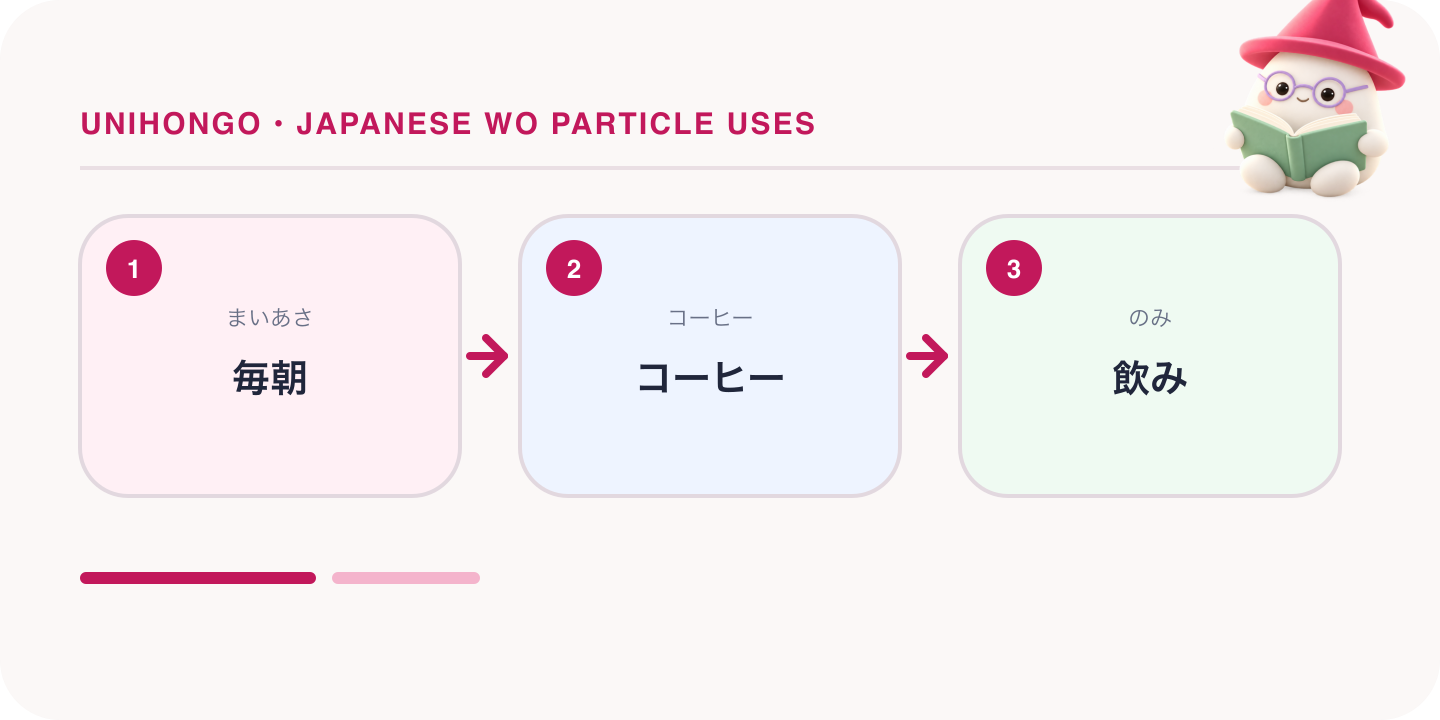
O follows a noun and tells you that the verb's action lands on that noun and covers it. In kōhī o nomimasu, the drinking happens to the coffee. The pattern is a noun, then o, then a verb that does something to that noun.
Because the label travels with its noun, word order is freer than in English. Kinō kutsu o kaimashita and kutsu o kinō kaimashita both mean I bought shoes yesterday. The scene below is a kitchen on a Saturday morning. A homestay student and her host mother are talking in polite masu forms.
| Japanese | Romaji | Meaning |
|---|---|---|
| 毎朝コーヒーを飲みます。 | Maiasa kōhī o nomimasu. | I drink coffee every morning. |
| 朝ご飯を食べましたか。 | Asagohan o tabemashita ka. | Have you had breakfast? |
| 何を作っていますか。 | Nani o tsukutte imasu ka. | What are you making? |
| 窓を開けてください。 | Mado o akete kudasai. | Please open the window. |
| 昨日、新しい靴を買いました。 | Kinō, atarashii kutsu o kaimashita. | I bought new shoes yesterday. |
O with suru verbs: benkyō suru and benkyō o suru
A large family of Japanese verbs is a noun plus suru, to do: benkyō suru, to study, sōji suru, to clean, denwa suru, to phone. The noun names the activity, so you are free to mark it with o: denwa o suru is literally to do a phone call. Both versions are correct and mean the same.
Here is the one restriction, and the reason for it. A single verb does not take two nouns marked with o, because the listener could not tell which one the action covers. So when you name what you study, you have two shapes to choose from. In Nihongo o benkyō suru, Nihongo is the object and benkyō suru is one verb. In Nihongo no benkyō o suru, no ties the two nouns into one object, literally to do the study of Japanese.
| Japanese | Romaji | Meaning |
|---|---|---|
| 毎晩、日本語を勉強します。 | Maiban, Nihongo o benkyō shimasu. | I study Japanese every evening. |
| 日本語の勉強をしています。 | Nihongo no benkyō o shite imasu. | I'm studying Japanese. |
| 週末に部屋の掃除をします。 | Shūmatsu ni heya no sōji o shimasu. | I clean my room at the weekend. |
| 昨日、母に電話をしました。 | Kinō, haha ni denwa o shimashita. | I phoned my mother yesterday. |
How it is built: five patterns with o
O attaches directly to a noun or noun phrase, never to a verb or an adjective. To make an action the object, you first turn it into a noun with no or koto: tomodachi ga utau no o kikimashita, I listened to my friend singing. What changes from one use to the next is the kind of verb that follows.
| Pattern | Reading | What o marks |
|---|---|---|
| パンを食べる | pan o taberu | Object: the thing the action is done to |
| 勉強をする | benkyō o suru | Activity noun with suru: the thing being done |
| 公園を歩く | kōen o aruku | Path: the space a movement passes over |
| 休みを過ごす | yasumi o sugosu | Time: the period you spend |
| 家を出る | ie o deru | Exit: the place or vehicle you leave |
Beyond the basics: the space you move through and the time you spend
Verbs of movement such as aruku, walk, hashiru, run, sanpo suru, stroll, wataru, cross, tōru, pass, magaru, turn, and tobu, fly, take o for the space the movement covers. Kōen o sanpo suru is literally to stroll the park: the walk sweeps across the park the way eating sweeps across a meal. English needs through, along, across or over; Japanese uses o for all of them.
The noun must be the ground that is covered, not the goal. A destination is a point you reach, so it takes ni or e: kōen ni ikimasu. Verbs with no travel in them, such as asobu, play, and hataraku, work, take de for their location. The same logic stretches from space to time. Sugosu, to spend, takes o for the period that passes: natsuyasumi o Okinawa de sugoshimashita, literally I passed the summer holiday in Okinawa. You hear path o most in directions, so picture a passer-by outside a station helping a tourist.
| Japanese | Romaji | Meaning |
|---|---|---|
| この道をまっすぐ行ってください。 | Kono michi o massugu itte kudasai. | Go straight along this road. |
| あの橋を渡ってください。 | Ano hashi o watatte kudasai. | Cross that bridge. |
| 次の角を右に曲がります。 | Tsugi no kado o migi ni magarimasu. | You turn right at the next corner. |
| 毎朝、公園を散歩します。 | Maiasa, kōen o sanpo shimasu. | I take a walk through the park every morning. |
| 鳥が空を飛んでいます。 | Tori ga sora o tonde imasu. | Birds are flying across the sky. |
| 夏休みを沖縄で過ごしました。 | Natsuyasumi o Okinawa de sugoshimashita. | I spent the summer holiday in Okinawa. |
The point you leave: heya o deru, densha o oriru
A small group of verbs marks the place you leave with o: deru, go out of, oriru, get off, hanareru, move away from, sotsugyō suru, graduate from, and yameru, quit. This use fits the paintbrush picture less neatly than the others. The simplest way to hold it is that the room or the train is still the thing your act of leaving is done to, just as English says leave the room with no preposition.
Why not kara, from? With physical exits kara is possible too, and the next section shows the difference. O becomes the only choice when the leaving is abstract. Daigaku o deru means to graduate from university, whereas daigaku kara deru could only mean walking out of the campus. One restriction follows from the idea of an act: o needs someone who leaves on purpose. Smoke and water do not decide to leave, so they take kara, as in kemuri ga mado kara dete imasu, smoke is coming out of the window.
| Japanese | Romaji | Meaning |
|---|---|---|
| 毎朝七時に家を出ます。 | Maiasa shichi-ji ni ie o demasu. | I leave home at seven every morning. |
| 次の駅で電車を降ります。 | Tsugi no eki de densha o orimasu. | I get off the train at the next station. |
| 去年、大学を卒業しました。 | Kyonen, daigaku o sotsugyō shimashita. | I graduated from university last year. |
| 三月に会社を辞めました。 | San-gatsu ni kaisha o yamemashita. | I left my company in March. |
Minimal pairs: o against de, kara and ga
In each pair below a single particle changes and everything else stays the same.
| Sentence | Reading | What it says |
|---|---|---|
| 公園を歩く | kōen o aruku | Walk through the park: the park is the ground covered |
| 公園で歩く | kōen de aruku | Do your walking in the park: the park is only the venue |
| 階段を上る | kaidan o noboru | Climb the stairs: the stairs are the path |
| 階段で上る | kaidan de noboru | Go up by the stairs: the stairs are the means, not the lift |
| 部屋を出る | heya o deru | Leave the room: the act of leaving as a whole |
| 部屋から出る | heya kara deru | Come out of the room: attention on the starting point |
| 水を飲みたい | mizu o nomitai | I want to drink water: focus on the act of drinking |
| 水が飲みたい | mizu ga nomitai | Water is what I want to drink: focus on the water |
De turns the place into a setting or a tool, kara turns it into a starting point, and o keeps it as the thing the action covers. The last pair shows that with the tai form, want to, both particles are correct. Ga is the traditional choice and puts the craving on the thing; o keeps the feel of an action and is common when other words stand between the noun and the verb.
Why suki, wakaru and dekiru take ga, not o
O needs an action that someone carries out on something. Suki, wakaru and dekiru are not actions in Japanese; they describe a state that the thing itself is in. Neko ga suki desu is literally cats are likeable, and Nihongo ga wakarimasu is literally Japanese is clear to me. There is no brush and no sweep, so there is nothing for o to label, and the thing takes ga as the subject of the state. The same goes for hoshii, wanted, jōzu, skilled, and for mieru and kikoeru, to be visible and to be audible.
Potential verbs sit on the border. Kanji ga yomemasu is the textbook form, but kanji o yomemasu is widely heard as well, because the verb yomu underneath is an action. Both are accepted. A separate post on ga with suki, wakaru and dekiru takes those predicates one by one; the point here is only why o has no place with them.
| Japanese | Romaji | Meaning |
|---|---|---|
| 猫が好きです。 | Neko ga suki desu. | I like cats. (Literally: cats are likeable.) |
| 日本語が少し分かります。 | Nihongo ga sukoshi wakarimasu. | I understand a little Japanese. |
| テニスができます。 | Tenisu ga dekimasu. | I can play tennis. |
| 新しいパソコンが欲しいです。 | Atarashii pasokon ga hoshii desu. | I want a new computer. |
Spoken reality: when o disappears
In casual conversation o is one of the particles most readily dropped. Gohan tabeta? is a complete and natural question between friends. The object sits right before the verb, so its role is clear without a label. Dropping is commonest in short sentences and questions, like these chat messages between two friends.
Keep o in writing beyond casual messages, in polite speech with customers or superiors, and whenever the object is long, stressed or far from its verb.
| Japanese | Romaji | Meaning |
|---|---|---|
| ご飯食べた? | Gohan tabeta? | Have you eaten? |
| 何飲む? | Nani nomu? | What are you drinking? |
| 宿題やった? | Shukudai yatta? | Did you do your homework? |
| あの映画、もう見た? | Ano eiga, mō mita? | Have you seen that film yet? |
Common mistakes with o and where they come from
Neko o suki desu is wrong. English like is a verb with an object, so learners copy the pattern, but suki describes the cat, not an action of yours. Say neko ga suki desu.
Basu o norimasu and tomodachi o aimasu are wrong. English says take the bus and meet a friend with plain objects, but noru and au are about arriving at a point, so they take ni: basu ni norimasu, tomodachi ni aimasu. The trap is that the opposite verb does take o: basu o orimasu. Learn noru and oriru as a pair, ni noru, o oriru.
Kōen o asobimasu is wrong. It comes from over-applying the path rule to any verb that happens in a park. Asobu has no line of travel, so the park is a venue: kōen de asobimasu.
Nihongo o benkyō o shimasu is wrong, because one verb takes one o. Say Nihongo o benkyō shimasu.