
One question decides the verb
Before you conjugate anything, ask a single question: did this change simply happen, or did somebody make it happen? If the change arrived on its own, through weather, time, growth, prices or circumstance, you want naru. If a person chose it and acted, you want suru. Everything else in the pattern stays the same, which is why these two verbs are usually taught as a pair rather than separately.
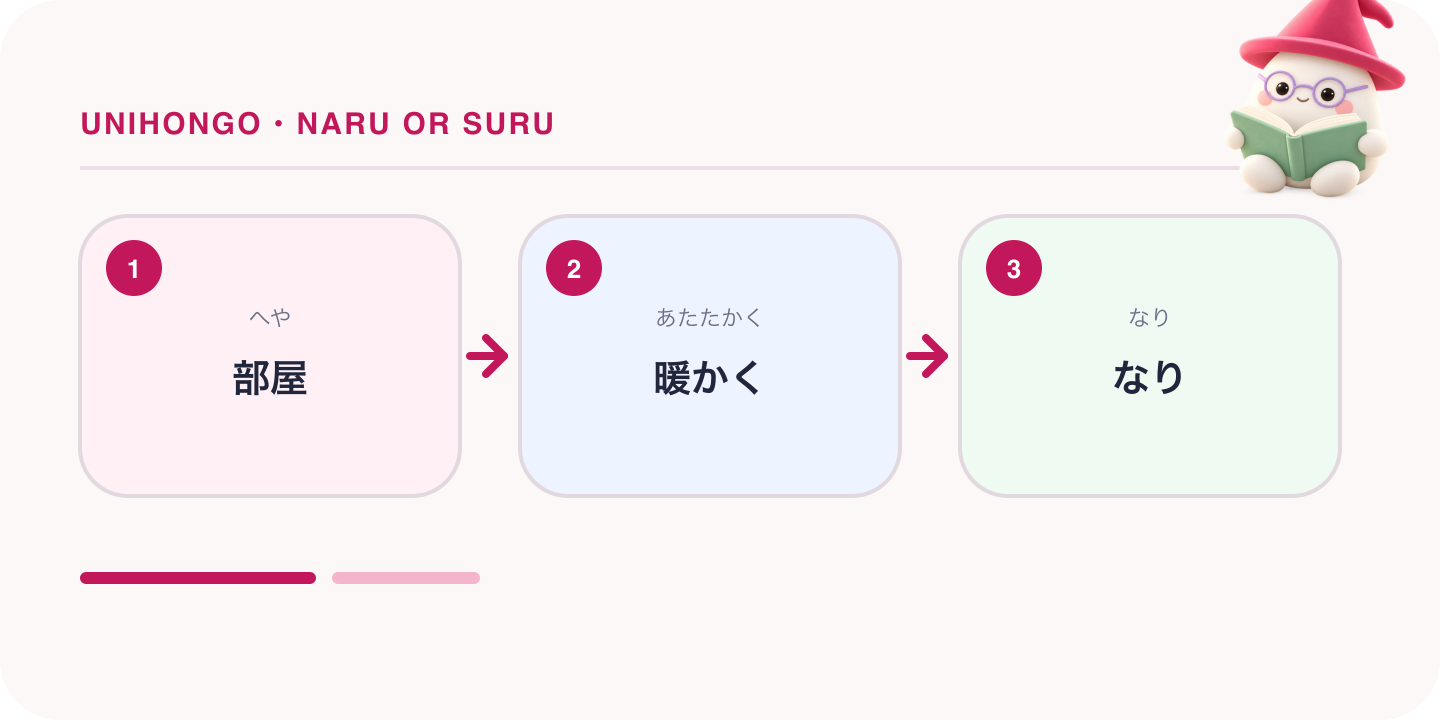
The particles follow that split. With naru, the thing that changed is the subject and takes ga or wa: heya ga atatakaku narimashita. With suru, the thing changed is an object and takes o: heya o atatakaku shimashita. If you find yourself unsure which particle to use, you probably have not yet decided which verb you mean, and the particle guide will not rescue you until you do.
| Japanese | Romaji | Meaning |
|---|---|---|
| 部屋が暖かくなりました。 | Heya ga atatakaku narimashita. | The room got warm. |
| 部屋を暖かくしました。 | Heya o atatakaku shimashita. | I made the room warm. |
| 髪が短くなりました。 | Kami ga mijikaku narimashita. | My hair got shorter. |
| 髪を短くしました。 | Kami o mijikaku shimashita. | I cut my hair short. |
How each word type connects
| Word type | Change that happens (naru) | Change you make (suru) | English pair |
|---|---|---|---|
| I-adjective 高い takai | 高くなる takaku naru | 高くする takaku suru | get expensive / make it expensive |
| I-adjective 大きい ōkii | 大きくなる ōkiku naru | 大きくする ōkiku suru | grow bigger / enlarge it |
| Irregular いい ii | よくなる yoku naru | よくする yoku suru | get better / improve it |
| Na-adjective 静か shizuka | 静かになる shizuka ni naru | 静かにする shizuka ni suru | go quiet / keep it quiet |
| Na-adjective 便利 benri | 便利になる benri ni naru | 便利にする benri ni suru | get convenient / make it convenient |
| Noun 先生 sensei | 先生になる sensei ni naru | 先生にする sensei ni suru | become a teacher / appoint as teacher |
| Noun 半分 hanbun | 半分になる hanbun ni naru | 半分にする hanbun ni suru | be halved / cut it in half |
| Verb 話す hanasu | 話すようになる hanasu yō ni naru | 話すようにする hanasu yō ni suru | come to speak / make a point of speaking |
| Negative 食べない tabenai | 食べなくなる tabenaku naru | 食べないようにする tabenai yō ni suru | stop eating it / avoid eating it |
| Clause + こと koto | ことになる koto ni naru | ことにする koto ni suru | it was decided / I decided |
Read the middle two columns as one shape with two endings. Once takaku is formed, both takaku narimasu and takaku shimasu are available, so the work of conjugating is done before you pick a verb. The only form worth drilling separately is ii, whose stem is yo-: yoku narimasu, not the incorrect iku narimasu.
Both verbs are ordinary godan and irregular verbs elsewhere, so all the tenses you already know apply. Naru is a godan verb: narimasu, narimashita, naranai, natte. Suru is the irregular one: shimasu, shimashita, shinai, shite. The te-form guide covers those endings in detail.
Ku naru with i-adjectives
Drop the final i and add ku, then attach narimasu. This is the everyday way to talk about weather, prices, health, ability, and anything that shifts over time. Japanese uses it constantly in small talk, so it is one of the highest-value patterns a beginner can automate. Adding kimashita gives the sense of a change that has been building: samuku natte kimashita, it has been getting colder.
A common learner error is saying atsui desu ni narimashita or atsui narimashita. There is no desu and no i before naru: the adjective becomes an adverb first. Say the pair aloud a few times, atsui, atsuku narimashita, until the ku slot feels obligatory.
| Japanese | Romaji | Meaning |
|---|---|---|
| 暑くなりましたね。 | Atsuku narimashita ne. | It has got hot, hasn't it. |
| 寒くなってきました。 | Samuku natte kimashita. | It has been getting colder. |
| 野菜が高くなりました。 | Yasai ga takaku narimashita. | Vegetables have got expensive. |
| 最近、忙しくなりました。 | Saikin, isogashiku narimashita. | I have got busy recently. |
| 日本語が少し難しくなりました。 | Nihongo ga sukoshi muzukashiku narimashita. | Japanese has got a bit harder. |
| 気分がよくなりました。 | Kibun ga yoku narimashita. | I feel better now. |
| 子どもが大きくなりましたね。 | Kodomo ga ōkiku narimashita ne. | Your child has grown, hasn't he. |
| 遅くなってすみません。 | Osoku natte sumimasen. | Sorry for being late. (it became late) |
Ni naru with na-adjectives and nouns
Na-adjectives and nouns take ni instead of ku, and nothing else changes. This covers life events, roles, ages, states of health and the arrival of skills: jōzu ni narimashita, genki ni narimashita, hatachi ni narimashita. Complimenting someone's progress with Nihongo ga jōzu ni narimashita ne is far more natural than saying you improved it, and it is exactly what a teacher would say.
Nouns of time and quantity work the same way, which gives you a neat way of announcing a schedule change without blaming anyone: kaigi wa san-ji ni narimashita, the meeting has become three o'clock. In business this is heard as a neutral report, not as an excuse, and it is why so many announcements arrive in this shape.
| Japanese | Romaji | Meaning |
|---|---|---|
| 日本語が上手になりましたね。 | Nihongo ga jōzu ni narimashita ne. | Your Japanese has got good, hasn't it. |
| 元気になりました。 | Genki ni narimashita. | I have got well again. |
| 店が静かになりました。 | Mise ga shizuka ni narimashita. | The shop has gone quiet. |
| 来月、二十歳になります。 | Raigetsu, hatachi ni narimasu. | I turn twenty next month. |
| 来月から店長になります。 | Raigetsu kara tenchō ni narimasu. | I become the store manager from next month. |
| 会議は三時になりました。 | Kaigi wa san-ji ni narimashita. | The meeting has moved to three o'clock. |
| 値段が半分になりました。 | Nedan ga hanbun ni narimashita. | The price has halved. |
| 部屋がきれいになりました。 | Heya ga kirei ni narimashita. | The room has become clean. |
Ku suru and ni suru: the deliberate version
Swap narimasu for shimasu and the sentence names a doer. This is the pattern behind most polite requests about the environment around you: oto o chiisaku shite kudasai, turn the sound down; shizuka ni shite kudasai, please be quiet. Because the adjective is doing the describing, one pattern replaces a whole set of English verbs such as lower, warm, shorten, simplify and tidy.
Watch the object particle. The thing being changed takes o with an i-adjective form, and na-adjectives and nouns behave the same way: heya o kirei ni shimashita. Shizuka ni shite kudasai looks like an exception only because the object, your own behaviour, is left unsaid.
| Japanese | Romaji | Meaning |
|---|---|---|
| 音を小さくしてください。 | Oto o chiisaku shite kudasai. | Please turn the sound down. |
| エアコンを強くしてもいいですか。 | Eakon o tsuyoku shite mo ii desu ka. | May I turn the air conditioning up? |
| 説明をもう少し簡単にしてください。 | Setsumei o mō sukoshi kantan ni shite kudasai. | Please make the explanation a little simpler. |
| 静かにしてください。 | Shizuka ni shite kudasai. | Please be quiet. |
| 部屋をきれいにしました。 | Heya o kirei ni shimashita. | I tidied the room. |
| 手紙を短くしました。 | Tegami o mijikaku shimashita. | I made the letter shorter. |
| 字を大きくしていただけますか。 | Ji o ōkiku shite itadakemasu ka. | Could you make the text larger? |
Kore ni shimasu: choosing and settling
With a noun, ni suru also means to settle on something. This is the standard way to place an order, agree a time, pick a meeting room, or choose between options. Kore ni shimasu is what you say pointing at a menu; watashi wa karē ni shimasu tells the table what you have gone for. The plain volitional shimashō turns it into a proposal: jū-ji ni shimashō, let's make it ten.
The staff reply is usually a confirmation, so learn the pair. Expect kashikomarimashita or hai, kōhī o hitotsu desu ne. If you change your mind, yappari kore ni shimasu is entirely normal and needs no apology. The food-ordering post covers the rest of the restaurant script; here the point is that one grammar pattern carries all of it.
| Japanese | Romaji | Meaning |
|---|---|---|
| これにします。 | Kore ni shimasu. | I'll have this one. |
| 私はカレーにします。 | Watashi wa karē ni shimasu. | I'll go for the curry. |
| やっぱりこれにします。 | Yappari kore ni shimasu. | Actually, I'll have this one after all. |
| かしこまりました。 | Kashikomarimashita. | Certainly. (staff reply) |
| 飲み物はどうなさいますか。 | Nomimono wa dō nasaimasu ka. | What would you like to drink? (staff) |
| じゃあ、十時にしましょう。 | Jā, jū-ji ni shimashō. | Right, let's make it ten o'clock. |
| 明日にしませんか。 | Ashita ni shimasen ka. | Shall we make it tomorrow? |
| 会議は木曜日にします。 | Kaigi wa mokuyōbi ni shimasu. | We'll make the meeting Thursday. |
| 今日は早めにします。 | Kyō wa hayame ni shimasu. | I'll make it a bit earlier today. |
Yō ni naru and yō ni suru for verbs
Adjectives take ku or ni, but a verb needs yō ni in between. Dictionary form plus yō ni narimashita means you have reached the point of doing something: hanaseru yō ni narimashita, I have become able to speak. This is the natural way to describe progress in a language, and it is much better than saying jōzu ni narimashita about yourself, which can sound self-congratulatory.
Yō ni shite imasu is the habit version: I make a point of doing it. With a negative verb it becomes yō ni shite imasu on tabenai, meaning I try not to. Compare tabenaku narimashita, which reports that you simply stopped, with tabenai yō ni shite imasu, which says you are deliberately avoiding it. That contrast alone will make your study plans sound adult.
| Japanese | Romaji | Meaning |
|---|---|---|
| 日本語が話せるようになりました。 | Nihongo ga hanaseru yō ni narimashita. | I have become able to speak Japanese. |
| 漢字が読めるようになりたいです。 | Kanji ga yomeru yō ni naritai desu. | I want to become able to read kanji. |
| 毎日日本語を話すようにしています。 | Mainichi Nihongo o hanasu yō ni shite imasu. | I make a point of speaking Japanese every day. |
| 甘いものを食べないようにしています。 | Amai mono o tabenai yō ni shite imasu. | I am trying not to eat sweet things. |
| 最近、コーヒーを飲まなくなりました。 | Saikin, kōhī o nomanaku narimashita. | I have stopped drinking coffee lately. |
| 早く寝るようにします。 | Hayaku neru yō ni shimasu. | I will make sure to go to bed early. |
| ニュースが少し分かるようになりました。 | Nyūsu ga sukoshi wakaru yō ni narimashita. | I have started to understand the news a little. |
Koto ni suru and koto ni naru
Attach koto to a plain-form verb and the pattern handles decisions. Koto ni shimashita says I decided, and it puts your hand on the choice: ryūgaku suru koto ni shimashita, I decided to study abroad. Koto ni narimashita says it has been decided, and it leaves the decider unnamed. Both are polite; they differ only in where the responsibility sits.
Japanese speakers announce personal news with koto ni narimashita far more often than English speakers would use a passive, including things they chose themselves, such as a marriage or a move. It sounds modest rather than evasive. There is also a fixed use for rules: koto ni natte imasu describes how things are arranged, which is why staff explaining a policy say sō iu kimari ni natte orimasu instead of naming whoever wrote the rule.
| Japanese | Romaji | Meaning |
|---|---|---|
| 留学することにしました。 | Ryūgaku suru koto ni shimashita. | I have decided to study abroad. |
| 今回は参加しないことにしました。 | Konkai wa sanka shinai koto ni shimashita. | I have decided not to take part this time. |
| 来月、結婚することになりました。 | Raigetsu, kekkon suru koto ni narimashita. | It has been settled that I will marry next month. |
| 大阪に転勤することになりました。 | Ōsaka ni tenkin suru koto ni narimashita. | I am being transferred to Osaka. |
| ここでは写真を撮らないことになっています。 | Koko de wa shashin o toranai koto ni natte imasu. | Photographs are not taken here, as a rule. |
| そういう決まりになっております。 | Sō iu kimari ni natte orimasu. | That is how the rule is set. (staff, humble) |
| 今日は休むことにします。 | Kyō wa yasumu koto ni shimasu. | I'll take today off. |
Why naru sounds softer at work
Because naru omits the actor, it lets a speaker report bad news without pointing at a person, including themselves. Nōki ga okuremasu names no one; nōki ga okureru koto ni narimashita is softer still, and both are preferred to saying that a named colleague caused the delay. This is not evasion so much as a shared convention that the fact matters more than the culprit, and business Japanese leans on it heavily.
The same instinct produces the service phrasing you hear in shops, such as shinagire ni natte orimasu for out of stock. One caution: a habit of adding ni narimasu to plain statements, as in kochira menyū ni narimasu, is widely criticised as over-polite filler, and a plain kochira ga menyū de gozaimasu is safer. Use naru where something genuinely changed.
| Japanese | Romaji | Meaning |
|---|---|---|
| 納期が遅れることになりました。 | Nōki ga okureru koto ni narimashita. | The delivery date has ended up being delayed. |
| 申し訳ありません、品切れになっております。 | Mōshiwake arimasen, shinagire ni natte orimasu. | I am sorry, it is out of stock. |
| ご迷惑をおかけすることになり、申し訳ありません。 | Go-meiwaku o o-kake suru koto ni nari, mōshiwake arimasen. | I am sorry that this has ended up troubling you. |
| 担当が変わることになりました。 | Tantō ga kawaru koto ni narimashita. | The person in charge is being changed. |
| こちらがメニューでございます。 | Kochira ga menyū de gozaimasu. | Here is the menu. (preferred to the ni narimasu version) |
Minimal pairs to drill
| Japanese | Romaji | Meaning |
|---|---|---|
| 電気が明るくなりました。 | Denki ga akaruku narimashita. | The light got brighter. |
| 電気を明るくしました。 | Denki o akaruku shimashita. | I made the light brighter. |
| 店が有名になりました。 | Mise ga yūmei ni narimashita. | The shop became famous. |
| 店を有名にしました。 | Mise o yūmei ni shimashita. | They made the shop famous. |
| 値段が安くなりました。 | Nedan ga yasuku narimashita. | The price came down. |
| 値段を安くしました。 | Nedan o yasuku shimashita. | We lowered the price. |
| 行くことになりました。 | Iku koto ni narimashita. | It has been decided that I will go. |
| 行くことにしました。 | Iku koto ni shimashita. | I decided to go. |
| 飲まなくなりました。 | Nomanaku narimashita. | I stopped drinking it. |
| 飲まないようにしています。 | Nomanai yō ni shite imasu. | I am making a point of not drinking it. |
Say each pair back to back and change only the verb. If you can hear the difference between the room got warm and I warmed the room without translating, the pattern has landed. When you meet a new adjective, add it to this list rather than starting a new one.
Errors worth checking in your own speech
- Leaving i on the adjective: say atsuku narimashita, never atsui narimashita.
- Using ku after a na-adjective: it is shizuka ni narimashita, not shizukaku narimashita.
- Forgetting the irregular ii: the form is yoku narimashita.
- Using ga with suru: the thing you change takes o, as in heya o atatakaku shimashita.
- Dropping yō ni before a verb: hanasu yō ni narimashita, not hanasu narimashita.
- Reaching for a causative when naru would do; ame ga furimashita needs no actor, and neither does most weather talk.
- Overusing ni narimasu as a politeness cushion in service situations, where de gozaimasu is the safer choice.