

Ka as an open slot: polite questions with desu ka and masu ka
A Japanese statement becomes a question without moving a single word. Chōshoku wa shichi-ji kara desu says breakfast is from seven. Add ka and you get chōshoku wa shichi-ji kara desu ka, literally: breakfast is from seven, followed by a blank box for true or not true. The listener is handed the box. That is all a yes or no question is.
Questions with a question word work the same way. The question word sits exactly where the answer will go, and ka signals that the sentence is unfinished business: chekkuauto wa nan-ji desu ka, literally: as for check-out, what time is it, blank. The pitch rises gently on ka. In traditional writing the sentence ends with a full stop, not a question mark, because ka already does the job, though question marks are common in messages and manga.
Picture a guest at a hotel front desk on the first morning of a trip. Every line ends in desu ka or masu ka, which is the right level for staff, strangers and anyone you call by surname plus san.
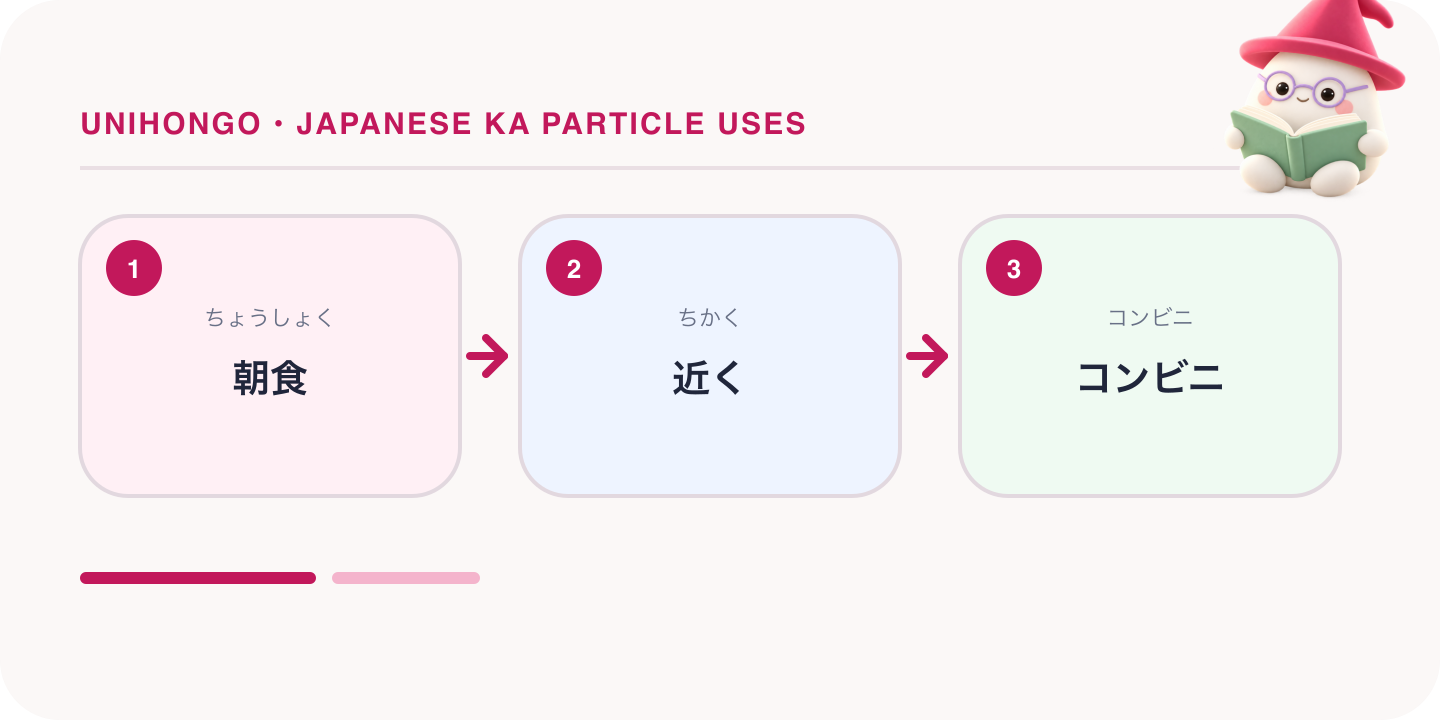
| Japanese | Romaji | Meaning |
|---|---|---|
| 朝食は七時からですか。 | Chōshoku wa shichi-ji kara desu ka. | Is breakfast from seven? |
| 近くにコンビニはありますか。 | Chikaku ni konbini wa arimasu ka. | Is there a convenience store nearby? |
| この荷物を預けられますか。 | Kono nimotsu o azukeraremasu ka. | Can I leave this luggage with you? |
| チェックアウトは何時ですか。 | Chekkuauto wa nan-ji desu ka. | What time is check-out? |
How ka is built: what it attaches to and what drops
Ka goes directly after the last word of the sentence. The one change to remember concerns da, the plain form of desu: da and ka do not sit together at the end of a question. Gakusei da becomes gakusei ka, never gakusei da ka. The reason is that da asserts. It stamps the sentence as fact, and you cannot stamp something as fact and leave it blank in the same breath. Desu is gentler, so desu ka is fine.
| Pattern | Reading | Built from | Note |
|---|---|---|---|
| 行きますか | ikimasu ka | Polite verb + ka | Standard polite question |
| 学生ですか | gakusei desu ka | Noun + desu + ka | Standard polite question |
| 静かですか | shizuka desu ka | Na-adjective + desu + ka | No na before desu |
| 寒いですか | samui desu ka | I-adjective + desu + ka | Desu only adds politeness |
| 行くか | iku ka | Plain verb + ka | Blunt to a person, fine to yourself |
| 学生か | gakusei ka | Noun + ka | Da drops before ka |
| 行こうか | ikō ka | Volitional form + ka | Shall we go? Friendly |
The last three rows are plain style, and they behave very differently from one another in conversation. The next section explains why.
Casual questions: dropping ka and raising the pitch
Among friends and family, the box is drawn with the voice. Iku with a rise on the last syllable means are you going, and nothing else is needed. Nouns and na-adjectives lose da as well: genki? not genki da? When the question asks for an explanation, or contains a question word, no often closes it: doko iku no, where are you off to?
So why not simply keep ka? Because plain form plus ka, said to someone's face, sounds like a demand for an answer with the politeness removed. Taberu ka? is how a gruff boss, a father in an old film or a detective in a drama speaks. Some men use it with close friends, and it is heard more from older speakers, but as a learner you will rarely need it. Plain form plus ka is perfectly soft when the slot is handed to nobody in particular: jā, iku ka, right, time to go, is said half to yourself, and ikō ka, shall we go, shares the decision.
Scene: two flatmates on a Saturday morning, deciding what to do with the day.
| Japanese | Romaji | Meaning |
|---|---|---|
| 明日、行く? | Ashita, iku? | Are you going tomorrow? |
| これ、食べる? | Kore, taberu? | Do you want to eat this? |
| 元気? | Genki? | Are you doing okay? |
| あの人、学生? | Ano hito, gakusei? | Is that person a student? |
| どこ行くの? | Doko iku no? | Where are you off to? |
| そろそろ帰ろうか。 | Sorosoro kaerō ka. | Shall we head home soon? |
Minimal pairs: one ka, one pitch, a different meaning
Because ka only opens a slot, the pitch decides whether you are handing that slot to the listener or closing it yourself. A rise passes it over. A fall keeps it: you have filled the blank with what you just heard or decided. Each pair below differs in one element only.
| Sentence | Reading | What it says |
|---|---|---|
| そうですか↘ | Sō desu ka, falling | I see. You take the news in and expect no answer |
| そうですか↗ | Sō desu ka, rising | Is that so? You doubt it or want confirmation |
| 行く↗ | Iku, rising | Are you going? A neutral casual question |
| 行くか↘ | Iku ka, falling | Right, time to go. Said to yourself or the group |
| いいですか↗ | Ii desu ka, rising | Is it all right? May I? |
| いいです↘ | Ii desu, falling | It is fine, or no thank you |
Sō desu ka with a fall is one of the most frequent responses in Japanese conversation. A colleague says she is moving to Sapporo; you say sō desu ka, falling, and it means I see, I have taken that in. Literally it is still: is that so, but the slot has been filled by her news, so nobody needs to answer. Say it with a rise and she will think you doubt her.
The casual versions are sō ka and sokka. Sō nan desu ka adds a note of surprise or interest and is a safe, warm response in polite conversation.
Beyond the basics: A ka B for or
Put ka between two nouns and the slot sits between two candidates: one of these goes in the box, and it has not been decided which. Kōhī ka kōcha, coffee or tea. A second ka after the last item is possible, kōhī ka kōcha ka, but it is usually left out before a particle. With verbs and adjectives both halves take ka: iku ka ikanai ka, literally: go, blank, not go, blank, which English turns into whether to go or not.
One restriction follows from the picture. A ka B is a single noun phrase meaning one of the two, so kōhī ka kōcha o nomimasu ka asks whether you will drink either of them, and the answer is yes or no. To make someone choose, ask two questions joined by soretomo, or use dochira.
Scene: a café counter, then an office where a visit is being arranged.
| Japanese | Romaji | Meaning |
|---|---|---|
| コーヒーか紅茶が選べます。 | Kōhī ka kōcha ga erabemasu. | You can choose coffee or tea. |
| 月曜か火曜に伺います。 | Getsuyō ka kayō ni ukagaimasu. | I will visit on Monday or Tuesday. |
| 行くか行かないか、まだ決めていません。 | Iku ka ikanai ka, mada kimete imasen. | I haven't decided yet whether to go or not. |
| コーヒーにしますか、それとも紅茶にしますか。 | Kōhī ni shimasu ka, soretomo kōcha ni shimasu ka. | Will you have coffee, or will you have tea? |
| コーヒーと紅茶、どちらがいいですか。 | Kōhī to kōcha, dochira ga ii desu ka. | Which would you like, coffee or tea? |
Question word plus ka: nanika, dareka, dokoka, itsuka
A question word is already a gap waiting for an answer. Add ka and the gap is declared open for good: the speaker does not know, or does not mind, what goes in it. Nani, what, becomes nanika, something. Dare becomes dareka, someone; doko becomes dokoka, somewhere; itsu becomes itsuka, someday.
Particles follow the whole word, and ga and o are often left out in speech: dareka kimashita, nanika tabemasu ka. Others stay: dokoka de, dareka ni. The combinations of question words with mo and demo belong to a different family, covered in the dedicated post on those endings, so here it is enough to see what ka does to a question. Scene: a host looking after a guest who has just arrived.
| Japanese | Romaji | Meaning |
|---|---|---|
| 何か飲みますか。 | Nanika nomimasu ka. | Would you like something to drink? |
| 何を飲みますか。 | Nani o nomimasu ka. | What will you drink? |
| 誰か来ましたよ。 | Dareka kimashita yo. | Someone has come. |
| どこかで会いましたか。 | Dokoka de aimashita ka. | Have we met somewhere? |
| いつか日本に住みたいです。 | Itsuka Nihon ni sumitai desu. | I'd like to live in Japan someday. |
Ka na, ka mo and ka dō ka: slots you keep for yourself
Three common endings use ka without asking anyone anything. Ka na adds the musing na to the open slot, so the question is addressed to yourself: hareru ka na, I wonder if it will clear up. Ka mo, short for ka mo shiremasen, means might: literally, whether it is so cannot even be known. Ka dō ka packs a yes or no question inside a larger sentence, literally: whether or how. Each has its own article on this site. What matters here is that all three are the same empty box, placed where no listener is asked to fill it.
Formation follows the plain-style rows of the table: plain form before ka, with da dropped after nouns and na-adjectives, so ame ka na and ame ka mo, not ame da ka na.
| Japanese | Romaji | Meaning |
|---|---|---|
| 明日は晴れるかな。 | Ashita wa hareru ka na. | I wonder if it will be sunny tomorrow. |
| 電車、遅れるかも。 | Densha, okureru ka mo. | The train might be late. |
| 彼は来ないかもしれません。 | Kare wa konai ka mo shiremasen. | He might not come. |
| 間に合うかどうか分かりません。 | Maniau ka dō ka wakarimasen. | I don't know whether I'll make it in time. |
Neighbours: ka versus no and ne
Two other sentence endings get mixed up with ka. No, with rising pitch, asks for the background to something you have noticed: dō shita no, what happened? It is the usual casual way to ask a question containing a question word, and in polite speech it becomes n desu ka. Choose it when you are asking for an explanation, and choose bare rising pitch when you only want a yes or no.
Ne asks for agreement, not information. Atsui desu ne assumes the listener feels the heat too. Atsui desu ka opens a real slot: you do not know, perhaps because the other person has just come in from outside. Using ka where ne belongs makes small talk sound like a survey.
| Japanese | Romaji | Meaning |
|---|---|---|
| どうしたの? | Dō shita no? | What's the matter? |
| 暑いですね。 | Atsui desu ne. | It's hot, isn't it? |
| 暑いですか。 | Atsui desu ka. | Are you hot? |
Common mistakes with ka and why they happen
Gakusei da ka is wrong. Learners produce it by converting desu to da word for word. Da cannot stand before a sentence-final ka, so the plain versions are gakusei ka or, far more often, gakusei? with a rise.
Taberu ka? said to a friend is grammatical but gruff. It comes from removing masu and leaving everything else in place. Say taberu? and let the pitch ask.
Sō desu ka with a rise, used as a listening response, is a pitch habit carried over from English, where anything shaped like a question rises. The listener hears doubt. Let the pitch fall.
Kōhī ka kōcha o nomimasu ka, meant as which would you like, copies English coffee or tea. It is a correct sentence with the wrong meaning: it asks whether the person wants either. Say kōhī to kōcha, dochira ga ii desu ka.
Nanika tabemasu ka used where nani o tabemasu ka was meant is the last trap. Learners treat nanika as a softer nani, then get hai as an answer when they expected the name of a dish.