
What each word is actually doing
These three are not synonyms with different politeness levels. They answer different questions. Zutsu answers how much for each, and attaches to a quantity: nimai zutsu, two sheets each. Goto ni answers how often, counting the full cycle from one event to the next: mikka goto ni, every three days. Oki ni also answers how often, but it counts what sits between the events: futsuka oki ni, skipping two days.
So goto ni measures the whole step and oki ni measures the gap inside it. That single sentence resolves most of the confusion, and it explains why a period expressed with oki ni is always one unit longer in practice than the same number with goto ni.
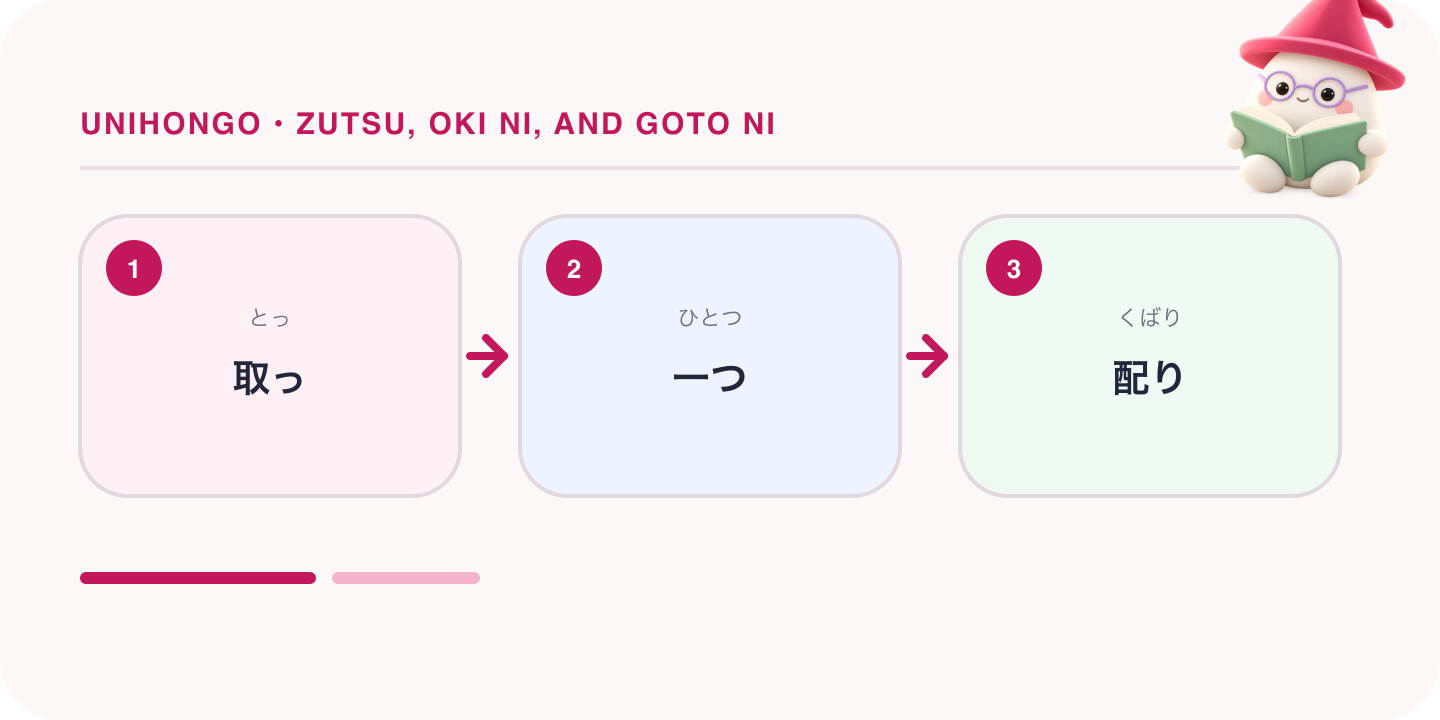
Zutsu shares an amount out
Zutsu attaches directly after a number and counter and needs no particle of its own. Hitori nimai zutsu means two each per person, with the per-person part carried by hitori rather than by zutsu. Nothing changes in the rest of the sentence: the object still takes o, the verb still comes last, and the polite form stays the default in instructions.
Because zutsu is about distribution, it pairs naturally with verbs of giving, taking, dividing and collecting: kubaru, toru, wakeru, atsumeru. A useful pattern for group work is number plus counter plus zutsu plus no plus noun, as in sannin zutsu no gurūpu, groups of three each.
| Japanese | Romaji | Meaning |
|---|---|---|
| 一人二枚ずつ取ってください。 | Hitori nimai zutsu totte kudasai. | Please take two sheets each. |
| みんなに一つずつ配ります。 | Minna ni hitotsu zutsu kubarimasu. | I will hand out one to each person. |
| 三人ずつのグループになってください。 | Sannin zutsu no gurūpu ni natte kudasai. | Please get into groups of three. |
| 五百円ずつ集めます。 | Gohyaku-en zutsu atsumemasu. | We will collect five hundred yen from each person. |
| 二人ずつ入ってください。 | Futari zutsu haitte kudasai. | Please go in two at a time. |
Zutsu for a bit at a time
The second use of zutsu describes gradual progress rather than sharing. Sukoshi zutsu, little by little, is the phrase you will use most as a learner, and it fits any verb of change or learning. Combining a time amount with zutsu turns it into a daily portion: mainichi juppun zutsu, ten minutes each day.
Hitotsu zutsu with a verb of checking or answering means one at a time, in sequence, which is different from the sharing sense but comes from the same idea of an equal portion per step. It is a polite way to slow a conversation down when someone has asked you three things at once.
| Japanese | Romaji | Meaning |
|---|---|---|
| 少しずつ覚えています。 | Sukoshi zutsu oboete imasu. | I am learning it bit by bit. |
| 毎日十分ずつ練習します。 | Mainichi juppun zutsu renshū shimasu. | I practise ten minutes each day. |
| 一つずつ確認しましょう。 | Hitotsu zutsu kakunin shimashō. | Let's check them one at a time. |
| 一問ずつ答えます。 | Ichimon zutsu kotaemasu. | I will answer one question at a time. |
| 少しずつ慣れてきました。 | Sukoshi zutsu narete kimashita. | I have gradually got used to it. |
Goto ni means every single one
Goto ni attaches to a noun or a quantity and picks out every member of the set without exception. With a time amount it gives a repeating cycle: sanjuppun goto ni, every thirty minutes. With a plain noun it means each of them individually: heya goto ni, room by room, hito goto ni, from person to person, kuni goto ni, country by country.
The ni can drop in written or compressed style, giving heya goto or nenmatsu goto, and the whole phrase can modify a noun with no, as in mikka goto no tenken, a check every three days. Goto ni never implies skipping. If you say futsuka goto ni it happens on a two-day cycle, and no day inside that cycle is treated as excluded.
| Japanese | Romaji | Meaning |
|---|---|---|
| 三十分ごとに休みます。 | Sanjuppun goto ni yasumimasu. | I take a break every thirty minutes. |
| 三日ごとに水をやってください。 | Mikka goto ni mizu o yatte kudasai. | Please water it every three days. |
| 一年ごとに契約を更新します。 | Ichinen goto ni keiyaku o kōshin shimasu. | The contract is renewed every year. |
| 部屋ごとにエアコンがあります。 | Heya goto ni eakon ga arimasu. | There is an air conditioner in every room. |
| 人ごとに答えが違います。 | Hito goto ni kotae ga chigaimasu. | The answer differs from person to person. |
| 五分ごとに更新されます。 | Gofun goto ni kōshin saremasu. | It refreshes every five minutes. |
Oki ni skips the interval
Oki ni attaches to an amount of time, distance or countable items and names what is left out. Ichinichi oki ni, skipping one day, is every other day. Isshūkan oki ni is every other week. Ichigyō oki ni is on alternate lines. The pattern also works in space: hitotsu oki ni suwaru means to sit leaving one seat empty between people.
Two formal equivalents are worth recognising because rosters and contracts use them: kakujitsu for alternate days and kakushū for alternate weeks. If a shift pattern is described as kakujitsu kinmu, you work Monday, Wednesday and Friday, not every day. The ni can also drop when the phrase modifies a noun, giving ichinichi oki no fukuyō, a dose taken on alternate days, which is how the instruction often appears in print.
| Japanese | Romaji | Meaning |
|---|---|---|
| 一日おきにジムに行きます。 | Ichinichi oki ni jimu ni ikimasu. | I go to the gym every other day. |
| 一週間おきに会議があります。 | Isshūkan oki ni kaigi ga arimasu. | There is a meeting every other week. |
| 二日おきに薬を替えます。 | Futsuka oki ni kusuri o kaemasu. | The medicine is changed every third day. |
| 一行おきに書いてください。 | Ichigyō oki ni kaite kudasai. | Please write on every other line. |
| 一つおきに座ってください。 | Hitotsu oki ni suwatte kudasai. | Please sit leaving one seat between you. |
The calendar test
The fastest way to fix these patterns is to stop translating and start counting dates. Take a month that begins on the first and mark which days each expression puts you on. Once you see that ichinichi oki ni and futsuka goto ni produce the same column of dates, the difference between the two words becomes a fact about counting rather than a rule to memorise.
| Expression | Reading | Days you act, starting on the 1st |
|---|---|---|
| 毎日 | Mainichi | 1, 2, 3, 4, 5 and so on, every day |
| 一日おきに | Ichinichi oki ni | 1, 3, 5, 7, one day skipped between |
| 二日ごとに | Futsuka goto ni | 1, 3, 5, 7, the same days as ichinichi oki ni |
| 二日おきに | Futsuka oki ni | 1, 4, 7, two days skipped between |
| 三日ごとに | Mikka goto ni | 1, 4, 7, the same days as futsuka oki ni |
| 毎週 | Maishū | 1, 8, 15, 22, once a week |
| 一週間おきに | Isshūkan oki ni | 1, 15, 29, every other week |
| 隔週 | Kakushū | 1, 15, 29, the formal word for every other week |
The pattern to remember is that an oki ni figure and the goto ni figure one higher describe the same schedule. Ichinichi oki ni equals futsuka goto ni, futsuka oki ni equals mikka goto ni, and so on up the scale.
Why oki ni is genuinely ambiguous
Native speakers do not all use oki ni the same way, and the split is predictable. With days, weeks and countable objects the skipping reading is firm. With short repeating units such as minutes, and with points along a line such as bus stops, most speakers treat oki ni as simply the interval between events, so juppun oki ni is understood as every ten minutes rather than every twenty.
This is why it is normal, not rude, to check. Doctors, pharmacists and schedulers often restate an oki ni instruction in dates or times, and you can ask them to. The safe move when you are the one speaking is to use goto ni or a plain date list for anything that matters medically or contractually.
| Japanese | Romaji | Meaning |
|---|---|---|
| この電車は十分おきに来ます。 | Kono densha wa juppun oki ni kimasu. | This train comes every ten minutes. |
| 一日おきというのは、明日は飲まなくていいということですか? | Ichinichi oki to iu no wa, ashita wa nomanakute ii to iu koto desu ka? | Does every other day mean I do not take it tomorrow? |
| はい、明日は飲まなくていいです。 | Hai, ashita wa nomanakute ii desu. | That is right, not tomorrow. (pharmacist) |
| 念のため、日にちで教えてください。 | Nen no tame, hinichi de oshiete kudasai. | Just to be safe, could you tell me the actual dates? |
| 火曜日と木曜日と土曜日ですね。 | Kayōbi to mokuyōbi to doyōbi desu ne. | So Tuesday, Thursday and Saturday. |
Schedules, timetables and dosage
In instructions the three words often appear together, and each does a separate job: goto ni or oki ni sets the interval, zutsu sets the amount, and a mai word sets the anchor. Ichinichi sankai, ichijō zutsu means three times a day, one tablet each time. Maishokugo ni ippō zutsu means one sachet after every meal.
Timetables prefer kankaku, interval, in written notices: jūgofun kankaku de unkō, running at fifteen-minute intervals. Work patterns prefer the kaku words. Recognising all three registers means you can read the notice, hear the announcement and repeat the instruction back correctly.
| Japanese | Romaji | Meaning |
|---|---|---|
| 一日三回、一錠ずつ飲んでください。 | Ichinichi sankai, ichijō zutsu nonde kudasai. | Take one tablet three times a day. |
| 毎食後に一包ずつ飲んでください。 | Maishokugo ni ippō zutsu nonde kudasai. | Take one sachet after each meal. (pharmacist) |
| 六時間ごとに体温を測ります。 | Rokujikan goto ni taion o hakarimasu. | We take the temperature every six hours. |
| バスは十五分間隔で出ます。 | Basu wa jūgofun kankaku de demasu. | Buses leave at fifteen-minute intervals. |
| 隔日勤務です。 | Kakujitsu kinmu desu. | I work on alternate days. |
| 隔週で出勤します。 | Kakushū de shukkin shimasu. | I go into the office every other week. |
The frequency family around them
For ordinary conversation the most common frequency pattern is not any of these three. It is period plus ni plus a count: shū ni nikai, twice a week, ichinichi ni sankai, three times a day, nishūkan ni ikkai, once every two weeks. The ni here marks the span the count sits inside, and the count uses kai or the slightly softer do.
Mai attaches directly to a time noun with no particle: maiasa, maishū, maitsuki, maitoshi. Tabi ni follows a plain-form verb or a noun plus no and means every time that thing happens, as in au tabi ni, every time we meet. Use tabi ni when the trigger is an event rather than a clock.
| Japanese | Romaji | Meaning |
|---|---|---|
| 週に二回、練習しています。 | Shū ni nikai, renshū shite imasu. | I practise twice a week. |
| 二週間に一回、病院に行きます。 | Nishūkan ni ikkai, byōin ni ikimasu. | I go to the clinic once every two weeks. |
| 一日に三回、歯を磨きます。 | Ichinichi ni sankai, ha o migakimasu. | I brush my teeth three times a day. |
| どのくらいの頻度で来ますか? | Dono kurai no hindo de kimasu ka? | How often does it come? |
| 月に一度くらいです。 | Tsuki ni ichido kurai desu. | About once a month. |
| 毎朝七時に家を出ます。 | Maiasa shichi-ji ni ie o demasu. | I leave home at seven every morning. |
| 日本に行くたびに買います。 | Nihon ni iku tabi ni kaimasu. | I buy some every time I go to Japan. |
| 会うたびに背が伸びていますね。 | Au tabi ni se ga nobite imasu ne. | You have grown every time I see you. |
The mistakes learners make
Three errors account for nearly all of the trouble. The first is treating oki ni as a synonym for mai and promising to do something daily when you meant alternate days. The second is attaching zutsu to a frequency rather than an amount: mainichi zutsu is not a phrase, because zutsu needs a quantity such as juppun zutsu to distribute. The third is putting a particle before these words; zutsu, goto ni and oki ni all follow their quantity directly.
- Every day is mainichi, never ichinichi oki ni
- Zutsu follows an amount, so say juppun zutsu, not mainichi zutsu
- No particle before zutsu, goto ni or oki ni; they attach straight to the quantity
- Say goto ni, or give dates, whenever the schedule really matters
- Kakujitsu and kakushū are the formal words you will see on shift rosters
- Tabi ni takes a plain-form verb even in an otherwise polite sentence