

Rough amounts: mikka hodo, sanzen-en hodo
After a number and its counter, hodo means about. Mikka hodo kakarimasu, it will take about three days, literally: it takes to the level of three days. The speaker draws the line at three and admits that the real figure may sit a little to either side.
This hodo is polite and a touch formal. It is what you hear from shop staff, on the phone to a company and in announcements, where a bare number might sound curt. Among friends, kurai or gurai does the same job.
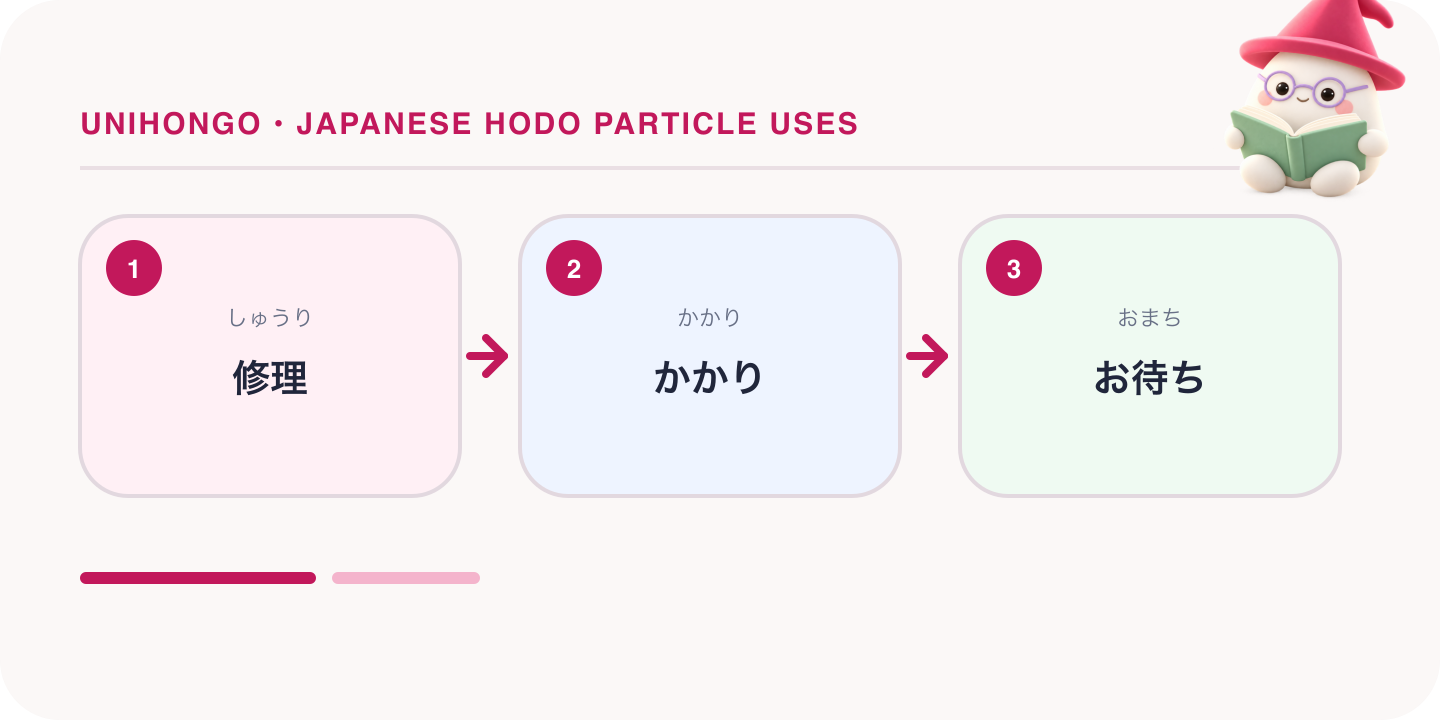
One limit follows from the picture. Hodo measures quantity, not position. A point on the clock is not an amount, so about three o'clock is san-ji goro, never san-ji hodo. A length of time is an amount, so san-jikan hodo, about three hours, is fine. Scene: a customer has brought a watch to a repair counter.
| Japanese | Romaji | Meaning |
|---|---|---|
| 修理は三日ほどかかります。 | Shūri wa mikka hodo kakarimasu. | The repair will take about three days. |
| 五分ほどお待ちください。 | Go-fun hodo omachi kudasai. | Please wait about five minutes. |
| 費用は三千円ほどです。 | Hiyō wa sanzen-en hodo desu. | The cost is around three thousand yen. |
| 駅から歩いて十分ほどです。 | Eki kara aruite juppun hodo desu. | It's about ten minutes on foot from the station. |
| 参加者は五十人ほどでした。 | Sankasha wa gojū-nin hodo deshita. | There were about fifty participants. |
Not as much as: A wa B hodo with a negative
The second use a beginner needs is the comparison that falls short. Kyō wa kinō hodo samukunai desu, today is not as cold as yesterday, literally: as for today, to yesterday's level it is not cold. Yesterday is the line on the door frame; today does not reach it.
The sentence must end in a negative, and there is a reason. Hodo only draws the line. To say something reaches the line exactly, Japanese has a different phrase, onaji kurai, and to say something passes it, Japanese uses yori. What is left for hodo is the case where the line is not reached. The pattern also carries a quiet message that B is high on the scale: kinō hodo samukunai implies yesterday was properly cold. Scene: two colleagues are chatting about a move from Tokyo to Fukuoka.
| Japanese | Romaji | Meaning |
|---|---|---|
| 福岡は東京ほど家賃が高くないです。 | Fukuoka wa Tōkyō hodo yachin ga takakunai desu. | Rent in Fukuoka isn't as high as in Tokyo. |
| 今年は去年ほど忙しくありません。 | Kotoshi wa kyonen hodo isogashiku arimasen. | This year isn't as busy as last year. |
| 思ったほど難しくなかったです。 | Omotta hodo muzukashikunakatta desu. | It wasn't as difficult as I had thought. |
| 私は兄ほど背が高くない。 | Watashi wa ani hodo se ga takakunai. | I'm not as tall as my older brother. |
How hodo is built
Hodo is a noun in origin, and it behaves like one: whatever comes before it takes the form used before a noun. That means plain forms for verbs and i-adjectives, and na for na-adjectives. Polite masu forms do not go before hodo. Politeness is shown once, at the end of the sentence.
| Pattern | Reading | Built from | Meaning |
|---|---|---|---|
| 三日ほど | mikka hodo | Number and counter + hodo | About three days |
| 東京ほど | Tōkyō hodo | Noun + hodo, then a negative | Not as much as Tokyo |
| 死ぬほど | shinu hodo | Verb plain form + hodo | To the point of dying |
| 動けないほど | ugokenai hodo | Verb nai form + hodo | So much that I cannot move |
| 痛いほど | itai hodo | I-adjective + hodo | To a painful degree |
| これほど | kore hodo | Kore, sore or are + hodo | To this degree |
| 思ったほど | omotta hodo | Verb plain past + hodo, then a negative | Not as much as I thought |
Na-adjectives are less common before hodo, but the rule holds: fushigi na hodo shizuka, strangely quiet, keeps its na.
Minimal pairs: hodo against yori, gurai and goro
Each pair changes one element and keeps the rest of the sentence as close as the grammar allows.
| Sentence | Reading | What it says |
|---|---|---|
| 今日は昨日ほど寒くない。 | Kyō wa kinō hodo samukunai. | Both days are cold; today falls short of yesterday |
| 今日は昨日より暖かい。 | Kyō wa kinō yori atatakai. | Today is warmer; neither day need be cold |
| 三日ほどかかります。 | Mikka hodo kakarimasu. | About three days, in polite or formal speech |
| 三日ぐらいかかります。 | Mikka gurai kakarimasu. | About three days, in everyday speech |
| 三時間ほど寝ました。 | San-jikan hodo nemashita. | I slept for about three hours: an amount |
| 三時ごろ寝ました。 | San-ji goro nemashita. | I went to bed at about three: a point in time |
The first pair matters most. Hodo with a negative and yori with a positive can describe the same weather, but hodo takes yesterday's cold as given. If you tell a host that today's curry is kinō hodo karakunai, you have also said that yesterday's was hot. Choose yori when you want to compare without that background claim.
Beyond the basics: to the extent that, shinu hodo tsukareta
Here the line on the scale is an event. Shinu hodo tsukareta, literally: I got tired to the level of dying. Namida ga deru hodo waratta, I laughed until tears came. The clause before hodo describes what happens at that level, and the listener works out how high the level must be. Often the event is an exaggeration, as with shinu. Often it is quite real, as in koe ga denaku naru hodo, to the point of losing my voice.
The nai form is equally common: shinjirarenai hodo yasui, unbelievably cheap, literally: cheap to a level that cannot be believed. Scene: a friend is telling you about moving flat in the middle of August.
| Japanese | Romaji | Meaning |
|---|---|---|
| 昨日は死ぬほど疲れた。 | Kinō wa shinu hodo tsukareta. | I was dead tired yesterday. |
| 涙が出るほど笑いました。 | Namida ga deru hodo waraimashita. | I laughed so much that I cried. |
| 信じられないほど安かったです。 | Shinjirarenai hodo yasukatta desu. | It was unbelievably cheap. |
| 動けないほどお腹がいっぱいです。 | Ugokenai hodo onaka ga ippai desu. | I'm so full that I can't move. |
| 声が出なくなるほど歌った。 | Koe ga denaku naru hodo utatta. | I sang until I lost my voice. |
Nothing reaches this mark: B hodo plus wa nai
Turn the negative comparison round and you get a superlative. Kore hodo oishii rāmen wa nai, literally: ramen that is tasty to this level does not exist. Nothing else comes up to the line, so this one is the best. With people the verb is inai: kanojo hodo yasashii hito wa inai, there is nobody as kind as her.
The pattern is warmer and more personal than ichiban. Ichiban ranks. Hodo with wa nai says the speaker has looked and found no rival, which suits praise, thanks and complaints. Kore hodo, sore hodo and are hodo also stand alone as adverbs: sore hodo takakunai, not all that expensive. Scene: a farewell dinner, where people are saying what they will miss.
| Japanese | Romaji | Meaning |
|---|---|---|
| これほどおいしいラーメンはありません。 | Kore hodo oishii rāmen wa arimasen. | There is no ramen as good as this. |
| 田中さんほど親切な人はいません。 | Tanaka-san hodo shinsetsu na hito wa imasen. | There is nobody as kind as Tanaka-san. |
| 健康ほど大切なものはない。 | Kenkō hodo taisetsu na mono wa nai. | Nothing is as important as health. |
| それほど高くないですよ。 | Sore hodo takakunai desu yo. | It's not all that expensive. |
Neighbours: hodo versus kurai and gurai
Kurai, also pronounced gurai, overlaps with hodo in amounts and in extent, and the dedicated post on it covers its range. Three differences decide between them. First, register: for amounts, hodo is the formal choice and gurai the everyday one. Second, the negative comparison, A wa B hodo followed by a negative, belongs to hodo; standard Japanese does not use kurai there. Third, attitude: kurai can treat a level as small, as in kore kurai dekiru, I can manage this much, or aisatsu kurai shite kudasai, at least say hello. Hodo never belittles. It tends to point at high levels.
Equality is kurai territory: onaji kurai, about the same, is the fixed phrase. In extent sentences both occur, nakitai hodo and nakitai kurai, with hodo a little more written or dramatic. Preferences here vary with the speaker.
| Japanese | Romaji | Meaning |
|---|---|---|
| 三十分ぐらい待ったよ。 | Sanjuppun gurai matta yo. | I waited about thirty minutes. |
| 弟は私と同じくらい背が高い。 | Otōto wa watashi to onaji kurai se ga takai. | My younger brother is about as tall as me. |
| 挨拶くらいしてください。 | Aisatsu kurai shite kudasai. | Please at least say hello. |
| 泣きたいくらい悔しかった。 | Nakitai kurai kuyashikatta. | I was so frustrated I wanted to cry. |
Hodo in conversation: saki hodo, nochi hodo and the ba pattern
Several everyday words are hodo in disguise. Saki hodo, a little while ago, and nochi hodo, a little later, are the polite versions of sakki and ato de, and you will hear them constantly on the phone and in shops. Naruhodo, I see, that makes sense, is written with the same kanji, though speakers no longer feel it as a particle. Be a little careful with naruhodo towards seniors: some people find that it sounds like passing judgement.
Then there is the pattern with ba and hodo: yomeba yomu hodo omoshiroi, the more I read, the more interesting it gets. The line on the door frame is now moving: as one level rises, the other rises with it. It has an article of its own, so two examples are enough here.
| Japanese | Romaji | Meaning |
|---|---|---|
| 後ほどお電話いたします。 | Nochi hodo odenwa itashimasu. | I will call you a little later. |
| 先ほどメールを送りました。 | Saki hodo mēru o okurimashita. | I sent the email a little while ago. |
| 読めば読むほど面白いです。 | Yomeba yomu hodo omoshiroi desu. | The more I read it, the more interesting it gets. |
| 早ければ早いほどいいです。 | Hayakereba hayai hodo ii desu. | The sooner, the better. |
Common mistakes with hodo
Kono heya wa ano heya hodo hiroi desu is wrong. It is a word-for-word copy of English as big as. The hodo comparison exists only in the negative. For equality, say ano heya to onaji kurai hiroi desu.
San-ji hodo ni aimashō is wrong. English about covers both amounts and clock times; hodo covers amounts only. Say san-ji goro ni aimashō.
Shinimasu hodo tsukaremashita is wrong. Learners who want the whole sentence to be polite put masu before hodo. Hodo is noun-like and takes plain forms, so the polite sentence is shinu hodo tsukaremashita.
Kyō wa kinō yori samukunai desu is grammatical, but it is not what learners mean by it. It says today is not colder than yesterday, which leaves room for the two days being equal. For not as cold as, say kinō hodo samukunai desu.