
But has two jobs in Japanese
The first job is the one dictionaries show: contrast. Takai desu kedo, kaimasu links two facts that do not sit comfortably together. The second job has almost nothing to do with contrast. When a Japanese speaker opens with sumimasen ga or yoyaku shitai n desu kedo, nothing is being contrasted at all. The connector is a hinge that says I have set something up, now over to you.
This second use is why beginners hear kedo and ga far more often than the textbook meaning would predict. If you only know but, these sentences sound broken, as though the speaker forgot the second half. They did not forget it. Leaving the second half out is the point, because an unfinished sentence asks for nothing directly and leaves the listener room to refuse.
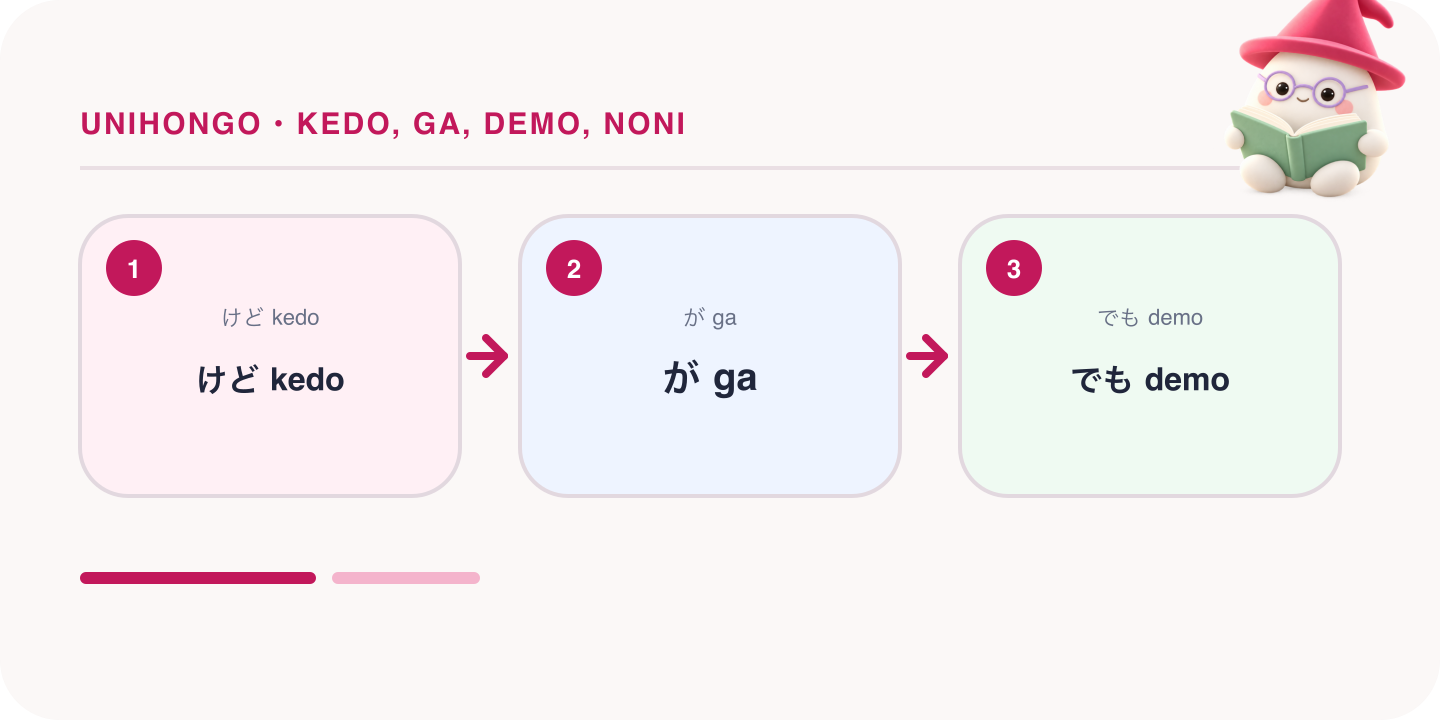
The connectors at a glance
| Connector | Register | Position | Nuance |
|---|---|---|---|
| けど kedo | Casual to polite speech | Joins two clauses | The everyday but; also the soft preface |
| けれど keredo | Slightly more careful speech | Joins two clauses | Tidier than kedo, still conversational |
| けれども keredomo | Formal speech, announcements | Joins two clauses | Careful and polite, a little old-fashioned |
| が ga | Formal speech and writing | Joins two clauses | Crisp and businesslike; standard in email |
| でも demo | Casual to polite speech | Starts a sentence | But, however, especially when replying |
| しかし shikashi | Writing, formal speech | Starts a sentence | However; argumentative and written |
| しかしながら shikashinagara | Very formal writing | Starts a sentence | However, in the stiffest register |
| のに noni | All registers | Joins two clauses | Even though; carries surprise or reproach |
| ところが tokoro ga | Storytelling, speech and writing | Starts a sentence | But then, unexpectedly; sets up a twist |
Position is the fastest filter. If you want to answer someone who has just spoken, you need a sentence starter, so demo or shikashi. If you want to put two ideas inside one sentence, you need a joiner, so kedo, ga or noni. Learners often produce demo in the middle of a clause because English but can sit there, and that single habit marks a sentence as translated.
Kedo and its politer relatives
Kedo attaches to whatever comes before it without changing it. After a plain form it stays plain: takai kedo. After a polite form it stays polite: takai desu kedo. That makes it unusually easy, because you do not have to learn a special connective form. With a na-adjective or a noun the plain version needs da, as in suki da kedo and gakusei da kedo, while the polite version simply uses desu kedo.
Keredo and keredomo are the same word made longer and more careful. Length tracks formality here, so kedo is the shortest and most casual, keredomo the most formal, and ga sits alongside keredomo in business use. In everyday polite conversation, desu kedo and masu kedo are entirely appropriate and will never sound rude.
| Japanese | Romaji | Meaning |
|---|---|---|
| 高いですけど、買います。 | Takai desu kedo, kaimasu. | It is expensive, but I will buy it. |
| 日本語は難しいけど、面白いです。 | Nihongo wa muzukashii kedo, omoshiroi desu. | Japanese is hard, but it is interesting. |
| 行きたいんですけど、時間がありません。 | Ikitai n desu kedo, jikan ga arimasen. | I want to go, but I do not have the time. |
| 好きだけど、毎日は無理です。 | Suki da kedo, mainichi wa muri desu. | I like it, but every day is too much. (plain plus polite) |
| 学生ですけど、働いています。 | Gakusei desu kedo, hataraite imasu. | I am a student, but I work. |
| 静かですけれども、少し不便です。 | Shizuka desu keredomo, sukoshi fuben desu. | It is quiet, but a little inconvenient. (formal) |
Ga in formal speech and writing
Ga is what kedo becomes when the setting is formal: a business email, a presentation, an announcement, a written report. It normally follows a polite predicate, so setsumei shimashita ga and takai desu ga are the usual shapes, and a plain form before ga reads as written style rather than speech.
Do not confuse this ga with the subject particle ga that follows a noun. The subject particle attaches to a noun and marks who or what; the connector ga attaches to the end of a whole clause and turns the sentence. Position tells you which is which every time.
| Japanese | Romaji | Meaning |
|---|---|---|
| 値段は高いですが、品質はいいです。 | Nedan wa takai desu ga, hinshitsu wa ii desu. | The price is high, but the quality is good. |
| 説明しましたが、伝わらなかったようです。 | Setsumei shimashita ga, tsutawaranakatta yō desu. | I explained it, but it seems it did not get through. |
| 恐れ入りますが、少々お待ちください。 | Osoreirimasu ga, shōshō omachi kudasai. | I am sorry to trouble you, but please wait a moment. (staff line) |
| 確認しましたが、まだ届いておりません。 | Kakunin shimashita ga, mada todoite orimasen. | I checked, but it has not arrived yet. |
Demo and shikashi start a new sentence
Demo is what you say when someone has just spoken and you want to push back gently. It opens a fresh sentence and is common in conversation, including polite conversation. Shikashi does the same job in writing and formal speech, and using it in casual chat sounds like reading from an essay.
| Japanese | Romaji | Meaning |
|---|---|---|
| 行きたいです。でも、お金がありません。 | Ikitai desu. Demo, okane ga arimasen. | I want to go. But I have no money. |
| そうですね。でも、時間がかかりますよ。 | Sō desu ne. Demo, jikan ga kakarimasu yo. | That is true. But it will take time. |
| でも、それは難しいと思います。 | Demo, sore wa muzukashii to omoimasu. | But I think that would be difficult. |
| しかし、問題も残っています。 | Shikashi, mondai mo nokotte imasu. | However, problems still remain. (written) |
| ご意見はよく分かります。しかしながら、今回は見送ります。 | Go-iken wa yoku wakarimasu. Shikashinagara, konkai wa miokurimasu. | I understand your view. However, we will pass this time. (very formal) |
Noni carries feeling
Noni means even though, and unlike kedo it is never neutral. It signals that the result was not what the situation promised, so it reports surprise, disappointment, or a complaint. Benkyō shita kedo, ochimashita is a plain statement of two facts. Benkyō shita noni, ochimashita adds and that is not fair.
The attachment is where mistakes happen. A verb or i-adjective takes noni directly: kita noni, samui noni. A na-adjective or a noun takes na noni: shizuka na noni, nichiyōbi na noni. And because noni carries the speaker's own emotion, it cannot be followed by a request, an invitation, or a command, which is a hard rule rather than a matter of taste.
| Japanese | Romaji | Meaning |
|---|---|---|
| 勉強したのに、試験に落ちました。 | Benkyō shita noni, shiken ni ochimashita. | Even though I studied, I failed the exam. |
| 約束したのに、来ませんでした。 | Yakusoku shita noni, kimasen deshita. | You promised, and yet you did not come. |
| 安いのに、おいしいです。 | Yasui noni, oishii desu. | It is cheap, and yet it is delicious. |
| 日曜日なのに、働いています。 | Nichiyōbi na noni, hataraite imasu. | It is Sunday, and yet I am working. |
| せっかく来たのに、閉まっていました。 | Sekkaku kita noni, shimatte imashita. | I came all that way, but it was closed. |
| 静かなのに、眠れません。 | Shizuka na noni, nemuremasen. | It is quiet, and yet I cannot sleep. |
Because noni leans toward reproach when it describes the listener, be careful with sentences such as yakusoku shita noni. Between friends it is normal; to a manager it sounds like an accusation. Swap in kedo and the same content becomes a neutral report.
The soft preface before a request
This is the use that matters most for everyday survival. The speaker states a situation, attaches ga or kedo, and stops. What follows is either a short question or nothing at all. Sumimasen ga is the frozen version of the pattern, and onegai ga aru n desu ga is the same move with the favour named but not yet described.
The n desu part is doing quiet work here. It frames the clause as background rather than a bare announcement, which is why yoyaku shitai n desu kedo sounds natural where yoyaku shitai kedo sounds abrupt. Learn the whole shape as one chunk: situation, n desu, kedo or ga, then a pause.
| Japanese | Romaji | Meaning |
|---|---|---|
| すみませんが、写真を撮っていただけますか。 | Sumimasen ga, shashin o totte itadakemasu ka? | Excuse me, but could you take a photo for me? |
| ちょっとお願いがあるんですけど。 | Chotto onegai ga aru n desu kedo. | I have a small favour to ask. |
| 予約したいんですが、空いていますか。 | Yoyaku shitai n desu ga, aite imasu ka? | I would like to book; do you have space? |
| 田中ですが、山田さんはいらっしゃいますか。 | Tanaka desu ga, Yamada-san wa irasshaimasu ka? | This is Tanaka; is Mr Yamada available? (on the phone) |
| 初めてなんですけど、大丈夫ですか。 | Hajimete na n desu kedo, daijōbu desu ka? | It is my first time; is that all right? |
| 質問があるんですが、よろしいでしょうか。 | Shitsumon ga aru n desu ga, yoroshii deshō ka? | I have a question; would now be all right? |
| 恐れ入りますが、この席は空いていますか。 | Osoreirimasu ga, kono seki wa aite imasu ka? | Excuse me, but is this seat free? |
| はい、何でしょうか。 | Hai, nan deshō ka? | Yes, what can I do for you? (what you hear back) |
Trailing kedo and what the listener hears
A sentence that ends on kedo with a falling tone is complete in Japanese terms. The speaker has given the situation and left the conclusion to the listener, who is expected to supply it. At a counter, chūmon ga mada kite inai n desu kedo means please check on my order without ever saying so. When declining, kyō wa tsugō ga warui n desu kedo means no, and no one will ask you to finish the sentence.
That is also why a flat English style refusal can feel harsh. Japanese prefers to stop short and let the other person close the loop, and the same device carries complaints without a raised voice. The one thing you must get right is the delivery: let the pitch fall and then wait. A trailing kedo said quickly and followed by more talking simply sounds like a sentence you abandoned.
| Japanese | Romaji | Meaning |
|---|---|---|
| あのう、これなんですけど…。 | Anō, kore na n desu kedo... | Um, it is about this... |
| すみません、注文がまだ来ていないんですけど。 | Sumimasen, chūmon ga mada kite inai n desu kedo. | Excuse me, my order still has not come. |
| ちょっと今日は都合が悪いんですけど…。 | Chotto kyō wa tsugō ga warui n desu kedo... | Today is a little inconvenient for me... (a refusal) |
| 明日までにお願いしたいんですが…。 | Ashita made ni onegai shitai n desu ga... | I would like to ask for it by tomorrow... |
| 少し高いと思うんですけど。 | Sukoshi takai to omou n desu kedo. | I do think it is a little expensive. |
| 申し訳ございません。すぐお持ちします。 | Mōshiwake gozaimasen. Sugu omochi shimasu. | I am very sorry. I will bring it right away. (staff reply) |
| かしこまりました。確認いたします。 | Kashikomarimashita. Kakunin itashimasu. | Certainly. I will check. (staff reply) |
Minimal pairs that change the feeling
| Japanese | Romaji | What it signals |
|---|---|---|
| 勉強したけど、落ちました。 | Benkyō shita kedo, ochimashita. | Neutral report of two facts |
| 勉強したのに、落ちました。 | Benkyō shita noni, ochimashita. | Same facts plus disappointment or unfairness |
| 高いけど、買います。 | Takai kedo, kaimasu. | Plain contrast, no attitude |
| 高いのに、買うんですか。 | Takai noni, kau n desu ka? | Mild reproach or surprise at the listener |
| 日曜日ですが、働きます。 | Nichiyōbi desu ga, hatarakimasu. | Factual, formal, no complaint |
| 日曜日なのに、働きます。 | Nichiyōbi na noni, hatarakimasu. | Grumbling about working on a Sunday |
| すみませんが、質問があります。 | Sumimasen ga, shitsumon ga arimasu. | Formal preface; standard at work |
| すみませんけど、質問があります。 | Sumimasen kedo, shitsumon ga arimasu. | The same move a step less formal |
Read each pair aloud back to back. The contrast is not in the vocabulary, which is identical, but in what the connector tells the listener about your position. This is the fastest way to feel why noni is not a synonym for kedo, and why a manager may notice which one you chose.
Mistakes that mark a translated sentence
- Using demo to join two clauses inside one sentence; use kedo or ga there and keep demo for the start of a reply.
- Saying da noni or byōki da noni instead of na noni; a na-adjective and a noun both need na before noni.
- Following noni with a request, as in samui noni mado o shimete kudasai; use node for a reason or kedo for a contrast.
- Treating a trailing kedo as an unfinished sentence and rushing to complete it, which removes the politeness.
- Using ga with friends in casual chat; it is not wrong, but it makes an ordinary remark sound like a memo.
- Confusing the connector ga at the end of a clause with the subject particle ga after a noun.
A short drill routine
- Take five sentences you can already say and add a contrast clause with kedo, then say each one again with ga and notice the change in register.
- Convert three of those into noni versions and check that none of them ends in a request or an invitation.
- Build three counter requests as situation plus n desu kedo, then stop, and hold the silence for two beats.
- Say a refusal three ways: kedo trailing, mōshiwake arimasen ga, and a plain muri desu, and decide which you would use with a colleague.
- Shadow one shop or station announcement containing ga and copy the pause before the second clause rather than the words alone.