

Nouns carry no number: hon is book and books
Start with what you do not have to do. English forces a choice between cat and cats every time. Japanese does not. The noun is a photograph without a count, and the listener fills in the number from the scene. At a bookshop till with three paperbacks in your hand, hon o kaimasu is complete.
When the number matters, you say it, with a number and counter or with a quantity word. Other posts on this site cover counters and quantity words in detail, so here you only need the principle: number is extra information you add, not a form the noun takes.
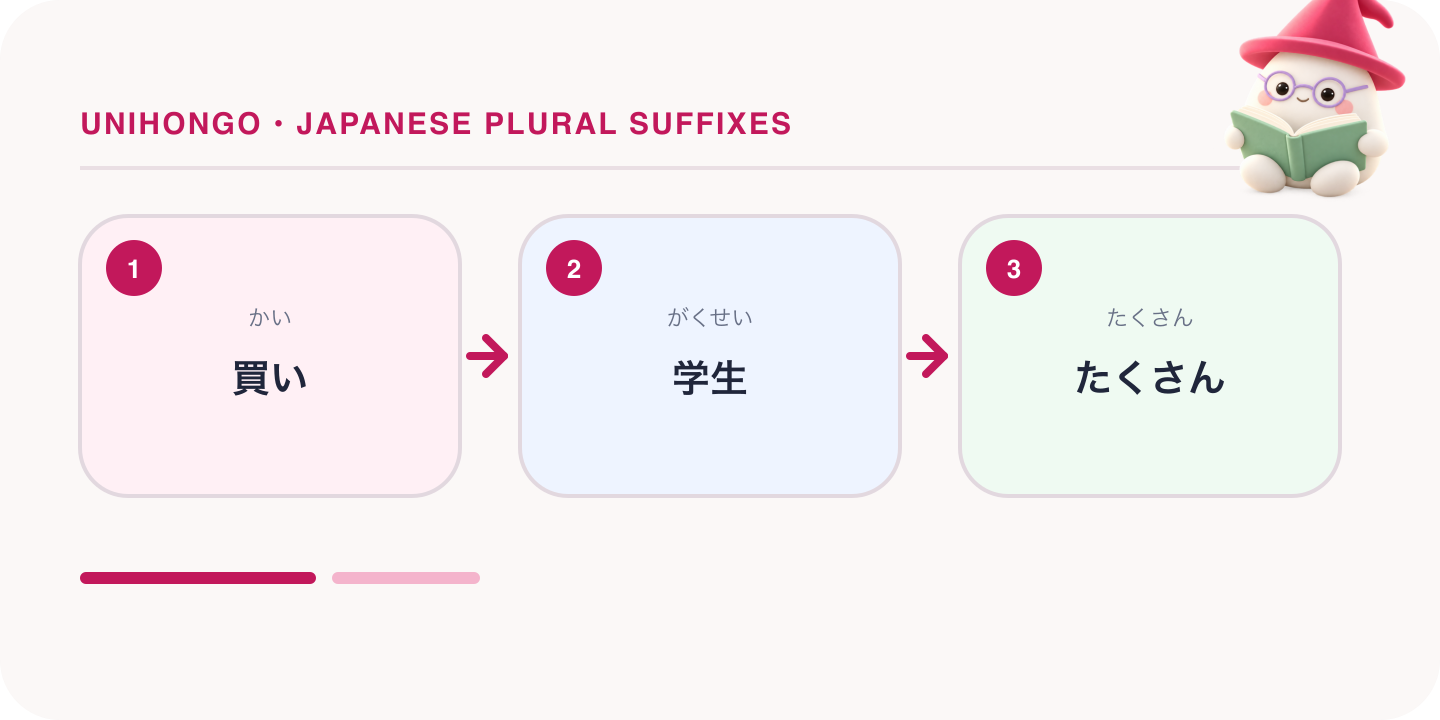
| Japanese | Romaji | Meaning |
|---|---|---|
| 本を買いました。 | Hon o kaimashita. | I bought a book. / I bought some books. |
| 庭に猫がいます。 | Niwa ni neko ga imasu. | There is a cat in the garden. / There are cats in the garden. |
| 本を三冊買いました。 | Hon o san-satsu kaimashita. | I bought three books. (Literally: bought books, three volumes.) |
| 学生がたくさんいます。 | Gakusei ga takusan imasu. | There are lots of students. |
Tachi draws a circle around people
Tachi takes one person, or one kind of person, and draws a circle around them and those with them. With a general noun the result looks like an English plural: kodomotachi, the children. With a name, the circle shows its true nature. Tanaka-san-tachi is not several people called Tanaka. It is Tanaka-san and whoever belongs with Tanaka-san in this scene: the family, the team, the friends who came along.
A mother at the school gate is chatting with another parent while they wait.
| Japanese | Romaji | Meaning |
|---|---|---|
| 子供たちは公園で遊んでいます。 | Kodomotachi wa kōen de asonde imasu. | The children are playing in the park. |
| 田中さんたちはもう着きました。 | Tanaka-san-tachi wa mō tsukimashita. | Tanaka-san and the others have arrived. (Literally: the Tanaka-san group.) |
| 私たちは先に帰ります。 | Watashitachi wa saki ni kaerimasu. | We'll head home first. |
| 猫たちにごはんをあげました。 | Nekotachi ni gohan o agemashita. | I fed the cats. |
Even with people, tachi is optional. Kodomo ga asonde imasu can describe twenty children. Speakers add tachi when they are picturing the group as a group of individuals, which is why it often sounds warm.
How each suffix attaches
All four suffixes attach directly to a noun, pronoun or name, after san or sama if there is one. Nothing else changes. The noun must refer to a living being, because only living beings gather in a circle. Doubling is a different process, which has its own section below.
| Form | Reading | Built from and tone |
|---|---|---|
| 先生方 | sensei-gata | Noun plus gata: respectful, the teachers |
| あなた方 | anata-gata | Pronoun plus gata: polite you, plural |
| 学生たち | gakuseitachi | Noun plus tachi: neutral, the students |
| 田中さんたち | Tanaka-san-tachi | Name plus tachi: Tanaka-san and company |
| 僕ら | bokura | Pronoun plus ra: casual we |
| 彼ら | karera | Pronoun plus ra: they, standard in writing |
| 私ども | watakushidomo | Pronoun plus domo: humble we |
| 人々 | hitobito | Doubled noun: people in general |
Two everyday words hide old suffixes. Tomodachi, friend, contains tachi, and kodomo, child, contains domo. Both lost their plural meaning long ago, so tomodachi ga hitori, one friend, is perfectly normal, and kodomotachi adds a fresh tachi on top.
Politeness: gata, tachi, ra and domo
Why four suffixes for one job? Because in Japanese, how you refer to people shows where you stand in relation to them, and a group is no exception. Gata comes from kata, the respectful word for person, so it lifts the group up. Tachi is level. Ra is casual, close or rough. Domo lowers the group, which makes it humble when the group is your own side and insulting when it is someone else's.
At a hotel reception desk, the clerk refers to guests with gata or sama and to the hotel itself with domo.
| Japanese | Romaji | Meaning |
|---|---|---|
| 先生方はあちらの部屋にいらっしゃいます。 | Sensei-gata wa achira no heya ni irasshaimasu. | The teachers are in the room over there. |
| 私どもでご用意いたします。 | Watakushidomo de goyōi itashimasu. | We will prepare it for you. (humble) |
| 僕らも行くよ。 | Bokura mo iku yo. | We're going too. (casual) |
| お前ら、静かにしろ。 | Omaera, shizuka ni shiro. | You lot, be quiet. (rough) |
One word changed: five ways to say our company
The phrases below mean our company in English. Only the word for we changes, and with it the speaker, the listener and the room.
| Phrase | Reading | What it says |
|---|---|---|
| 私たちの会社 | watashitachi no kaisha | Neutral: explaining to a friend or in a polite chat |
| 僕らの会社 | bokura no kaisha | Casual, with a feeling of us together; more often from men |
| 我々の会社 | wareware no kaisha | Formal and collective: a president's speech to staff |
| 私どもの会社 | watakushidomo no kaisha | Humble: speaking to a customer, and the customer is outside the circle |
| うちの会社 | uchi no kaisha | Everyday and relaxed; literally the company of our inside |
The circle idea explains a detail learners miss. Watashitachi can include the listener, as in watashitachi, ikimashō ka, shall we go? Watakushidomo never does. Its circle is drawn around the speaker's side only, which is what makes it humble: we, as opposed to you, the honoured customer.
First-person words themselves, watashi, boku and ore, are covered in a separate post. What matters here is that the suffix you add has its own politeness, and the two must match. Oretachi and orera are both common. Watakushi-ra is not.
Beyond the basics: doubled nouns like hitobito and yamayama
Some nouns form a plural by being said twice: hito becomes hitobito, yama becomes yamayama. In writing, the repeat mark is used instead of the second kanji. The first sound of the second half often becomes voiced, so hito turns into bito and kuni into guni, while sounds with no voiced partner, such as the y of yamayama, stay as they are.
The meaning is not simply more than one. A doubled noun means many of them, one after another, seen as a spread: the mountains ranged along the horizon, the countries of the world, the houses along a street. This use does not come from the circle idea, and it is best learned as vocabulary. The set is closed. You cannot double a noun freely, so nekoneko and honhon do not exist.
| Japanese | Romaji | Meaning |
|---|---|---|
| 町の人々は親切でした。 | Machi no hitobito wa shinsetsu deshita. | The people of the town were kind. |
| 遠くに山々が見えます。 | Tōku ni yamayama ga miemasu. | You can see the mountains in the distance. |
| アジアの国々を旅行しました。 | Ajia no kuniguni o ryokō shimashita. | I travelled around the countries of Asia. |
| 日々の生活が大切です。 | Hibi no seikatsu ga taisetsu desu. | Day-to-day life is what matters. (Literally: the life of days and days.) |
| 瀬戸内海の島々を回りました。 | Setonaikai no shimajima o mawarimashita. | I toured the islands of the Seto Inland Sea. |
Wareware is itself a doubled word, from the old pronoun ware. Doubled nouns belong mostly to writing, speeches and narration. In conversation, iroiro na kuni, various countries, is more natural than kuniguni.
Which nouns cannot take tachi, and what to use instead
Since tachi draws a circle of companions, it needs members who can be companions. People qualify. Animals usually qualify, especially pets and animals in stories. Objects, places and abstract ideas do not, so isu, kuruma, machi and mondai stay bare.
The neighbours that do the work for things are counters and quantity words. For this and these, Japanese has korera and sorera, which are formal and mostly written. In speech, kore covers both, or you say kono hon, zenbu, all of these books.
| Japanese | Romaji | Meaning |
|---|---|---|
| 椅子が足りません。 | Isu ga tarimasen. | There aren't enough chairs. |
| 車が五台止まっています。 | Kuruma ga go-dai tomatte imasu. | Five cars are parked there. |
| これ、全部ください。 | Kore, zenbu kudasai. | I'll take all of these, please. |
| いろいろな問題があります。 | Iroiro na mondai ga arimasu. | There are various problems. |
Common mistakes with Japanese plurals
The first mistake is tachi on things. Learners say hontachi o kaimashita because English demands books. It is wrong in standard Japanese. Say hon o kaimashita, or hon o takusan kaimashita if the quantity matters.
The second is hearing a name plus tachi as several people of that name. Satō-san-tachi ga kimasu does not mean the Satōs are coming. It means Satō-san and whoever is with Satō-san, who may have entirely different names.
The third is the wrong level. Calling a group of teachers sensei-ra, or asking customers anata-tachi wa, sounds rough because ra and tachi do not lift the listener. Say sensei-gata and mina-sama.
The fourth is using watakushidomo to include the listener. Watakushidomo mo ikimashō, meant as let's go together, is wrong, because domo shuts the listener out of the circle. Say watashitachi, or simply issho ni ikimashō.
The fifth is inventing doubled nouns. Inuinu and honhon are not words. If a doubled form is not in the dictionary, use takusan no or iroiro na.
- Things: bare noun, number plus counter, or takusan
- Name plus tachi: that person and their group
- Respected people: gata, mina-san, mina-sama
- Humble we, listener excluded: watakushidomo
How plurals sound in real conversation
In everyday speech the most common plural-like words are not suffixes at all. Minna and mina-san, everyone, do the job for groups of people. Friends talk about uchira, a casual we heard especially from younger speakers, and about ano hitotachi, those people.
Tachi is frequent with pronouns and with kodomo, and much less frequent elsewhere. If you catch yourself adding tachi to every noun that would have an s in English, take most of them off. Your Japanese will sound lighter immediately.
| Japanese | Romaji | Meaning |
|---|---|---|
| 皆さん、こちらへどうぞ。 | Mina-san, kochira e dōzo. | Everyone, this way, please. |
| みんなで行こう。 | Minna de ikō. | Let's all go together. |
| あの人たちは誰ですか。 | Ano hitotachi wa dare desu ka. | Who are those people? |
| うちらも行く。 | Uchira mo iku. | We're going too. (casual) |
| 友達が一人来ます。 | Tomodachi ga hitori kimasu. | One friend is coming. |