
Where commands actually live in Japanese
In English you can say sit down to a friend without much thought, adjusting the tone of voice to make it warm. Japanese does that work with grammar instead, so the choice of ending is the choice of relationship. That is why the bare imperative sounds so strong: it strips away every marker of consideration for the listener, and the listener notices the absence immediately.
The result is that the command form is common in exactly the places where the relationship is already settled or where there is no time for one. Road signs command. A coach commands a team. A parent commands a small child. A character in a manga commands an enemy. In ordinary conversation between adults who are not close, requests are dressed as questions, and the harshest thing most people ever say to a stranger is a polite notice on a wall.
So a learner has an asymmetric job. You need to produce the polite end of the scale fluently, and you need to understand the harsh end instantly, because the moment you will hear tomare or abunai is the moment you cannot afford to think. Recognition and production are trained separately here, and that is the point of this guide.
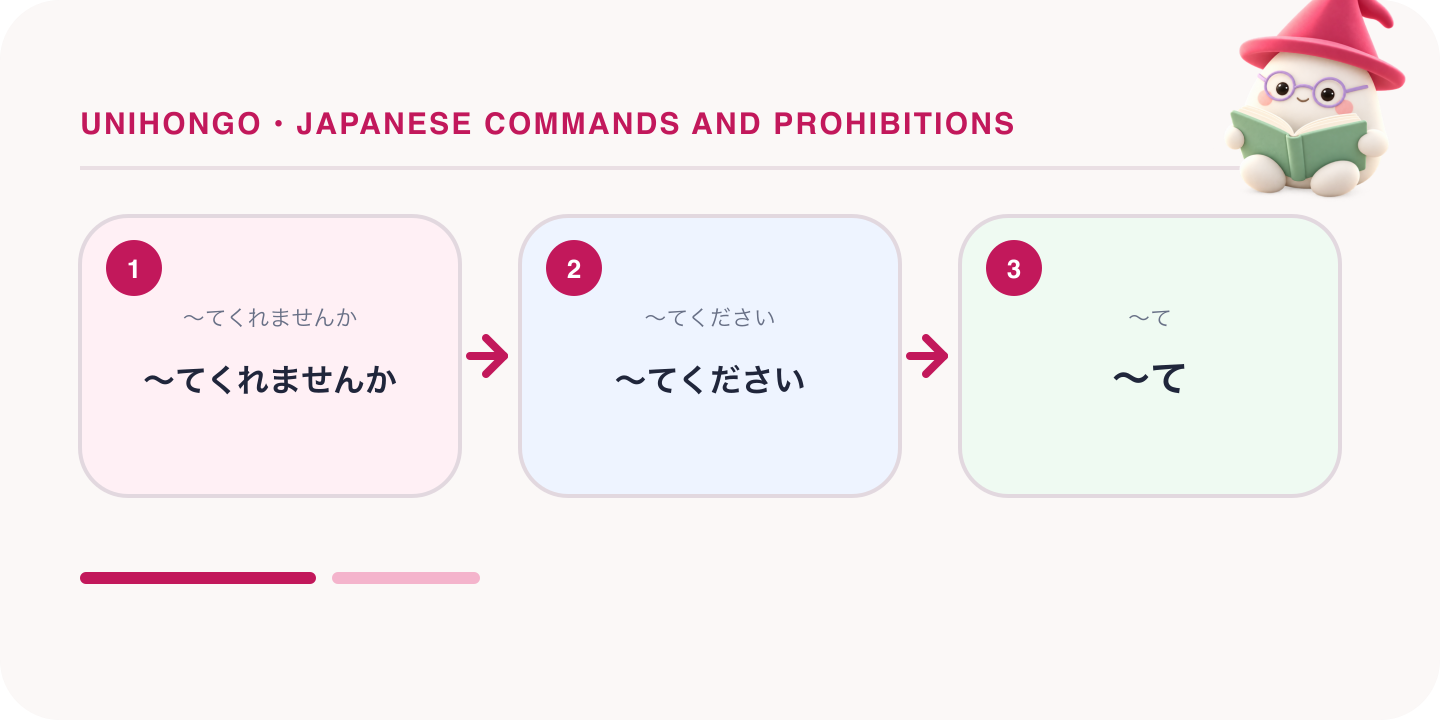
The register scale from softest to harshest
| Form | Example with tetsudau (help) | Feel | Where you hear it |
|---|---|---|---|
| 〜ていただけませんか | 手伝っていただけませんか。 Tetsudatte itadakemasen ka. | Humble request, maximum distance | To a superior, a stranger, a client |
| 〜てくれませんか | 手伝ってくれませんか。 Tetsudatte kuremasen ka. | Polite ask, slightly warmer | Colleagues, shop staff, neighbours |
| 〜てください | 手伝ってください。 Tetsudatte kudasai. | Neutral polite instruction | Teachers, staff, notices, instructions |
| 〜て | 手伝って。 Tetsudatte. | Casual request | Friends, family, partners |
| 〜てくれ | 手伝ってくれ。 Tetsudatte kure. | Blunt, traditionally masculine | Close male friends, fiction, older speakers |
| 〜なさい | 手伝いなさい。 Tetsudainasai. | Instruction from above | Parent to child, teacher, exam papers |
| Bare imperative | 手伝え。 Tetsudae. | Order, no consideration shown | Coach, emergency, anger, sport, manga |
| 〜な | 手伝うな。 Tetsudau na. | Blunt prohibition | Warnings, anger, signs, fiction |
Read the table downward and notice that only the top four are safe for a learner in daily life. The bottom half is not a casual version of the top half; it is a different social move. A colleague who hears tetsudae from you will not hear friendliness, they will hear a claim to authority you do not have.
Te kudasai and the softer requests above it
Te kudasai is polite, but it is still an instruction rather than a plea, which is why it appears in classrooms, on notices and in staff announcements. When you want a favour rather than obedience, climb higher: te kuremasen ka turns the instruction into a question, and te itadakemasen ka adds a humble verb that puts the listener above you. The negative question shape is doing the softening, so the longer the ending, the smaller the imposition sounds.
The reply you should expect to a request is rarely a flat yes. Hai, wakarimashita is the standard acceptance from staff, ii desu yo from a friendly equal, and a refusal usually arrives as chotto muzukashii desu ne rather than a clear no. Treat that hesitation as an answer and withdraw the request rather than repeating it.
| Japanese | Romaji | Meaning |
|---|---|---|
| ちょっと待ってください。 | Chotto matte kudasai. | Please wait a moment. |
| もう一度言ってください。 | Mō ichido itte kudasai. | Please say that once more. |
| ゆっくり話していただけませんか。 | Yukkuri hanashite itadakemasen ka. | Could you possibly speak slowly? |
| 手伝ってくれませんか。 | Tetsudatte kuremasen ka. | Would you help me? |
| 写真を撮ってもらえますか。 | Shashin o totte moraemasu ka. | Could you take a photo? |
| はい、わかりました。 | Hai, wakarimashita. | Certainly. (the reply you will hear) |
| ちょっと難しいですね。 | Chotto muzukashii desu ne. | That would be a little difficult. (a soft refusal) |
The plain te form and te kure among friends
Dropping kudasai leaves the bare te form, which is the everyday casual request between friends and inside a family. It is light and does not sound like an order, especially with a softener attached: matte ne, mite yo. Adding chōdai instead, as in matte chōdai, sounds gentle and slightly old-fashioned and is heard more from women and from adults speaking to children.
Te kure is the blunt end of the same family. It is grammatically a request, but the kure comes from a verb that assumes the speaker outranks or is close to the listener, so it reads as brusque. Learners often pick it up from subtitled fiction and use it at work, where it lands badly. Keep it passive: understand it, do not say it.
| Japanese | Romaji | Meaning |
|---|---|---|
| ちょっと待って。 | Chotto matte. | Hang on a second. (casual) |
| これ見て。 | Kore mite. | Look at this. (casual) |
| 早くして。 | Hayaku shite. | Hurry up. (casual) |
| 心配しないで。 | Shinpai shinaide. | Don't worry. (casual negative) |
| 誰にも言わないで。 | Dare ni mo iwanaide. | Don't tell anyone. (casual negative) |
| ちょっと待ってちょうだい。 | Chotto matte chōdai. | Wait a moment, would you. (soft, informal) |
| ちょっと手伝ってくれ。 | Chotto tetsudatte kure. | Give me a hand. (blunt, understand only) |
Nasai: the parent, teacher and exam paper form
Nasai attaches to the masu stem: tabemasu gives tabenasai, shimasu gives shinasai, kimasu gives kinasai. It is not harsh, but it is unmistakably an instruction from someone with the standing to give one, which is why it is the natural voice of a parent, a teacher and a written exam question. Saying it to an adult peer would sound like you were treating them as a child.
You will meet it constantly in reading and listening even if you never say it. Every Japanese test paper is written in it: kotaenasai, erabinasai, kakinasai. Learning to hear the stem plus nasai as an instruction means you stop parsing exam rubrics word by word. In speech, the clipped form tabena, hayaku shina is common in casual family talk and sounds encouraging rather than stern.
| Japanese | Romaji | Meaning |
|---|---|---|
| 早く寝なさい。 | Hayaku nenasai. | Go to bed now. (parent to child) |
| 宿題をしなさい。 | Shukudai o shinasai. | Do your homework. |
| 手を洗いなさい。 | Te o arainasai. | Wash your hands. |
| 次の質問に答えなさい。 | Tsugi no shitsumon ni kotaenasai. | Answer the following question. (exam wording) |
| 正しいものを選びなさい。 | Tadashii mono o erabinasai. | Choose the correct option. (exam wording) |
| 早く食べな。 | Hayaku tabena. | Go on, eat up. (clipped, warm) |
How the bare imperative is built
| Verb class | Dictionary form | Imperative | Prohibition | Nasai form |
|---|---|---|---|---|
| Godan | 行く iku (go) | 行け ike | 行くな iku na | 行きなさい ikinasai |
| Godan | 待つ matsu (wait) | 待て mate | 待つな matsu na | 待ちなさい machinasai |
| Godan | 飲む nomu (drink) | 飲め nome | 飲むな nomu na | 飲みなさい nominasai |
| Godan | 話す hanasu (speak) | 話せ hanase | 話すな hanasu na | 話しなさい hanashinasai |
| Godan | 急ぐ isogu (hurry) | 急げ isoge | 急ぐな isogu na | 急ぎなさい isoginasai |
| Ichidan | 食べる taberu (eat) | 食べろ tabero | 食べるな taberu na | 食べなさい tabenasai |
| Ichidan | 見る miru (look) | 見ろ miro | 見るな miru na | 見なさい minasai |
| Ichidan | 起きる okiru (get up) | 起きろ okiro | 起きるな okiru na | 起きなさい okinasai |
| Irregular | する suru (do) | しろ shiro | するな suru na | しなさい shinasai |
| Irregular | 来る kuru (come) | 来い koi | 来るな kuru na | 来なさい kinasai |
The godan rule is one step: swap the final u sound for the matching e sound. Iku becomes ike, matsu becomes mate because the tsu row's e sound is te, hanasu becomes hanase. Ichidan verbs drop ru and add ro. The two irregulars have to be memorised, and koi in particular looks nothing like kuru, so it is worth saying aloud until it is automatic.
There is a second, more literary imperative that ends in yo for ichidan verbs and seyo for suru: tabeyo, seyo. You will meet it in written slogans, older texts and formal notices rather than in speech, so recognise it and leave it there.
The prohibition is simpler still. Take the dictionary form, unchanged for every class, and add na. There is no exception, which makes iku na, taberu na, suru na and kuru na the easiest command shapes in the language to build and the hardest to use safely.
Where the bare imperative is really heard
Sport and encouragement are the friendliest home of the imperative. Ganbare, shouted from a touchline or sent as a message before an exam, is a command in form but pure support in feeling, and nobody hears it as rude. The same goes for ike and hashire from a crowd, or makeru na and akirameru na, which are prohibitions used as encouragement.
The other home is urgency. When something is about to go wrong, politeness disappears because it costs syllables: nigero, tomare, ugoku na, sawaru na. These are the lines you must understand at full speed and without context, so drill them as listening items rather than as speaking items. Fiction, especially action manga and anime, is a third home, and it is where most learners absorb the form and then misjudge its weight.
| Japanese | Romaji | Meaning |
|---|---|---|
| 頑張れ! | Ganbare! | You can do it. (imperative used as support) |
| 行け! | Ike! | Go. |
| 走れ! | Hashire! | Run. |
| 諦めるな! | Akirameru na! | Don't give up. |
| 負けるな! | Makeru na! | Don't let them beat you. |
| 逃げろ! | Nigero! | Get out of here. |
| 危ない! | Abunai! | Look out. |
| 止まれ! | Tomare! | Stop. |
| 動くな! | Ugoku na! | Don't move. |
| 手を離すな! | Te o hanasu na! | Don't let go. |
| 落ち着け。 | Ochitsuke. | Calm down. |
| こっちに来い。 | Kotchi ni koi. | Come here. (blunt) |
Signs that command you politely
Public Japanese solves the command problem in a way that surprises learners: it is extremely polite and completely non-negotiable at the same time. Go-enryo kudasai literally asks you to hold back out of consideration, and it is the standard wording for forbidding phone calls, smoking and photography. O-sagari kudasai asks you to step back. None of these are suggestions.
Alongside them you will find flat imperatives on road signs, where space and speed rule: tomare painted at a junction, osu na on emergency equipment. And you will find noun-based prohibitions ending in kinshi, which simply label the act as forbidden without addressing anyone. Reading the wording tells you the tone of the place: kinshi is official, go-enryo kudasai is social pressure, and both mean do not.
| Japanese | Romaji | Meaning |
|---|---|---|
| 止まれ | Tomare | Stop (painted at road junctions) |
| 立入禁止 | Tachiiri kinshi | No entry |
| 撮影禁止 | Satsuei kinshi | No photography |
| 押すな | Osu na | Do not push |
| 芝生に入らないでください。 | Shibafu ni hairanaide kudasai. | Please keep off the grass. |
| ゴミは持ち帰ってください。 | Gomi wa mochikaette kudasai. | Please take your rubbish home with you. |
| 白線の内側までお下がりください。 | Hakusen no uchigawa made o-sagari kudasai. | Please stand back behind the white line. |
| 携帯電話でのご通話はご遠慮ください。 | Keitai denwa de no go-tsūwa wa go-enryo kudasai. | Please refrain from phone calls. |
| 足元にご注意ください。 | Ashimoto ni go-chūi kudasai. | Please watch your step. |
| お静かにお願いします。 | O-shizuka ni onegai shimasu. | Quiet, please. |
Saying no to someone politely
The safe way to stop an action is the nai de kudasai pattern: take the plain negative, drop the final i, add de kudasai. Ikanai gives ikanaide kudasai, toranai gives toranaide kudasai, shinai gives shinaide kudasai. This is what a member of staff will say to you and what you should say to anyone outside your close circle.
Above it sit two more layers. Nai de itadakemasu ka makes the same prohibition a humble question, and phrasing the request positively often works better than forbidding at all: instead of telling someone not to smoke here, point them to where they can. Japanese frequently prefers the redirect to the ban, and learners who translate do not directly can sound sharper than they intend.
| Japanese | Romaji | Meaning |
|---|---|---|
| ここでタバコを吸わないでください。 | Koko de tabako o suwanaide kudasai. | Please do not smoke here. |
| 写真を撮らないでください。 | Shashin o toranaide kudasai. | Please do not take photographs. |
| ここに車を停めないでください。 | Koko ni kuruma o tomenaide kudasai. | Please do not park here. |
| 中に入らないでいただけますか。 | Naka ni hairanaide itadakemasu ka. | Could I ask you not to go inside? |
| 喫煙は外でお願いします。 | Kitsuen wa soto de onegai shimasu. | Smoking is outside, please. (the redirect) |
| すみません、大丈夫です。 | Sumimasen, daijōbu desu. | Sorry, I'm fine. (declining an offer) |
Understanding a command without producing one
- Split your study: imperatives and na prohibitions go on a listening list, te kudasai and above go on a speaking list.
- Learn the emergency set as whole sounds, not as conjugations: abunai, tomare, ugoku na, nigero, sawaru na.
- When you meet an imperative in fiction, note who says it to whom, and whether the pair are equals.
- Rewrite every command you hear into the polite version you would actually use, as a two-second drill.
- Watch for ganbare and its family, which are imperatives that carry warmth rather than authority.
- If a sign contains kinshi or go-enryo kudasai, treat it as an absolute rule regardless of how gentle it sounds.
A week of drills for the register scale
Day one, build the ladder for five verbs you use constantly: miru, matsu, kuru, suru, hanasu. Say all seven levels for each. Day two, take the same verbs and produce only the negative request, since nai de kudasai is the form learners reach for too slowly under pressure. Day three, do a pure listening day with the emergency set, reacting physically to each one.
Day four, read signs. Photograph or recall five real notices and decide whether each uses kinshi, go-enryo kudasai, te kudasai or a bare imperative, and why. Day five, roleplay a situation where you must stop someone politely: a neighbour's noise, a stranger about to sit in a reserved seat. Day six, review the mistakes. Day seven, test yourself by translating in the other direction, from English commands into the correct Japanese register rather than the correct Japanese words.