
One ni, two completely different promises
Both patterns attach to a time, a date or an event, and both point at the same moment on the calendar. What differs is what happens in the space before that moment. With made, the action occupies that whole space and then stops. With made ni, the space is simply available, and the action happens once somewhere inside it. English hides this difference behind until and by, which is why learners reach for the wrong one under pressure.
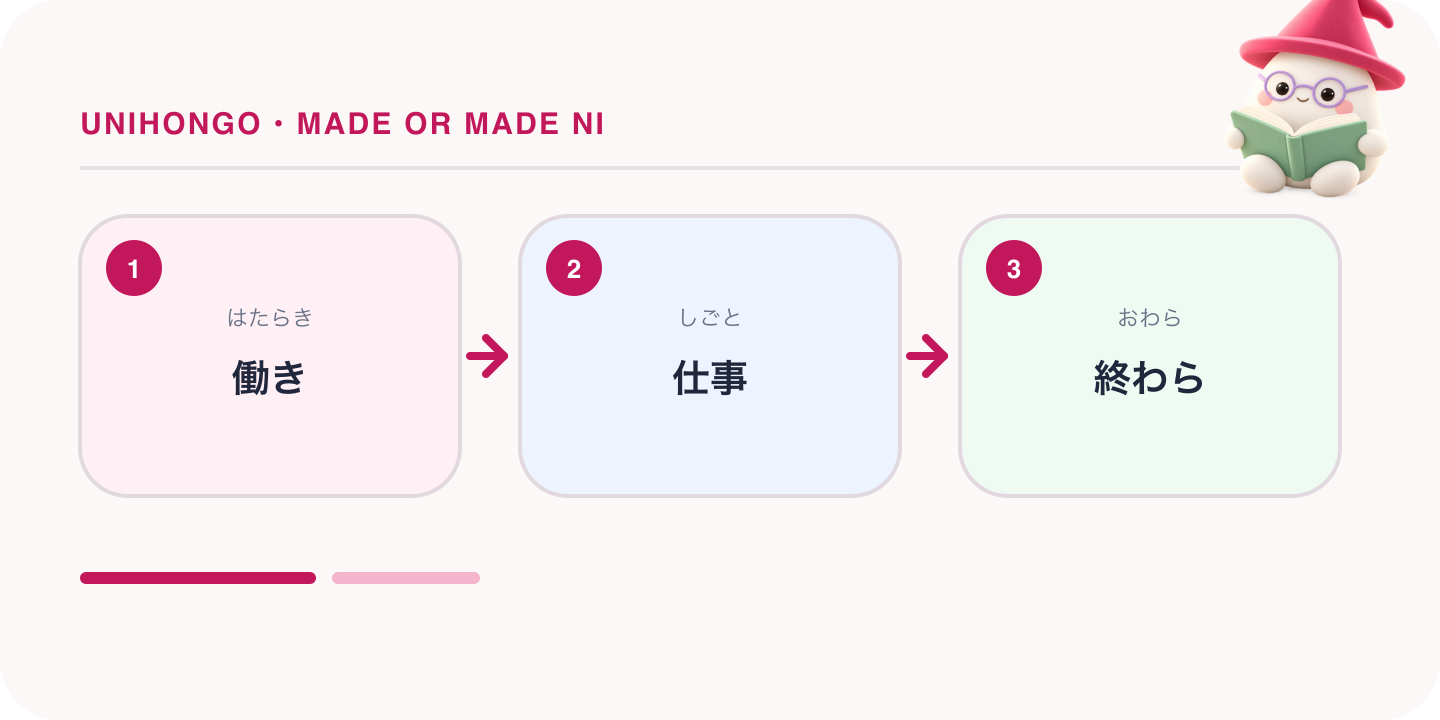
| Japanese | Romaji | Meaning |
|---|---|---|
| 五時まで働きます。 | Go-ji made hatarakimasu. | I work until five. |
| 五時までに仕事を終わらせます。 | Go-ji made ni shigoto o owarasemasu. | I will finish the work by five. |
The first sentence says nothing about finishing; it describes where you are and what you are doing from now until five. The second says nothing about how you spend the afternoon; it only promises that the finishing happens before five arrives. A manager hearing the first one has been told your schedule. A manager hearing the second one has been given a deadline.
Made covers a continuous stretch
Use made when the verb describes something that goes on: working, waiting, staying, sleeping, continuing, being somewhere. The end point is the moment the activity stops. Because the action fills the stretch, made pairs comfortably with verbs in the te iru form and with verbs that already carry the idea of duration. Nothing needs to be completed at the end point; the activity simply ceases there.
| Japanese | Romaji | Meaning |
|---|---|---|
| 五時まで会社にいます。 | Go-ji made kaisha ni imasu. | I will be at the office until five. |
| 雨がやむまで待ちましょう。 | Ame ga yamu made machimashō. | Let us wait until the rain stops. |
| 昨日は十二時まで起きていました。 | Kinō wa jūni-ji made okite imashita. | Yesterday I stayed up until twelve. |
| 最後まで見ます。 | Saigo made mimasu. | I will watch it to the end. |
| 三月まで日本にいます。 | San-gatsu made Nihon ni imasu. | I will be in Japan until March. |
| 信号が青になるまで待ってください。 | Shingō ga ao ni naru made matte kudasai. | Please wait until the light turns green. |
| 卒業までアルバイトを続けます。 | Sotsugyō made arubaito o tsuzukemasu. | I will keep the part-time job until graduation. |
Made ni sets a deadline for one action
Use made ni when the verb describes a single completion: submitting, deciding, arriving, returning something, sending, finishing. The action takes a moment, and the deadline says that moment must fall before the limit. This is why made ni appears with requests, obligations and promises. Kudasai, onegaishimasu, nakereba narimasen and shite okimasu all sit naturally after it, because all of them talk about getting one thing done.
| Japanese | Romaji | Meaning |
|---|---|---|
| 五時までに帰ります。 | Go-ji made ni kaerimasu. | I will be home by five. |
| 金曜日までに報告書を出します。 | Kin'yōbi made ni hōkokusho o dashimasu. | I will hand in the report by Friday. |
| 明日までに返事をください。 | Ashita made ni henji o kudasai. | Please give me an answer by tomorrow. |
| 会議が始まるまでに資料を印刷します。 | Kaigi ga hajimaru made ni shiryō o insatsu shimasu. | I will print the handouts before the meeting starts. |
| 十時までに空港に着かなければなりません。 | Jū-ji made ni kūkō ni tsukanakereba narimasen. | I have to arrive at the airport by ten. |
| 今月末までに決めてください。 | Kongetsu-matsu made ni kimete kudasai. | Please decide by the end of this month. |
| 出発までに両替しておきます。 | Shuppatsu made ni ryōgae shite okimasu. | I will change money before we leave. |
Why the verb decides the particle
The choice is not stylistic. A duration verb cannot take made ni, because there is no single moment for the deadline to point at, and a completion verb sounds strange with made, because it cannot be stretched across hours. Learn the verb together with its particle the way you learned verbs with o and ni, and the choice stops being a decision you make sentence by sentence.
| Verb | Kind of action | Particle | Why |
|---|---|---|---|
| 働く hataraku (work) | Continuous | まで made | The working fills the whole stretch |
| 待つ matsu (wait) | Continuous | まで made | Waiting lasts right up to the point |
| いる iru (be somewhere) | Continuous | まで made | A state that holds until then |
| 続ける tsuzukeru (continue) | Continuous | まで made | The verb is built out of duration |
| 寝る neru (be asleep) | Continuous | まで made | Jū-ji made nemashita covers the whole night |
| 出す dasu (hand in) | One-time | までに made ni | Handing in happens in a single moment |
| 決める kimeru (decide) | One-time | までに made ni | A decision lands at one point |
| 着く tsuku (arrive) | One-time | までに made ni | Arrival is instant, not a stretch |
| 終わらせる owaraseru (finish it) | One-time | までに made ni | Completion cannot be spread out |
| 返す kaesu (return it) | One-time | までに made ni | The handing back is one act |
| 帰る kaeru (go home) | One-time | までに made ni | Leaving for home happens once |
| 送る okuru (send) | One-time | までに made ni | Sending is a single completed act |
| 覚える oboeru (learn by heart) | One-time result | までに made ni | The point is the finished state |
Two entries deserve a note. Neru means both go to bed and be asleep, so jūni-ji made ni nemasu means get to bed by twelve while jūni-ji made nemasu describes sleeping through until then. And owaru, the intransitive partner of owaraseru, works the same way as owaraseru here: go-ji made ni owarimasu is a promise, not a description of your afternoon.
Minimal pairs that change the meaning entirely
These pairs use the same nouns and the same time. Only the particle and the verb move, and the promise you are making moves with them. Say each pair aloud one after the other until the two feel like different situations rather than different grammar. This is the fastest way to stop translating from English, because the English pairs look almost identical while the Japanese situations do not.
| Japanese | Romaji | Meaning |
|---|---|---|
| 金曜日まで待ちます。 | Kin'yōbi made machimasu. | I will wait until Friday. |
| 金曜日までに決めます。 | Kin'yōbi made ni kimemasu. | I will decide by Friday. |
| 明日まで借ります。 | Ashita made karimasu. | I will borrow it until tomorrow. |
| 明日までに返します。 | Ashita made ni kaeshimasu. | I will give it back by tomorrow. |
| 最後までいます。 | Saigo made imasu. | I will stay to the end. |
| 始まるまでに来てください。 | Hajimaru made ni kite kudasai. | Please come before it starts. |
| 三時まで教室を使えます。 | San-ji made kyōshitsu o tsukaemasu. | We can use the classroom until three. |
| 三時までに教室を出てください。 | San-ji made ni kyōshitsu o dete kudasai. | Please leave the classroom by three. |
| 日曜日まで東京にいます。 | Nichiyōbi made Tōkyō ni imasu. | I will be in Tokyo until Sunday. |
| 日曜日までに東京に着きます。 | Nichiyōbi made ni Tōkyō ni tsukimasu. | I will get to Tokyo by Sunday. |
Kara and made draw the whole range
Kara marks a starting point and made marks an end point, and together they frame opening hours, distances and school terms. They do not have to appear as a pair, so you can add either half once the sentence already makes sense. Note that made ni never joins kara this way: a range needs two edges, and made ni is a limit rather than an edge. The particles guide covers the wider family of kara uses.
| Japanese | Romaji | Meaning |
|---|---|---|
| 九時から五時まで働きます。 | Ku-ji kara go-ji made hatarakimasu. | I work from nine until five. |
| 何時から何時までですか? | Nan-ji kara nan-ji made desu ka? | From what time to what time is it? |
| 駅から会社まで歩いて十分です。 | Eki kara kaisha made aruite juppun desu. | It is a ten-minute walk from the station to the office. |
| 月曜日から金曜日まで授業があります。 | Getsuyōbi kara Kin'yōbi made jugyō ga arimasu. | There are classes from Monday to Friday. |
| 夏休みは七月から九月までです。 | Natsuyasumi wa shichi-gatsu kara ku-gatsu made desu. | The summer holiday runs from July to September. |
Clauses before made and made ni
Both patterns can follow a whole clause instead of a time word, and the clause verb stays in the plain non-past form even when the sentence is about the past. Kare ga kaeru made, not kare ga kaerimasu made. The important habit is to ignore the clause verb when choosing the particle: the verb at the end of the sentence is the one that decides, because it is the one that either lasts or completes.
| Japanese | Romaji | Meaning |
|---|---|---|
| 彼が帰るまで待ちます。 | Kare ga kaeru made machimasu. | I will wait until he goes home. |
| 彼が帰るまでに片づけます。 | Kare ga kaeru made ni katazukemasu. | I will tidy up before he goes home. |
| 日本語が話せるようになるまで続けます。 | Nihongo ga hanaseru yō ni naru made tsuzukemasu. | I will keep going until I can speak Japanese. |
| 先生が来るまでに準備しておきます。 | Sensei ga kuru made ni junbi shite okimasu. | I will get things ready before the teacher arrives. |
For before something unwanted happens, Japanese often prefers the nai uchi ni pattern instead: kuraku naranai uchi ni kaerimashō, let us go home before it gets dark. Made ni would need a positive event to point at, and there is no moment called it got dark that you want to arrive before.
Made ni wa, made mo nai and made as even
Made ni wa adds the contrastive wa, which turns a plain deadline into an outer limit and often implies you may be earlier. Made mo nai appears in the fixed expression iu made mo naku, it goes without saying. And made on its own can mean even, marking something surprising at the far end of a scale, which is a different job from the time uses above but comes from the same idea of reaching a limit.
| Japanese | Romaji | Meaning |
|---|---|---|
| 五時までには終わります。 | Go-ji made ni wa owarimasu. | It will be finished by five at the latest. |
| 来週までにはお返事します。 | Raishū made ni wa o-henji shimasu. | I will reply by next week at the latest. |
| 言うまでもなく、締め切りは守ってください。 | Iu made mo naku, shimekiri wa mamotte kudasai. | It goes without saying, but please meet the deadline. |
| そこまでしなくてもいいですよ。 | Soko made shinakute mo ii desu yo. | You do not have to go that far. |
| 駅まで送ります。 | Eki made okurimasu. | I will see you as far as the station. |
| 子供まで知っています。 | Kodomo made shitte imasu. | Even children know it. |
The traps that cost you marks and deadlines
- Saying go-ji made ni hatarakimasu: hataraku is a duration, so this asks when your working will be completed and lands as nonsense.
- Saying go-ji made owarimasu when you mean by five; it sounds like the finishing itself lasts all afternoon.
- Answering itsu made ni with a stretch, such as raishū made, when your colleague asked for a delivery date.
- Conjugating the clause verb: kaerimasu made instead of kaeru made, which is wrong in both patterns.
- Joining kara to made ni, as in ku-ji kara go-ji made ni, when you mean the working day.
- Hearing made ni wa and treating the wa as a topic marker rather than as at the latest.
Exam questions exploit exactly one of these at a time. They give you a sentence whose verb is unmistakably durative or unmistakably punctual, then offer both particles. Read to the final verb before you choose, because everything earlier in the sentence is designed to look equally compatible with both answers.
Talking about deadlines at work
In an office the two patterns split cleanly by role. You ask about a deadline with itsu made ni and about availability or opening hours with nan-ji made. When you accept a deadline, repeat it back with made ni so both people have heard the same commitment, and when you need more time, ask for a stretch with made rather than announcing a new deadline of your own.
| Japanese | Romaji | Meaning |
|---|---|---|
| いつまでに提出すればいいですか。 | Itsu made ni teishutsu sureba ii desu ka? | By when should I hand it in? |
| 金曜日の十七時までにお願いします。 | Kin'yōbi no jūshichi-ji made ni onegaishimasu. | By five on Friday, please. (colleague's line) |
| 明日までに間に合いますか? | Ashita made ni maniaimasu ka? | Can you make it by tomorrow? (colleague's line) |
| はい、明日の午前中までに送ります。 | Hai, ashita no gozen-chū made ni okurimasu. | Yes, I will send it by tomorrow morning. |
| すみません、水曜日まで待っていただけますか。 | Sumimasen, Suiyōbi made matte itadakemasu ka? | Sorry, could you wait until Wednesday? |
| 何時までいらっしゃいますか。 | Nan-ji made irasshaimasu ka? | Until what time will you be here? |
| 六時までおります。 | Roku-ji made orimasu. | I will be here until six. |
| 遅くとも月曜日までにはお渡しします。 | Osokutomo Getsuyōbi made ni wa o-watashi shimasu. | I will hand it over by Monday at the latest. |
A drill that fixes the choice
- Write down five things in your real week: two you do continuously and three you must finish once.
- Say each one twice, first with made and then with made ni, and notice which version is nonsense.
- Rebuild each sentence with a clause instead of a time: shigoto ga owaru made, densha ga kuru made ni.
- Add made ni wa to the three deadlines and hear the promise soften into at the latest.
- Record yourself answering itsu made ni dekimasu ka three times with three different dates.
The drill works because it forces production rather than recognition. Choosing the right particle in a multiple-choice question takes a second of thought; producing it while you are also choosing a verb, a time and a polite ending is a different skill, and it only improves when you speak the whole sentence at natural speed.