
Four ways to say if, and why they are not one word
A Japanese speaker picks a conditional on three questions asked below the level of conscious thought. Does the result follow automatically every time, or does it depend on a decision? Am I talking about a general case or about one particular occasion? And am I introducing this condition myself, or picking up something my partner has just told me? Answer those and the form is already chosen. Learners who translate the English word if pick one form and use it everywhere, which is why their Japanese sounds flat in places and breaks in others.
Keep this rough division of labour. To reports an automatic consequence, the sort that holds every time, so it suits natural laws, machines, and directions. Ba is the general hypothetical of proverbs and advice. Tara sets up one specific sequence, first this happens and then that, and dominates casual speech. Nara reaches back to what the other person said and builds a comment on it, which is why it so often opens a reply. The forms below are the easy part.
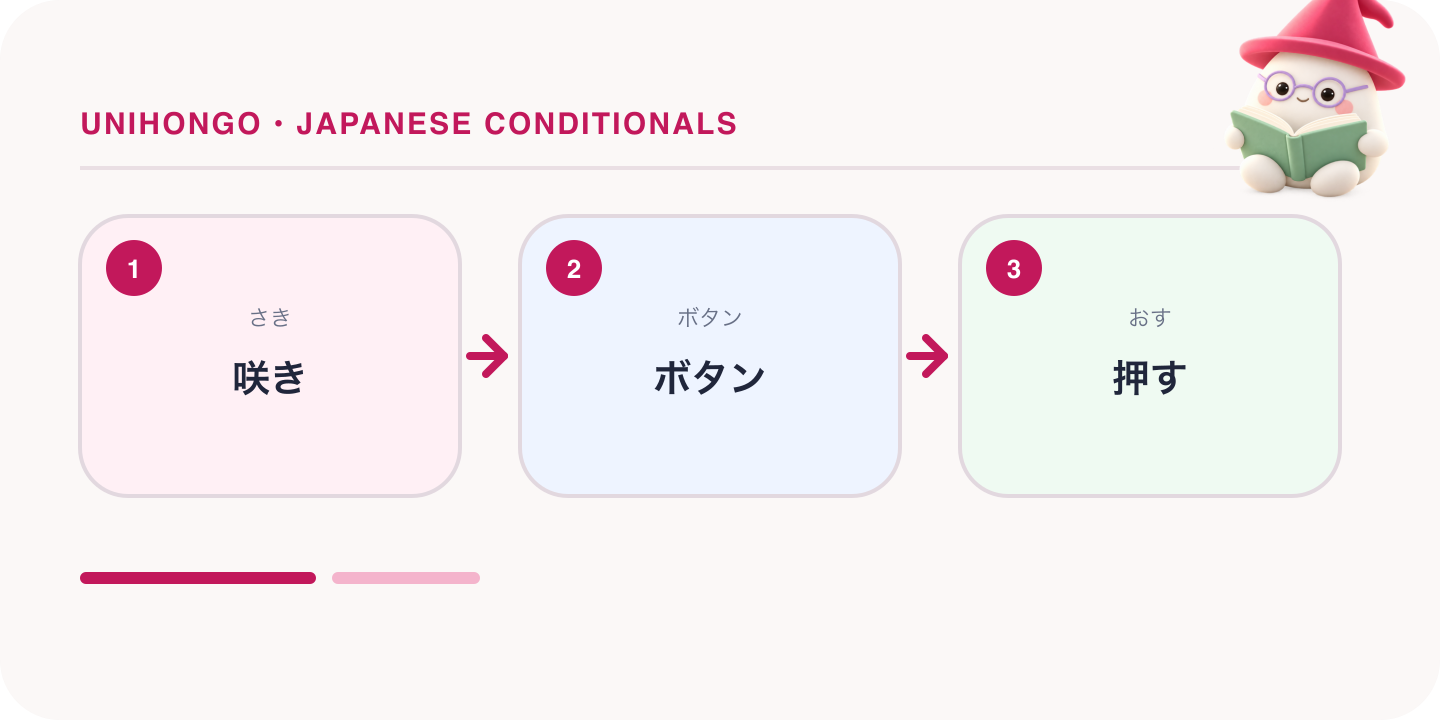
Building all four from the dictionary form
Three of the four are built from shapes you already own. Ba changes the final -u of a godan verb to -eba and swaps the ru of an ichidan verb for reba. Tara is simply the plain past form plus ra, so anyone who can say tabeta can say tabetara, and every irregular verb is covered at once. Nara attaches to the plain form with nothing added, and to a bare noun with no da. To attaches to the plain non-past form.
| Word type | Ba | Tara | Nara | To |
|---|---|---|---|---|
| Godan 書く kaku | 書けば kakeba | 書いたら kaitara | 書くなら kaku nara | 書くと kaku to |
| Godan 飲む nomu | 飲めば nomeba | 飲んだら nondara | 飲むなら nomu nara | 飲むと nomu to |
| Ichidan 食べる taberu | 食べれば tabereba | 食べたら tabetara | 食べるなら taberu nara | 食べると taberu to |
| Irregular する suru | すれば sureba | したら shitara | するなら suru nara | すると suru to |
| Irregular 来る kuru | 来れば kureba | 来たら kitara | 来るなら kuru nara | 来ると kuru to |
| I-adjective 安い yasui | 安ければ yasukereba | 安かったら yasukattara | 安いなら yasui nara | 安いと yasui to |
| Na-adjective 静か shizuka | 静かなら shizuka nara | 静かだったら shizuka dattara | 静かなら shizuka nara | 静かだと shizuka da to |
| Noun 学生 gakusei | 学生なら gakusei nara | 学生だったら gakusei dattara | 学生なら gakusei nara | 学生だと gakusei da to |
| Negative 行かない ikanai | 行かなければ ikanakereba | 行かなかったら ikanakattara | 行かないなら ikanai nara | 行かないと ikanai to |
To: the result that follows on its own
To presents the second clause as the natural, repeatable outcome of the first. Nothing is chosen and nobody is persuaded: press the button and the ticket appears, spring arrives and the blossom opens. Because of that, to is the conditional of instruction manuals, street directions, and statements about how the world behaves. Both clauses stay in plain non-past form before to, whatever tense the sentence as a whole describes.
| Japanese | Romaji | Meaning |
|---|---|---|
| 春になると、桜が咲きます。 | Haru ni naru to, sakura ga sakimasu. | When spring comes, the cherry blossoms bloom. |
| このボタンを押すと、切符が出ます。 | Kono botan o osu to, kippu ga demasu. | If you press this button, a ticket comes out. |
| 右に曲がると、駅があります。 | Migi ni magaru to, eki ga arimasu. | If you turn right, there is the station. |
| お酒を飲むと、顔が赤くなります。 | Osake o nomu to, kao ga akaku narimasu. | When I drink alcohol, my face goes red. |
| 使わないと、忘れますよ。 | Tsukawanai to, wasuremasu yo. | If you do not use it, you will forget it. |
The restriction is absolute in ordinary Japanese: the clause after to cannot be a request, a command, an invitation, an offer of permission, or a statement of what the speaker has decided to do. Eki ni tsuku to, denwa shite kudasai is wrong, and so is ame ga furu to, ikimasen ka. Swap in tara and both sentences become normal.
Ba: the general hypothetical
Ba states a condition in the abstract. It does not commit to a particular day or a particular object, which is why it is at home in proverbs, in advice, and in sentences of the form if that is true, then this follows. It is also the form inside two patterns worth learning whole: nakereba narimasen for obligation, and the regret pattern ba yokatta, meaning I should have done it.
| Japanese | Romaji | Meaning |
|---|---|---|
| 安ければ買います。 | Yasukereba kaimasu. | If it is cheap, I buy it. |
| 時間があれば、行きます。 | Jikan ga areba, ikimasu. | If I have time, I will go. |
| 練習すれば、上手になります。 | Renshū sureba, jōzu ni narimasu. | If you practise, you will get better. |
| 天気がよければ、散歩します。 | Tenki ga yokereba, sanpo shimasu. | If the weather is good, I take a walk. |
| 明日までに出さなければなりません。 | Ashita made ni dasanakereba narimasen. | I have to hand it in by tomorrow. |
| もっと早く出ればよかったです。 | Motto hayaku dereba yokatta desu. | I should have left earlier. |
Tara: one specific sequence
Tara ties two events together in time on one particular occasion. First the condition is met, then the second clause happens, and the speaker is usually thinking of a real upcoming situation rather than a general rule. It is the loosest of the four in what it allows afterwards: requests, invitations, intentions, permission, and questions all sit comfortably in the second clause. That flexibility is why it is the conditional you hear most in everyday conversation.
| Japanese | Romaji | Meaning |
|---|---|---|
| 駅に着いたら、電話してください。 | Eki ni tsuitara, denwa shite kudasai. | When you arrive at the station, please call me. |
| 雨が降ったら、行きません。 | Ame ga futtara, ikimasen. | If it rains, I will not go. |
| 仕事が終わったら、飲みに行きましょう。 | Shigoto ga owattara, nomi ni ikimashō. | When work finishes, let us go for a drink. |
| 高かったら、買いません。 | Takakattara, kaimasen. | If it turns out to be expensive, I will not buy it. |
| 日本に行ったら、京都に行きたいです。 | Nihon ni ittara, Kyōto ni ikitai desu. | When I go to Japan, I want to visit Kyoto. |
| よかったら、一緒にどうですか? | Yokattara, issho ni dō desu ka? | If you like, how about coming along? |
Yokattara at the end of that list is worth keeping as a set phrase. It softens an invitation the way if you feel like it does in English, and it saves you from the blunter issho ni ikimasen ka on its own when you do not yet know the person well.
Past tara: when I did that, this is what I found
With a past-tense second clause, tara stops meaning if altogether. It reports a sequence that has already happened, and the second clause is something the speaker discovered rather than planned. This is the pattern behind a great deal of everyday storytelling, and learners tend to under-use it because it looks like the conditional they were taught to translate as if.
| Japanese | Romaji | Meaning |
|---|---|---|
| 家に帰ったら、誰もいませんでした。 | Ie ni kaettara, dare mo imasen deshita. | When I got home, nobody was there. |
| 窓を開けたら、雪が降っていました。 | Mado o aketara, yuki ga futte imashita. | When I opened the window, it was snowing. |
| 店に行ったら、閉まっていました。 | Mise ni ittara, shimatte imashita. | When I went to the shop, it was closed. |
| 財布を見たら、お金がありませんでした。 | Saifu o mitara, okane ga arimasen deshita. | When I looked in my wallet, the money was gone. |
The second clause here must be outside the speaker's control. Ie ni kaettara, gohan o tabemashita sounds odd, because eating was your own decision, and the plain te-form sequence kaette, gohan o tabemashita is what a speaker would actually say. To can also carry this discovery reading in a narrative, as in mado o akeru to, yuki ga futte imashita, which sounds slightly more literary.
Nara: picking up what your partner just said
Nara marks the condition as given rather than supposed. Somebody has told you something, or the situation makes it obvious, and you are now responding on that basis. That is why nara so often begins a reply and why it pairs naturally with recommendations, offers, and advice. It also has a timing property the others lack: the second clause can happen before the first one, which is exactly what you need when advising somebody on what to do before a trip.
| Japanese | Romaji | Meaning |
|---|---|---|
| 日本に行くなら、京都がおすすめです。 | Nihon ni iku nara, Kyōto ga osusume desu. | If you are going to Japan, I recommend Kyoto. |
| 傘を買うなら、駅前の店が安いですよ。 | Kasa o kau nara, ekimae no mise ga yasui desu yo. | If you are going to buy an umbrella, the shop by the station is cheap. |
| パソコンなら、田中さんが詳しいです。 | Pasokon nara, Tanaka-san ga kuwashii desu. | If it is computers you need, Tanaka knows about them. |
| 明日なら、大丈夫です。 | Ashita nara, daijōbu desu. | Tomorrow would be fine. |
| 疲れているなら、休んでください。 | Tsukarete iru nara, yasunde kudasai. | If you are tired, please have a rest. |
Compare the first line with Nihon ni ittara, sushi o tabemasu. The nara version advises you before you leave; the tara version describes what happens after you land. Getting these the wrong way round produces sentences that are grammatical but tell the listener the opposite of what you meant.
The request rule that decides tara over ba
Ba has a restriction of its own, narrower than the one on to but just as real. When the ba-clause is an action verb describing something the listener will do, the second clause cannot be a request, a command, an invitation, or a statement of the speaker's intention. Tōkyō ni ikeba, omiyage o katte kite kudasai is wrong; ittara fixes it. When the ba-clause is a state rather than an action, that is, an adjective, a potential form, aru or iru, or a negative, a request afterwards is perfectly natural.
| Japanese | Romaji | Meaning |
|---|---|---|
| 東京に行ったら、連絡してください。 | Tōkyō ni ittara, renraku shite kudasai. | When you get to Tokyo, please get in touch. |
| 時間があれば、ぜひ来てください。 | Jikan ga areba, zehi kite kudasai. | If you have time, please do come. |
| 分からなければ、いつでも聞いてください。 | Wakaranakereba, itsu demo kiite kudasai. | If you do not understand, please ask at any time. |
| 熱があったら、すぐ休んでください。 | Netsu ga attara, sugu yasunde kudasai. | If you have a temperature, please rest straight away. |
| 終わったら、教えてください。 | Owattara, oshiete kudasai. | When you have finished, please let me know. |
Minimal pairs where the choice changes the meaning
| Form | Sentence | What it commits you to |
|---|---|---|
| To | 春になると、桜が咲きます。Haru ni naru to, sakura ga sakimasu. | An automatic consequence that repeats every year |
| Tara | 春になったら、花見をしましょう。Haru ni nattara, hanami o shimashō. | A plan for one specific spring |
| Ba | 安ければ買います。Yasukereba kaimasu. | A general statement about how I shop |
| Tara | 安かったら買います。Yasukattara kaimasu. | This item, on this occasion, once I see the price |
| Nara | 日本に行くなら、パスを買ったほうがいいです。Nihon ni iku nara, pasu o katta hō ga ii desu. | Advice to act before departure |
| Tara | 日本に行ったら、寿司を食べます。Nihon ni ittara, sushi o tabemasu. | Something that happens after arrival |
| To | ボタンを押すと、ドアが開きます。Botan o osu to, doa ga akimasu. | How the machine always behaves |
| Tara | ボタンを押したら、ドアが開きました。Botan o oshitara, doa ga akimashita. | What happened the one time I pressed it |
Read each pair aloud back to back. The Japanese difference is one ending, but the English gloss changes from a rule to an event, or from before to after. That is the whole skill: the conditional is not decorating the sentence, it is telling the listener how seriously to take the link between the two halves.
The mistakes that come from defaulting to one form
- Using to before a request. Eki ni tsuku to, denwa shite kudasai is ungrammatical; use tsuitara.
- Using ba where you mean one specific occasion, which makes an ordinary arrangement sound like a policy.
- Using tara for a natural law, which suggests you saw it happen once rather than that it always happens.
- Opening a reply with tara where nara is needed, so your advice lands after the trip instead of before it.
- Forgetting that nara attaches to a bare noun: ashita nara, not ashita da nara.
- Translating past tara as if, and so missing the discovery meaning in ittara, shimatte imashita.