

Tokoro de: closing a topic and opening another
Tokoro de is a sentence-initial conjunction meaning by the way. Its job is to mark a clean break: the previous topic is finished and what comes next is unrelated. Unlike English by the way, which can slide into a related aside, tokoro de is a proper reset, used to raise something you had in mind all along.
Because it announces a new topic, tokoro de is followed by a short pause and often by a noun with wa or the form desu ga: tokoro de, Tanaka san wa? or tokoro de, ano ken desu ga. The listener prepares for a new subject before it arrives.
It is polite by nature. Cutting off a topic can feel rude, and tokoro de softens the cut by signalling it openly, whether you are raising your item after small talk in a meeting or asking a friend the question you actually came to ask.
| Japanese | Romaji | Meaning |
|---|---|---|
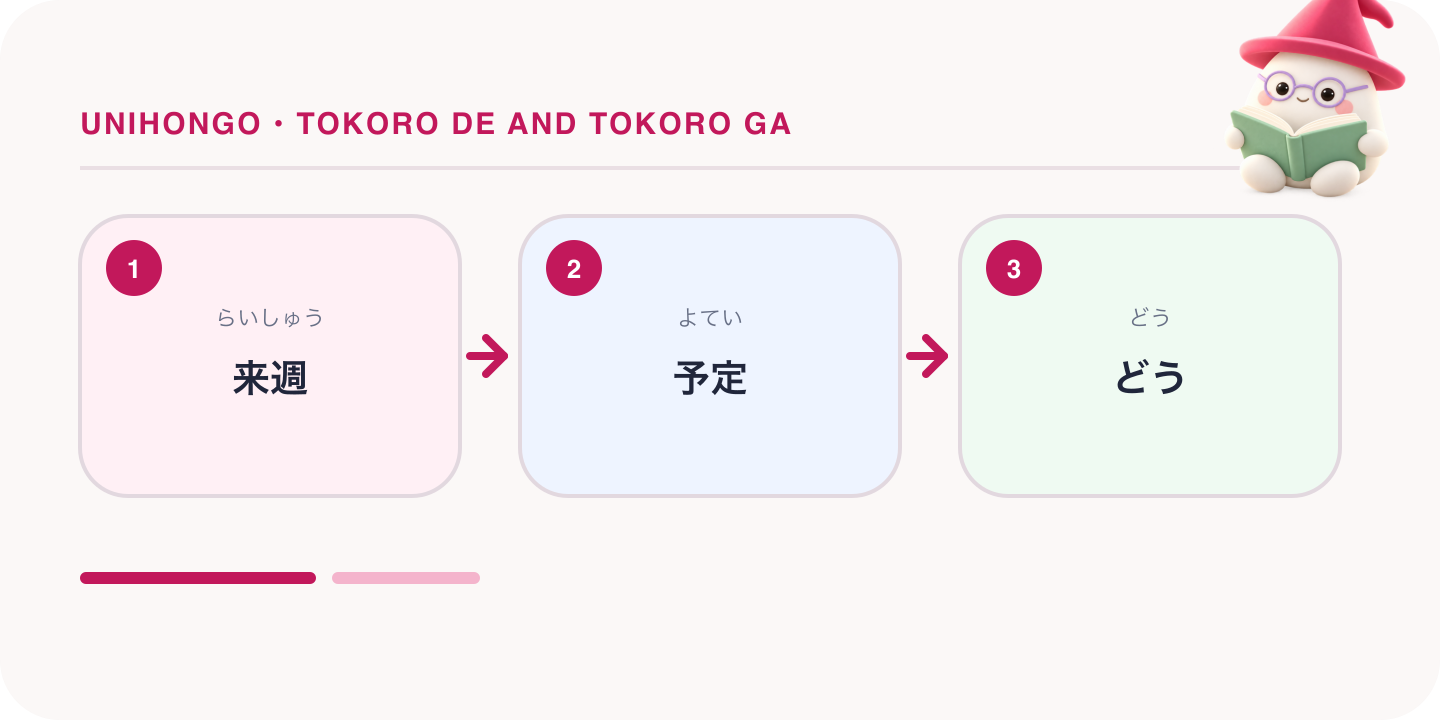
| ところで、来週の予定はどうなってる? | Tokoro de, raishū no yotei wa dō natteru? | By the way, what's happening with next week's plans? |
| ところで、田中さんは元気? | Tokoro de, Tanaka san wa genki? | By the way, how's Tanaka doing? |
| ところで、あの件ですが。 | Tokoro de, ano ken desu ga. | By the way, about that matter. |
| ところで、お昼はもう食べた? | Tokoro de, ohiru wa mō tabeta? | By the way, have you had lunch yet? |
| ところで、本日の議題に入ってもよろしいでしょうか。 | Tokoro de, honjitsu no gidai ni haitte mo yoroshii deshō ka. | By the way, may we move on to today's agenda? |
| ところで、この近くにコンビニある? | Tokoro de, kono chikaku ni konbini aru? | By the way, is there a convenience store near here? |
Tokoro ga: the turn nobody expected
Tokoro ga is also sentence-initial, but it links two sentences tightly. The first sets up an expectation; tokoro ga introduces the second, which overturns it. Ichijikan mae ni dekaketa. Tokoro ga, densha ga tomatte ita. The listener feels the drop because tokoro ga promised it.
The key restriction is that the second sentence must be a fact, not a decision or an opinion. Tokoro ga reports how things turned out. You cannot say tokoro ga, ikimasen, meaning but I won't go, because that is your choice rather than an outcome. For your own objections use demo, kedo or shikashi.
This restriction is what makes tokoro ga so good in stories. Every anecdote has a moment where the plan meets reality, and tokoro ga marks it. Speakers often slow down before it, which tells the listener the punchline is coming.
| Japanese | Romaji | Meaning |
|---|---|---|
| 一時間前に出かけた。ところが、電車が止まっていた。 | Ichijikan mae ni dekaketa. Tokoro ga, densha ga tomatte ita. | I left an hour early. But then, the trains had stopped. |
| 雨の予報だった。ところが、快晴だった。 | Ame no yohō datta. Tokoro ga, kaisei datta. | The forecast said rain. But it was perfectly clear. |
| 簡単だと思った。ところが、全然できなかった。 | Kantan da to omotta. Tokoro ga, zenzen dekinakatta. | I thought it would be easy. But I couldn't do it at all. |
| 店は空いてるはずだった。ところが、行列だった。 | Mise wa aiteru hazu datta. Tokoro ga, gyōretsu datta. | The shop should have been empty. Instead, there was a queue. |
| 準備は万全でした。ところが、当日停電が起きました。 | Junbi wa banzen deshita. Tokoro ga, tōjitsu teiden ga okimashita. | Preparation was complete. However, there was a power cut on the day. |
| 誰も来ないと思ってた。ところが、五十人も来た。 | Dare mo konai to omotteta. Tokoro ga, gojūnin mo kita. | I thought nobody would come. But fifty people turned up. |
Demo, sore de, shikashi: what each opener does
Learners lean on demo because it is short and safe: a general but that contrasts, objects, softens and hedges. Sore de means and so, and continues a sequence, often as a question asking for the next event. Shikashi is a formal however, common in writing and speeches. Tokoro de and tokoro ga sit outside this set.
Hear the same story told four ways. Yoyaku shita, I booked. Demo, ikenakatta is a plain contrast. Sore de, dō shita no? asks for the continuation. Shikashi, ikenakatta sounds like a report. Tokoro ga, mise ga shimatte ita, but the shop turned out to be closed, is the surprise.
In a meeting, demo can sound like disagreement, so soften it with desu ga; sore de shows attention; shikashi states a formal counterpoint; tokoro de is how you take the floor for your own item.
| Japanese | Romaji | Meaning |
|---|---|---|
| 予約した。でも、行けなかった。 | Yoyaku shita. Demo, ikenakatta. | I booked. But I couldn't go. |
| それで、どうしたの? | Sore de, dō shita no? | And then what did you do? |
| しかし、予算が足りません。 | Shikashi, yosan ga tarimasen. | However, the budget is insufficient. |
| 予約した。ところが、店が閉まっていた。 | Yoyaku shita. Tokoro ga, mise ga shimatte ita. | I booked. But the shop turned out to be closed. |
| それで、結局どうなったの? | Sore de, kekkyoku dō natta no? | So, how did it end up? |
| でも、それは少し難しいかもしれません。 | Demo, sore wa sukoshi muzukashii kamo shiremasen. | But that might be a little difficult. |
Telling a story with both openers
Stories among friends often use both words within a minute. Tokoro de brings the story in, tokoro ga delivers the turn, and sore de carries the listener to the end.
Listeners have their own responses. After tokoro ga, the expected reaction is e, uso, no way, or maji de, seriously. After sore de, the listener waits or prompts with un, un.
| Japanese | Romaji | Meaning |
|---|---|---|
| ところで、昨日さ、面白いことがあったんだ。 | Tokoro de, kinō sa, omoshiroi koto ga atta n da. | By the way, something funny happened yesterday. |
| 新しいラーメン屋に行ったの。ところが、休みだった。 | Atarashii rāmen'ya ni itta no. Tokoro ga, yasumi datta. | I went to the new ramen place. But it was closed. |
| え、うそ。それで? | E, uso. Sore de? | No way. And then? |
| それで、隣の店に入ったら、すごくおいしかった。 | Sore de, tonari no mise ni haittara, sugoku oishikatta. | So I went into the place next door, and it was really good. |
| ところが、その店も来月閉まるんだって。 | Tokoro ga, sono mise mo raigetsu shimaru n datte. | But apparently that place is closing next month too. |
| まじで?残念だね。 | Maji de? Zannen da ne. | Seriously? That's a shame. |
In meetings: moving the agenda and reporting setbacks
At work, tokoro de is the standard bridge from small talk to business, and from one agenda item to the next. It does not say the previous topic was unimportant, only that it is finished. Its more formal cousin sate is what a chair uses to open a meeting; tokoro de is what a participant uses to raise a new point.
Tokoro ga is useful for reporting a setback without assigning blame. Yotei dōri susunde imashita. Tokoro ga, senshū shiyō ga henkō ni narimashita. It was going to plan. However, the specification was changed last week. The word frames the change as something that happened, not something anyone did, which keeps the report calm.
- Tokoro de, honjitsu no gidai desu ga: by the way, about today's agenda
- Tokoro de, sakihodo no ken desu ga: by the way, about the earlier matter
- Sate, hajimemashō: right then, let's begin (chair only)
- Tokoro ga, tōjitsu ni mondai ga hassei shimashita: however, a problem arose on the day
- Tokoro ga, kyaku sama kara henkō no irai ga arimashita: however, the customer requested a change
- Sore de, taiō to shite wa: and so, as our response
The polite register is carried by what comes after the opener, not by the opener itself.
The openers compared
The table lines up the openers you are most likely to need, with the job, the register and the typical follow-up.
| Opener | Reading | Job, register and what follows |
|---|---|---|
| ところで | tokoro de | changes the subject; any register; a new noun with wa |
| ところが | tokoro ga | unexpected outcome; any register; a fact, not a decision |
| でも | demo | general but; casual to polite; contrast or objection |
| しかし | shikashi | formal however; writing and speeches; any contrast |
| それで | sore de | and so; continues a sequence; often a question |
| さて | sate | right then; formal; opens a meeting or section |
| そういえば | sō ieba | that reminds me; casual; a related aside |
| それが | sore ga | well, actually; casual; a disappointing answer |
| けど | kedo | but; casual; an objection or a soft ending |
| そして | soshite | and then; neutral; the next event, no surprise |
Sō ieba introduces something the current topic reminded you of; tokoro de introduces something unrelated.
Sore ga and tokoro ga: two ways to disappoint
Sore ga is a close relative of tokoro ga and the better choice when replying to a question. When someone asks dō datta? and the answer is a let-down, sore ga warns them: sore ga, dame datta n da. Tokoro ga does the same job when you are narrating rather than answering.
Both words say that reality did not match expectation. The difference is who set up the expectation: with sore ga, the other person did, by asking hopefully; with tokoro ga, you did, in your own previous sentence.
| Japanese | Romaji | Meaning |
|---|---|---|
| 面接、どうだった? | Mensetsu, dō datta? | How was the interview? |
| それが、だめだったんだ。 | Sore ga, dame datta n da. | Well, actually, it didn't go well. |
| 自信はあった。ところが、質問が全然違った。 | Jishin wa atta. Tokoro ga, shitsumon ga zenzen chigatta. | I was confident. But the questions were completely different. |
| それが、まだ返事がないんです。 | Sore ga, mada henji ga nai n desu. | Actually, there's been no reply yet. |
| ところが、翌日連絡が来た。 | Tokoro ga, yokujitsu renraku ga kita. | But then, the next day they got in touch. |
Mistakes learners make with tokoro de and tokoro ga
The first mistake is using tokoro ga for an opinion or a decision. Tokoro ga, watashi wa hantai desu, meaning but I disagree, is wrong; use shikashi or demo. Tokoro ga needs an outcome that happened.
The second is using tokoro de for a related aside. If you are talking about lunch and want to mention the café near the office, that is sō ieba, not tokoro de. Tokoro de after a related remark sounds like you did not listen to the previous topic.
The third is placing either word mid-sentence. Both are sentence openers; mid-sentence they revert to the noun tokoro plus a particle, a different grammar entirely.
Finally, watch the follow-up. After tokoro ga, a past-tense fact. After tokoro de, a new subject with wa or a question. If your tokoro ga sentence ends in mashō or tsumori, something has gone wrong.
| Japanese | Romaji | Meaning |
|---|---|---|
| しかし、私は反対です。 | Shikashi, watashi wa hantai desu. | However, I disagree. (opinion, so not tokoro ga) |
| そういえば、駅前のカフェ、行った? | Sō ieba, ekimae no kafe, itta? | That reminds me, did you go to the café by the station? |
| ところで、週末は何か予定ある? | Tokoro de, shūmatsu wa nani ka yotei aru? | By the way, any plans at the weekend? (new topic) |
| 安いと思った。ところが、高かった。 | Yasui to omotta. Tokoro ga, takakatta. | I thought it was cheap. But it was expensive. (outcome) |
| ところが、実際は違いました。 | Tokoro ga, jissai wa chigaimashita. | However, in reality it was different. |