
Why helper verbs decide how natural you sound
A learner who only knows tabemashita can report that eating happened. A speaker who knows the helpers can say that they polished the plate off, that they ate something they should not have, that they ate in advance because the meeting runs late, or that they tried a dish to see what it was like. None of that lives in the main verb. It lives in what follows the te-form.
This is also why helper verbs are worth learning as choices rather than as forms. The grammar is mechanical once you have the te-form, which the dedicated te-form guide covers in detail. The difficulty is deciding, in the half second before you speak, which shade of meaning the situation calls for. So each section below starts with the situation and only then gives the conjugation.
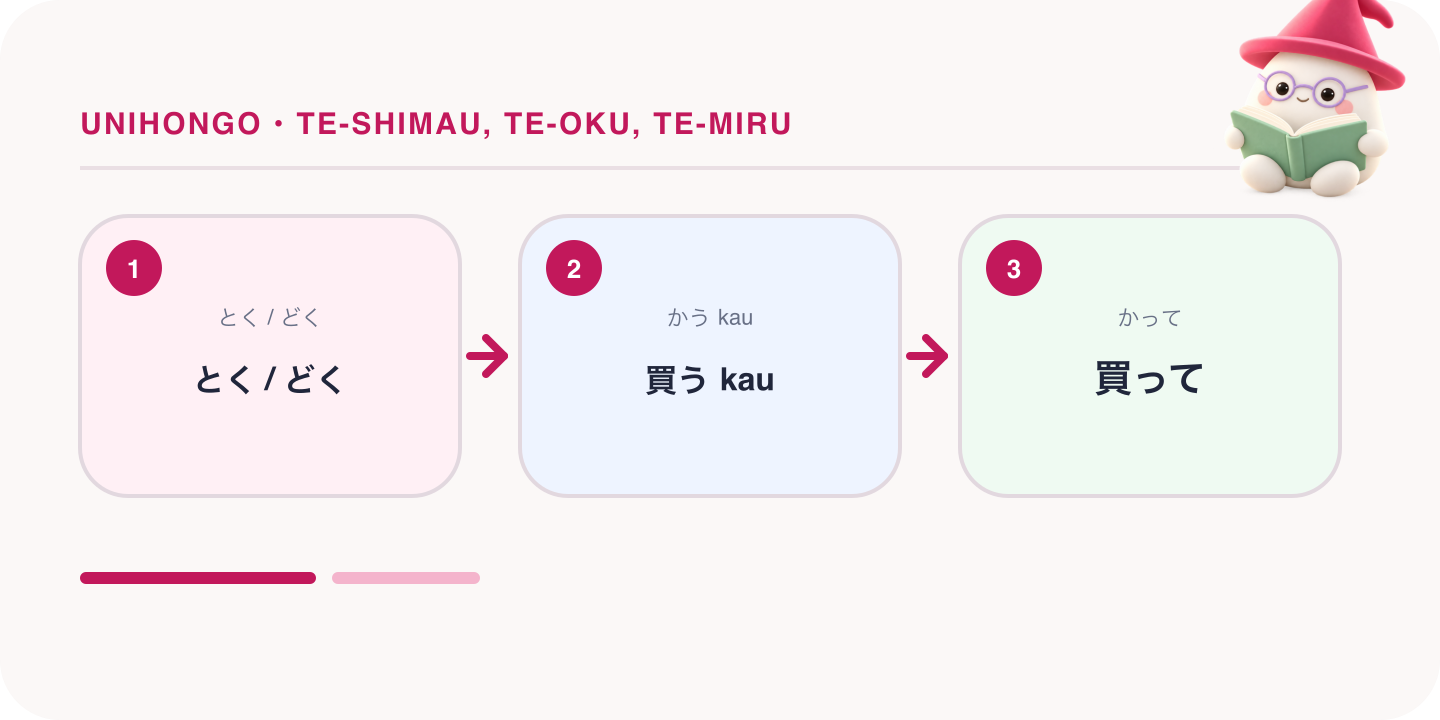
The helper verbs at a glance
| Helper | Core meaning | Casual contraction | Register notes |
|---|---|---|---|
| てしまう te shimau | Finish it off, or an accident you regret | ちゃう / じゃう | Full form fits any register; contraction is casual |
| ておく te oku | Do it in advance, or leave it in that state | とく / どく | Full form fits any register; toku is casual |
| てみる te miru | Try it and see how it turns out | No common contraction | Neutral at every politeness level |
| ていく te iku | Change continuing from now, or go and do | てく (casual only) | Neutral; teku is spoken shorthand |
| てくる te kuru | Change up to now, or go, do, and come back | No common contraction | Neutral at every politeness level |
| てくれる te kureru | Someone does it for your benefit | No common contraction | Neutral; te kurenai is a casual request |
| てもらう te morau | You have someone do it for you | No common contraction | Neutral; te itadaku is the humble version |
The last two rows belong to the giving-and-receiving family and deserve a post of their own, so this guide only points at them: kaite kuremashita means someone wrote it for me, and kaite moraimashita means I had it written for me. Everything else on the list is covered below.
Getting the te-form right first
None of these helpers work until the te-form is automatic, because a wrong te-form produces a wrong contraction as well. Godan verbs split by their final syllable, ichidan verbs simply drop ru, and the two irregulars are memorised. The de-ending group matters especially here, since it is the group that later produces jau and doku rather than chau and toku.
| Verb class | Dictionary form | Te-form | Romaji |
|---|---|---|---|
| Godan う・つ・る | 買う kau | 買って | Katte |
| Godan む・ぶ・ぬ | 読む yomu | 読んで | Yonde |
| Godan く | 書く kaku | 書いて | Kaite |
| Godan ぐ | 急ぐ isogu | 急いで | Isoide |
| Godan す | 話す hanasu | 話して | Hanashite |
| Ichidan | 食べる taberu | 食べて | Tabete |
| Irregular suru | する suru | して | Shite |
| Irregular kuru | 来る kuru | 来て | Kite |
| Exception | 行く iku | 行って | Itte |
Te shimau for finishing something off
With a deliberate action, te shimau says the job was taken all the way to completion, often faster or more thoroughly than expected. It is the difference between I did my homework and I got my homework done. Japanese speakers reach for it when the completion itself is the news, especially with words like zenbu, mō, and made ni, which set a boundary the action closes.
The helper conjugates like any godan verb ending in u, so shimau becomes shimaimasu, shimaimashita, shimatte, and shimaimasen, while the main verb stays frozen in its te-form and never changes. That is the whole mechanism, and it holds for every helper on this page, which is why learning one of them properly makes the other four almost free.
| Japanese | Romaji | Meaning |
|---|---|---|
| 宿題をしてしまいました。 | Shukudai o shite shimaimashita. | I got my homework finished. |
| 昼までにレポートを書いてしまいます。 | Hiru made ni repōto o kaite shimaimasu. | I will get the report written by noon. |
| 全部食べてしまいました。 | Zenbu tabete shimaimashita. | I ate the whole lot. |
| この本をもう読んでしまいました。 | Kono hon o mō yonde shimaimashita. | I have already finished this book. |
| 先に片づけてしまいましょう。 | Saki ni katazukete shimaimashō. | Let us get the tidying out of the way first. |
Te shimau for accidents and regret
With an action you did not intend, the same helper turns into an apology in advance. It signals that the result is unwanted and that you are not shrugging it off. This is why so many workplace apologies contain it: okurete shimatte, sumimasen sounds sincere in a way that okurete sumimasen does not quite reach, because shimau admits the outcome was bad.
The mistake learners make is choosing between the two meanings as if the grammar decided. It does not. A verb that describes a controllable act reads as completion, and a verb that describes a slip reads as regret. Wasurete shimaimashita can only be regret, because nobody forgets on purpose.
| Japanese | Romaji | Meaning |
|---|---|---|
| 財布を落としてしまいました。 | Saifu o otoshite shimaimashita. | I dropped my wallet, unfortunately. |
| 約束を忘れてしまいました。 | Yakusoku o wasurete shimaimashita. | I completely forgot our arrangement. |
| コップを割ってしまいました。 | Koppu o watte shimaimashita. | I broke a glass, I am afraid. |
| 遅れてしまって、すみません。 | Okurete shimatte, sumimasen. | I am sorry for being late. |
| 電車を間違えてしまいました。 | Densha o machigaete shimaimashita. | I took the wrong train. |
Chau and jau, the casual contractions
In speech among friends, te shimau collapses. Te shimau becomes chau and de shimau becomes jau, and every conjugation follows: chatta and jatta for the past, chaimasu and jaimasu for a lightly polite version, chaimashita for the polite past. The de-group is the only thing you have to watch, so yomu gives yonjau and nomu gives nonjau, while taberu gives tabechau.
Register is the trap. Chatta is warm and informal and lands well with friends or close colleagues. In front of a customer, a manager, or anything written, use shite shimaimashita. The middle option, chaimashita, exists and is common in friendly offices, but it is not neutral, so avoid it when you are unsure of the room.
| Japanese | Romaji | Meaning |
|---|---|---|
| 忘れちゃった。 | Wasurechatta. | I forgot. (casual) |
| 全部食べちゃった。 | Zenbu tabechatta. | I ate all of it. (casual) |
| ビールを飲んじゃった。 | Bīru o nonjatta. | I went and drank the beer. (casual) |
| もう読んじゃったよ。 | Mō yonjatta yo. | I have already finished reading it. (casual) |
| 言っちゃいました。 | Itchaimashita. | I said it, and I probably should not have. |
| やっちゃいましたね。 | Yatchaimashita ne. | Well, that is done now, for better or worse. |
Te oku for doing it in advance
Te oku means doing something now because of a later moment: booking before the weekend, reading the file before the meeting, buying drinks before guests arrive. It also covers leaving something in a useful state, as in mado o akete okimasu, meaning open the window and leave it open. Both senses share the same idea of setting things up so the future runs smoothly.
Oku is a godan verb ending in ku, so it gives okimasu, okimashita, and oite. Requests are extremely common in this pattern: yonde oite kudasai asks someone to read it in advance, which is softer and more precise than yonde kudasai. In casual speech te oku contracts to toku and de oku to doku, so katte oku becomes kattoku and yonde oku becomes yondoku.
| Japanese | Romaji | Meaning |
|---|---|---|
| 飲み物を買っておきます。 | Nomimono o katte okimasu. | I will buy the drinks in advance. |
| 会議の前に資料を読んでおいてください。 | Kaigi no mae ni shiryō o yonde oite kudasai. | Please read the documents before the meeting. |
| レストランを予約しておきました。 | Resutoran o yoyaku shite okimashita. | I booked the restaurant ahead of time. |
| 窓を開けておきます。 | Mado o akete okimasu. | I will open the window and leave it open. |
| 私から言っておきます。 | Watashi kara itte okimasu. | I will mention it to them beforehand. |
| 買っとくね。 | Kattoku ne. | I will grab it in advance. (casual) |
| 読んどいて。 | Yondoite. | Read it beforehand. (casual) |
Te miru for trying it and seeing
Te miru is an experiment. You do the action in order to find out the result, which is exactly the English try doing rather than try to do. Tabete mimasu means eat some and see what it is like; it does not mean attempt to eat. That distinction matters, because the attempt meaning belongs to a different pattern built on the volitional, as in tabeyō to shimasu.
Miru is ichidan, so it gives mimasu, mimashita, mite, and mitai. The mitai form is the everyday way to express curiosity: itte mitai desu means I would like to go and see for myself. Requests are common too, and kite mite mo ii desu ka is the standard way to ask whether you may try a garment on in a shop.
| Japanese | Romaji | Meaning |
|---|---|---|
| 食べてみます。 | Tabete mimasu. | I will try it and see. |
| 着てみてもいいですか。 | Kite mite mo ii desu ka. | May I try it on? |
| 一度行ってみたいです。 | Ichido itte mitai desu. | I would like to go there once and see it. |
| 店の人に聞いてみます。 | Mise no hito ni kiite mimasu. | I will ask the shop staff and find out. |
| やってみましょう。 | Yatte mimashō. | Let us give it a go. |
| 使ってみましたが、難しかったです。 | Tsukatte mimashita ga, muzukashikatta desu. | I tried using it, but it was difficult. |
Te iku and te kuru for change and direction
These two draw an arrow in time or space. Te kuru brings the action toward the present or toward the speaker: samuku natte kimashita says it has been getting colder up to now, and katte kimasu says I will go and buy it and come back. Te iku pushes away from here: tsuzukete ikimasu says I will carry on from now onward, and motte ikimasu says I will take it there.
The physical and the temporal senses are the same arrow. Motte ikimasu and motte kimasu are the pair English splits into take and bring, and learners mix them constantly because English chooses by the listener's location while Japanese chooses by the speaker's. Ask where the object ends up relative to you: with you, kimasu; away from you, ikimasu. In casual speech te iku shortens to teku, so motte iku becomes motteku.
| Japanese | Romaji | Meaning |
|---|---|---|
| 傘を持っていきます。 | Kasa o motte ikimasu. | I will take an umbrella with me. |
| お土産を持ってきます。 | Omiyage o motte kimasu. | I will bring a souvenir back. |
| パンを買ってきます。 | Pan o katte kimasu. | I will go and buy bread and come back. |
| だんだん寒くなってきました。 | Dandan samuku natte kimashita. | It has been gradually getting colder. |
| 三年間日本語を勉強してきました。 | San-nen-kan nihongo o benkyō shite kimashita. | I have been studying Japanese for three years. |
| これからも続けていきます。 | Kore kara mo tsuzukete ikimasu. | I will keep it up from here on. |
| 外国人の社員は増えていくと思います。 | Gaikokujin no shain wa fuete iku to omoimasu. | I think the number of foreign staff will keep rising. |
One verb, every helper
| Form | Romaji | What it says |
|---|---|---|
| 書きます | Kakimasu | I write it. Plain statement, no shading. |
| 書いてしまいます | Kaite shimaimasu | I will get it written and out of the way. |
| 書いてしまいました | Kaite shimaimashita | I finished it, or I wrote it by mistake. |
| 書いちゃった | Kaichatta | Same, casual speech only. |
| 書いておきます | Kaite okimasu | I will write it in advance, ready for later. |
| 書いときます | Kaitokimasu | Same, casual speech only. |
| 書いてみます | Kaite mimasu | I will try writing it and see how it goes. |
| 書いていきます | Kaite ikimasu | I will go on writing it from now onward. |
| 書いてきました | Kaite kimashita | I have been writing it up until now. |
| 書いてくれました | Kaite kuremashita | Someone wrote it for me, kindly. |
Read the column aloud in order. Because the base verb never moves, your mouth learns that the meaning is being decided by the tail, which is the mental habit that lets you choose a helper mid-sentence instead of planning it in advance.
Choosing the helper in real time
- If the point is that it is done and out of the way, use te shimau; if the point is that it was a mistake, use te shimau as well and let the verb decide the reading.
- If the action exists to serve a later moment, use te oku, and say shite okimasu when accepting a task with a deadline.
- If you do not know the result yet and want to find out, use te miru rather than a plain verb.
- If something has been developing up to now, use te kuru; if it will develop from now, use te iku.
- Match the contraction to the room: chatta and toku with friends, shite shimaimashita and shite okimasu with anyone senior or unfamiliar.