

The core meaning
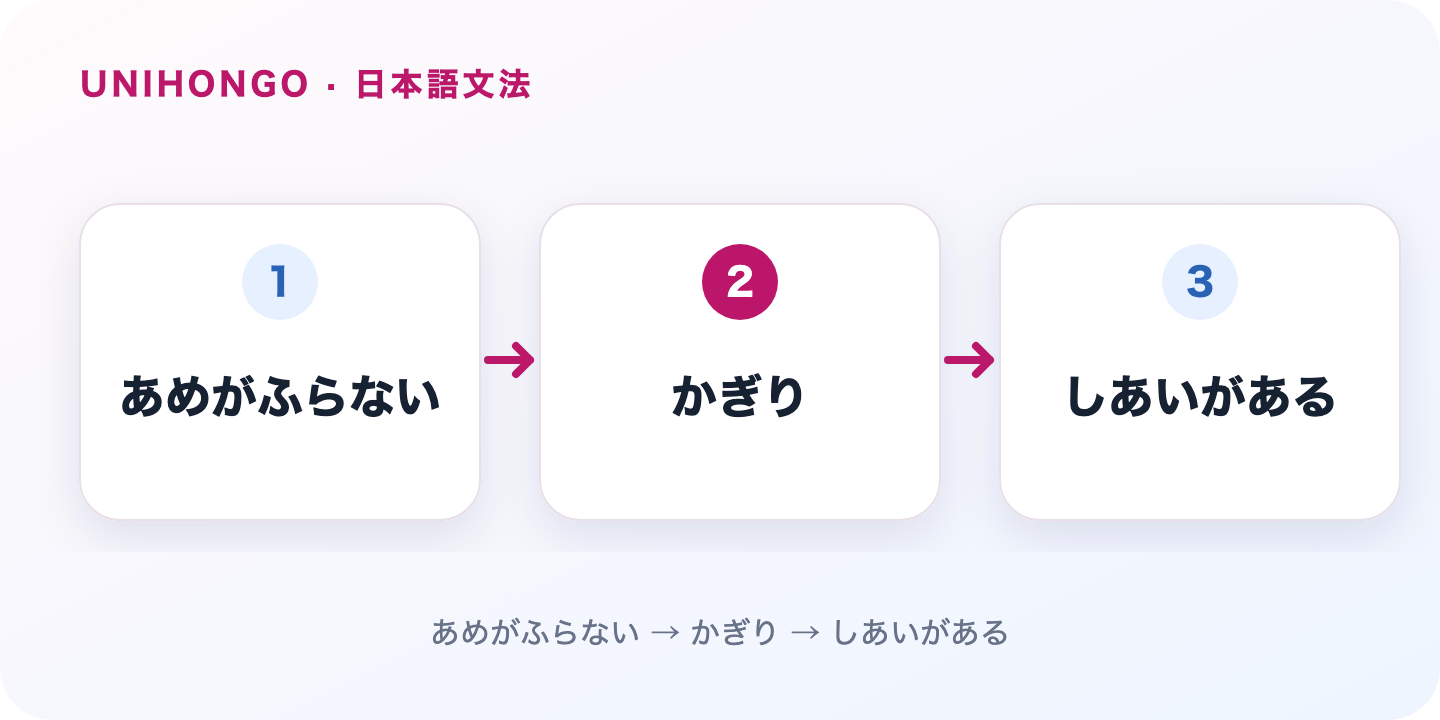
雨が降らない限り、試合はあります means the match will go ahead unless it rains. The negative clause defines the boundary of the claim. The speaker treats the main result as the default and the first clause as the exception that could overturn it. This is useful for rules, plans, availability and cautious predictions.
| Japanese | Romaji | Meaning |
|---|---|---|
| 雨が降らない限り、試合はあります。 | Ame ga furanai kagiri, shiai wa arimasu. | The match is on unless it rains. |
| 予定が変わらない限り、金曜日に出発します。 | Yotei ga kawaranai kagiri, kin'yōbi ni shuppatsu shimasu. | We'll leave Friday unless the plan changes. |
How to form it
Use the plain negative form plus 限り: 降らない限り, 変わらない限り. The main clause then states what remains true. The phrase can appear at the beginning or middle of the sentence. Be careful with negative polarity: the condition is the absence of an event, and the exception is when that event occurs.
| Use | Japanese form | Meaning |
|---|---|---|
| Weather | 雨が降らない限り | Unless it rains |
| Change | 予定が変わらない限り | Unless the plan changes |
| Ability | 練習しない限り | Unless one practices |
Natural examples
Read each sentence for the relationship between the first idea and the second. The English translation gives a natural meaning, while the Japanese wording shows exactly where the pattern attaches.
| Japanese | Romaji | Meaning |
|---|---|---|
| 練習しない限り、上達しません。 | Renshū shinai kagiri, jōtatsu shimasen. | You won't improve unless you practice. |
| 本人が同意しない限り、写真は公開しません。 | Honnin ga dōi shinai kagiri, shashin wa kōkai shimasen. | We won't publish the photo unless the person agrees. |
Compare the nearby pattern
雨が降らなければ、試合をします is an ordinary conditional, 'if it doesn't rain, we'll play.' 雨が降らない限り、試合をします presents playing as the standing plan with rain as the one named exception. 以上は draws a duty from a premise; 限り instead sets the scope in which a claim holds.
| Japanese | Romaji | Meaning |
|---|---|---|
| 雨が降らなければ、試合をします。 | Ame ga furanakereba, shiai o shimasu. | If it doesn't rain, we'll play. |
| 雨が降らない限り、試合をします。 | Ame ga furanai kagiri, shiai o shimasu. | We'll play unless it rains. |
The two examples may describe similar situations, but they lead the listener to different conclusions. Choose the form that matches the claim you really intend to make.
Common mistake to avoid
Do not flip the meaning by using a positive clause: 雨が降る限り means 'as long as it rains,' not 'unless it rains.' Also do not assume the named exception is the only possible one in reality; the speaker may simply be naming the relevant exception for this discussion.
- The main result is the default
- The first clause names an exception boundary
- Use plain negative + 限り
- Positive 限り means 'as long as'
Try it yourself
State a standing plan with one exception, such as weather or a schedule change. Use ない限り, then paraphrase it with なければ and note which version sounds more like a default rule.
Say your sentence once slowly while looking at the Japanese pattern. Then say it again without reading. If your second clause changes from a possibility to a fact, or from advice to a requirement, revise it so the grammar still matches your meaning.