

What tte is and where it comes from
Tte is a contraction of the quotation particle to, sometimes with to iu or to itta folded into it. In writing you will see って, occasionally just て after ん, as in nante. Because it started as a quotation marker, all its uses share one idea: framing words as something said, heard or named.
In casual speech tte has almost entirely replaced to for quoting. A friend will say kanojo, konai tte, she says she's not coming, where a textbook sentence would be kanojo wa konai to itte imashita. It is not slang; it is simply the spoken form, and you will hear it from children, office workers and television presenters alike.
The four main uses are quoting (with a verb such as iu, kiku or omou), hearsay (without a verb), topic marking (X tte followed by a question or comment), and emphasis (datte, tte ba, tte itta desho). Each is covered below.
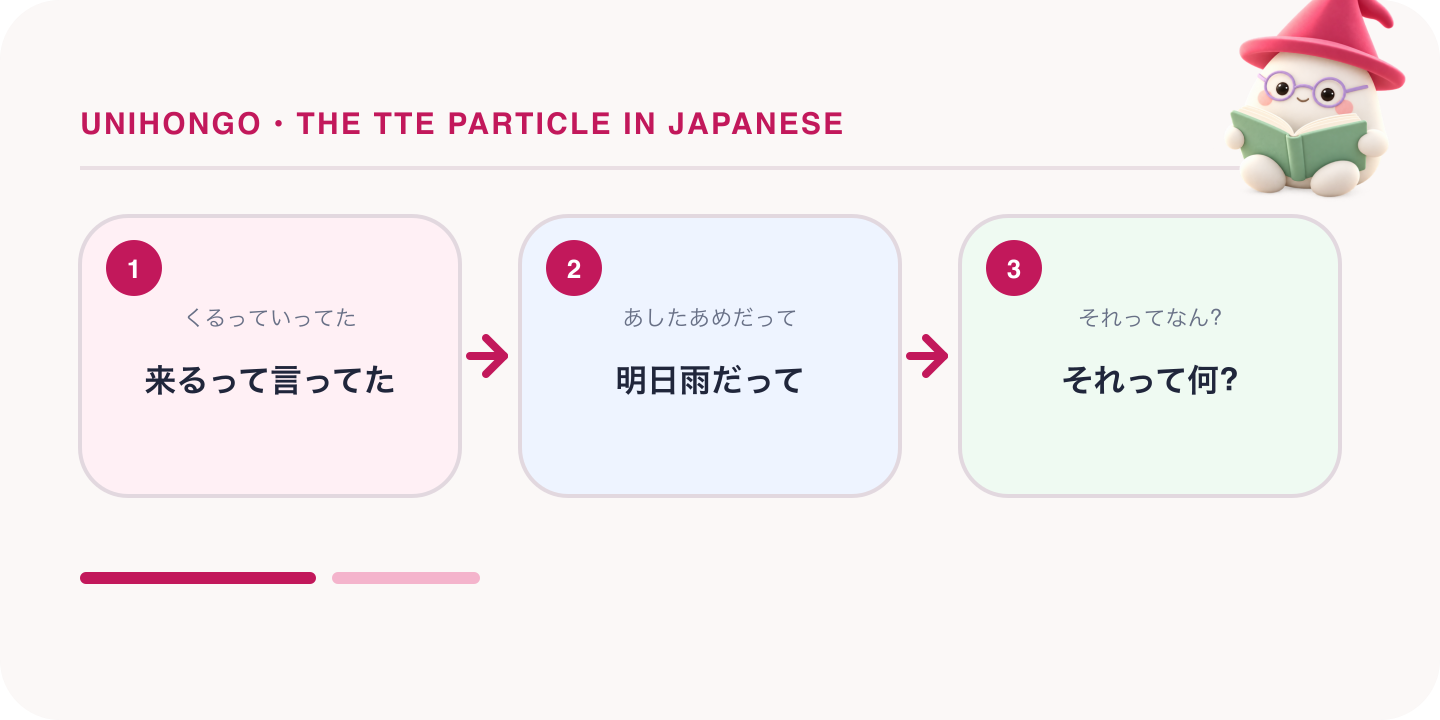
| Use | Pattern | Example | Meaning |
|---|---|---|---|
| Quoting | Plain form + って + 言う/聞く/思う | 来るって言ってた | He said he's coming |
| Hearsay | Plain form + って | 明日雨だって | Apparently it'll rain tomorrow |
| Topic | Noun + って + question/comment | それって何? | What's that? |
| Naming | Noun + って + noun | 田中って人 | Someone called Tanaka |
| Insistence | Sentence + ってば | もういいってば | I said it's fine! |
| Re-quoting | だって / って言ったでしょ | だって言ったじゃん | I told you so! |
Quoting what someone said: tte itta and tte itteta
To quote speech, put the plain form of what was said before tte and follow it with a verb of saying. Itta, said, and itteta, was saying, are the most common, but kiita, heard, iwareta, was told, and kaite atta, it was written, all work the same way.
Itteta, the contraction of itte ita, is especially natural when you are passing on a message: Tanaka-san, okureru tte itteta yo, Tanaka said he'd be late. It suggests the words were said earlier and still apply.
After a noun or na-adjective, the plain form usually keeps da: ashita wa yasumi da tte itta. In fast speech the da is often dropped, especially before a question, but keeping it is never wrong. Tte also quotes questions: ashita kuru ka tte kikareta, I was asked whether I'm coming tomorrow.
| Japanese | Romaji | Meaning |
|---|---|---|
| 田中さん、遅れるって言ってたよ。 | Tanaka-san, okureru tte itteta yo. | Tanaka said he'd be late. |
| 明日は休みだって言ってた。 | Ashita wa yasumi da tte itteta. | She said tomorrow is a day off. |
| 先生に宿題を出せって言われた。 | Sensei ni shukudai o dase tte iwareta. | The teacher told me to hand in my homework. |
| 明日来るかって聞かれた。 | Ashita kuru ka tte kikareta. | I was asked if I'm coming tomorrow. |
| もう無理だって思った。 | Mō muri da tte omotta. | I thought, that's it, I can't do this. |
| 駅に着いたら電話してって。 | Eki ni tsuitara denwa shite tte. | She says to call her when you get to the station. |
Hearsay with no verb: they say, I heard
Drop the verb after tte and it becomes hearsay: sentence plus tte means apparently, I heard, they say. Ashita ame da tte, apparently it's going to rain tomorrow. This is the casual counterpart of sō da in its reporting sense (ame da sō desu) and of rashii.
The difference in nuance is mostly register. Sō desu is neutral to polite and sounds like reporting information. Rashii adds a note of inference or distance, as in it seems. Tte is casual and immediate, the way you pass on news to a friend a few minutes after you heard it.
Tte also works as a question to check hearsay: ashita yasumi da tte? is tomorrow a day off, is that what they said? And adding yo or ne softens or shares the news: ano mise, heiten suru tte ne, I hear that shop is closing, isn't it?
| Japanese | Romaji | Meaning |
|---|---|---|
| 明日雨だって。 | Ashita ame da tte. | Apparently it'll rain tomorrow. |
| あの店、来月閉店するって。 | Ano mise, raigetsu heiten suru tte. | I hear that shop is closing next month. |
| 佐藤さん、結婚するんだって。 | Satō-san, kekkon suru n da tte. | Apparently Sato is getting married. |
| 課長、今日は来ないって。 | Kachō, kyō wa konai tte. | The section chief says he isn't coming today. |
| え、試験延期だって? | E, shiken enki da tte? | What, the exam's been postponed? |
| 明日は雨だそうです。 | Ashita wa ame da sō desu. | I understand it will rain tomorrow. (polite) |
N da tte, from no da plus tte, is very common for surprising or personal news: it adds the sense of so it turns out. Kekkon suru n da tte sounds more like gossip than kekkon suru tte.
Tte as a topic marker: sore tte nani?
Attached to a noun at the start of a sentence, tte picks out that thing as the topic, much like wa. It comes from to iu no wa, the thing called X, so it often carries a sense of this thing you mentioned or this thing in general. Sore tte nani? means what's that (you just said)?
It is typical in questions and in comments about the nature of something: Nihon no natsu tte atsui ne, Japanese summers are hot, aren't they; Tanaka-san tte, dare? who is this Tanaka? When the thing is new, unfamiliar or being defined, tte feels more natural than wa.
Tte can also connect two nouns in the sense of called or named: Sakura tte mise, a shop called Sakura. This is the casual version of to iu, as in Sakura to iu mise.
| Japanese | Romaji | Meaning |
|---|---|---|
| それって何? | Sore tte nani? | What's that? |
| 「積ん読」って何ですか。 | "Tsundoku" tte nan desu ka. | What does tsundoku mean? |
| 日本の夏って暑いね。 | Nihon no natsu tte atsui ne. | Japanese summers are really hot, aren't they? |
| 田中さんって、どんな人? | Tanaka-san tte, donna hito? | What kind of person is Tanaka? |
| 駅前の「さくら」って店、知ってる? | Ekimae no "Sakura" tte mise, shitteru? | Do you know that shop called Sakura by the station? |
| この漢字って、どう読むの? | Kono kanji tte, dō yomu no? | How do you read this kanji? |
Datte, tte itta desho and tte ba: insisting and repeating
Tte also carries emphasis when you are repeating or defending something. Datte at the end of a sentence (from da plus tte) means but I said, or but it's true. At the start of a sentence datte is a separate word meaning but or because, used to justify yourself: datte, isogashikatta n da mon, but I was busy!
Tte itta desho and tte itta jan mean I told you, didn't I? They are the standard way to point out that you already said something. Desho can be softened with ne; jan is more casual and a little sharper.
Tte ba, often written tteba, is an insistent ending: I'm telling you. Mō ii tte ba means I said it's fine, enough already. It signals impatience because the listener is not responding, and it can sound childish or irritated. Tte, on its own and with rising stress, can have a similar effect: chotto matte tte! I said wait!
| Japanese | Romaji | Meaning |
|---|---|---|
| だって、忙しかったんだもん。 | Datte, isogashikatta n da mon. | But I was busy! |
| だから、遅れるって言ったでしょ。 | Dakara, okureru tte itta desho. | I told you I'd be late, didn't I? |
| もういいってば。 | Mō ii tte ba. | I said it's fine, enough already. |
| 早くしてってば。 | Hayaku shite tte ba. | I said hurry up! |
| ちょっと待ってって! | Chotto matte tte! | I said wait a moment! |
| 本当だって。 | Hontō da tte. | It's true, I'm telling you. |
These are strongly casual and emotional. Use them with close friends and family; in polite settings, rephrase with sakihodo mo mōshiagemashita ga, as I mentioned earlier, or simply repeat the information calmly.
Tte vs to, wa, rashii and sō da
Tte overlaps with several patterns, and the choice mostly depends on register and on whether a verb follows. The table sets the common alternatives side by side.
| Meaning | Casual (tte) | Neutral or formal | Difference |
|---|---|---|---|
| He said he'd come | 来るって言ってた | 来ると言っていました | To needs a verb; tte is spoken style |
| Apparently it'll rain | 雨だって | 雨だそうです | Sō da is neutral reporting |
| It seems it'll rain | 雨だって | 雨らしい | Rashii adds inference or distance |
| What's that? | それって何? | それは何ですか | Tte suits new or unfamiliar things |
| A shop called Sakura | さくらって店 | さくらという店 | To iu is the written form |
| I told you | 言ったってば | 申し上げた通りです | Tte ba is insistent and informal |
A good rule: if you would write to iu, to itta or wa in an essay, you can usually say tte in conversation, but not the other way round. Hearsay tte without a verb, and tte ba, have no direct written equivalent and must be rephrased.
Other forms you will hear: nante, tteiu ka and tte koto
A few fixed expressions grow out of tte and are worth recognising. Tte iu ka, often shortened to tteka, means or rather, actually, and corrects or reframes what was just said. Tte koto wa means so that means, and tte koto? checks your understanding: so you mean...?
Nante is related (from nado to) and adds surprise or dismissal: benkyō nante shitakunai, I don't want to do something like studying. Tte mo, as in nani o itte mo, no matter what I say, and tatte, even if, are also contracted forms you will see in manga and hear in conversation.
| Japanese | Romaji | Meaning |
|---|---|---|
| っていうか、もう帰りたい。 | Tte iu ka, mō kaeritai. | Actually, I just want to go home. |
| 明日は休みってこと? | Ashita wa yasumi tte koto? | So you mean tomorrow is a day off? |
| ってことは、会議は中止? | Tte koto wa, kaigi wa chūshi? | So that means the meeting is cancelled? |
| 雨なんて平気だよ。 | Ame nante heiki da yo. | A bit of rain doesn't bother me. |
| 何回言ったって聞かない。 | Nankai ittatte kikanai. | No matter how many times I tell him, he doesn't listen. |
Common mistakes with tte
- Putting tte after a polite form in casual relay: okuremasu tte is possible if you are quoting the exact polite words, but for ordinary relayed news use the plain form, okureru tte.
- Dropping da where it matters: yasumi tte itteta is common in speech, but learners should keep yasumi da tte until they have an ear for when da disappears.
- Using tte in formal writing or business email: write to itte imashita, sō desu or to iu instead.
- Confusing hearsay tte with your own opinion: ame da tte means someone told you, not that you think so. For your own guess use to omou or darō.
- Using tte ba politely: it always sounds impatient, so avoid it with superiors, customers and people you do not know well.
- Mixing up sentence-final datte (I said so) with sentence-initial datte (but, because); the position changes the meaning.