
What n desu actually adds
Compare ashita wa ikimasen, I will not go tomorrow, with ashita wa ikenai n desu, I can't go tomorrow, you see. The first is a plain statement. The second presents the fact as an explanation connected to the situation, as if the listener needs this information to understand something.
The no in no desu is the same nominaliser you meet in turning verbs into nouns: it packages the sentence as a thing, and desu then says that this is the situation. That is why n desu is often translated as it's that, the thing is or you see, though in natural English you usually just change your tone rather than add words.
Because it signals shared context, n desu creates a feeling of engagement between speaker and listener. Used in the right places, it makes your Japanese sound warmer and more conversational; missing entirely, your speech can sound like a list of announcements.
| Japanese | Romaji | Meaning |
|---|---|---|
| 明日は行きません。 | Ashita wa ikimasen. | I won't go tomorrow. (plain fact) |
| 明日は行けないんです。 | Ashita wa ikenai n desu. | I can't go tomorrow, you see. (explaining) |
| 頭が痛いです。 | Atama ga itai desu. | I have a headache. (report) |
| 頭が痛いんです。 | Atama ga itai n desu. | It's that I have a headache. (reason for something) |
How to form n desu
N desu attaches to the plain form of a verb or i-adjective. Na-adjectives and nouns need na before n desu, which is the one step learners most often forget: gakusei na n desu, not gakusei da n desu.
For the past, put the verb or adjective in the plain past first, then add n desu. The desu at the end does not change for tense; the sentence before it carries the tense.
| Word type | Present | Negative | Past |
|---|---|---|---|
| Verb (行く) | 行くんです iku n desu | 行かないんです ikanai n desu | 行ったんです itta n desu |
| I-adjective (高い) | 高いんです takai n desu | 高くないんです takakunai n desu | 高かったんです takakatta n desu |
| Na-adjective (好き) | 好きなんです suki na n desu | 好きじゃないんです suki ja nai n desu | 好きだったんです suki datta n desu |
| Noun (学生) | 学生なんです gakusei na n desu | 学生じゃないんです gakusei ja nai n desu | 学生だったんです gakusei datta n desu |
Job one: giving a reason or excuse
The most common use is explaining why something is the case, especially when you are apologising, declining or justifying a request. The listener hears n desu and understands that this is the background to something.
Japanese often leaves the conclusion unsaid. Chotto yōji ga aru n desu, I have something on, can be a complete refusal on its own, because the n desu tells the listener it is an explanation and they can infer the rest.
| Japanese | Romaji | Meaning |
|---|---|---|
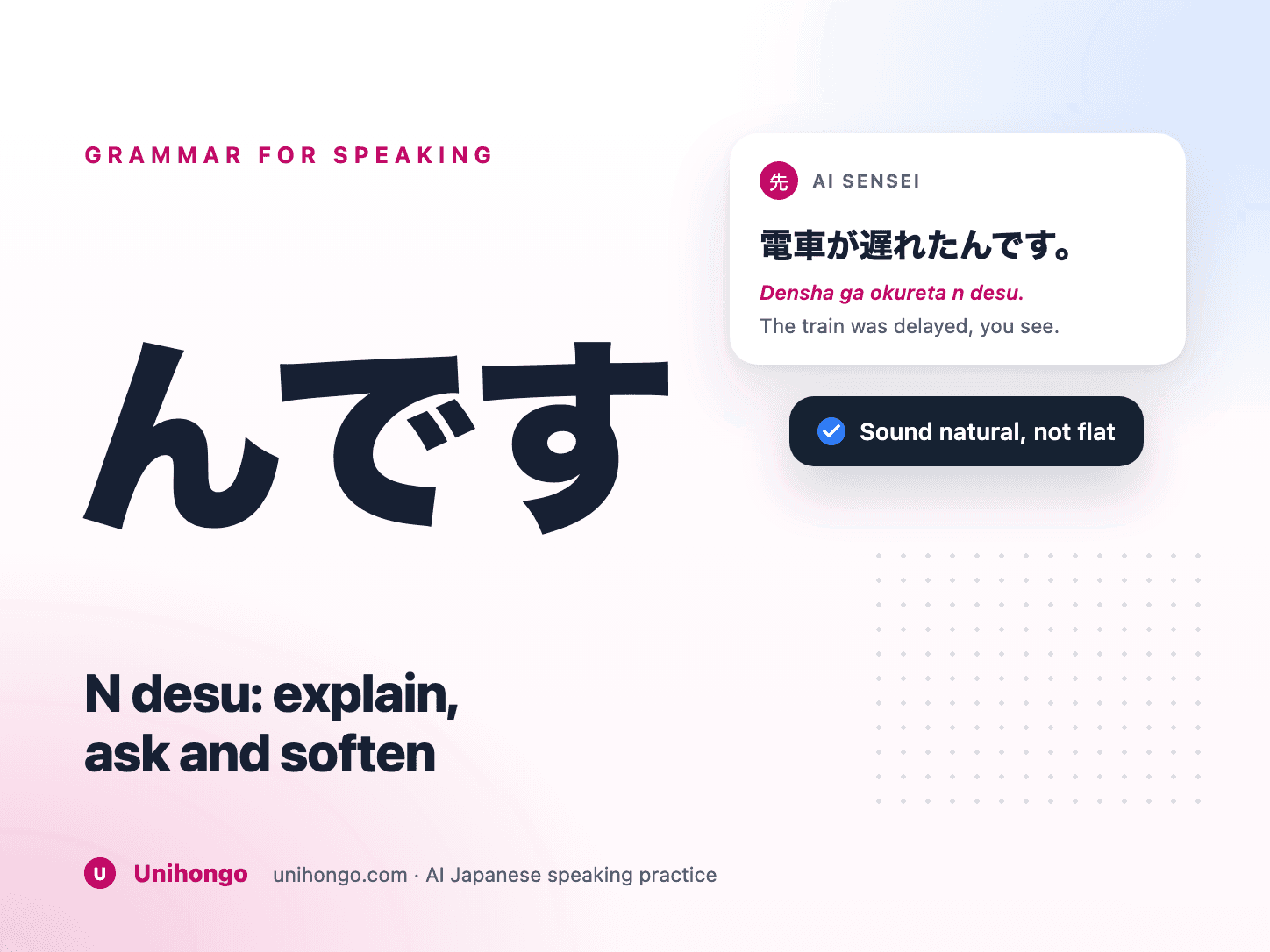
| すみません、電車が遅れたんです。 | Sumimasen, densha ga okureta n desu. | Sorry, the train was delayed. |
| 今日はちょっと用事があるんです。 | Kyō wa chotto yōji ga aru n desu. | I've got something on today. (so I can't come) |
| 実は、お酒が飲めないんです。 | Jitsu wa, osake ga nomenai n desu. | Actually, I can't drink alcohol. |
| 財布を忘れちゃったんです。 | Saifu o wasurechatta n desu. | I forgot my wallet, you see. |
| 日本語がまだ下手なんです。 | Nihongo ga mada heta na n desu. | My Japanese still isn't very good. |
Notice how jitsu wa, actually, pairs naturally with n desu. It flags that you are about to reveal some background, and the n desu confirms it.
Job two: asking for an explanation with n desu ka
When you add ka, you are not simply asking a yes or no question; you are asking about the situation behind what you see or hear. Dō shita n desu ka, what happened, is natural when someone looks upset. Dō shimashita ka is correct too but sounds more like a receptionist asking what your issue is.
N desu ka also shows interest. When a colleague mentions they are going to Okinawa, Okinawa ni iku n desu ka! sounds engaged, like oh, you're going to Okinawa? The plain ikimasu ka would sound like you had not been listening.
The risk comes with why questions. Naze or dōshite plus n desu ka can sound like a demand for justification, particularly with a flat tone. Soften it with a rising, curious intonation, or use a gentler frame such as nani ka atta n desu ka, did something happen?
| Japanese | Romaji | Meaning |
|---|---|---|
| どうしたんですか。 | Dō shita n desu ka. | What's wrong? What happened? |
| 沖縄に行くんですか!いいですね。 | Okinawa ni iku n desu ka! Ii desu ne. | You're going to Okinawa? How nice. |
| これ、手作りなんですか。 | Kore, tezukuri na n desu ka. | Did you make this yourself? |
| 何かあったんですか。 | Nani ka atta n desu ka. | Did something happen? |
| どうして来なかったんですか。 | Dōshite konakatta n desu ka. | Why didn't you come? (can sound accusing) |
| もう帰るの? | Mō kaeru no? | You're leaving already? (casual) |
Job three: n desu kedo as a soft opener
N desu kedo or n desu ga sets up a situation and leaves the sentence hanging. It is how Japanese speakers typically start a request, a question to a stranger or a complaint. The listener hears the setup and often responds before you finish, which saves both sides from a direct demand.
This is one of the highest-value patterns for learners, because it works in shops, stations, offices and on the phone. The ga version is slightly more formal; kedo is everyday polite speech.
| Japanese | Romaji | Meaning |
|---|---|---|
| すみません、駅に行きたいんですけど。 | Sumimasen, eki ni ikitai n desu kedo. | Excuse me, I'm trying to get to the station... |
| ちょっとお聞きしたいんですが。 | Chotto okiki shitai n desu ga. | I'd like to ask you something... |
| これ、サイズを交換したいんですけど。 | Kore, saizu o kōkan shitai n desu kedo. | I'd like to exchange this for another size... |
| 予約したんですけど、名前がないみたいで。 | Yoyaku shita n desu kedo, namae ga nai mitai de. | I made a reservation, but my name doesn't seem to be there. |
| 明日の会議なんですが、少し遅れてもいいですか。 | Ashita no kaigi na n desu ga, sukoshi okurete mo ii desu ka. | About tomorrow's meeting, would it be all right if I were a little late? |
The last example shows another handy use: noun plus na n desu ga introduces a topic, like about the meeting... It is common in email and at work.
Job four: realising, emphasising and sharing feelings
N desu also marks things the speaker has just realised or wants to stress. Sō na n desu ka, is that so, shows you have taken in new information. Sō na n desu, that's right, it is, confirms the listener's guess with some feeling.
When you talk about your own feelings or likes in a way that invites empathy, n desu makes the sentence personal. Kono uta, suki na n desu, I really love this song, shares something rather than just stating a preference.
| Japanese | Romaji | Meaning |
|---|---|---|
| そうなんですか。 | Sō na n desu ka. | Oh, is that right? I didn't know. |
| そうなんです。 | Sō na n desu. | Yes, exactly. That's how it is. |
| この歌、本当に好きなんです。 | Kono uta, hontō ni suki na n desu. | I really love this song. |
| なるほど、だから混んでいるんですね。 | Naruhodo, dakara konde iru n desu ne. | I see, so that's why it's crowded. |
| 実は来月、国に帰るんです。 | Jitsu wa raigetsu, kuni ni kaeru n desu. | Actually, I'm going back to my country next month. |
When n desu is too much
Once learners discover n desu, many attach it to everything. Self-introductions show the problem clearly: watashi wa Ana na n desu. Igirisu kara kita n desu. Enjinia na n desu. Each sentence sounds like an explanation for something unstated, which is odd and a little insistent.
Leave it out for plain facts, introductions, answers to simple questions and routine reports. In a meeting update, kinō kanryō shimashita, it was finished yesterday, is cleaner than kanryō shita n desu, which might suggest there is a story behind it.
Overused n desu ka questions are the other trap. Asking every question with n desu ka makes you sound like you are probing for background. Mix in plain masu questions for information you simply need.
| Situation | Natural choice | Why |
|---|---|---|
| Self-introduction | アナです。イギリスから来ました。 | Plain facts, nothing to explain |
| Explaining lateness | 電車が遅れたんです。 | A reason for the situation |
| Asking the time of a train | 何時に出ますか。 | Simple information request |
| Reacting to someone's news | 結婚するんですか! | Showing interest in their situation |
| Status report at work | 昨日、完了しました。 | A fact, not an excuse |
| Opening a request | ちょっとお願いがあるんですが。 | Soft setup before asking |
Common learner mistakes
- Forgetting na after nouns and na-adjectives: say gakusei na n desu and kirei na n desu, not gakusei n desu.
- Using the masu form before n desu: ikimasu n desu is wrong; use the plain form iku n desu.
- Changing desu for the past: itta n deshita exists but has a special nuance of realisation or narration; the normal past explanation is itta n desu.
- Using dōshite plus n desu ka with a flat tone to superiors, which can sound like a challenge.
- Answering a simple question with n desu, which can make the listener wonder what you are hinting at.