

Find the activity and what the sentence says about it
Start with an action such as reading, cooking, or walking. Then ask what the larger sentence wants to say about that action: that you enjoy it, that it matters, or that someone decided to do it. Mocchi can help you separate these pieces before introducing terminology. This gives the form a structural purpose rather than turning the lesson into a choice between two isolated symbols.
Keep the first construction constant while changing the activity. If the activity, sentence ending, and context all change at once, it becomes harder to identify which part controls the wording. A controlled first comparison makes later differences easier to investigate.
Read two complete examples before comparing the forms
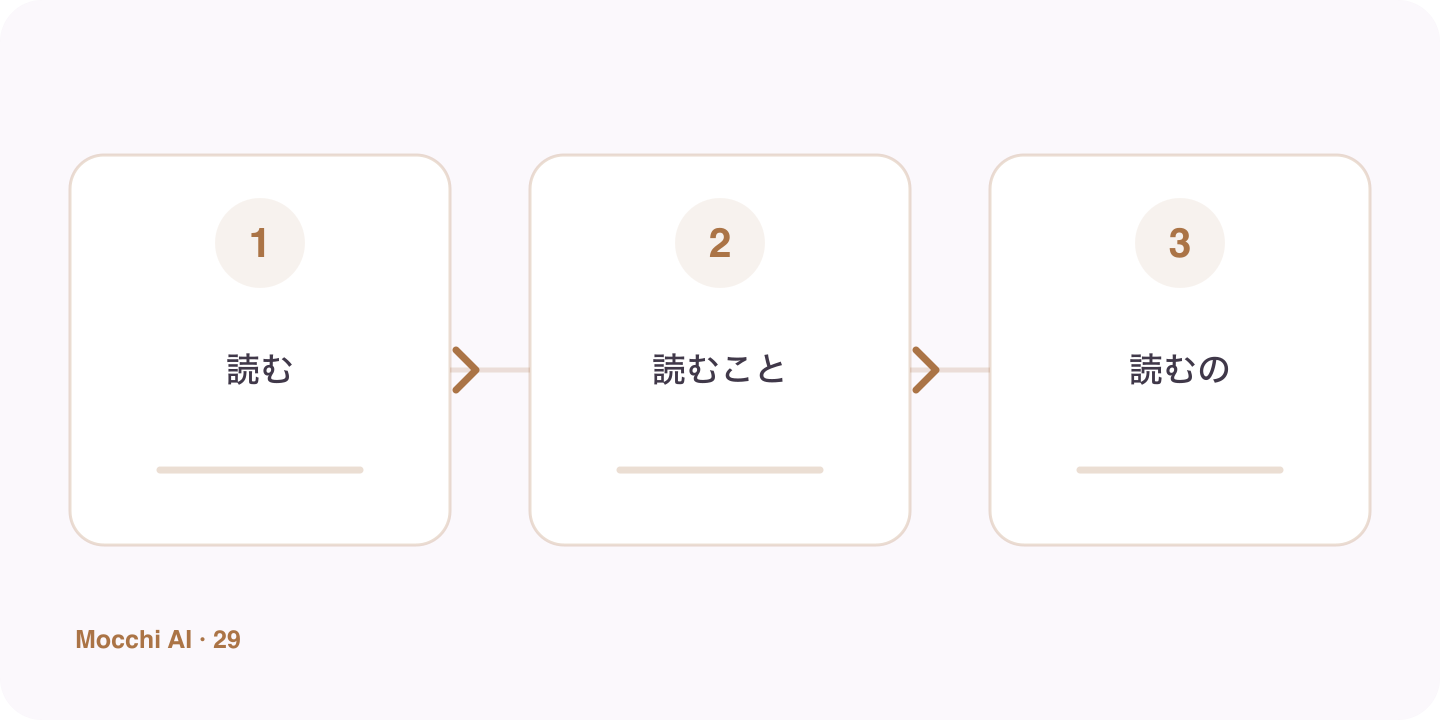
本を読むのが好きです says that you like reading books. 毎日読むことは大切です presents reading every day as important. Identify the activity clause and the rest of each statement. These examples show usable constructions; they are not a complete explanation of every place where こと or の can appear. Ask about a substitution only after the intended statement is clear.
| Japanese | Romaji | Meaning |
|---|---|---|
| 本を読むのが好きです。 | Hon o yomu no ga suki desu. | I like reading books. |
| 毎日読むことは大切です。 | Mainichi yomu koto wa taisetsu desu. | Reading every day is important. |
Ask what a proposed substitution changes
If you want to use the other expression, provide the complete sentence and intended situation. Ask Mocchi whether the result is acceptable there and whether its interpretation changes. If the answer depends on context, request a short example that supplies it. This is more informative than a broad question about which form is always better, since the useful decision belongs to a particular construction.
Make a controlled new sentence
Choose an activity you can express with familiar words and place it into the first construction. Explain which words describe the activity and which part states your attitude toward it. Ask for feedback on that structure before optional stylistic improvements. If the verb form itself causes difficulty, practice it separately and then return to the whole sentence.
Record constructions rather than a vague equivalence
Keep a short note of the complete pattern and the context in which you used it. At a later visit, ask Mocchi for a changed activity within that construction before adding another one. As your reading expands, collect examples that differ and ask what the surrounding grammar contributes. This develops a practical understanding of distribution and meaning without relying on a rule that treats こと and の as universal substitutes.