

Why the sentence trails off
Japanese conversation is built around turns, and a good speaker signals clearly when a turn is over and what kind of response is wanted. A flat sentence ending in desu closes the topic. A sentence ending in kedo leaves a door open: I have said my part, the rest depends on you. That is why the ending is so common in requests, where the other person has to act, and in disagreement, where they have to reconsider.
English speakers hear the but and wait for more, or worse, supply the missing half themselves and assume the speaker is being evasive. Neither is right. The listener is expected to fill the gap with an offer of help or an opinion, and doing so promptly is part of being a good listener. Once you hear kedo as a handover rather than a contrast, both understanding and speaking become easier.
| Japanese | Romaji | Meaning |
|---|---|---|
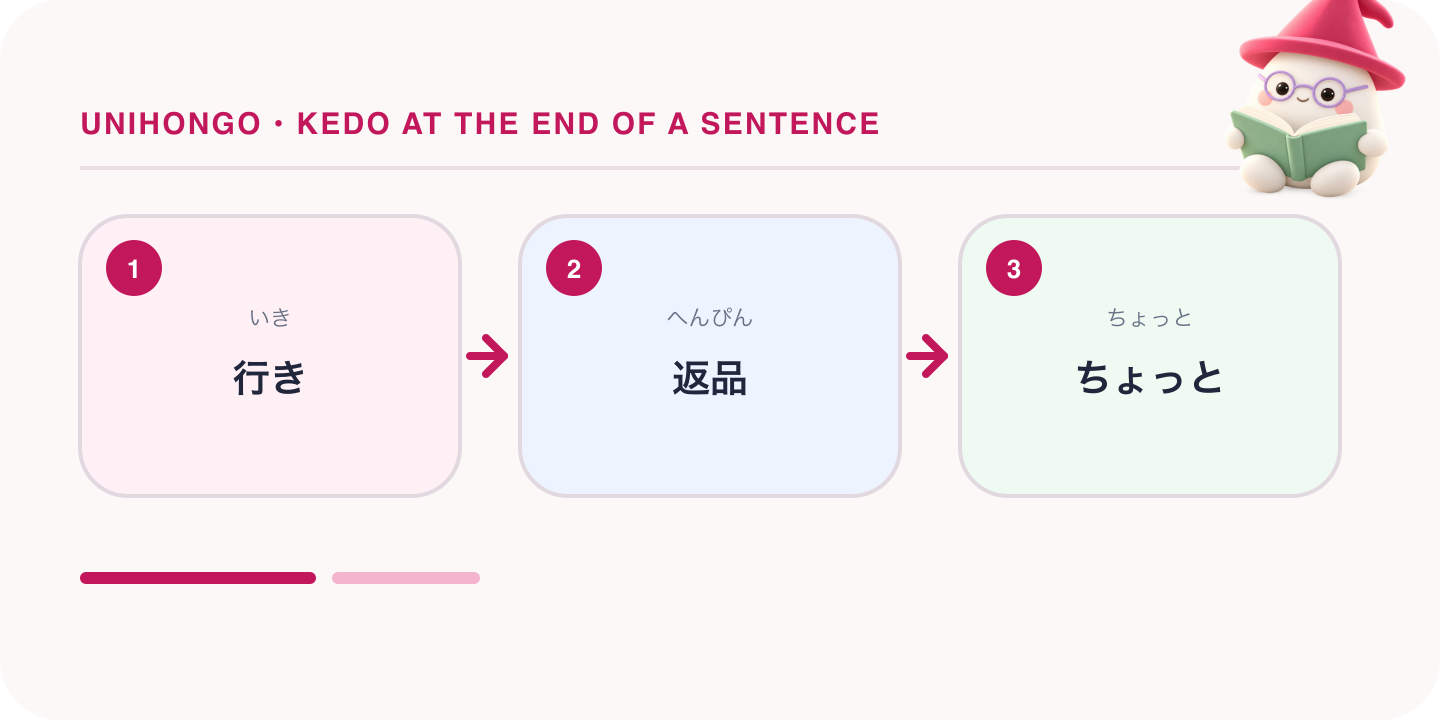
| 駅に行きたいんですけど。 | Eki ni ikitai n desu kedo. | I'd like to get to the station. |
| これ、返品したいんですけど。 | Kore, henpin shitai n desu kedo. | I'd like to return this. |
| ちょっと聞きたいんですけど。 | Chotto kikitai n desu kedo. | There's something I'd like to ask. |
| 私はいいと思うけど。 | Watashi wa ii to omou kedo. | I think it's fine, personally. |
| エアコンが動かないんですけど。 | Eakon ga ugokanai n desu kedo. | The air conditioner isn't working. |
Openers: getting someone's attention politely
The first job of the trailing ending is to open a conversation with a stranger or a busy person. The shape is sumimasen plus a short sentence about who you are or what you want, ending in n desu kedo or ga. Sumimasen, chotto ii desu ka is the question form and works too, but the kedo version tells the listener what the interruption is about in the same breath, which is why staff and callers prefer it.
Introductions follow the same pattern. Tanaka to mōshimasu ga identifies you and hands over; yoyaku shita Suzuki desu kedo identifies you at a hotel desk and hands over. Ga is the safer choice on the phone and with a company, kedo the everyday choice in a shop or at school. Both leave the next line to the other person, who will typically answer hai or nan deshō ka.
| Japanese | Romaji | Meaning |
|---|---|---|
| すみません、ちょっとお願いがあるんですけど。 | Sumimasen, chotto onegai ga aru n desu kedo. | Excuse me, I have a small favour to ask. |
| 田中と申しますが、山田さんはいらっしゃいますか。 | Tanaka to mōshimasu ga, Yamada-san wa irasshaimasu ka. | My name is Tanaka; is Mr Yamada there? |
| 予約した鈴木ですけど。 | Yoyaku shita Suzuki desu kedo. | It's Suzuki, I have a reservation. |
| 昨日電話した者ですけど。 | Kinō denwa shita mono desu kedo. | I'm the person who called yesterday. |
| これ、落としましたけど。 | Kore, otoshimashita kedo. | You dropped this. |
| あの、ちょっとよろしいですか。 | Ano, chotto yoroshii desu ka. | Um, may I have a moment? |
Requests: state the situation and stop
Japanese requests often avoid the word for please altogether. Instead you describe what you want or what is wrong, add n desu kedo, and let the listener offer the solution. Rokuji ni yoyaku shita n desu kedo at a restaurant means you expect to be shown to a table. Eakon ga ugokanai n desu kedo at a hotel means you expect someone to fix it. The request is implied, and stating it explicitly can sound demanding.
The n matters. Ikitai desu kedo announces a wish; ikitai n desu kedo explains a situation the listener can help with. Learners who drop the n sound as if they are reporting feelings rather than asking. When you do need to add an explicit request, it follows naturally: henpin shitai n desu kedo, dekimasu ka. Even then, many speakers stop at kedo and let the staff take over.
| Japanese | Romaji | Meaning |
|---|---|---|
| 六時に予約したんですけど。 | Rokuji ni yoyaku shita n desu kedo. | I have a reservation for six o'clock. |
| 明日、休みたいんですが。 | Ashita, yasumitai n desu ga. | I'd like to take tomorrow off. |
| もう少し安いのがいいんですけど。 | Mō sukoshi yasui no ga ii n desu kedo. | I'd prefer something a little cheaper. |
| 再配達をお願いしたいんですけど。 | Saihaitatsu o onegai shitai n desu kedo. | I'd like to arrange a redelivery. |
| まだ料理が来ていないんですけど。 | Mada ryōri ga kite inai n desu kedo. | Our food hasn't come yet. |
| サイズを交換したいんですけど、できますか。 | Saizu o kōkan shitai n desu kedo, dekimasu ka. | I'd like to swap the size; is that possible? |
Soft disagreement and gentle refusal
When you cannot agree, a trailing kedo lets you say so without a confrontation. Sore wa chotto muzukashii n desu kedo, that is a bit difficult, is a refusal every Japanese listener recognises, and the kedo signals that you would rather they withdrew the request than force you to say no. Kyō wa chotto tsugō ga warui n desu kedo declines an invitation the same way.
For opinions, to omou kedo and to omoimasu ga mark your view as one side of the discussion. Watashi wa ii to omou kedo tells a friend you like the plan but are not going to insist. In casual speech n da kedo and n da kedo ne carry a hint of reservation: waruku wa nai n da kedo, it's not bad, but. The listener hears the unspoken reservation and usually asks what it is, which is exactly the conversation you wanted.
| Japanese | Romaji | Meaning |
|---|---|---|
| それはちょっと難しいんですけど。 | Sore wa chotto muzukashii n desu kedo. | That's a bit difficult for me. |
| 今日はちょっと都合が悪いんですけど。 | Kyō wa chotto tsugō ga warui n desu kedo. | Today isn't very convenient for me. |
| うーん、悪くはないんだけど。 | Ūn, waruku wa nai n da kedo. | Hmm, it's not bad, but. |
| 別に嫌いじゃないんだけどね。 | Betsu ni kirai ja nai n da kedo ne. | It's not that I dislike it, you know. |
| もう決まったことなんですが。 | Mō kimatta koto na n desu ga. | It has already been decided, though. |
How to reply when the kedo is aimed at you
Recognising the ending is half the skill; answering it is the other half. After an opener, the reply is a short go-ahead: hai, dōzo or hai, nan deshō ka. After a request, act or acknowledge: kashikomarimashita, shōshō omachi kudasai, or kochira e dōzo. After a soft refusal from a friend, accept gracefully: sokka, jā mata kondo ne. After a reserved opinion, invite the rest: nani ka ki ni naru?
The common thread is that you speak next, and quickly. If you leave a pause, the speaker will assume you did not understand and repeat the sentence more slowly, which is embarrassing for both sides. Learn the four reply types as fixed phrases and you will never be caught waiting for a sentence that has already ended.
| Japanese | Romaji | Meaning |
|---|---|---|
| はい、どうぞ。 | Hai, dōzo. | Yes, go ahead. |
| はい、何でしょうか。 | Hai, nan deshō ka. | Yes, what can I do for you? |
| かしこまりました。少々お待ちください。 | Kashikomarimashita. Shōshō omachi kudasai. | Certainly. One moment, please. |
| あ、そうなんですね。 | A, sō na n desu ne. | Oh, I see. |
| そっか。じゃあ、また今度ね。 | Sokka. Jā, mata kondo ne. | Okay. Another time, then. |
| 何か気になる? | Nani ka ki ni naru? | Is something bothering you about it? |
Sentence-final endings by register
The endings below all hand the turn over. The differences are in politeness and in how much reservation they carry. Read each Japanese form with its reading and the situation it fits.
| Ending | Reading | Register and feel |
|---|---|---|
| 〜けど | kedo | Neutral, after plain or polite forms, everyday |
| 〜けどね | kedo ne | Casual, adds a shrug of reservation |
| 〜けどさ | kedo sa | Very casual, leading into a story |
| 〜けれど | keredo | Slightly more careful than kedo |
| 〜けれども | keredomo | Full form, formal or old-fashioned |
| 〜が | ga | Formal, business and phone calls |
| 〜んですけど | n desu kedo | Polite explanation, the standard request opener |
| 〜んですが | n desu ga | Polite and formal, same job as n desu kedo |
| 〜んだけど | n da kedo | Casual explanation, friends and family |
| 〜のですが | no desu ga | Written or very formal spoken |
Note that kedo after masu, ikimasu kedo, is common and polite in everyday speech, even though some textbooks label the combination as clumsy. Ga after masu is simply the more formal option.
Near-synonyms: other trailing endings
Kedo is not the only particle that can end a sentence with something left for the listener. The list places it against the endings learners most often confuse with it.
- Kedo or ga: neutral handover, request or mild reservation
- Noni: trailing complaint, the outcome went against expectation
- Shi: trailing reason, one of several, often with a sigh
- Kara: trailing reason offered as justification, can sound defensive
- Te or de: trailing cause, mainly for apologies and delays
- Node: trailing polite reason, softer than kara
Compare osoku natte, sumimasen, I'm late, sorry, with osoku natta n desu kedo, which sounds as if you expect the listener to do something about it. The trailing te explains; the trailing kedo requests.
Mistakes that make kedo sound wrong
The first mistake is falling intonation, which turns any of these sentences into a complaint. The second is dropping the n in requests: ikitai desu kedo and kaeshitai desu kedo sound like diary entries. The third is plain form plus kedo to a superior: muri da kedo to a manager is rude, muri na n desu kedo is fine, and chotto muzukashii n desu ga is better still.
A fourth mistake is finishing the sentence anyway. Yoyaku shita n desu kedo, heya ni annai shite kudasai spells out a request that the kedo had already made, and it sounds pushy. Finally, do not answer a trailing kedo with silence or with a translation of but in your head. The speaker has finished; say hai, dōzo and move the conversation on.
| Japanese | Romaji | Meaning |
|---|---|---|
| 返したいんですけど。 | Kaeshitai n desu kedo. | I'd like to return this. (Not kaeshitai desu kedo.) |
| ちょっと難しいんですが。 | Chotto muzukashii n desu ga. | That's a little difficult. (Not muri da kedo.) |
| 予約したんですけど。 | Yoyaku shita n desu kedo. | I have a reservation. (Stop here.) |
| 遅くなって、すみません。 | Osoku natte, sumimasen. | Sorry I'm late. (Te, not kedo.) |