
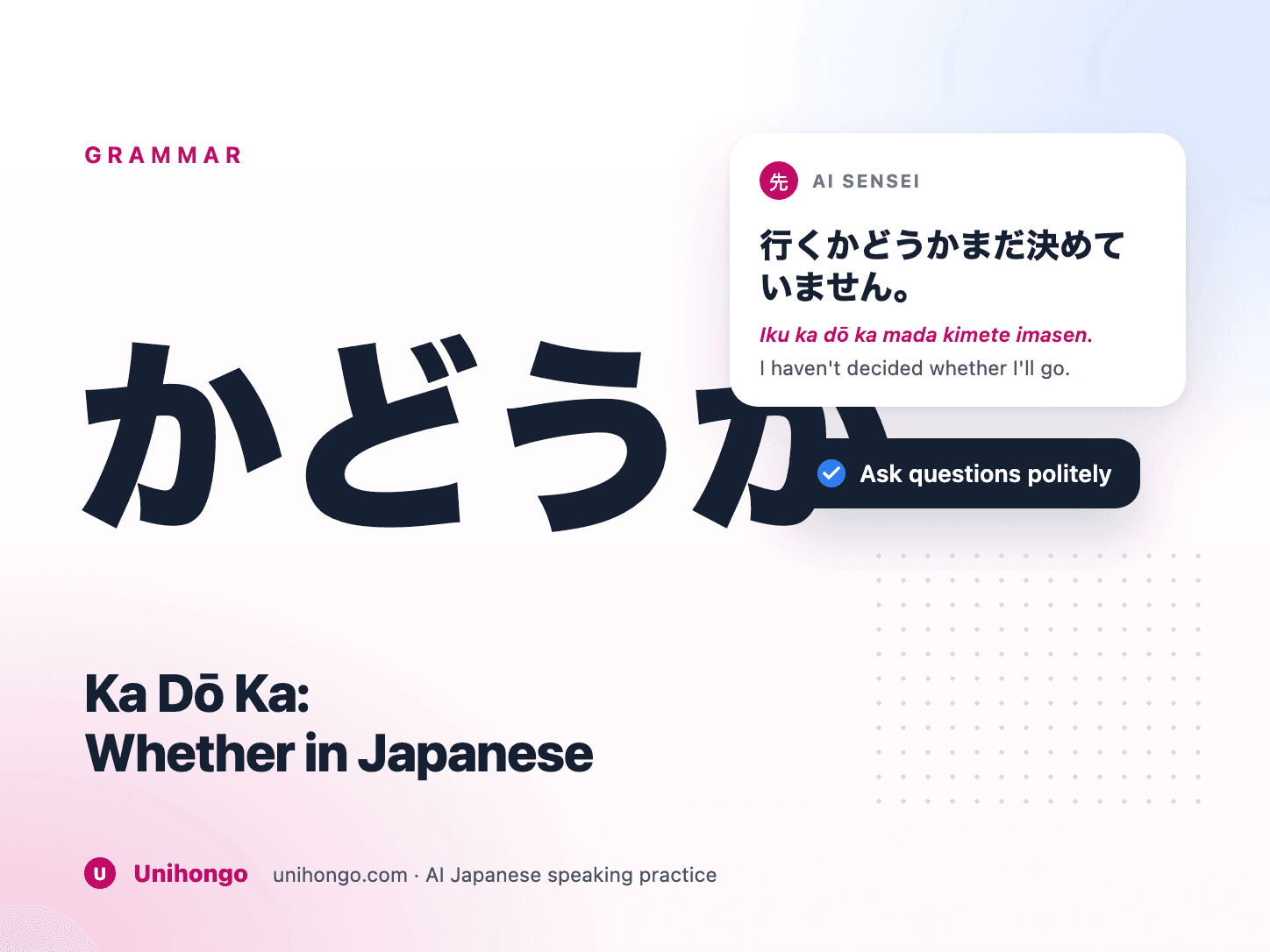
What an embedded question is
Compare two sentences. Itsu kimasu ka? is a direct question: When is he coming? Itsu kuru ka wakarimasen is a statement that contains a question: I don't know when he is coming. The question has become a noun-like chunk, and the sentence now has a main verb, wakarimasen, that says what you do with it.
Japanese marks that chunk with ka, the same particle that ends a direct question. What changes is the form before it: the verb goes into plain form, and the whole thing sits before a verb such as know, understand, tell, ask, decide or check. If you already know the question words from the guide to Japanese question words, you have most of what you need.
| Japanese | Romaji | Meaning |
|---|---|---|
| いつ来るかわかりません。 | Itsu kuru ka wakarimasen. | I don't know when he's coming. |
| どこにあるか知っていますか。 | Doko ni aru ka shitte imasu ka. | Do you know where it is? |
| 何を買ったか忘れました。 | Nani o katta ka wasuremashita. | I forgot what I bought. |
| 誰が来るか聞いてみます。 | Dare ga kuru ka kiite mimasu. | I'll ask who is coming. |
| いくらかかるか調べます。 | Ikura kakaru ka shirabemasu. | I'll look up how much it costs. |
Ka dō ka: whether or not
When the question has no question word, it is a yes-or-no question, and English uses whether or if. Japanese adds dō ka after ka. Iku ka dō ka literally means go or how, and it works as whether or not I go.
Ka dō ka is extremely common with decisions and uncertainty: mada kimete inai, I haven't decided yet; wakaranai, I don't know; kakunin shimasu, I'll confirm. It also appears in formal checks, such as whether stock is available or whether a seat is free.
| Japanese | Romaji | Meaning |
|---|---|---|
| 行くかどうかまだ決めていません。 | Iku ka dō ka mada kimete imasen. | I haven't decided whether I'll go. |
| 彼が来るかどうかわかりません。 | Kare ga kuru ka dō ka wakarimasen. | I don't know whether he's coming. |
| 在庫があるかどうか確認します。 | Zaiko ga aru ka dō ka kakunin shimasu. | I'll check whether it's in stock. |
| 間に合うかどうか心配です。 | Maniau ka dō ka shinpai desu. | I'm worried about whether I'll make it in time. |
| おいしいかどうか食べてみないとわからない。 | Oishii ka dō ka tabete minai to wakaranai. | You won't know if it's good until you try it. |
Building the clause: the plain-form rule
Everything before ka is in plain form, whether the full sentence is polite or casual. Verbs and i-adjectives are simple: kuru ka, konakatta ka, takai ka. The one trap is da. After a noun or na-adjective in the present tense, da is normally dropped, so you say gakusei ka, not gakusei da ka.
In the past tense, datta stays, because it carries the tense: gakusei datta ka dō ka. The same drop happens in other structures built on ka, such as ka mo shirenai, so learning it here pays off twice.
| Type | Direct question | Embedded form |
|---|---|---|
| Verb | 来ますか (kimasu ka) | 来るか (kuru ka) |
| Verb, past | 来ましたか (kimashita ka) | 来たか (kita ka) |
| i-adjective | 高いですか (takai desu ka) | 高いか (takai ka) |
| na-adjective | 静かですか (shizuka desu ka) | 静かか (shizuka ka) |
| Noun | 何ですか (nan desu ka) | 何か (nan ka) |
| Noun, past | 雨でしたか (ame deshita ka) | 雨だったか (ame datta ka) |
A frequent learner mistake is to keep the polite form inside: nan desu ka wakarimasen. Japanese listeners will understand, but it sounds like two sentences glued together. Keep the inside plain and put desu or masu only at the very end.
The verbs that usually follow
Embedded questions attach to a fairly small set of verbs, and learning them as ready-made endings makes the pattern easy to use in real time. Wakaru and shiru are the most frequent, but they are not interchangeable.
Wakaranai means I can't tell or I don't understand, and it is the softer, more common choice when you are unsure. Shiranai means I have no information, and said flatly in reply to someone it can sound a little blunt; shiranai desu or chotto wakaranai desu is gentler. When asking, shitte imasu ka? is the natural form for Do you know?
- わかる (wakaru): know, be able to tell. Doko ka wakarimasen.
- 知っている (shitte iru): know a fact. Nanji ni hajimaru ka shitte imasu ka?
- 教える (oshieru): tell, let someone know. Dō yomu ka oshiete kudasai.
- 聞く (kiku): ask. Itsu aite iru ka kiite mimasu.
- 決める (kimeru): decide. Nani o taberu ka kimeta?
- 調べる / 確認する (shiraberu / kakunin suru): look up, confirm.
- 覚えている / 忘れる (oboete iru / wasureru): remember, forget.
Polite requests with oshiete itadakemasen ka
One of the most practical uses is asking for information politely. Instead of the blunt Nanji desu ka?, you frame the question inside a request: Nanji ni hajimaru ka oshiete itadakemasen ka? That softens it considerably, because you are asking the person to tell you rather than firing a question at them.
Choose the ending to fit the situation. Oshiete kudasai is fine with friends' parents, shop staff and teachers. Oshiete itadakemasen ka and oshiete itadakemasu ka are standard for phone calls, offices and hotels. With colleagues or friends, oshiete kureru? or just oshiete is enough.
| Japanese | Romaji | Meaning |
|---|---|---|
| 何時に始まるか教えていただけませんか。 | Nanji ni hajimaru ka oshiete itadakemasen ka. | Could you tell me what time it starts? |
| 席が空いているかどうか教えていただけますか。 | Seki ga aite iru ka dō ka oshiete itadakemasu ka. | Could you let me know whether there are seats available? |
| この漢字はどう読むか教えてください。 | Kono kanji wa dō yomu ka oshiete kudasai. | Please tell me how to read this kanji. |
| いつ届くかわかりますか。 | Itsu todoku ka wakarimasu ka. | Do you know when it will arrive? |
| 参加できるかどうか、明日までにお知らせします。 | Sanka dekiru ka dō ka, ashita made ni oshirase shimasu. | I'll let you know by tomorrow whether I can attend. |
| 明日来られるか教えてくれる? | Ashita korareru ka oshiete kureru? | Can you let me know if you can come tomorrow? (casual) |
Particles, topics and word order
The embedded clause usually takes no particle before the main verb: itsu kuru ka wakaranai. You will also hear ga or o after ka in some cases, such as nani ga ii ka ga mondai da, what's good is the question, but in everyday speech the bare form is the norm.
For the topic, Japanese often pulls the subject out to the front with wa: Tanaka-san wa itsu kuru ka wakarimasen. This is natural and sounds tidier than packing everything inside the clause. Use ga for the subject when it belongs inside the question itself, especially with question words: dare ga kuru ka, who is coming.
To say you are unsure whether something is true, ka dō ka pairs neatly with a demonstrative: sore ga hontō ka dō ka wakaranai, I don't know whether that is true.
| Japanese | Romaji | Meaning |
|---|---|---|
| 田中さんはいつ来るかわかりません。 | Tanaka-san wa itsu kuru ka wakarimasen. | I don't know when Tanaka-san is coming. |
| それが本当かどうかわかりません。 | Sore ga hontō ka dō ka wakarimasen. | I don't know whether that's true. |
| どれがいいか迷っています。 | Dore ga ii ka mayotte imasu. | I can't decide which one is best. |
| 何を言えばいいかわからなかった。 | Nani o ieba ii ka wakaranakatta. | I didn't know what to say. |
Common mistakes to avoid
- Keeping desu inside: say nan ka wakarimasen, not nan desu ka wakarimasen.
- Keeping da after a noun: say gakusei ka dō ka, not gakusei da ka dō ka.
- Using ka dō ka with a question word: say doko ni iku ka, not doko ni iku ka dō ka.
- Forgetting the question word entirely when you mean when or where: kuru ka wakaranai means whether, not when.
- Answering shiranai flatly to a colleague; chotto wakaranai desu is usually kinder.
- Confusing ka dō ka with dō ka alone, which is a formal please, as in dō ka yoroshiku onegai shimasu.
Once these patterns feel automatic, they cover a surprising amount of daily life, from checking train times to saying you are still thinking about an invitation. For decisions that you want to decline gently, the phrase mada kimete inai, I haven't decided yet, is often softer than a direct no.