
What plain form actually is
Plain form, sometimes called the dictionary style or futsūkei, is the base shape of a Japanese predicate without the politeness layer that desu and masu add. Every verb has four of them: the dictionary form for non-past affirmative, the nai form for non-past negative, the ta form for past affirmative, and the nakatta form for past negative. Nomu, nomanai, nonda, and nomanakatta are one verb wearing four grammatical outfits, not four separate words to memorise.
The reason to build them early is structural. Japanese attaches grammar to the end of a plain predicate, then adds politeness only once, at the very end of the whole sentence. So a sentence can be perfectly polite while containing three plain forms inside it. If you only know masu forms, you can make simple statements but you cannot quote a thought, describe a noun with a clause, or state a reason, because those patterns have nowhere to attach.
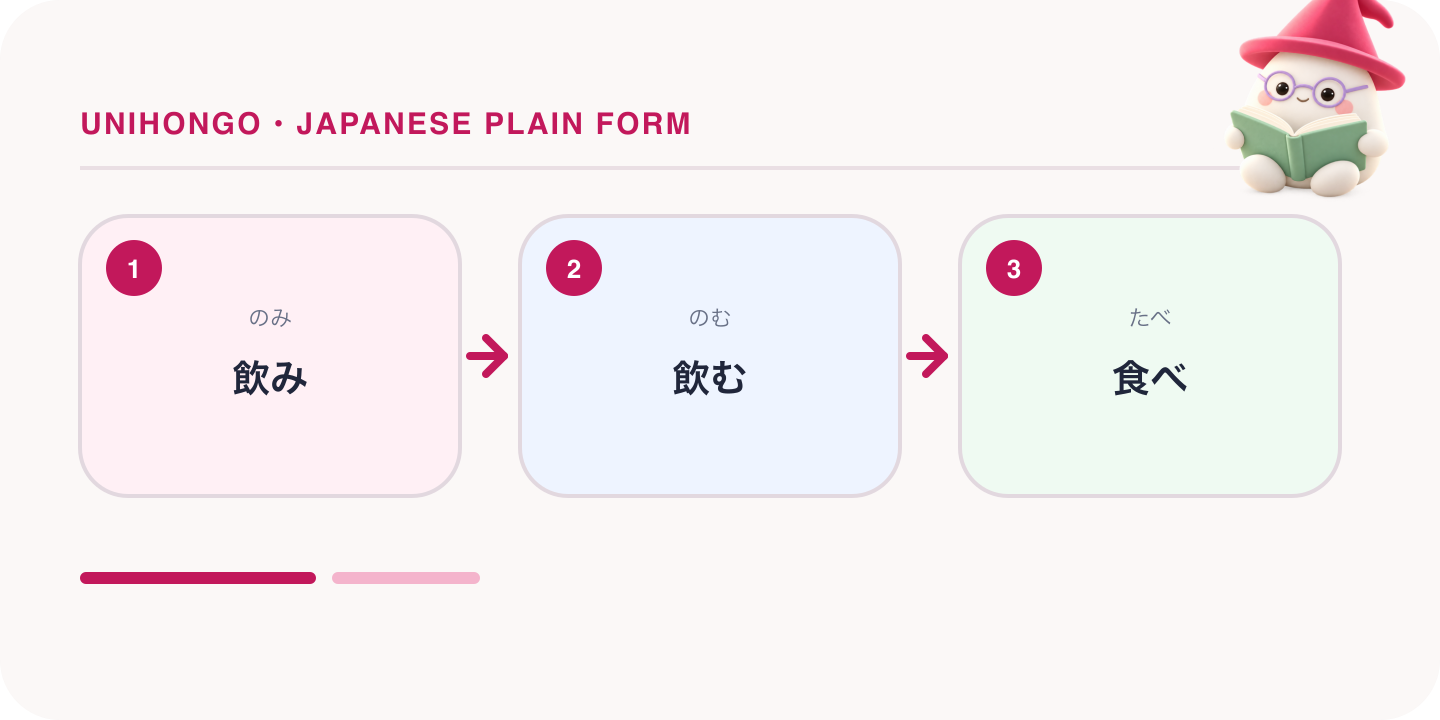
Building plain form from the masu form you already know
Most learners start from masu forms, so the fastest route to plain form runs through them. Drop masu to get the stem. If the stem ends in an e sound, or is a short i-sound stem such as mi or i, you are almost always looking at an ichidan verb: add ru. Tabemasu becomes taberu, mimasu becomes miru. If the stem ends in an i sound after a consonant, it is a godan verb: move that final i sound one row down to the matching u sound. Nomimasu has the stem nomi, so nomi becomes nomu; kakimasu becomes kaku; hanashimasu becomes hanasu, because the shi row maps to su.
The two irregulars are simply learned. Shimasu becomes suru and kimasu becomes kuru, written 来る. Watch for godan verbs that look ichidan: kaerimasu is kaeru, hairimasu is hairu, and hashirimasu is hashiru, all godan despite the ru ending. Because their masu stems end in ri rather than an e sound, the masu-form route quietly gets these right, which is one reason it is a safer starting point than guessing from the dictionary form alone.
| Japanese | Romaji | Meaning |
|---|---|---|
| 飲みます。飲む。 | Nomimasu. Nomu. | I drink. (polite, then plain) |
| 食べます。食べる。 | Tabemasu. Taberu. | I eat. (polite, then plain) |
| 話します。話す。 | Hanashimasu. Hanasu. | I speak. (polite, then plain) |
| 帰ります。帰る。 | Kaerimasu. Kaeru. | I go home. (polite, then plain) |
| します。する。 | Shimasu. Suru. | I do it. (polite, then plain) |
| 来ます。来る。 | Kimasu. Kuru. | I come. (polite, then plain) |
The nai form and the u-to-a shift
For a godan verb, replace the final u sound with the matching a sound and add nai: kaku becomes kakanai, nomu becomes nomanai, matsu becomes matanai because the tsu row's a sound is ta, and hanasu becomes hanasanai. The one wrinkle is verbs ending in the vowel u, such as kau and iu. Their negatives are kawanai and iwanai, with a w rather than a bare a. This is not an exception invented for learners; the w survives from the older shape of those verbs.
Ichidan verbs are easy: drop ru and add nai, so taberu becomes tabenai and miru becomes minai. Suru becomes shinai. Kuru becomes konai, written 来ない, and the reading changes from ki to ko, which is worth saying aloud a few times because the kanji hides it. Finally, aru is irregular: its plain negative is not aranai but simply nai.
| Japanese | Romaji | Meaning |
|---|---|---|
| お酒は飲まない。 | Osake wa nomanai. | I don't drink alcohol. (casual) |
| 肉は食べません。 | Niku wa tabemasen. | I don't eat meat. (polite) |
| 傘を買わないと濡れるよ。 | Kasa o kawanai to nureru yo. | If you don't buy an umbrella you'll get wet. (casual) |
| 彼は来ないと思います。 | Kare wa konai to omoimasu. | I don't think he is coming. |
| 時間がないんです。 | Jikan ga nai n desu. | The thing is, I don't have time. |
| 今日は何もしなかった。 | Kyō wa nani mo shinakatta. | I didn't do anything today. (casual) |
| 昨日は誰も来ませんでした。 | Kinō wa dare mo kimasen deshita. | Nobody came yesterday. (polite) |
The ta form and the te-form shortcut
If you know the te form, the past is nearly free: keep the same sound change and swap the ending from te to ta, or de to da. Nonde becomes nonda, kaite becomes kaita, itte becomes itta, tabete becomes tabeta, shite becomes shita, kite becomes kita. This works for every verb including the irregulars, which is why teachers usually teach the te form first and hand you the past tense as a bonus.
The nakatta form is the past negative, and it is built from the nai form rather than from the verb directly. Take the nai form, drop the final i, and add katta: nomanai becomes nomanakatta, tabenai becomes tabenakatta, konai becomes konakatta, nai becomes nakatta. This is the same katta ending that i-adjectives use, which is a useful hint that nai behaves like an i-adjective throughout Japanese grammar.
The full plain-form table by verb class
| Verb (class) | Dictionary | Nai | Ta | Nakatta |
|---|---|---|---|---|
| 買う to buy (godan) | kau 買う | kawanai 買わない | katta 買った | kawanakatta 買わなかった |
| 書く to write (godan) | kaku 書く | kakanai 書かない | kaita 書いた | kakanakatta 書かなかった |
| 泳ぐ to swim (godan) | oyogu 泳ぐ | oyoganai 泳がない | oyoida 泳いだ | oyoganakatta 泳がなかった |
| 話す to speak (godan) | hanasu 話す | hanasanai 話さない | hanashita 話した | hanasanakatta 話さなかった |
| 待つ to wait (godan) | matsu 待つ | matanai 待たない | matta 待った | matanakatta 待たなかった |
| 死ぬ to die (godan) | shinu 死ぬ | shinanai 死なない | shinda 死んだ | shinanakatta 死ななかった |
| 遊ぶ to play (godan) | asobu 遊ぶ | asobanai 遊ばない | asonda 遊んだ | asobanakatta 遊ばなかった |
| 飲む to drink (godan) | nomu 飲む | nomanai 飲まない | nonda 飲んだ | nomanakatta 飲まなかった |
| 帰る to go home (godan) | kaeru 帰る | kaeranai 帰らない | kaetta 帰った | kaeranakatta 帰らなかった |
| 行く to go (godan, irregular ta) | iku 行く | ikanai 行かない | itta 行った | ikanakatta 行かなかった |
| ある to exist (godan, irregular nai) | aru ある | nai ない | atta あった | nakatta なかった |
| 食べる to eat (ichidan) | taberu 食べる | tabenai 食べない | tabeta 食べた | tabenakatta 食べなかった |
| 見る to see (ichidan) | miru 見る | minai 見ない | mita 見た | minakatta 見なかった |
| する to do (irregular) | suru する | shinai しない | shita した | shinakatta しなかった |
| 来る to come (irregular) | kuru 来る | konai 来ない | kita 来た | konakatta 来なかった |
Read the table down a single column rather than across a single row. Reading down the nai column trains the u-to-a shift as one motion, and reading down the ta column exposes the godan sound groups that the past tense guide covers in detail. Rows across are useful only once each column is automatic.
Plain forms of adjectives and nouns
Verbs are only half of it, because Japanese sentences can end in an adjective or a noun instead. An i-adjective already is its own plain form: takai is the plain non-past. The negative is takakunai, the past is takakatta, and the past negative is takakunakatta. Notice that desu adds politeness without changing any of this, so takakatta desu is correct and takai deshita is not.
Na-adjectives and nouns behave alike because both rely on the copula. The plain non-past is da, the negative is ja nai, the past is datta, and the past negative is ja nakatta. In writing and in careful speech, de wa nai and de wa nakatta replace the contracted ja forms. One trap: before to omou and node, a na-adjective or noun keeps na or a form of the copula, so gakusei da to omoimasu and shizuka na node are correct while gakusei to omoimasu is not.
| Word type | Plain non-past | Plain negative | Plain past | Plain past negative |
|---|---|---|---|---|
| Verb 飲む | nomu | nomanai | nonda | nomanakatta |
| i-adjective 高い | takai | takakunai | takakatta | takakunakatta |
| i-adjective いい (irregular) | ii | yokunai | yokatta | yokunakatta |
| na-adjective 静か | shizuka da | shizuka ja nai | shizuka datta | shizuka ja nakatta |
| Noun 学生 | gakusei da | gakusei ja nai | gakusei datta | gakusei ja nakatta |
The adjective guide on this blog covers comparison and modification in more depth. What matters here is that the four-way past and negative grid is identical in shape across all four word types, so one drill covers everything you can put at the end of a Japanese clause.
Where plain form is required regardless of politeness
This is the part that turns plain form from a register topic into a grammar necessity. When a pattern attaches to a predicate, it usually attaches to the plain one, and the politeness is added later at the very end of the sentence. Ashita ame ga furu to omoimasu is polite as a whole, yet furu inside it is plain, because to omou never takes a masu form before it. The same holds for relative clauses: kinō katta hon desu is polite, but the clause describing the book is plain.
Two of these deserve a caveat. Kara and node both give reasons, and both accept polite forms before them in formal delivery, such as an announcement or a careful business explanation. In ordinary speech, however, the plain form before kara or node is the norm even when the sentence ends in desu or masu. Node in particular sounds softer with a plain form in front of it, which is why it is the reason marker of choice for customer-facing apologies.
| Pattern | Example | Meaning |
|---|---|---|
| Plain + と思う | 行くと思います Iku to omoimasu | I think I will go |
| Plain + こと | 話すことができます Hanasu koto ga dekimasu | I am able to speak |
| Plain + ので | 時間がないので Jikan ga nai node | because there is no time |
| Plain + から | 疲れたから Tsukareta kara | because I got tired |
| Plain clause + noun | 昨日買った本 Kinō katta hon | the book I bought yesterday |
| Plain past + ら | 雨が降ったら Ame ga futtara | if it rains |
| Dictionary + 前に | 食べる前に Taberu mae ni | before eating |
| Plain past + あとで | 食べたあとで Tabeta ato de | after eating |
| Dictionary + つもり | 行くつもりです Iku tsumori desu | I intend to go |
| Plain + かもしれない | 来ないかもしれません Konai kamo shiremasen | he might not come |
| Plain + んです | 行くんです Iku n desu | the thing is, I am going |
| Plain past + ことがある | 行ったことがあります Itta koto ga arimasu | I have been there before |
Polite sentences full of plain forms
Practise saying these aloud and notice the shape: plain in the middle, polite at the end. Once that pattern feels normal you stop trying to insert masu forms in the middle of clauses, which is the single most common structural mistake at this stage.
| Japanese | Romaji | Meaning |
|---|---|---|
| 明日は雨が降ると思います。 | Ashita wa ame ga furu to omoimasu. | I think it will rain tomorrow. |
| 日本語を話すことができます。 | Nihongo o hanasu koto ga dekimasu. | I can speak Japanese. |
| 時間がないので、失礼します。 | Jikan ga nai node, shitsurei shimasu. | I have no time, so I will excuse myself. |
| 昨日買った本を持ってきました。 | Kinō katta hon o motte kimashita. | I brought the book I bought yesterday. |
| 雨が降ったら、中止します。 | Ame ga futtara, chūshi shimasu. | If it rains, we will cancel. |
| 食べる前に手を洗います。 | Taberu mae ni te o araimasu. | I wash my hands before eating. |
| 会議が終わったあとで電話します。 | Kaigi ga owatta ato de denwa shimasu. | I will call after the meeting ends. |
| 来週、京都へ行くつもりです。 | Raishū, Kyōto e iku tsumori desu. | I intend to go to Kyoto next week. |
| 彼はまだ来ないかもしれません。 | Kare wa mada konai kamo shiremasen. | He might not be here yet. |
| 北海道へ行ったことがあります。 | Hokkaidō e itta koto ga arimasu. | I have been to Hokkaido. |
| 安いから、この店で買います。 | Yasui kara, kono mise de kaimasu. | It is cheap, so I buy at this shop. |
| 日本語で話すのは難しいです。 | Nihongo de hanasu no wa muzukashii desu. | Speaking in Japanese is difficult. |
When a plain ending changes the register
Now the other half. Putting a plain form at the very end of a spoken sentence signals closeness or informality, and that choice is separate from everything above. With friends, family, and classmates of the same age, plain endings are the default and masu endings can sound oddly stiff. Toward a customer, a manager, or someone you have just met, keep desu and masu. The safest habit is to let the other person set the register and follow it.
Two details make plain endings sound natural rather than blunt. First, da is often dropped after a noun or na-adjective in casual speech, especially by women: kirei rather than kirei da. Second, casual questions rise in pitch without ka, so iku with a rising tone means are you going. Adding ka to a plain form makes a sentence sound abrupt or masculine, so avoid iku ka until you have heard it used in context. The polite-versus-casual guide on this blog goes further into the social side.
| Japanese | Romaji | Meaning |
|---|---|---|
| 行く? うん、行く。 | Iku? Un, iku. | Going? Yeah, I'm going. (casual) |
| 今日は行かない。 | Kyō wa ikanai. | I'm not going today. (casual) |
| 昨日、映画を見た。 | Kinō, eiga o mita. | I watched a film yesterday. (casual) |
| あまり面白くなかった。 | Amari omoshirokunakatta. | It wasn't very interesting. (casual) |
| この店、きれいだね。 | Kono mise, kirei da ne. | This place is nice, isn't it. (casual) |
| ごめん、まだ終わってない。 | Gomen, mada owattenai. | Sorry, I haven't finished yet. (casual) |
| 行きますか。ええ、行きます。 | Ikimasu ka. Ee, ikimasu. | Are you going? Yes, I am. (polite) |
A drill that makes the switch automatic
- Pick five verbs a week, one from each godan sound group, and chant all four plain forms in the order dictionary, nai, ta, nakatta.
- Immediately convert each into a polite sentence with a plain form buried inside, such as tabeta ato de renraku shimasu.
- Take a masu sentence you already say and rebuild it three ways: with to omoimasu, with node, and as a relative clause.
- Record yourself telling one thing you did yesterday in plain endings, then retell the same story in masu endings without pausing.
- Write your daily notes in plain form with da or de aru, since that is where plain endings are genuinely standard in writing.
- Whenever a correction shows a wrong middle-of-sentence form, say the fixed sentence three times before moving on.