

The core meaning
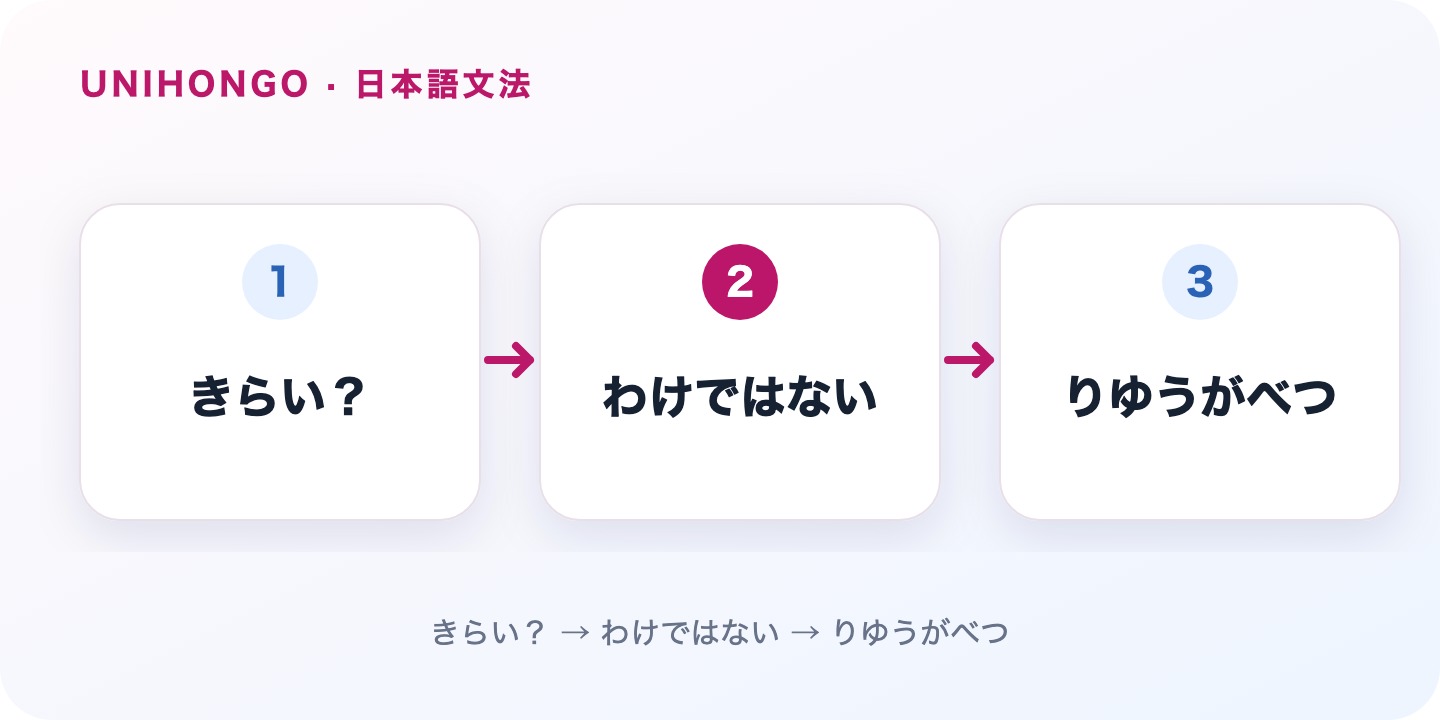
嫌いなわけではありません means 'It's not that I dislike it.' The speaker pushes back against an interpretation, perhaps because they simply cannot eat it today. The phrase is excellent for nuance: not everyone, not always, not exactly, or not for that reason. It often follows a statement that someone might reasonably infer from the context.
| Japanese | Romaji | Meaning |
|---|---|---|
| 嫌いなわけではありませんが、今日は食べられません。 | Kirai na wake de wa arimasen ga, kyō wa taberaremasen. | It's not that I dislike it; I just can't eat it today. |
| 全員が賛成したわけではありません。 | Zen'in ga sansei shita wake de wa arimasen. | Not everyone agreed. |
How to form it
Attach わけではない to a plain clause: 行きたくないわけではない, 高いわけではない. With nouns and な adjectives use な or である where required: 嫌いなわけではない, 学生なわけではない. Casual speech often contracts では to じゃ: わけじゃない.
| Use | Japanese form | Meaning |
|---|---|---|
| Verb | 行かないわけではない | It's not that I won't go |
| な adjective | 嫌いなわけではない | It's not that I dislike it |
| Casual | 嫌いなわけじゃない | Same meaning in speech |
Natural examples
Read each sentence for the relationship between the first idea and the second. The English translation gives a natural meaning, while the Japanese wording shows exactly where the pattern attaches.
| Japanese | Romaji | Meaning |
|---|---|---|
| 毎日忙しいわけではない。 | Mainichi isogashii wake de wa nai. | I'm not busy every single day. |
| 行きたくないわけじゃないけど、時間がない。 | Ikitakunai wake ja nai kedo, jikan ga nai. | It's not that I don't want to go; I have no time. |
Compare the nearby pattern
嫌いではない straightforwardly says 'I do not dislike it.' 嫌いなわけではない says 'It is not that I dislike it,' correcting an assumed explanation. とは限らない means 'not necessarily' and usually challenges a general rule; わけではない is especially useful for correcting a specific inference.
| Japanese | Romaji | Meaning |
|---|---|---|
| この料理は嫌いではありません。 | Kono ryōri wa kirai de wa arimasen. | I don't dislike this dish. |
| 嫌いなわけではありません。 | Kirai na wake de wa arimasen. | It's not that I dislike it. |
The two examples may describe similar situations, but they lead the listener to different conclusions. Choose the form that matches the claim you really intend to make.
Common mistake to avoid
Do not treat わけではない as a stronger absolute no. 'Not everyone likes it' is みんなが好きなわけではない, not a claim that nobody likes it. Look for the scope of the negation: it denies the whole proposed interpretation, not necessarily each word inside it.
- It corrects an inference or overgeneralization
- The meaning is often partial negation
- Casual speech uses わけじゃない
- Plain ない directly negates a predicate
Try it yourself
Imagine someone thinks you dislike a food because you declined it. Correct that inference with わけではない and give the real reason. Then make a sentence that means 'not everyone' without implying 'nobody.'
Say your sentence once slowly while looking at the Japanese pattern. Then say it again without reading. If your second clause changes from a possibility to a fact, or from advice to a requirement, revise it so the grammar still matches your meaning.