
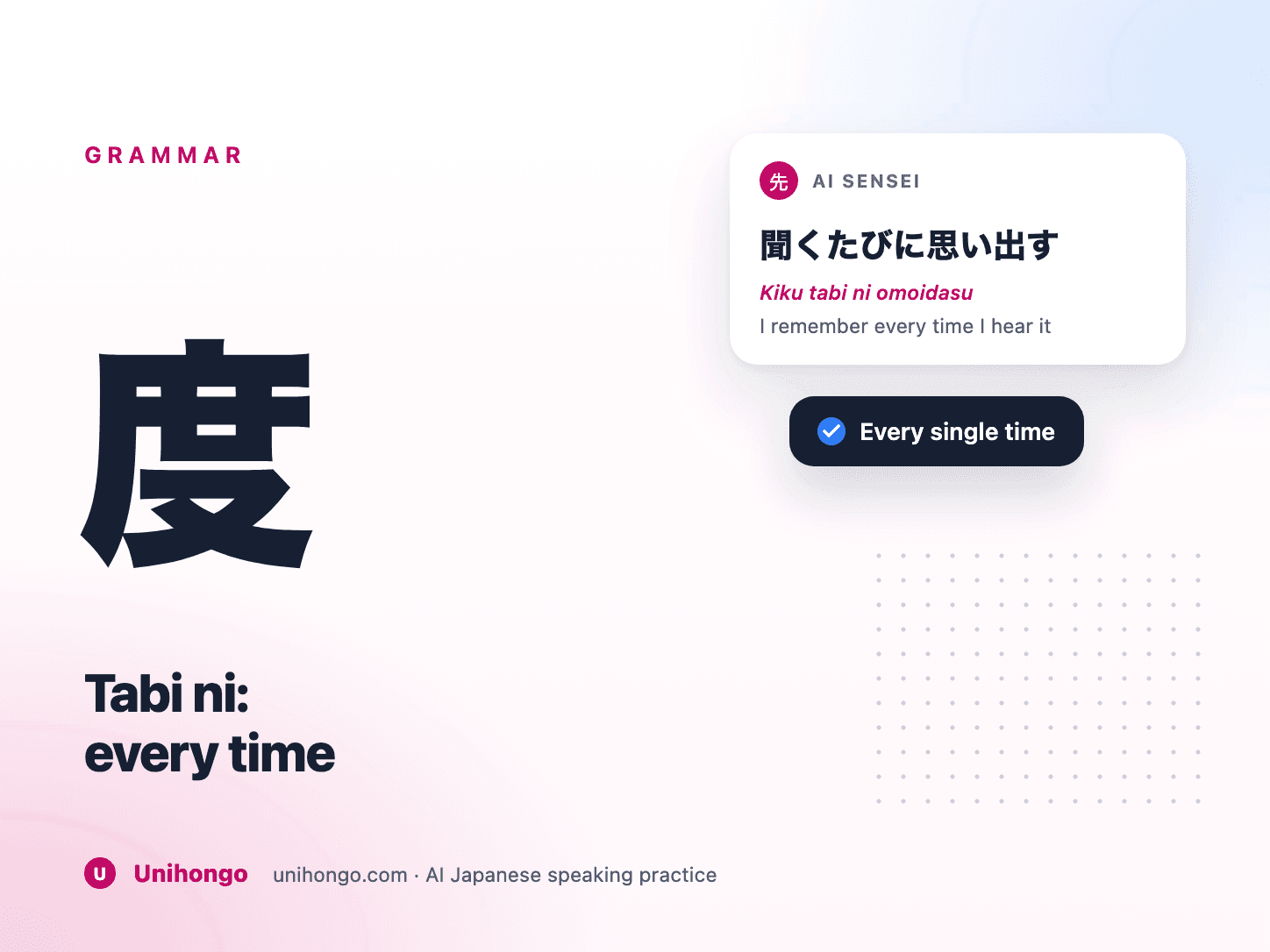
Every single time
Tabi means occasion, and tabi ni means on each occasion. It connects a trigger that happens repeatedly to a result that follows it every time.
The result is often a feeling or something noticeable, which makes tabi ni a very human pattern for talking about memories, reactions and small running jokes.
| Japanese | Romaji | Meaning |
|---|---|---|
| この曲を聞くたびに、学生時代を思い出します。 | Kono kyoku o kiku tabi ni, gakusei jidai o omoidashimasu. | Every time I hear this song, I remember my student days. |
| 会うたびに、背が伸びているね。 | Au tabi ni, se ga nobite iru ne. | You are taller every time I see you. |
How tabi ni attaches
Tabi is a noun, so nouns take no before it and verbs take the dictionary form. The noun version works well with events such as trips, meetings and holidays.
| Japanese | Romaji | Meaning |
|---|---|---|
| 旅行のたびに、お土産を買ってきてくれる。 | Ryokō no tabi ni, omiyage o katte kite kureru. | She brings back souvenirs from every trip. |
| 出張のたびに、家族に電話します。 | Shutchō no tabi ni, kazoku ni denwa shimasu. | I call my family on every business trip. |
| 引っ越すたびに、物が減っていく。 | Hikkosu tabi ni, mono ga hette iku. | Every time I move, I own fewer things. |
| Before tabi ni | Form to use | Example sense |
|---|---|---|
| Verb | Dictionary form | Every time I go |
| Noun | Noun plus no | Every business trip |
| Kono | Kono tabi, often with wa | On this occasion, formal |
The dictionary form, even for the past
Learners often want to put the trigger verb in the past when the story is in the past. With tabi ni, the dictionary form stays, and the main clause carries the tense.
This is similar to how mae ni behaves, and it keeps the trigger as a repeating event rather than a single past moment.
| Japanese | Romaji | Meaning |
|---|---|---|
| 京都に行くたびに、雨だった。 | Kyōto ni iku tabi ni, ame datta. | It rained every time I went to Kyoto. |
| 電話するたびに、留守だった。 | Denwa suru tabi ni, rusu datta. | Every time I called, nobody was home. |
| その話をするたびに、みんな笑った。 | Sono hanashi o suru tabi ni, minna waratta. | Everyone laughed every time I told that story. |
Tabi ni, itsumo or goto ni?
Three expressions can all translate as every or always, but they frame repetition differently. Tabi ni ties a result to a trigger. Itsumo describes a general habit. Goto ni marks a regular interval or each unit in a series.
| Japanese | Romaji | Meaning |
|---|---|---|
| いつも朝はコーヒーを飲みます。 | Itsumo asa wa kōhī o nomimasu. | I always have coffee in the morning. |
| 三十分ごとにバスが来ます。 | Sanjuppun goto ni basu ga kimasu. | A bus comes every thirty minutes. |
| コーヒーを飲むたびに、眠れなくなる。 | Kōhī o nomu tabi ni, nemurenaku naru. | Every time I drink coffee, I cannot sleep. |
| Expression | What it links | Typical use |
|---|---|---|
| tabi ni | A repeated trigger and its result | Memories, reactions, patterns you notice |
| itsumo | A general habit with no specific trigger | Routines and usual behaviour |
| goto ni | A regular interval or each unit | Timetables, schedules, steps |
Feelings and repeated reactions
Tabi ni shines when the result is an emotional or physical reaction. It gives a small story shape: whenever this happens, this is what I feel or do.
These sentences are also useful in conversation because they invite the other person to share their own trigger.
| Japanese | Romaji | Meaning |
|---|---|---|
| この写真を見るたびに、笑ってしまう。 | Kono shashin o miru tabi ni, waratte shimau. | I laugh every time I see this photo. |
| 失敗するたびに、落ち込みます。 | Shippai suru tabi ni, ochikomimasu. | Every time I make a mistake, I feel down. |
| 電話が鳴るたびに、びくっとする。 | Denwa ga naru tabi ni, bikutto suru. | I jump every time the phone rings. |
Tabi ni and kono tabi in polite speech
Tabi ni is comfortable in polite conversation and can carry warm, respectful sentiments. Kono tabi, a related formal phrase, opens many business apologies, announcements and thank-you messages.
| Japanese | Romaji | Meaning |
|---|---|---|
| お会いするたびに、元気をいただいています。 | O-ai suru tabi ni, genki o itadaite imasu. | Every time we meet, you lift my spirits. |
| 伺うたびに、丁寧にご対応いただき、ありがとうございます。 | Ukagau tabi ni, teinei ni go-taiō itadaki, arigatō gozaimasu. | Thank you for looking after us so carefully every time we visit. |
| この度は大変ご迷惑をおかけし、申し訳ございません。 | Kono tabi wa taihen go-meiwaku o o-kake shi, mōshiwake gozaimasen. | We sincerely apologise for the trouble caused on this occasion. |
- Keep the trigger verb in the dictionary form.
- Use no between a noun and tabi ni.
- Choose itsumo for habits without a trigger.
- Choose goto ni for timetables and regular intervals.
- Recognise kono tabi as formal and occasion-focused, not every time.